

Frozen Seafood for Wholesalers and Distributors: Bulk Sourcing From Bangladesh
Wholesale frozen seafood from Bangladesh, planned as a distribution programme: outlet volumes, bulk cartons and pallets, market approval, cold chain at scale, and margin per case.
Short answer
For wholesalers and distributors, frozen seafood sourcing from Bangladesh starts with outlet movement, not with a supplier list. Plan weekly volume per outlet, fix the carton and pallet format each outlet can handle, confirm market approval for your destination, and prove margin after freight, cold storage, break-bulk handling, and shrinkage on a first lot sized to movement, not to a container.
On this page
Key takeaways
Start with outlet movement, not a container: weekly volume per outlet, carton sizes outlets can handle, and margin after freight, cold storage, break-bulk handling, and shrinkage decide the order.
Buy a programme, not a single lot: repeated lots in one carton and pallet format, with market approval confirmed for your destination before samples.
State glaze and net weight in writing: price basis, maximum glaze percentage, and the arrival check, because a case heavy with ice is a margin loss on every case distributed.
Hold the cold chain at minus 18 degrees Celsius or below from factory to outlet, with the temperature record travelling with the lot and a written receiving threshold.
Enter stock by lot and record which outlets received which lot, so a quality or document problem can be contained instead of freezing the whole warehouse.
A wholesaler or distributor buying Bangladesh frozen seafood for wholesalers and distributors is not buying a single product. You are buying a flow: repeated bulk lots that must arrive frozen, clear the border, split across outlets, and sell before quality or margin slips. This guide covers that wholesale version of the purchase, for buyers who move stock onward to retailers, food service accounts, or smaller distributors.
The direct answer is short. Start with your onward channels, not with a supplier list. Work out weekly volume per outlet, carton sizes those outlets can handle, and margin after freight, cold storage, break-bulk handling, and shrinkage. Then buy against that plan, from plants whose market approvals fit your destination.
For comparison, see the frozen seafood sourcing guide and the wholesale frozen shrimp guide. This guide covers only distributor questions: volume tiers, onward margins, multi-outlet supply, and cold chain at scale.
Why this matters for buyers and sellers
For a wholesaler, the unit that matters is not the container or the retail pack. It is the case, the pallet, and the weekly movement rate per outlet. A container of block-frozen shrimp can be well frozen and well priced, and still be a poor distribution purchase if the cartons are too heavy for your handlers, the pallet pattern does not fit your racking, or the lot is one size grade that only half your customers want. Settle the distribution format at the factory.
For the supplier, a distributor order is a repeat programme with a forecast, even a rough one. That forecast lets a plant plan raw material, line time, and cold storage, and it is the basis for asking about tier pricing and consistent carton formats across lots.
Bangladesh frozen seafood for wholesalers and distributors: what the first order should prove
The first order should prove five things: repeated supply to specification, a cold chain that holds to your warehouse with readable records, documents that match the cartons lot by lot, margin after every distribution cost, and customer acceptance once the stock moves through their freezers.
What should I know first about Frozen Seafood & Fish Sourcing From Bangladesh for Wholesalers and Distributors?
Know your channels before you know your suppliers. For each outlet type, record the pack sizes it accepts, carton weights it can handle, delivery frequency it expects, and payment terms it actually keeps. A distributor serving both restaurants and retailers needs a lot that can be broken down both ways without thawing the whole pallet.
Next, know the product forms in distribution terms. Block-frozen fish and shrimp suit buyers who portion or reprocess at destination. Individually quick frozen shrimp suits buyers who need small quantities without thawing the rest. Fillets suit ready-to-cook buyers. Whole frozen fish suits buyers with their own cutting preparation. Choose the form by channel, not by cheapest price per kilogram at origin.
Step-by-step: how it works
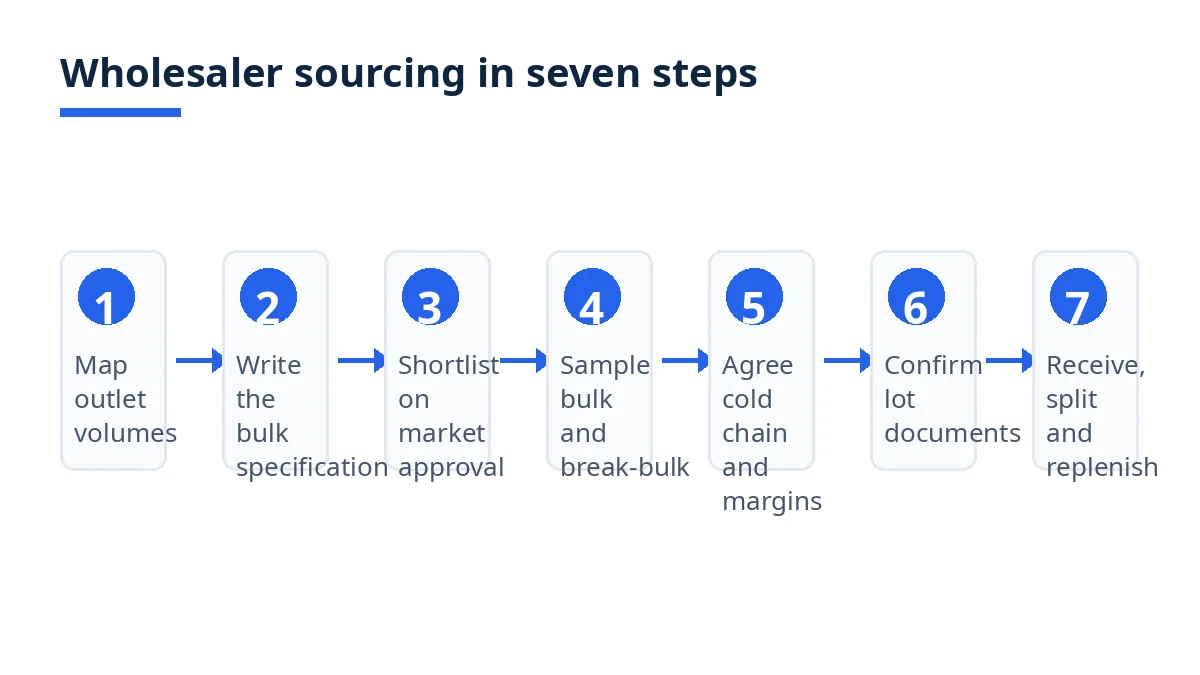
Map outlets and weekly movement. Record species, forms, weekly quantity, delivery days, and freezer capacity per outlet type. That plan, not a container size, sets your order quantity.
Write a bulk specification. State species, form, size grade, treatment, glaze basis, net weight basis, carton weight and count, pallet pattern, and lot marking. Send the same specification to every candidate.
Shortlist on market approval. For the European Union, confirm the dispatching establishment sits on the permitted list and the health certificate route is clear. For the United States, confirm the importer verification position for your product. Do not move to samples until those questions have an answer.
Sample at bulk and at break-bulk. Check species, taste, texture, glaze, and net weight on a bulk sample. Then break a sample case down as your customers will receive it, and check carton strength, inner wrapping, and lot marking.
Agree the cold chain and the margin together. State the reefer set point, data-logger placement, temperature record, and receiving threshold for a warm load. Build the distributed cost per case in the same document, including cold storage, break-bulk labour, delivery, and shrinkage.
Confirm lot documents before loading. Match the invoice, packing list, health certificate, and certificate of origin to the exact species, form, size grade, carton count, and lot numbers on the cartons.
Receive, split, and replenish by outlet. Check carton temperature, case integrity, lot marking, and net weight on a sample of cases before stock enters your system. Enter stock by lot, and replenish by case and movement rate.
Costs, timelines and documents
What are the typical costs and timelines?
There are no typical wholesale costs or timelines a guide can state as fact, because species, form, size grade, glaze, carton format, destination market, delivery term, and order rhythm all change the price. Demand the cost in distribution lines instead: product, packing, inspection, freight and insurance, destination charges, cold storage, break-bulk and delivery costs, and shrinkage. That separation gives the margin per case per outlet.
For timelines, ask for the same separation: sample, approval, production, certification, loading, transit, clearance, and receiving. A single delivery week hides the step that usually slips, which is document approval or a missed receiving slot. Build outlet promises around the receiving date, not the loading date.
Glaze and net weight need a separate line in every quotation. Glaze is the ice coating that protects frozen seafood, and it counts in the gross weight unless the contract states otherwise. The Codex standard for quick frozen fish fillets states that where food has been glazed, the declared net contents shall be exclusive of the glaze, and that the label shall state storage at minus 18 degrees Celsius or colder.1 State the price basis, the maximum glaze percentage, and the arrival check. A case heavy with ice and light on seafood is a margin loss on every case.
The delivery term decides who bears cost and risk at each stage, and who controls the reefer settings. The Incoterms 2020 rules explain a set of eleven commonly used trade terms, covering obligations, risk transfer, and costs.2 Compare quotes only on the same rule and the same named place, and confirm in writing who sets and monitors the reefer temperature under that rule.
Example figures: a distributor plans a first programme as three repeated lots of one species and one form, with the same carton and pallet format each time, sized to outlet movement rather than to a full container. The example shows structure only, not a typical order size, price, or lead time.
Which documents are needed?
For export clearance in Bangladesh, goods may not be loaded unless an export declaration, the Bill of Export or Shipping Bill, is submitted to Customs and approved.3 Documents enclosed with the Bill of Export include the export contract or purchase order where there is no export letter of credit, the commercial invoice, the packing list, the EXP form certified by an authorized dealer, and a certificate of origin issued by the Export Promotion Bureau or a Chamber of Commerce and Industry.3
Your destination adds its own layer, per lot. For the European Union, an importer of products of animal origin from a third country must ensure that the country and the dispatching establishment appear on the permitted lists and that the certificate requirements are met, under Regulation (EC) No 853/2004.4 For the United States, the importer verification rule requires written verification procedures for imported fish and fishery products, including product specifications and affirmative steps to confirm that the foreign processor meets the seafood safety rule.5 The Foreign Supplier Verification Program rule requires most food importers to analyse hazards and evaluate the foreign supplier, while seafood complying with the seafood HACCP regulation is exempt.6
Add three shipment papers of your own: the temperature record, the packing list by lot and carton, and a lot list mapping each lot to the outlets it will serve.
Bangladesh-specific rules and tips
Buy the distribution format, not only the product. The same species can leave a plant in a bulk block, an individually quick frozen case, or a retail pack. State the carton weight, inner count, pallet pattern, and lot marking you need, and hold that format across lots.
Treat the cold chain as a distribution specification. Regulation (EC) No 852/2004 places primary responsibility for food safety on the food business operator, and names maintaining the cold chain for frozen food as a core principle.7 Hold at minus 18 degrees Celsius or below from factory to outlet, with no unrecorded break, and set a written receiving threshold for warm deliveries.
Check food-safety systems at the plant, lot by lot. Ask which safety plan covers your species and form, and whether the plant can show monitoring records for the lots it ships to you. Add one distribution question: does the plant run a separated changeover for allergen products such as shrimp, so a fish fillet line does not carry shrimp residue into a case labelled fish only.
Plan around the factory calendar. Plants balance raw material seasons, line capacity, and cold storage across many buyers. A programme that orders in a steady rhythm, with the size and form mix confirmed well before each lot, is easier to schedule than a sudden large order in a busy period.
Keep one legal name and one specification across every paper. The export declaration names the exporter and the foreign buyer,3 so the name on the licence, quotation, invoice, and payment account should match, as should the specification on the purchase order, invoice, packing list, and cartons.
Mistakes and red flags
What are the most common mistakes?
Buying a container instead of a programme. A full container can look efficient at the port and still exceed your weekly movement and fill your cold store with one size grade. Buy to the movement plan, in repeated lots.
Leaving glaze and net weight undefined. A wholesale margin is calculated per kilogram of product, not per kilogram of ice. If the contract does not state the net weight basis, the maximum glaze percentage, and the arrival check, you cannot prove a shortfall after the stock has been split. State all three before the first lot.
Accepting one specification for every outlet. A restaurant customer, a retail chain, and a smaller distributor rarely need the same case. Split the specification by outlet type in the purchase order.
Comparing quotes on different delivery terms or carton formats. A lower price on a term that leaves destination cold-chain cost with you, or a format that adds break-bulk labour, is not a lower distribution cost. Compare only replies to the same specification, term, and format.
Treating a profile or a badge as distribution proof. A profile is a starting point for enquiries. It does not test repeated supply, cold chain across lots, or lot documents that match the cartons. A badge is not a guarantee of capacity, quality, or delivery.
Skipping the receiving check. The receiving check is the last control before stock splits across outlets. Check temperature, case integrity, lot marking, and net weight on a sample of cases, and quarantine any failure.
Letting lots mix in the warehouse. If lots are not entered and picked by lot number, a quality or document problem cannot be contained. Record which outlets received which lot.
Checklist
Before you confirm a wholesale programme, every line should be answered in writing.
Outlet plan complete: outlet types, weekly movement per outlet, delivery days, and freezer capacity per outlet.
Bulk specification sent: species, form, size grade, treatment, glaze and net weight basis, carton weight and count, pallet pattern, lot marking.
Market approval confirmed: permitted establishment and certificate route for the European Union, or importer verification position for the United States, for your destination.
Bulk and break-bulk samples approved in writing, including carton, inner wrapping, and lot marking.
Cold chain agreed: reefer set point, data-logger placement, temperature record with the shipment, and a written receiving threshold.
Margin calculated per case per outlet, including cold storage, break-bulk labour, delivery, and shrinkage.
Lot documents confirmed: invoice, packing list by lot, health certificate, certificate of origin, and temperature record.
Delivery term and named place stated on every quotation, with reefer control confirmed in writing.
Receiving check defined: temperature, case integrity, lot marking, and net weight sample, with a quarantine rule.
Lot traceability agreed: stock entered by lot, outlets recorded per lot, and a correction route for a problem lot.
How Exportain helps
Exportain is a marketplace where buyers can look for Bangladeshi suppliers, compare offers, and post a request for quotation for the specification they need.8 For a distributor, post the distribution specification itself, not a general enquiry: outlet plan in brief, species and form, carton and pallet format, market approval needed, and ordering rhythm. That detail lets suppliers reply with a programme price.
Read the supplier listings, read the how to buy guide, and post your specification through the request for quotation page. Keep the specification, replies, sample record, and lot documents together, lot by lot. For wider background, see the frozen seafood sourcing guide and the frozen shrimp quality control checklist.
FAQs
What should I know first about Frozen Seafood & Fish Sourcing From Bangladesh for Wholesalers and Distributors?
Know your outlets first, then your specification, then your suppliers. A programme stands or falls on weekly movement, carton formats, and margin after every distribution cost. Confirm market approval before samples, and prove the programme on a first lot sized to your movement plan.
What are the typical costs and timelines?
There are no typical wholesale costs or timelines a guide can state as fact, because species, form, glaze, carton format, market, term, and rhythm all change the figures. Ask for costs and timelines broken down by line, and build outlet promises around the receiving date.
Which documents are needed?
The Bangladesh export set starts with the Bill of Export or Shipping Bill, with the contract or purchase order, invoice, packing list, EXP form certified by an authorized dealer, and certificate of origin.3 Your destination adds its own layer: the European Union permitted-list and certificate route under Regulation (EC) No 853/2004,4 or the United States importer verification procedures.5 Add the temperature record, a packing list by lot, and a lot list mapping lots to outlets.
What are the most common mistakes?
The most common mistakes are buying a container instead of a programme, leaving glaze and net weight undefined, forcing one carton format on every outlet, comparing quotes on different terms, treating a profile or badge as proof of supply, skipping the receiving check, and letting lots mix without traceability.
Next steps on Exportain
Start with the distribution specification, not a general enquiry. Read the supplier listings, read the how to buy guide, and post your bulk specification through the request for quotation page. Judge the programme lot by lot against outlet movement and margin.
Sources
- Standard for Quick Frozen Fish Fillets (CXS 190-1995). Food and Agriculture Organization of the United Nations (accessed )
- Incoterms® 2020. International Chamber of Commerce (ICC) (accessed )
- Customs Clearance Procedures for Export. Bangladesh Customs, National Board of Revenue (accessed )
- Regulation (EC) No 853/2004 laying down specific hygiene rules for food of animal origin. European Union (accessed )
- Code of Federal Regulations Title 21. Food and Drugs 21 CFR § 123.12. FindLaw (accessed )
- Final Rule on Foreign Supplier Verification Programs (FSVP) At-A-Glance. U.S. Food and Drug Administration (accessed )
- Regulation (EC) No 852/2004 on the hygiene of foodstuffs. legislation.gov.uk (accessed )
- How to source and buy from Bangladesh. Exportain (accessed )
About the author
Sourcing from Bangladesh?
Post a request for quotation and suppliers on Exportain can send you their quotes directly.
Post an RFQ


