

Wholesale Frozen Shrimp From Bangladesh: Prices, MOQ and Reliable Suppliers
Wholesale frozen shrimp from Bangladesh, by line: tiers, per-line minimums, cold-chain terms, replenishment rhythms, market rules for the USA, UK, EU and UAE, and the checks to make before bulk.
Short answer
Wholesale frozen shrimp from Bangladesh is bought by line, not by total quantity: one species, form, count size and pack size, repeated on a replenishment rhythm. For each line, fix the net-weight basis, per-line minimum, cold-chain handover points and delivery term in writing, check the packing plant's market status for your destination, and approve a production sample before bulk. All price and quantity figures in this guide are examples showing structure only.
On this page
Key takeaways
Wholesale frozen shrimp is bought by line: one species, form, count size and pack size, repeated on a replenishment rhythm, rather than as a single mixed quantity.
Fix the net-weight basis, per-line minimum quantity, cold-chain handover points and delivery term in writing for each line before sampling, because each changes the usable product and the landed cost.
Market status is plant-specific and line-specific: the EU uses an authorised-establishment list for fishery products, while the United States relies on processor HACCP plans and importer verification.
Frozen shrimps and prawns other than cold-water varieties fall under subheading 030617, and the exact line for cooked or prepared forms must be confirmed with a customs broker.
Approve a production sample matching the bulk line, run the first order as a test of the whole replenishment system, and record any line change so later shipments do not drift.
Wholesale buying of frozen shrimp is different from placing a single import order. A wholesaler does not buy one mixed container and hope it sells. A wholesaler buys by line: one species, one form, one count size, one pack size, repeated over a season. The supplier, in turn, plans freezing, packing and cold storage around lines that repeat. This guide explains how that wholesale channel works when the shrimp comes from Bangladesh, and what to settle in writing before the first repeat shipment.
A wholesale line only works if both sides mean the same thing by every word on the specification. "Peeled" can mean peeled and deveined, or peeled with the tail left on. "Net weight" can mean shrimp alone, or shrimp plus glaze. "Count" can mean pieces per kilogram or per pound. None of these is a detail to sort out after loading: each changes the product the customer receives and the price per usable kilogram.
Why this matters for buyers and sellers
For a buyer, the wholesale channel is a replenishment problem, not a bargain hunt. Distributors, cash-and-carry operators, food-service suppliers and processors need the same line to arrive in the same form, month after month, so their own customers do not have to re-specify or re-price. A gap in supply, a change in count size, or a different glaze level breaks that chain. The cost of a failed line is therefore larger than the cost of one container: it is lost shelf space, substitute buying at short notice, and customers who switch supplier.
For a seller, a wholesale buyer is a planning asset. A processor that knows a line will repeat can schedule raw material intake, freezing and packing, and hold the right pack sizes in cold storage. Wholesale discussions therefore usually start with the annual shape of demand — which lines, in which months, in what quantities — rather than with a single spot price.
The two sides also carry different risks. The buyer carries the risk of a line that does not match its market: wrong count, wrong form, wrong pack. The seller carries the risk of a buyer who orders a line once and never repeats it, leaving specialised packs in storage. Good wholesale terms share those risks openly: minimum quantities per line, a replenishment rhythm, and a clear rule for what happens when a line is discontinued.
Step-by-step: how it works
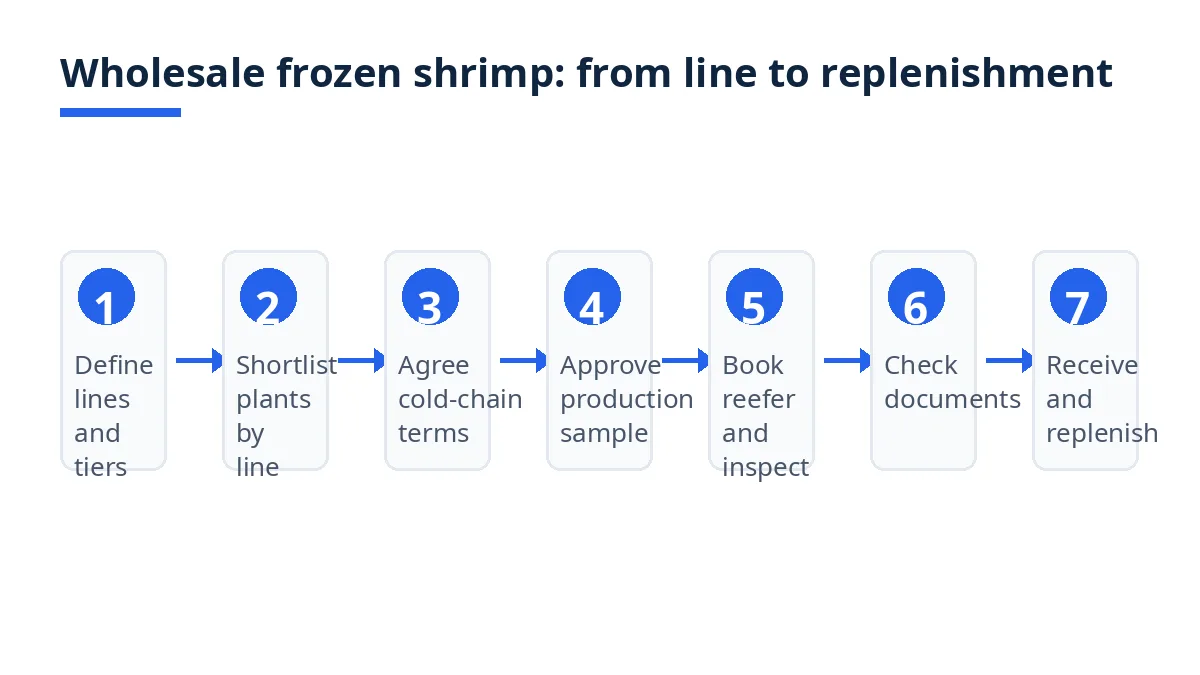
Wholesale buying follows a sequence. Skipping a step usually moves the problem later, where it costs more to fix.
First, define the lines. Write one specification per line: species, form (for example head-on shell-on, headless shell-on, or peeled), count size, freezing method, pack size, carton size, and the net-weight basis. Frozen shrimps and prawns other than cold-water varieties fall under subheading 030617 in the Harmonised System classification.1 That classification describes the product in shell or not, and covers shrimp that are smoked or cooked before or during smoking, as well as shrimp cooked by steaming or boiling in water.1 Confirm the exact line for each of your forms with your customs broker, because a cooked or prepared product may fall elsewhere.
Second, shortlist plants by line, not by catalogue size. A plant that packs headless shell-on shrimp well may not be the right plant for a peeled line. Ask which lines the plant already packs in your form and pack size, and in which destination markets. A long general catalogue is less useful than a short list of lines already in regular production.
Third, agree the wholesale terms before sampling: tiers, per-line minimums, replenishment rhythm, cold-chain terms, inspection, and payment. Sampling before terms are agreed wastes samples on deals that cannot work.
Fourth, approve a production sample, not a showroom sample. The sample should come from the same form, count and pack as the bulk line, and should be checked on thawing, count, weight basis and appearance. Record the approved sample as the reference for the line.
Fifth, place the first order as a trial of the replenishment system, not just of the product. Check the cold chain, the documents, the carton marking and the arrival condition, and confirm that the second order can be placed on the same terms.
Sixth, move to a standing rhythm: a forecast, a regular order point, and a rule for adjusting quantities. That rhythm is what makes the channel wholesale rather than occasional.
Costs, timelines and documents
Wholesale costs are best understood as a structure, not as a single number. The elements are the product price per line, packing, cold storage, inland movement to the port, ocean freight in a refrigerated container, insurance, destination handling, and any inspection or testing. Which side pays each element depends on the delivery term agreed. The International Chamber of Commerce publishes the Incoterms 2020 rules that define those delivery terms, and buyers should name the rule and the named place in the contract rather than relying on a shorthand term alone.2
All figures in this section are Example figures. They show structure only and are not market rates. A wholesale tier table might look like this:
Example tier | Example quantity per line | What it usually changes |
|---|---|---|
Trial line | Example figures: 1 pallet of one line | Tests product, pack and documents only |
Regular line | Example figures: 1 full refrigerated container of one line | Full line pricing and a replenishment rhythm |
Programme line | Example figures: monthly containers of the same lines for a season | Forecast planning, reserved cold storage and steadier supply |
Example figures: a buyer running three lines at one container each per month, for a six-month season, moves 18 containers in the season before any additional or replacement lines are counted. The figure shows how quickly a small line list becomes a large programme, and why per-line quantities matter more than a single total. Get a live quote for every line, form and destination before treating any example as a budget.
Timelines follow structure rather than a fixed promise: production depends on raw material availability and the packing schedule, and shipping on the sailing, route and destination handling. Build backwards from the date stock must be available for sale, leaving room for inspection, document correction and a missed sailing.
Documents for a frozen shrimp shipment typically include the commercial invoice, packing list, bill of lading, certificate of origin, and the health or food-safety certificate required by the destination market. Bangladesh customs publishes clearance procedures for export, and buyers should confirm the export-side documents with the supplier and their broker before loading.3 Keep the document set identical across repeat shipments of the same line, so destination clearance does not have to be relearned each time.
Bangladesh-specific rules and tips
Bangladesh's seafood export system has a specific institutional shape that wholesale buyers should understand. The Department of Fisheries is the primary government agency responsible for regulating the fishery industry, and it has been designated as the competent authority for verifying and certifying compliance of fishery and aquaculture products intended for export with European Union directives.4 The same account notes that the Department operates quality control laboratories in Dhaka, Chattogram and Khulna, accredited to ISO 17025, which test fish and fish products, ice, swabs and feed components, including checks for microbial quality and for prohibited substances such as antibiotics and dyes.4
For the European Union, the establishment question comes first. The European Commission publishes lists of non-EU establishments authorised to export food, and fishery products appear under Section VIII of that categorisation.5 A buyer selling into the EU should confirm that the specific processing plant, and any cold store used for the line, appears on the relevant list for the product concerned, and should not assume that a plant authorised for one product is authorised for another.5
For the United States, the control system is different. The US Food and Drug Administration's seafood guidance addresses hazards and controls for fish and fishery products, and processors must work under the seafood Hazard Analysis and Critical Control Points (HACCP) system.6 Under that system, every processor must conduct a hazard analysis for each kind of fish and fishery product it processes, and must have and implement a written HACCP plan whenever the analysis shows hazards reasonably likely to occur.7 The plan is specific to each processing location and each kind of product.7 A US buyer therefore needs the processor's HACCP position and its own importer verification records, rather than expecting the same per-shipment health certificate model used elsewhere.
Three practical tips follow from this. First, check market status plant by plant and line by line, and re-check it before a new season, because lists and authorisations change. Second, name the competent-authority certificate, if any, for your destination in the contract, and say who obtains it and by when. Third, keep species, form and market in one line specification: a plant, a product and a market approval that do not line up together will not clear together.
The Bangladesh Trade Portal publishes a list of frozen food exporters, useful for identifying names for further checking.8 Treat any such list as a starting point only, not a substitute for checking the plant, the line and the market status yourself.
Mistakes and red flags
The most common wholesale mistake is buying on a total quantity instead of per-line quantities. A supplier may accept a large total spread across many small lines, then struggle to pack each line economically, or may quietly substitute a form or count. Insist on a quantity for each line, and a price for each line, in the quotation.
A second mistake is leaving the net-weight basis undefined. If glaze is counted differently by buyer and seller, the price per usable kilogram is different from the price on the invoice. State the basis in the specification, state how it will be checked on arrival, and state what happens if a check fails.
A third mistake is agreeing a delivery term without naming the place and the cold-chain handover point. A refrigerated container changes hands more than once between plant and destination, and each handover is a point where temperature control can break. Name who is responsible at each stage, what records must be kept, and what happens if the container arrives with a temperature record outside the agreed range.
Red flags include a supplier who cannot name the plant that will pack the line, a quotation that covers many forms but no line in regular production, a sample that does not match the bulk specification, pressure to skip inspection on the first order, and documents that arrive after loading with different product descriptions from the order. Any one of these is a reason to pause, not a reason to hurry. A wholesale relationship that starts with unclear lines rarely becomes clearer after money has moved.
Checklist
Use this checklist for each line before the first bulk shipment:
One written specification per line: species, form, count size, freezing method, pack and carton size, and net-weight basis.
Per-line minimum quantity and per-line price, confirmed in writing.
Plant named for the line, with market status checked for your destination.
Cold-chain terms: who controls each stage, what records are kept, and what counts as a failure.
Delivery term named with its Incoterms 2020 rule and named place.2
Inspection plan for the first shipment and for repeat shipments, including sampling and arrival checks.
Document set agreed in advance: invoice, packing list, bill of lading, certificate of origin, and the destination's food-safety certificate.
Replenishment rhythm: forecast, order point, lead time and a rule for changing or discontinuing a line.
Payment terms, and the remedy if a shipment fails an agreed check.
A reference sample held by both sides for the line.
How Exportain helps
Exportain is a place where buyers can find suppliers in Bangladesh, compare lines, and raise requests for quotation for the lines they need. A buyer using the platform can start from a line specification rather than from a general catalogue search, and can keep the conversation about one line in one place. That discipline matters for wholesale buying, because the line, not the supplier in general, is what must match.
Use the platform to shortlist by line, to ask for per-line quantities and terms, and to keep the agreed specification, sample reference and document set together for repeat orders. When a line needs to change, record the change against that line, so the next shipment does not silently drift from the last one.
FAQs
What should I know first about frozen shrimp?
Know your lines before you talk price. Write one specification per line, covering species, form, count size, freezing method, pack size and net-weight basis, and confirm the classification for each form. Frozen shrimps and prawns other than cold-water varieties fall under subheading 030617.1 Then check that the plant packing the line holds the market status your destination requires: an authorised establishment listing for the EU,5 or a HACCP-based system with importer verification for the United States.6 7
What are the typical costs and timelines?
There is no single typical cost or timeline, because both depend on the line, form, pack, delivery term and destination. Costs are built from product, packing, cold storage, inland movement, refrigerated freight, insurance, destination handling and inspection, divided by the agreed delivery term.2 All figures here are Example figures showing structure only, not market rates. Build timelines backwards from the date stock must be available for sale.
Which documents are needed?
Expect a commercial invoice, packing list, bill of lading, certificate of origin, and the food-safety or health certificate your destination requires. Bangladesh customs publishes export clearance procedures for the export side.3 Agree the full set before loading, keep it identical for repeat shipments of the same line, and check that descriptions match the order exactly.
What are the most common mistakes?
Buying on a total quantity instead of per-line quantities, leaving the net-weight basis undefined, and agreeing a delivery term without a named place and a cold-chain handover point. Each of these looks small at quotation stage and becomes expensive after loading. Other common mistakes are accepting a sample that does not match the bulk line, skipping inspection on the first order, and letting a line drift from shipment to shipment without recording the change. The checklist above is designed to catch all of these before bulk.
Next steps on Exportain
Start with the supplier directory to shortlist plants by line, then raise a request for quotation carrying your full line specification, per-line quantities and delivery term. If you are still shaping quantities, read the minimum order quantity guide first, so the minimums you ask for match how you will replenish.
Sources
- Classification Detail — HS Code 030617. United Nations Statistics Division (accessed )
- Incoterms® 2020. International Chamber of Commerce (ICC) (accessed )
- Customs Clearance Procedures for Export. Bangladesh Customs, National Board of Revenue (accessed )
- Portraying the Bangladesh Shrimp Industry: A SWOT Analysis. MDPI Sustainability (accessed )
- Non-EU countries authorised establishments. European Commission (accessed )
- Fish and Fishery Products Hazards and Controls. U.S. Food and Drug Administration (accessed )
- 21 CFR 123.6 — Hazard analysis and Hazard Analysis Critical Control Point (HACCP) plan. FindLaw (accessed )
- List of Frozen Food Exporters. Bangladesh Trade Portal (accessed )
About the author
Sourcing from Bangladesh?
Post a request for quotation and suppliers on Exportain can send you their quotes directly.
Post an RFQ


