

Bangladesh Frozen Seafood for Retailers: Shelf Packs, Cold Chain and Labelling for Retail Buyers
No standard retail pack exists for Bangladesh frozen seafood, so retailers must agree pack size, label, glaze basis and case count first, then check cold-chain records and lot documents for that exact pack.
Short answer
A retailer buying frozen seafood from Bangladesh should start with the shelf, not the container: agree the retail pack, label and case first, then check the cold chain and the documents for that exact pack. There is no standard retail pack or typical retail price, so compare suppliers on the same pack size, glaze basis, label and delivery term.
On this page
Key takeaways
There is no standard retail pack for Bangladesh frozen seafood: agree species, form, pack weight, label, barcode and units per master case before discussing price.
Approve a retail-pack sample and a filled label proof per market, including species and scientific name, production method, catch or farm area, defrosted status and durability date.
Hold frozen seafood at minus 18 degrees Celsius or below from factory to shelf, and require the reefer set point, data-logger placement and arrival temperature record in writing.
State the glaze basis and maximum glaze percentage, and check net weight on arrival, because glaze decides the margin on every pack sold.
Match the invoice, packing list, health certificate and temperature record to the exact pack size, case count and lot numbers before stock goes to stores.
A retailer buying Bangladesh frozen seafood for retailers does not buy what a wholesaler buys, even when species and factory are the same. The retailer buys a shelf-ready pack: a fixed weight, a label a shopper can read, a barcode that scans, a case count that fits a freezer cabinet, and a cold chain that holds from the factory freezer to the store shelf. This guide covers that retail version of the purchase: which pack decisions to settle first, how to check the cold chain and the label before you commit, what the cost and document questions really turn on, and which mistakes cost retailers shelf space rather than just freight money.
Bangladesh frozen fish and shrimp exports reached 388.7 million US dollars in the last fiscal year reported by the Export Promotion Bureau (EPB), up from 325.73 million dollars a year earlier, with shrimp accounting for 296.29 million dollars on 23,238 tonnes and frozen fish accounting for 92.41 million dollars.1 That scale means a retailer has a real choice of suppliers, but it does not mean a standard retail pack exists. Pack size, glaze, count size, label language and case configuration are set per order, so the brief you send decides what arrives on your shelf.
Why this matters for buyers and sellers
For a retailer, the unit that matters is not the container, it is the pack on the shelf and the case behind it. A 20-foot container of bulk block-frozen shrimp can be excellent raw material and still be useless to a retail chain if it arrives without retail packs, without consumer labels, without barcodes and without the inner-case split your stores need. Settle the retail pack at the factory, where the product is already frozen, labelled and cased.
What should I know first about Bangladesh frozen seafood for retailers?
Start with four retail decisions, in this order: species and form, pack, label, and case. Species and form means the exact product a shopper buys, for example headless shell-on black tiger shrimp, peeled and deveined shrimp, or a named fish fillet, with the size grade and the treatment stated (raw or cooked, individually quick frozen or block frozen). Pack means the consumer unit weight and material, plus whether the pack is a bag, a tray, or a box, and how many consumer units sit in a master case. Label means every panel a shopper and a regulator see, in the language of the market where the pack will be sold. Case means the master-carton count and dimensions, because that decides pallet patterns, freezer storage and store replenishment.
Retail buying also reverses the usual sampling logic: a wholesaler samples for taste and yield, while a retailer must also sample for the shelf. Order a retail-pack sample, not only a bulk sample: the actual bag or tray, label artwork, barcode and master case. Put it in your own freezer cabinet, scan the barcode at a till if you can, and check the label under store lighting.
Step-by-step: how it works
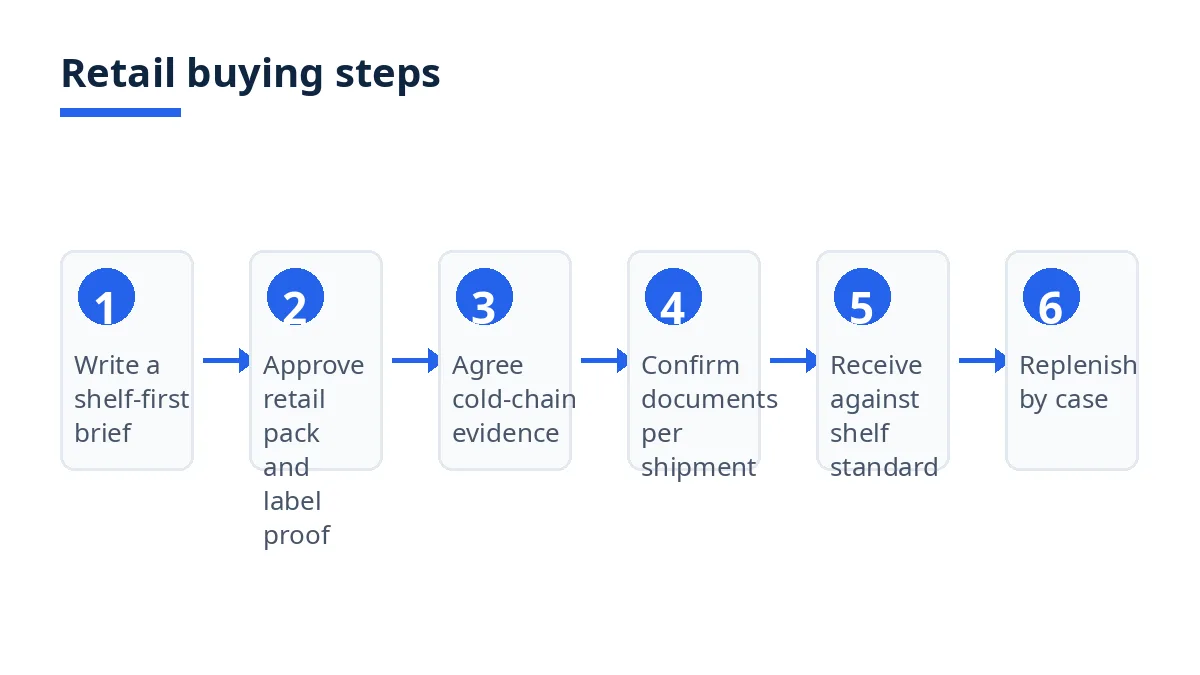
Write a shelf-first brief. State species, form, size grade, treatment, consumer pack weight, pack material, units per master case, label language and artwork, barcode requirement, and the delivery term. Send the same brief to every candidate so quotes compare like with like.
Ask for a retail-pack sample and a label proof. Approve the pack, the label text and the barcode in writing before bulk production. Record the approved glaze, net weight basis, and count per pack.
Agree the cold-chain evidence. Ask how temperature will be recorded from factory cold store to loading, what the reefer set point will be, and which temperature records travel with the shipment. Check the first delivery against those records.
Confirm the documents per shipment. Match the commercial invoice, packing list, health certificate and certificate of origin to the exact species, pack count and lot numbers on the cartons. A mismatch at this stage is a retail delay, not a paperwork detail.
Receive against the shelf standard. On arrival, check carton temperature, pack integrity, label accuracy and barcode readability before the stock goes to stores. Quarantine any case that fails, and record the failure against the supplier and the lot.
Replenish by case, not by container. Track sales per consumer pack and restock stores by master case. If one pack size moves slowly while another sells out, change the pack mix on the next order rather than discounting the slow pack and repeating it.
Costs, timelines and documents
What are the typical costs and timelines?
There is no typical retail cost or timeline a guide can state as fact, because the pack, the glaze, the label work, the case configuration and the delivery term all change the price, and each factory prices its own inputs and line time. A retail pack costs more per kilogram to produce than a bulk block, because it adds packing material, label printing, barcoding, smaller case handling and more quality checks per unit. That extra cost is not waste: it is the work you would otherwise pay for again at destination, with a cold-chain break attached.
Ask for the price broken down by line, not as one landed figure: product price, retail packing and labelling, master casing, inspection if you require it, freight and insurance under the stated delivery term, and any destination charges that fall on you. For timelines, ask for sampling, label-proof approval, production, cold-store ready date and loading date as separate lines. Label approval is the step retailers most often underestimate: artwork corrections, translation checks and barcode testing can move a production date even when the fish is ready.
The delivery term matters more for retailers than for bulk buyers, because it decides who bears the cost and risk while the goods are in transit and who controls the reefer settings. The Incoterms 2020 rules set out 11 rules with a clear allocation of cost, risk and obligations for each rule.2 Compare retail quotes only on the same rule and the same named place, and confirm in writing who sets and monitors the reefer temperature under that rule.
Which documents are needed?
For export clearance in Bangladesh, goods may not be loaded unless an export declaration, the Bill of Export or Shipping Bill, is submitted to Customs and approved.3 Enclosed documents include the export contract or purchase order where there is no export letter of credit, the commercial invoice, the packing list, the EXP form certified by an authorized dealer, and a certificate of origin issued by the EPB or a Chamber of Commerce and Industry.3 A retailer should add three shipment papers of its own to that list: the health certificate for the lot, the temperature record for the shipment, and the packing list broken down by retail pack size and master case, not only by total weight.
On the classification side, heading 0306 covers crustaceans including shrimp and prawns, and heading 0304 covers fish fillets and other fish meat, with frozen shrimp lines such as 0306.17 appearing in trade data for Bangladesh.4 Confirm the exact subheading with your customs broker for your species, form and market, because the subheading drives the duty and the import conditions that apply to your retail packs. Do not let a supplier's heading stand without that broker check.
Bangladesh-specific rules and tips
Buy the label with the product, not after it. For the European Union market, Regulation (EU) No 1169/2011 requires that foods frozen before sale and sold defrosted carry the designation "defrosted" with the name of the food, and that the date of freezing or the date of first freezing be indicated for frozen meat and frozen unprocessed fishery products.5 Separately, Regulation (EU) No 1379/2013 requires that fishery and aquaculture products offered to the final consumer carry the commercial designation of the species and its scientific name, the production method (caught or farmed), the area where the product was caught or farmed and the category of fishing gear for capture fisheries, whether the product has been defrosted, and the date of minimum durability where appropriate.6 That is a long list of label fields, and every one of them must be correct on the retail pack before it ships. Ask the supplier to return a filled label proof against that list, and check the scientific name and the catch or farm area yourself. A label error found at your store is a relabelling job; a label error found at the border is a detained shipment.
Treat the cold chain as a retail specification, not a logistics detail. Finished frozen shrimp products are stored in cold storage at minus 22 degrees Celsius to minus 18 degrees Celsius, under stable conditions, to support shelf-life requirements of up to 24 months, with those requirements set for quality rather than safety.7 For a retailer, the practical rule is narrower: hold at minus 18 degrees Celsius or below from factory to shelf, with no unrecorded break. Ask for the reefer set point, the data-logger placement, and the temperature record on arrival, and set a written rejection or quarantine threshold for a delivery that arrives above your limit.
Check food-safety systems at the plant, not only on paper. Under the United States seafood HACCP regulation, 21 CFR Part 123, processors of fish and fishery products must operate preventive control systems, and seafood importers must comply with HACCP programs equivalent to those for domestic processors.8 Ask which HACCP plan covers your species and form, which hazards it controls, and whether the plant can show monitoring records for the lots it ships to you. A plant that can show records for your lot is a different supplier from a plant that can only show a certificate on a wall. For retail, add one more question: does the plant run a separate line or a separated changeover for allergen products such as shrimp, so a fish fillet line does not carry shrimp residue into a pack labelled fish only.
Order by store, not by container. Before you confirm quantities, map the order to your stores: packs per case, cases per store per week, freezer capacity per store, and the sell-through period for the full order at your current sales rate. A container that looks efficient at the port can sit for months in a central freezer while stores run out of one size and overstock another. Smaller, more frequent retail orders with a fixed pack mix usually serve a chain better than one large mixed container, even when the per-unit freight is higher. Put that pack mix in writing as part of the order, not as a side note.
Mistakes and red flags
What are the most common mistakes?
Approving a bulk sample for a retail order. A bulk block sample tells you about species, taste and texture. It tells you nothing about the retail bag, the label, the barcode or the case. If the first retail pack you see is the one in the container, you have already paid for any pack or label fault it carries.
Leaving glaze and net weight undefined. Glaze is the ice coating that protects frozen seafood, and it counts in the gross weight unless the contract states otherwise. State whether the price is per kilogram of net product weight excluding glaze, state the maximum glaze percentage, and state how net weight will be checked on arrival. A pack that is heavy with ice and light on seafood is a margin problem on every unit you sell, and it is hard to prove after the stock is in stores.
Accepting one label for every market. A label written for one market rarely satisfies another. Species names, allergen declarations, net quantity rules and durability dates differ by market, and a single English label may not meet a market that requires its own language. Approve a label per market, not a label in general, and keep the approved artwork version on file against each shipment.
Checking temperature only at the port. Port and warehouse checks catch failures that happened before arrival, but the retail risk continues after delivery: central freezer doors, store cabinets and replenishment trolleys. Log freezer temperatures at the central store and spot-check store cabinets, and keep those logs against the lot numbers. If a quality complaint reaches you from a shopper, the log is what separates a supplier problem from a handling problem in your own chain.
Red flags. A supplier who cannot provide a retail-pack sample, a filled label proof, a lot-level temperature record or a packing list by pack size is not ready for a retail order, whatever the bulk price looks like. A quote that gives one total price with no packing, labelling or delivery-term split cannot be compared with another quote. A supplier who will not state the glaze basis, the count per pack or the units per case in writing is leaving the three numbers that decide your shelf margin undefined.
Checklist
Use this list before you confirm a retail order, and keep the completed copy against the shipment.
Species, form, size grade and treatment stated exactly as they will appear on the label.
Consumer pack weight, pack material and units per master case agreed in writing.
Label proof approved per market: species and scientific name, production method, catch or farm area, defrosted status where applicable, durability date, allergen declaration, net quantity and barcode.
Glaze basis and maximum glaze percentage stated, with the net-weight check method agreed.
HACCP plan and lot monitoring records requested for your species and form.
Reefer set point, data-logger placement and arrival temperature threshold agreed in writing.
Packing list required by retail pack size and master case, matched to invoice and health certificate.
Store allocation mapped: packs per case, cases per store, freezer capacity and expected sell-through period.
Rejection and quarantine procedure agreed for temperature, label or barcode failure on arrival.
How Exportain helps
Exportain connects international buyers with Bangladeshi suppliers, and its trust and safety pages describe a document and photo review process, not a factory inspection or a guarantee of any supplier.9 Use that distinction when you shortlist: the platform can help you find candidates and post a request, but the retail checks in this guide, the pack sample, the label proof, the temperature record and the arrival inspection, remain your own. Ask candidates through the platform for the retail-pack sample and the filled label proof before you discuss price, and keep every approval in writing against the order.
Next steps on Exportain
Start with the general sourcing background in the frozen seafood sourcing guide, then read the black tiger shrimp quality control checklist and the frozen shrimp quality control checklist for the inspection points to put in your order. When your shelf brief is ready, post it as a request at Exportain RFQs and compare candidates on the same retail pack, label and delivery term, not on headline price alone.
Sources
- Frozen fish, shrimp exports rebound with 19% growth, India and China top destinations. The Business Standard, (accessed )
- Incoterms® 2020. International Chamber of Commerce (ICC) (accessed )
- Customs Clearance Procedures for Export. Bangladesh Customs, National Board of Revenue (accessed )
- Frozen, seafood and HSN Code 03061700 Exports from World. Volza (accessed )
- Regulation (EU) No 1169/2011 on the provision of food information to consumers, Annex VI, Part A. legislation.gov.uk (accessed )
- EU market for fishery and aquaculture products. European Union (accessed )
- Shrimp Processing: Safety, Quality, and Manufacturing of Raw and Frozen Products. Food Safety Magazine (accessed )
- Seafood HACCP Regulation: Basic Information for the Florida Seafood Industry. University of Florida IFAS Extension (accessed )
- Trust & Safety Center. Exportain (accessed )
About the author
Sourcing from Bangladesh?
Post a request for quotation and suppliers on Exportain can send you their quotes directly.
Post an RFQ


