

Government Tender Electrical Buying From Bangladesh: Specification, Bids and Delivery
Tender-first electrical buying from Bangladesh: write the specification so bids compare, require conformity and test evidence before award, and file every delivery against the tender for audit.
Short answer
Government and tender buyers should buy electrical products from Bangladesh by tender document, not by catalogue: one specification line per item stating rating, voltage, standard and test evidence, bids compared on the same price and weight basis, conformity documents checked before award, and every delivery filed against the tender specification. Framework lots should name the institutions, the maximum quantity and the term in the tender documents from the outset.
On this page
Key takeaways
Write the tender as a bid-comparison document: one specification line per item stating rating, voltage, standard and test evidence, so bids can be compared on the same product and the same price basis.
Require conformity evidence before award: the declaration of conformity, the test report and, where mandatory, the BSTI licence or mark evidence, each covering the offered model.
For a framework arrangement, name the institutions covered, the maximum total quantity and the term in the tender documents from the outset, and stop call-offs at the maximum.
Compare bids only on one published basis: one delivery term and named place, separate lines for freight, insurance, spares and warranty, and separate dates for sample, production, shipment and arrival.
File every call-off order, delivery note, receiving check and conformity document against the tender specification, so any delivery can be traced to the specification line it was bought under.
A tender for electrical goods fails or succeeds in the tender file, long before any cable is shipped. This guide is for government departments, municipalities, public utilities and the buying agents who prepare tenders for them, and for donor-funded programmes buying electrical products from Bangladesh for public use. It covers cables, switchgear, LED lighting, solar modules, meters and accessories: how to write the specification, how to compare bids on the same basis, what conformity evidence to require before award, and what to file so each delivery can be checked against the tender.
A tender buyer asks many of the same questions about quality and price as a private buyer. The difference is the audit trail: a tender buyer must also show, after the fact, that every bidder was treated the same way and that the award followed the documents published at the start. This guide therefore treats the specification, the bid comparison sheet and the receiving record as one connected file.
Why the tender file decides the outcome before prices are compared
Public procurement rules in the European Union require contracting authorities to treat all applicants equally and without discrimination, and to act transparently.1 The award must follow from the published criteria, not from a conversation held after bids arrive. When the specification leaves a rating, a voltage or a standard open, bidders fill the gap differently, and the committee ends up comparing different products.
The award criterion in the European Union rules is the most economically advantageous tender, identified on the basis of the lowest price or the best price-quality ratio, with quality able to include technical quality, environmental and social aspects, and delivery conditions.1 A tender buyer who wants quality to count must state the quality criteria, and their weight, in the tender documents.
Two tender structures suit electrical buying. A single lot suits one delivery to one site, such as switchgear for one building. A framework arrangement suits repeated call-offs, such as LED street lights for several municipalities over a season. Under Directive 2014/24/EU, a framework agreement sets the terms governing contracts to be awarded during a given period, in particular price and, where appropriate, the quantity envisaged, and its term shall not exceed four years save in exceptional cases duly justified.2 State the institutions covered, the maximum total quantity and the term from the outset, so every call-off stays inside the terms that were competed.
Electrical conformity is part of the same file. For equipment sold in the European Union, Directive 2014/35/EU applies to electrical equipment designed for use with a voltage rating between 50 and 1,000 V for alternating current and between 75 and 1,500 V for direct current, and requires CE marking, a conformity assessment, technical documentation and a signed EU declaration of conformity, kept for 10 years.3 For apparatus that can cause or be affected by electromagnetic disturbance, Directive 2014/30/EU likewise requires CE marking, a conformity assessment, an EU declaration of conformity and documentation kept for 10 years.4 A tender that names the applicable directive, the standard and the document to be supplied turns a general promise of compliance into a checkable delivery condition. For destinations outside the European Union, name the destination-market rules in the same place.
Step-by-step: from tender specification to accepted delivery
Write the tender so that a bidder, an evaluator and an auditor all read the same document and reach the same product.
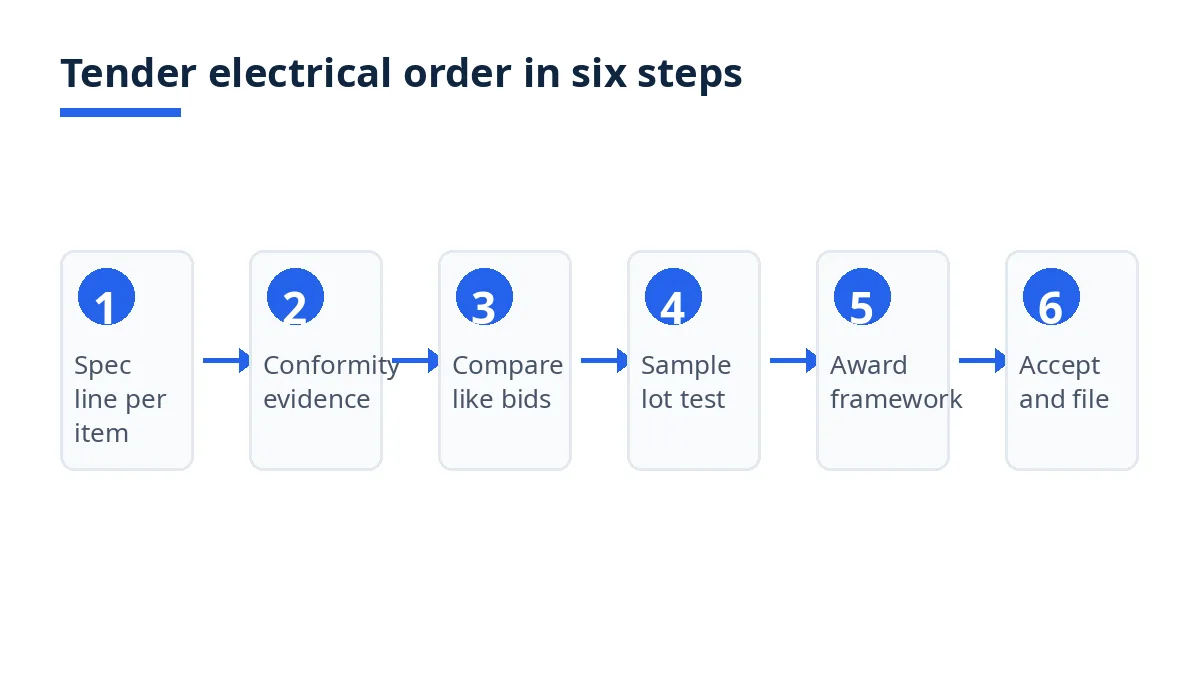
Write one specification line per item. Give each item its own line: product, rating, voltage, conductor or lamp type, applicable standard, finish, packing and quantity. A line that reads "LED street light" cannot be compared; a line that reads "LED street light, 60 W, 220 V, IP66, driver included, BDS 1851 or equivalent standard stated in the bid" can. State the unit of quantity on every line.
State the conformity evidence as a tender condition. Require the declaration of conformity, the test report and, where the product is on a mandatory list, the licence or mark evidence, with the bid or before award, naming the model and batch each document covers.
Publish the comparison basis. State one delivery term for every bid, one currency or conversion rule, and whether spares, warranty visits, freight and insurance sit inside the unit price or on separate lines. The Incoterms 2020 rules set out eleven rules describing obligations, risk transfer and costs between seller and buyer.5 Compare bids only on the same rule and named place, so a lower price does not win by leaving freight out.
Test a sample lot before the bulk order. Require a sample of the exact model offered, in the exact finish and rating, and test it against the specification line. Record the approval in writing, with photographs and the test result, and keep the approved sample as the reference for receiving.
Award, contract and schedule call-offs in writing. Award against the published criteria, record the scores, and sign a contract that repeats the specification lines, the delivery term, the call-off quantities and the receiving checks. For a framework, schedule call-offs against the named institutions and the maximum quantity.
Deliver, inspect, accept and file. Check each delivery against its call-off order: item, quantity, model, marking, documents and condition. Record the receiving check and any shortage or damage on the delivery note, and file it with the call-off order.
Costs, timelines and documents for a tender lot
What are the typical costs and timelines?
There are no typical costs or timelines a guide can state as fact for electrical tenders from Bangladesh. Each lot prices its own specification, quantity, delivery term and inspection regime. What a tender buyer can do is force every bid onto the same cost lines, so the comparison is honest.
Require separate bid lines for the unit price, freight, insurance, inspection or testing charges, spares, warranty visits and any installation or commissioning work. A single lump-sum price hides the item that will later appear as an extra charge. Require the price basis in writing: the quantity unit, the weight or length basis for cable, and whether the price covers the full lot or one call-off.
Timelines need the same separation. Ask for separate dates for sample delivery, sample approval, production or stock readiness, shipment, arrival and installation, rather than one delivery week for the whole lot. Where delivery runs to several sites, require a delivery schedule per site.
Example figures: a tender for 2,400 LED street lights across three municipalities, at an illustrative unit price of USD 38 per luminaire including driver, shows how the comparison basis changes the result. Bid A prices the luminaire alone, with spares and freight on separate lines. Bid B prices USD 42 per luminaire with 2 percent spares and freight included. On unit price alone, Bid A wins. On the tender total, Bid B can win. The example shows the comparison method only, not a market price, a typical quantity or a delivery time.
Which documents belong in the tender and audit file?
The tender file should hold the specification, the published criteria and their weights, the bid comparison sheet, the conformity documents for the awarded model, the contract and the call-off schedule. The delivery file should hold, for each call-off, the call-off order, the delivery note with the receiving check, the test or inspection record, the invoice and the payment record. Keep the two files linked by tender number and call-off number, so any delivery can be traced back to the specification line it was bought under.
Conformity documents sit inside that file, not beside it. For the European Union, the EU declaration of conformity and the technical documentation must be kept for 10 years under the low voltage rules,3 and the same 10-year retention applies under the electromagnetic compatibility rules.4 Ask for copies with the bid or before award, and file them under the model number, so a later change of model cannot borrow an earlier approval.
Bangladesh rules that belong in the tender documents
Bangladesh has a mandatory certification system that a tender buyer should write into the specification rather than discover at delivery. The Bangladesh Standards and Testing Institution (BSTI) Certification Marks licence is mandatory for 191 products, and the licensing route runs through application, factory inspection, sample collection and sealing, laboratory testing against the relevant Bangladesh Standard, fee payment and licence issuance, with the licence valid for three years.6 The tender should state, for each item, whether a BSTI licence or mark is required and which Bangladesh Standard (BDS) code applies. Examples from the mandatory list include electric cable under BDS 900 and 901, LED lamps under BDS 1851, switches for domestic use under BDS 377, socket outlets and plugs under BDS 378, and circuit breakers under BDS IEC 60898, with solar photovoltaic modules under BDS IEC 61215.6 Do not copy a code from an old tender without checking it: confirm the current list status and code for the exact item, and require the licence document that covers the offered model.
Classification matters for the same reason. In the Harmonized System, heading 8544 covers insulated wire, cable and other electric conductors, whether or not fitted with connectors, and optical fibre cables, with subheadings that separate winding wire, coaxial cable, wiring sets, conductors for a voltage not exceeding 1,000 volts fitted with or without connectors, conductors for a voltage exceeding 1,000 volts, and optical fibre cables.7 Put the heading on the tender line for cable items, and ask bidders to confirm the subheading for the voltage and construction offered. A cable tender that states the heading but not the voltage subheading still leaves room for two different products at two different prices.
Ask bidders to state the factory that will make the goods, and keep one legal name for the bidder across the bid, the contract, the invoice and the payment account. See the electrical cables quality control checklist for cable inspection points to write into the receiving check.
Mistakes and red flags in electrical tenders
What are the most common mistakes?
Writing a catalogue description instead of a specification. A line that names a product type without rating, voltage, standard and quantity unit invites bids for different products. Every line needs the values that decide whether the product will work in the installation it is bought for.
Comparing bids on different bases. A bid priced per drum against a bid priced per metre, or a bid with freight included against a bid with freight excluded, are different comparisons. The Incoterms 2020 rules describe obligations, risk and costs for eleven rules,5 so state one rule and one named place for the lot.
Accepting a test report for the wrong model. A report proves the tested model. Require the report to name the model, rating and standard of the item offered, and check that the name on the report matches the name on the bid. A report for a higher-rated model does not cover a lower-rated one.
One delivery date for a multi-site lot. A single date hides a short delivery to one site behind a complete delivery to another. Require a schedule per site, and record the receiving check per site.
A verbal promise on spares and warranty. Spares, warranty period, response time and the cost of warranty visits must sit on bid lines and in the contract. A promise made during a site visit, with no line in the contract, cannot be enforced when a luminaire fails in the second year.
Treating a profile or a badge as an inspection. A supplier profile is a starting point for enquiries. Verification on Exportain is a review of documents and photos by staff, not a factory inspection, and a badge is not a guarantee of capacity, quality or delivery.8 Sample approval, test evidence and the receiving check stay with the buyer.
Leaving the framework quantity open. A framework that names no maximum quantity and no covered institutions cannot be audited call-off by call-off. Under the framework rules, the agreement sets the terms for contracts during a given period, in particular price and, where appropriate, the quantity envisaged.2 State both in the tender documents, and stop call-offs at the maximum.
Checklist for the tender file
Before the tender notice goes out, every line should be answered in the documents, not in a meeting note.
One specification line per item: rating, voltage, standard, finish, packing, quantity and quantity unit.
Conformity evidence named as a tender condition: declaration, test report and licence or mark evidence, each covering the offered model.
Destination-market rules named per item, with the directive or regulation, standard and document stated.
Comparison basis published: one delivery term and named place, one currency rule, and spares, freight, insurance and warranty on separate lines.
Award criteria and weights published, including any quality criterion, before bids arrive.
Framework terms stated where used: institutions covered, maximum total quantity and term.
Sample lot required for the exact model, with written approval and a retained reference sample.
Delivery schedule per site, with separate dates for sample, production, shipment and arrival.
Receiving check defined: item, quantity, model, marking, documents and condition, recorded on the delivery note.
Call-off and tender numbers linking the delivery file to the specification line for every delivery.
How Exportain helps
On Exportain, browse suppliers and post a request for quotation (RFQ) on the RFQ board that carries the tender specification lines, the comparison basis and the conformity evidence required, so suppliers quote against the same document a tender committee would publish. Ask each reply to restate the specification line it is quoting, the delivery term and named place, and the model its test report covers, and keep the replies on the same comparison sheet.
Read the badges for what they record. Exportain Verified means Exportain has checked identity, phone, email and business registration, and Export Verified means it has checked the Export Registration Certificate (ERC).9 Factory Verified means it has reviewed photos of the manufacturer factory, while Trading Company Verified means it has reviewed photos of the trading company office or warehouse.9 Verification is a document review, free, and never granted by membership plans, and it is not a factory inspection.8 See how supplier verification works on Exportain before relying on a badge in a tender file.
When you accept a quotation, Exportain creates one order and issues one proforma invoice from the accepted terms.10 Keep the tender specification, the awarded bid and the delivery record together under the same tender and call-off numbers, so the audit file and the order file tell the same story.
FAQs
What should government and tender buyers settle before writing the tender?
Settle the specification line per item, the conformity evidence required, the comparison basis and the award criteria, and for a framework, the institutions covered, the maximum quantity and the term. Public procurement rules require equal treatment and transparency,1 and a framework agreement sets the terms for contracts during a given period, in particular price and, where appropriate, the quantity envisaged.2 Every point must sit in the tender documents before bids arrive.
What are the typical costs and timelines for a tender lot?
There are no typical costs or timelines to quote, because each lot prices its own specification, quantity, delivery term and inspection regime. Require separate bid lines for unit price, freight, insurance, inspection, spares and warranty visits, and separate dates for sample, production, shipment and arrival. Compare bids only on the same delivery term and named place under the Incoterms 2020 rules, which describe obligations, risk transfer and costs.5
Which documents belong in the tender and audit file?
The tender file holds the specification, the published criteria and weights, the bid comparison sheet, the conformity documents for the awarded model, the contract and the call-off schedule. Each delivery file holds the call-off order, the delivery note with the receiving check, the test or inspection record, the invoice and the payment record. For the European Union, the EU declaration of conformity and technical documentation must be kept for 10 years under the low voltage rules,3 and documentation must likewise be kept for 10 years under the electromagnetic compatibility rules.4
What are the most common mistakes in electrical tenders?
The most common mistakes are writing a catalogue description instead of a specification, comparing bids on different price or delivery bases, accepting a test report for a different model, using one delivery date for a multi-site lot, leaving spares and warranty as verbal promises, and reading a badge as an inspection. A badge records a document and photo review, not a factory inspection, and it is not a guarantee of capacity, quality or delivery.8
Next steps on Exportain
Browse suppliers, then post your specification lines, comparison basis and conformity evidence on the RFQ board so suppliers quote against one tender document. Before you confirm, read the electrical products sourcing guide and the HS code guide for electrical cables, and keep the awarded bid, the conformity documents and every delivery record under the same tender number.
Sources
- Public procurement. European Union (accessed )
- Directive 2014/24/EU on public procurement. European Union (accessed )
- Directive 2014/35/EU on electrical equipment designed for use within certain voltage limits — summary. EUR-Lex, European Union (accessed )
- Directive 2014/30/EU on electromagnetic compatibility — summary. European Union (accessed )
- Incoterms® 2020. International Chamber of Commerce (ICC) (accessed )
- How to Obtain BSTI License in Bangladesh. LegalSeba LLP, (accessed )
- Classification Detail — HS 2017 Code 8544: Insulated wire, cable and other electric conductors. United Nations Statistics Division (UNSD) (accessed )
- Trust & Safety Center. Exportain (accessed )
- Supplier verification: Earn trust badges buyers can see. Exportain (accessed )
- How to source and buy from Bangladesh. Exportain (accessed )
About the author
Sourcing from Bangladesh?
Post a request for quotation and suppliers on Exportain can send you their quotes directly.
Post an RFQ


