Baby Clothes Price in Bangladesh: FOB Cost Breakdown for Buyers
Baby clothes price in Bangladesh explained as an FOB build-up: fabric, dyeing, CM, snaps and trims, print, testing, packing, overheads and margin.
Short answer
There is no single baby clothes price in Bangladesh, because the FOB price is built per order from fabric, dyeing and finishing, labor operations, trims and fasteners, printing or embroidery, testing, packing, overheads and margin. This guide shows how each driver moves the quote, and how to compare two quotes on the identical specification before you order.
On this page
Key takeaways
There is no published market price for baby clothes in Bangladesh: the FOB price is built per order from fabric, dyeing, labor (CM), trims and fasteners, print, testing, packing, overheads and margin.
Fabric is the line to reconcile first: composition, construction, GSM and cutting waste across many small baby sizes explain most gaps between two quotes for the same bodysuit.
Fixed lines such as dyeing, print set-up, label printing and testing are spread over the run, so quantity per color and per size moves the unit price as much as the specification does.
Baby clothes classify under HS heading 6111 when knitted or crocheted and heading 6209 when not, and EU entries from Bangladesh can be duty-free under Everything But Arms when origin is proved.
If you are comparing a baby clothes price Bangladesh quotation, the unit number on its own tells you very little, because no official source publishes a market price for these garments and no two factories price the same specification. The FOB (Free On Board) price is built per order, from the fabric and snaps you choose to the size ratio, packing and delivery term you approve.
Why this matters for buyers and sellers
The Bangladesh Knitwear Manufacturers and Exporters Association (BKMEA), established in 1996 as the apex trade body for the knitwear sector, represents approximately 2,540 member factories.1 Baby clothes sit across knit and woven production, so that pool produces a wide spread of quotes for the same garment name, which is why the build-up matters more than the headline price.
Export Promotion Bureau (EPB) data for the first quarter of fiscal 2026-27, July to September, put ready-made garment exports at US$10.578 billion, with knitwear at US$5.963 billion, up 6.88 percent year on year, and woven garments at US$4.614 billion.2 A quote that shows its build-up can be checked against the specification, and that transparency shortens negotiation, because the buyer can see which choice moves which line.
Price and quantity are linked, but they are not the same question. The guide to baby clothes manufacturers in Bangladesh covers factory types, and wholesale baby clothes from Bangladesh covers lots, sets and cartons.
Step-by-step: how it works
Write the specification before you ask for a price. Cover garment type (bodysuit, romper, sleepsuit, dress or set), fiber composition, fabric construction and weight in grams per square meter (GSM) with a tolerance, neck and closure type, snap and binding specification, colors, size chart and ratio, labels, testing and packing. Send the identical version to every supplier.
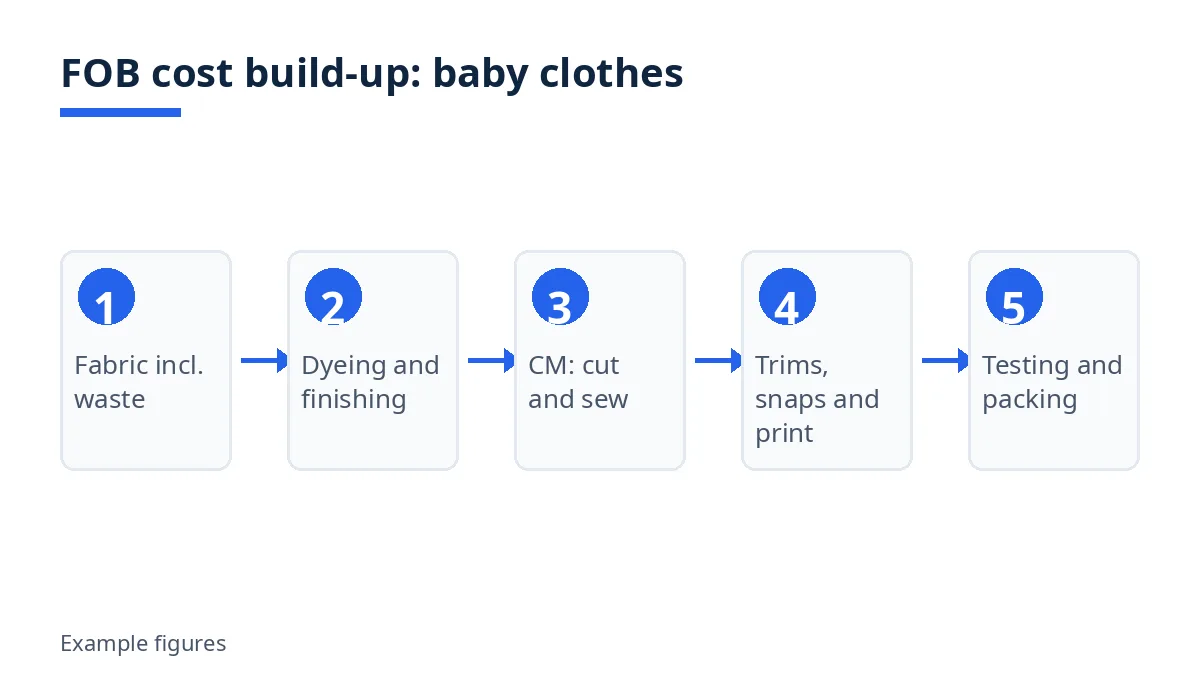
Ask each factory for the build-up, not only the total. Request the FOB price split into fabric, dyeing and finishing, labor (cut-make, or CM), trims and fasteners, printing or embroidery, testing, packing, and overheads and margin.
Compare the quotes line by line. A gap in the fabric line usually means a different composition, weight or waste allowance, while a gap in labor can mean fewer snaps or plainer binding.
Verify the supplier and approve samples. Check trade license, export registration and association membership, with company name, address and bank account name matching across documents. BKMEA membership is one cross-check for knit lines.1 The page on how supplier verification works on Exportain explains what document and photo reviews cover. Approve a pre-production sample in production fabric and fasteners, washed and re-measured.
Confirm the order and inspect before shipment. Confirm the build-up and total, quantity split by color and size, delivery term, payment terms, inspection plan and shipment date on the pro forma invoice. Run a final random inspection against the approved sample, using the baby clothes quality control checklist.
Costs, timelines and documents
What builds the FOB price, line by line?
Fabric is normally the largest line. Interlock, single jersey and rib price differently at the same weight, a higher GSM uses more yarn per piece, and a cotton-rich composition prices differently from a polyester-rich one. Cutting waste is real consumption: baby sizes are small, panels are many, and the factory buys fabric for the marker, not only for the panels in the garment.
Dyeing and finishing covers dyeing each color, plus finishes such as softening where your specification calls for them. Each color is a separate dye lot, so the same total split across more colors carries more dyeing cost per piece. A set is dyed and finished as its separate pieces, then costed as a set.
Labor operations (CM) cover spreading, cutting, sewing and finishing: binding neck and leg openings, attaching snaps, hemming and thread trimming. Construction moves this line: an envelope neck, flat seams or a lined bodice add machine and hand time compared with a plain bodysuit.
Trims and fasteners cover snaps, binding tape, elastic, labels, hang tags, stickers and barcodes. Snaps are specified per garment, so the count and finish you choose sit in this line or in labor, and a quote should say which. Private-label work adds print runs of its own.
Printing and embroidery covers chest prints, all-over prints and embroidered motifs. Each design carries set-up fixed for the run and spread over its pieces, and an all-over print consumes fabric differently from a plain dye.
Compliance and testing covers fiber composition, colorfastness, dimensional stability and the fastener and safety checks your market or retailer requires. Testing is costed per style or per color lot, then spread over the pieces in that lot, so it weighs more on a small run.
Packing covers folding, polybagging or boxed gift sets, size-ratio packs, export cartons and marks. Retail-ready boxed sets cost more per unit than bulk folding.
Overheads and margin close the build: supervision, utilities, maintenance, audits, finance and profit. A build-up with no allowance for overheads will be recovered elsewhere, usually in fabric.
Terms sit underneath the whole build. Price basis and named port, quantity per color and per size, and quote validity all change what the total means. The Incoterms 2020 rules set out 11 rules with a clear allocation of cost, risk and obligations,3 so two FOB quotes are comparable only on the same named place.
Every number below is an example figure, not a quote.
Example figures: one cotton interlock bodysuit, envelope neck, snap closure, a single dye lot per color, polybagged singly, FOB Chattogram.
Cost element | Example figures (per unit) |
|---|---|
Fabric, including cutting waste | $0.64 |
Dyeing and finishing | $0.20 |
Labor operations (CM): cutting and sewing | $0.52 |
Trims and fasteners: snaps, binding, labels | $0.16 |
Printing or embroidery | $0.12 |
Compliance and testing | $0.07 |
Packing | $0.15 |
Factory overheads and margin | $0.30 |
Total example FOB price | $2.16 |
How do you compare two quotes on equal terms?
Reconcile both build-ups against the same specification sheet in a fixed order. First, fabric: composition, construction, GSM, waste allowance and set composition must match, because that line explains most total gaps. Second, the operations: count dye lots by color, snap counts, binding and neck construction, print placements and label sets on each side. Third, the fixed lines: ask how testing was spread and what packing was assumed. Fourth, the terms: price basis and port, quantity per color and per size, and quote validity. Only then compare totals. Negotiate on specification before price: lowering the GSM or removing snaps produces a different garment, so change an item openly and record it in the tech pack.
What does quantity do to the price?
Quantity moves the unit price through the build-up, not through a discount table. Dyeing, print set-up, label printing and testing carry costs fixed for a run and spread over its pieces, so the same bodysuit costs more per unit in a small run, and a split across many colors and sizes costs more than the same total in fewer colors. The minimum order quantity guide explains how minimums are built.
How long does an order take, and which documents are needed?
Production time and transit time are separate, and neither has a single typical figure. Production runs from sample approval, through fabric and trim delivery, dyeing, cutting, sewing and inspection. Sea freight takes weeks rather than days, so confirm each date as a separate line in writing.
Classification sets the duty line beyond the FOB price. In the Harmonized System, heading 6111 covers babies' garments and clothing accessories, knitted or crocheted, split by fiber at the six-digit level,4 and heading 6209 covers babies' garments and clothing accessories, not knitted or crocheted, also split by fiber.5 See the HS code for baby clothes guide. In the European Union, Bangladesh, as a least developed country, benefits from the Everything But Arms arrangement, which grants duty-free, quota-free access for all exports except arms and ammunition, and Bangladesh is the largest beneficiary under it.6 For other markets, this guide states no rate: read the rate beside your confirmed code in the official tariff for your entry date, with your broker.
For export clearance in Bangladesh, goods may not be loaded unless an export declaration, the Bill of Export or Shipping Bill, is submitted to Customs and approved.7 Documents enclosed include the export contract or purchase order where there is no export letter of credit, the commercial invoice, the packing list, the EXP form certified by an authorized dealer, and a certificate of origin issued by the EPB or a Chamber of Commerce and Industry.7
Quality is agreed before production. ISO 2859-1 defines a system of acceptance sampling plans for inspection by attributes, indexed by acceptance quality limit (AQL) for lot-by-lot inspection.8 Set the AQL per defect class in the order confirmation, and add the baby-specific checks from the baby clothes quality control checklist: snap attachment, measurements after washing and shade across cartons.
Bangladesh-specific rules and tips
Check the association and export documents together. Trade license, export registration and association membership should name the same company, at the same address, as the bank account you pay. BKMEA also states that it addresses environmental and labor standard issues in its member factories,1 so membership is a cross-check, never a substitute for your own review of the factory.
Label fiber composition correctly for your market. If you sell into the European Union, Regulation (EU) No 1007/2011 covers textile fiber names and related labeling of fiber composition.9 The composition on your care label must match your specification and test reports, because a mismatch at entry becomes your cost. State size the same way on the garment, the pack and the carton.
Manage shade, shrinkage and snaps as production risks. Fabric is dyed in lots, and one order can span more than one lot. Approve a shade band at sampling, check shade across cartons, and measure the pre-production sample after washing, because baby sizes leave little room for shrinkage error.
Keep payments inside the documents. Pay the company account named in the trade documents, never a personal account, and verify bank-detail changes through a separate channel.
Mistakes and red flags
Comparing totals without comparing build-ups. Two totals are comparable only when composition, fabric, GSM, dyeing, construction, snaps, labels, testing and packing are identical. Ask each factory to state the fabric and fasteners behind its price first.
Treating a set as one garment. A bodysuit and legging set is two garments dyed, sewn, tested and packed, then sold as one unit. A quote silent on which pieces it includes will be corrected later or delivered differently.
Approving fit from a sample in substitute fabric. Shrinkage and stretch come from the production fabric, not a similar cloth. Approve the pre-production sample in production materials, washed and re-measured, before confirming the price.
Splitting colors and sizes after the price is agreed. Adding a color adds a dye lot and a cutting run, and changing the size ratio changes fabric consumption. The new structure is a new build, so record any change and its price effect in writing.
Leaving duty and terms out of the comparison. A cheaper FOB quote can lose once duty, freight and clearance are added, and an EU entry can be duty-free under Everything But Arms where origin is proved.6 Compare landed cost on the same term.3
Checklist
Write the specification: garment type, composition, fabric, GSM and tolerance, neck and closure, snaps and binding, colors, size chart and ratio, labels, testing and packing.
Request the FOB build-up from each factory: fabric, dyeing and finishing, labor (CM), trims and fasteners, printing or embroidery, testing, packing, overheads and margin.
Reconcile the build-ups line by line against the identical specification before you compare totals.
Confirm the quantity split per color and per size behind each quote, and how fixed lines such as testing were spread.
Classify each style under heading 6111 or 6209, and confirm duty and preference eligibility with your broker.
Verify the supplier: trade license, export registration, association membership and matching bank details.
Approve samples in stages: fit sample, then a pre-production sample in production fabric, washed and re-measured.
Confirm the order in writing: build-up, delivery term, payment terms, AQL plan and shipment date, then inspect.
How Exportain helps
Exportain is a B2B marketplace where buyers can browse Bangladeshi suppliers, post an RFQ and compare quotations. When you accept a quotation, Exportain creates one order and issues one pro forma invoice from the accepted terms, including quantity, unit price, currency and Incoterm as quoted.10 Supplier profiles carry trust badges earned through document and photo reviews: Exportain Verified records a check of identity, phone, email and business registration, and Export Verified records a check of the Export Registration Certificate.10
Those badges are reviews of documents and photos, not factory inspections, certifications or guarantees of capacity, quality or delivery.10 Verification is a document review by staff, free, and never granted by membership plans.11 Exportain is not a party to the contract for goods, and it does not inspect goods, book freight or clear customs. State fabric, construction, snaps, testing, packing and quantity per color and size in your RFQ. The guide to how to import baby clothes from Bangladesh covers the order sequence after the price is agreed.
FAQs
What should I know first about baby clothes?
Know the garment as a specification before you ask for a price: garment type, composition, fabric and GSM, neck and closure, snaps and binding, colors and size ratio, labels, testing and packing. Classification follows construction: heading 6111 for knitted or crocheted babies' garments and heading 6209 for babies' garments not knitted or crocheted.4 5
What are the typical costs and timelines?
There is no single typical cost or timeline. The unit price is built from fabric, dyeing, labor, trims and fasteners, printing or embroidery, testing, packing, and overheads and margin for your exact specification. The worked build in this guide, labeled Example figures at every mention, shows the shape of that calculation. Production runs from sample approval, and sea transit takes weeks.
Which documents are needed?
For clearance: the Bill of Export, commercial invoice, packing list and EXP form certified by an authorized dealer, plus a certificate of origin issued by the EPB or a Chamber of Commerce and Industry.7 Keep the specification, build-up, sample record and pro forma invoice together.
What are the most common mistakes?
Comparing totals written against different fabrics or constructions, accepting a quote that will not show its build-up, approving fit from substitute materials, treating a set as one garment, and splitting colors after the price is agreed.
Next steps on Exportain
Browse Bangladeshi suppliers, read how supplier verification works on Exportain, and post a free RFQ at Exportain RFQs with fabric, construction, snaps, testing, packing and quantity per color and size stated.
Sources
- BKMEA at a Glance. BKMEA (accessed )
- Merchandise exports rise 6.34pc to $13.09b in Q1 FY27: EPB. The Financial Express, (accessed )
- Incoterms® 2020. International Chamber of Commerce (ICC) (accessed )
- Classification Detail — HS Code 6111. United Nations Statistics Division (accessed )
- HS 2012 Classification Detail: Code 6209, babies' garments and clothing accessories, not knitted or crocheted. United Nations Statistics Division (accessed )
- EU trade relations with Bangladesh. European Commission, (accessed )
- Customs Clearance Procedures for Export. Bangladesh Customs, National Board of Revenue (accessed )
- ISO 2859-1:2026 - Sampling procedures for inspection by attributes — Part 1: Sampling schemes indexed by acceptance quality limit (AQL) for lot-by-lot inspection. International Organization for Standardization (accessed )
- Regulation (EU) No 1007/2011 on textile fibre names and related labelling and marking of the fibre composition of textile products. European Union, (accessed )
- Trust & Safety Center. Exportain (accessed )
- Supplier verification: Earn trust badges buyers can see. Exportain (accessed )
About the author
Sourcing from Bangladesh?
Post a request for quotation and suppliers on Exportain can send you their quotes directly.
Post an RFQ