

Top Workwear and Uniforms Manufacturers in Bangladesh: How to Find and Verify Them
Bangladeshi workwear supply is organised by factory type, not by ranking: eight types from woven industrial workwear to hi-vis PPE, flame-resistant makers and uniform programs, with the checks that matter for wash durability, sizing and safety compliance.
Short answer
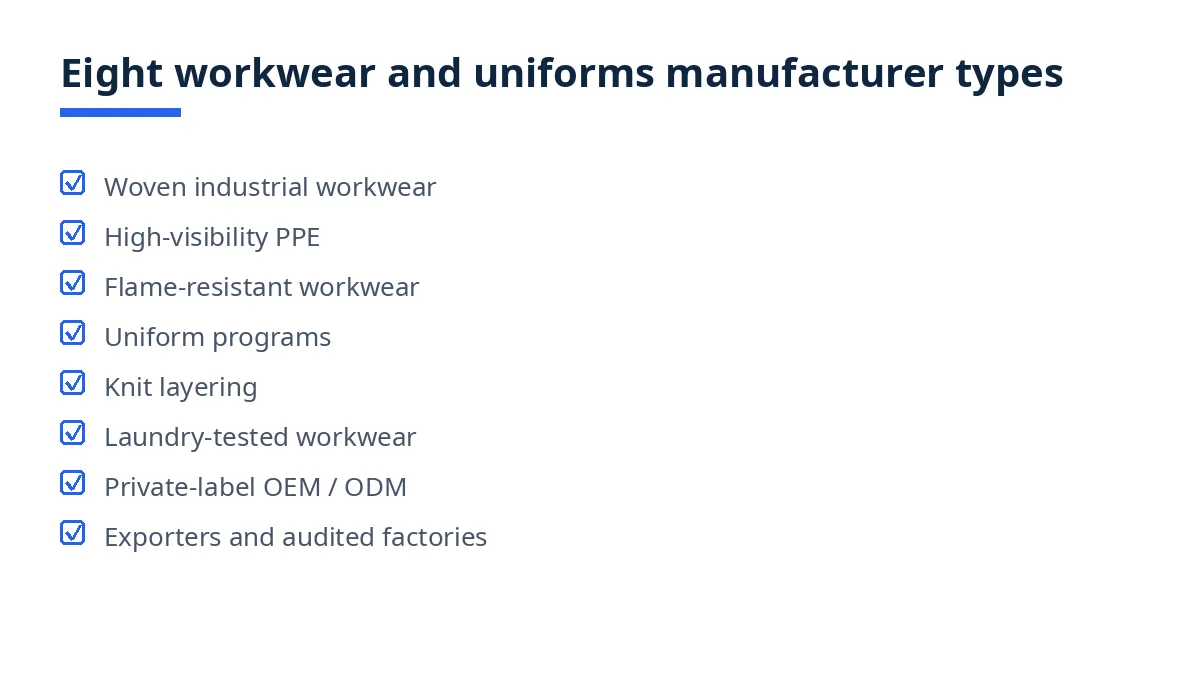
Workwear and uniforms manufacturers in Bangladesh fall into eight types: woven industrial workwear factories, high-visibility and safety PPE makers, flame-resistant makers, uniform program suppliers, knit layering makers, industrial laundry-tested makers, private-label OEM and ODM suppliers, and exporters and compliance-audited factories. Match the type to the hazard, wash route and replenishment need, then check test reports, washed samples and certificate scope before paying.
On this page
Key takeaways
Workwear and uniforms draw on both woven and knit production in Bangladesh: woven twill and canvas for coveralls and trousers, and knitted polos, fleece and sweatshirts for uniform layering.
A uniform program is judged on consistency across batches: shade, fit and branding must match on every reorder, even from a new dye lot months later.
Protective claims must name the hazard standard and the class or code letters achieved: EN ISO 20471 for high visibility, EN ISO 11612 for heat and flame, with ISO 13688 only as a general companion standard.
Wash durability decides workwear life: check ISO 15797 results for industrial laundering and wash the sample on the route the garments will actually follow.
Exportain badges record document and photo checks reviewed by the Exportain team; they are not factory inspections or quality guarantees.
A workwear order should start from the hazard, not from a catalogue page. The crew that will wear the garment faces a specific risk — traffic, heat, or daily abrasion — and the garment has to keep doing its job after dozens of wash cycles, in every size on the roster, with matching shade and logo placement on the tenth reorder as on the first. A fashion order can absorb a shade drift between seasons. A uniform program cannot, because the mismatch shows on the workforce the next morning.
Bangladesh is a practical place to look for this kind of production because most of it sits in the woven sector. Export Promotion Bureau figures reported by The Financial Express put woven shipments at US$4.6148 billion in the July–September quarter of fiscal 2026-27, up 5.11 percent on the year before, within ready-made garment exports of US$10.578 billion.1 The Bangladesh Garment Manufacturers and Exporters Association (BGMEA) lists the assessment frameworks used across its member factories, including BSCI, WRAP, SMETA, ICS, the Higg Index, ZDHC, GOTS and OEKO-TEX.2 That listing is background, not proof of what any factory passed. The eight types below follow the job the garment must do, so the shortlist follows the hazard and wash route rather than catalogue size.
Workwear quotes are built style by style: cloth weight and blend, protective finish, size-curve breadth, branding placements, and packing each move the figure, and replenishment adds its own cost. Price the same garment, sizes, and packing from every candidate; see the guide to MOQ in the supply chain.
The list: workwear and uniforms manufacturers in Bangladesh by type
1. Heavy woven workwear for site and plant crews
These factories cut and sew the heavy woven core of a workwear program: coveralls, bib overalls, jackets, trousers, and aprons, usually in cotton twill, polyester-cotton, or canvas. Their lines handle thick cloth, dense seams, and hardware such as rivets, heavy zips, and knee-pad pockets built for kneeling, climbing, and loaded pockets. Specify cloth weight and blend: heavier twill resists abrasion but stiffens the knee; lighter blends move better and wear sooner.
Judge the sample the way the crew will judge the garment. Kneel in it, fill every pocket with the items the wearer actually carries, and run it through the care-label wash before measuring it again. Check the knee, the seat, the pocket corners, and the waistband, and put bar-tacks and double-needle stitching at those points in writing. Insist the sample cloth matches bulk cloth exactly; a lighter sample cloth will pass this test and still fail on site.
2. High-visibility garments and safety PPE
High-visibility makers build garments whose job is to make the wearer conspicuous: vests, jackets, trousers, and coveralls in fluorescent fabric with retroreflective tape, for road, rail, warehouse, and construction crews. EN ISO 20471 sets the requirements for this clothing, covering the fluorescent background material, the retroreflective material, the minimum visible areas, and where the tape must sit, and it ties performance to cleaning: where the maker states a maximum number of wash cycles, the materials must still meet the requirements after that many cycles.3
Put the class and the working conditions in the specification, and ask for the test report covering the exact fabric-and-tape combination you will buy, not a report for a similar tape on a different cloth. Check the sample for tape width and placement, and keep chest logos and branding clear of the tape, since tape hidden under a logo does not count toward the visible area. Wash the sample for the stated cycle count and re-check brightness and tape adhesion before approving bulk.
3. Flame-resistant and heat-protective clothing
Flame-resistant makers serve foundry, welding, and refinery crews, where the garment must limit flame spread and resist radiant, convective, or contact heat and molten metal splash. EN ISO 11612 sets performance requirements for this clothing, including limited flame spread, and its design rules extend to pocket linings, hardware, seams, and closures.4 That last point is the one buyers miss: a fabric that passes on its own can still fail as a finished garment when the thread chars, a zip melts, or a pocket lining ignites.
Ask for a garment-level report showing the code letters achieved for the finished construction, seams and hardware included, not a fabric swatch alone. Confirm the certificate names the factory that will sew your order and the product type, and that it is still in date. Wash-test the sample too: some treatments lose performance over laundering, and a home-wash pass may not survive your crew's actual route.
4. Uniform programs and corporate wear
Uniform program suppliers run a wardrobe over time instead of shipping a single order: corporate shirts and blouses, tunics, suiting, hospitality and healthcare uniforms, with size curves, repeat orders, and top-up deliveries built into the arrangement. The test is not the first delivery but the fifth: whether a shirt ordered eight months later matches the first batch in shade, fit, and branding despite a new dye lot. Programs fail on slow drift — a collar shade that moves a step, a trouser leg that narrows a fraction — long before they fail on a torn seam.
Ask how the supplier holds the standard between orders: a sealed reference garment checked against every new dye lot, measurement checks at each reorder, and a written rule for a lot that drifts outside tolerance. Agree the top-up minimum per size and color in advance, since a small replenishment run may not be possible at the first order's price, and settle branding reproduction in advance, so a reorder does not quietly switch methods.
5. Knit layers worn under woven workwear
Knit makers supply the layers worn under or beside woven workwear: uniform polo shirts, T-shirts, fleece jackets, and sweatshirts for staff, warehouse, and field teams. These layers carry most of the visible branding and get washed more often than the outer garments, so a polo that shrinks, twists, or fades after ten washes makes the whole uniform look tired while the coveralls still hold up. Fabric weight, collar construction, and the durability of the print or embroidery decide the result, not the softness of the first sample.
Approve the sample in the production yarn and weight, then wash it repeatedly and measure shrinkage, twisting, and color change against limits agreed in advance. For printed layers, wash-test the print for cracking and fading; for embroidered layers, check that the embroidery does not pucker the fabric after washing. Check knit shade against the woven garments it will be worn with; lots dyed separately can clash.
6. Workwear built for industrial laundering
Some workwear lives in industrial laundering rather than home washing: rental garments, healthcare and food-processing uniforms, and heavy-industry clothing washed hotter, harsher, and more often than a household machine allows. ISO 15797 gives test procedures and equipment for evaluating workwear intended for industrial laundering, covering dimensional stability, color characteristics, creasing, seam puckering, pilling, and visual aspects.5 A garment that holds its shape at home can still shrink, pucker, or lose color under industrial cycles, so a home-wash sample is the wrong evidence here.
State the laundering route in the specification: industrial or home, temperature, and the wash count the garment must survive across its working life. Ask for results after the agreed number of ISO 15797 cycles for the exact fabric, and confirm the care label describes the tested route rather than a gentler one. With a rental laundry, confirm its cycle with the factory before approving the sample; an untested recipe is a guess, not evidence.
7. Factory output sold under your own label
Own-label suppliers make workwear under the buyer's brand through two different routes. On the first route, the buyer hands over a finished pattern set and specification and the factory sews to it; on the second, the buyer selects from patterns the factory already sells and adds its own labels, branding, and packing. The first route suits a buyer with a developed size curve and a fixed protective standard; the second suits a buyer that needs a faster start and can accept the factory's existing fits. Workwear adds one wrinkle: labels, barcodes, and wash-care instructions must survive the same washing as the garment.
On the buyer-pattern route, send a specification covering cloth and weight, construction and stress points, protective standard and class or code letters, size set, branding placements, and packing, and judge the counter-sample against it section by section. On the factory-pattern route, confirm the styles on offer were developed by that supplier and check which protective claims they actually carry, rather than assuming the whole range is certified. Settle pattern ownership and file handover before production, so a later move does not strand your size curve.
8. Traders and independently audited plants
Trading exporters hold export licenses and sell workwear sewn in partner factories, pooling capacity across several plants under one contract. That suits a buyer kitting out a whole workforce at once, but it puts distance between the buyer and the sewing line. A trader's export record shows it can ship; it says nothing about the knee seam on your coverall or the tape adhesion on your vest.
Put the sewing plant for each style in the order document before any deposit is paid, and arrange inspection at that plant rather than at a trader warehouse. Separately, audited factories hold current audits or certifications under schemes their buyers require; BGMEA lists frameworks including BSCI, WRAP, SMETA, ICS, the Higg Index, ZDHC, GOTS and OEKO-TEX.2 Treat every such document as bounded by its scope: confirm the number with the issuing body, check the address is the plant that will sew your order, and read the expiry date, standard, and product category. Confirmation comes from the issuing body, not from the profile that displays the document.
Summary table
Type | Fits | Ask for first |
|---|---|---|
Heavy woven workwear | Site and plant crews | Washed production-cloth sample, knees and pockets loaded |
High-visibility PPE | Road, rail, warehouse, construction crews | Test report for the exact fabric-and-tape combination, washed |
Flame-resistant clothing | Foundry, welding, refinery crews | Garment-level code letters, factory named, expiry checked |
Uniform programs | Repeat corporate, hospitality, healthcare wardrobes | Shade and fit controls between reorders, top-up minimums agreed |
Knit layers | Staff polos, fleece, sweatshirts | Washed sample: shrinkage, twist, print durability |
Industrial-laundry workwear | Rental, healthcare, food-processing programs | ISO 15797 results for the agreed wash route |
Own-label OEM / ODM | Buyer-brand workwear ranges | Specification match, pattern and file ownership settled |
Trading exporters / audited factories | Whole-workforce kits, chain programs | Sewing plant named; certificate scope confirmed with issuer |
One general standard sits behind the hazard-specific ones. ISO 13688 covers ergonomics, sizing, ageing, compatibility with other protective equipment, labelling, and the information the maker must supply, but it works only as a companion to a hazard standard, never as a substitute for one.6 When a supplier cites it alone for a hi-vis or flame-resistant claim, ask for the hazard standard by name, the class or code letters achieved, and the test report for the finished garment.
How Exportain helps
Shortlist workwear suppliers in the Exportain catalogue by category, then send one RFQ stating the hazard, protective standard and class, wash route, size curve, and replenishment terms, so every quote answers the same specification.7 Profiles show badge level, location, main products, and declared certifications.7
Treat a badge as a summary of paperwork and photograph checks, not as evidence that anyone visited the factory floor.8 Read the guide to how supplier verification works on Exportain before leaning on a badge for a protective claim.
FAQs
What is the biggest mistake?
Buying workwear the way fashion is bought: ranking quotes by unit price while the hazard class, the wash route, and the size curve stay undefined. A coverall approved on a single size, a vest judged by its first-day brightness, and a shirt matched only to its first batch can each fail once the crew wears and washes them, and the failure only surfaces weeks after delivery, when the garments are already in use.
How can I avoid it?
Put the hazard, standard and class or code letters, cloth weight, branding placements, wash route with cycle count, and size curve on one sheet, and ask each candidate to quote against that sheet alone. Approve a sample in the production fabric, wash it on the route the garments will actually follow, and set the sampling plan in writing before production starts: ISO 2859-1 gives AQL-indexed schemes for lot-by-lot inspection.9 Agree replenishment terms at the same time, so a top-up order months later is priced and possible, not improvised.
Who is responsible?
The split follows the paperwork. The factory owns building the garment to the agreed specification and the approved sample, including protective performance after washing where the standard requires it. The buyer owns writing a specification that can actually be measured — hazard, class, wash route, size set, inspection rule — and checking the shipment against it before it leaves. When the specification is vague, neither side can prove its case, and the dispute is decided by whoever kept the better record.
Where can I get help?
Three checks sit outside any marketplace. Association listings confirm a company is registered in the trade; the body that issued a certificate confirms whether it covers your factory and product; and an independent inspector checks the shipment before it leaves.2 On Exportain, check what a profile badge covers before leaning on it, and hold the exchange in one platform thread, so nothing agreed is lost.8
Next steps on Exportain
Your first stop is the catalogue at Bangladeshi suppliers: look for workwear ranges whose badge level, minimums, and own-label capacity fit the program, and read how supplier verification works on Exportain so the limits of each badge are clear before you commit to any name.
Then use post an RFQ to send the shortlisted suppliers your hazard sheet — standard and class, wash route, size curve, replenishment terms — and judge their replies against that sheet, not against each other.
Sources
- RMG exports rise 6.10pc to US$10.58b in July-Sept of FY27. The Financial Express, (accessed )
- BGMEA | Home. Bangladesh Garment Manufacturers and Exporters Association (BGMEA) (accessed )
- EN ISO 20471:2013 High visibility clothing - Test methods and requirements. Roots Original (accessed )
- EN ISO 11612:2015 Protective clothing - Clothing to protect against heat and flame. Roots Original (accessed )
- ISO 15797:2017 Textiles - Industrial washing and finishing procedures for testing of workwear. International Organization for Standardization (ISO) (accessed )
- ISO 13688 Protective Clothing - General Requirements. Eurolab (accessed )
- How to source and buy from Bangladesh. Exportain (accessed )
- Supplier verification: Earn trust badges buyers can see. Exportain (accessed )
- ISO 2859-1:2026 — Sampling for Inspection by AQL. American National Standards Institute (ANSI) (accessed )
- MOQ
- supplier verification
- woven garments
- importing from Bangladesh
- Workwear and uniforms
- Private label apparel
About the author
Sourcing from Bangladesh?
Post a request for quotation and suppliers on Exportain can send you their quotes directly.
Post an RFQ


