Top Women's Dresses Manufacturers in Bangladesh: How to Find and Verify Them
Bangladeshi women's dresses supply is organised by factory type, not by ranking: eight types, what each suits, and the dress-specific checks on drape, grading, finishing and embellishment to run before ordering.
Short answer
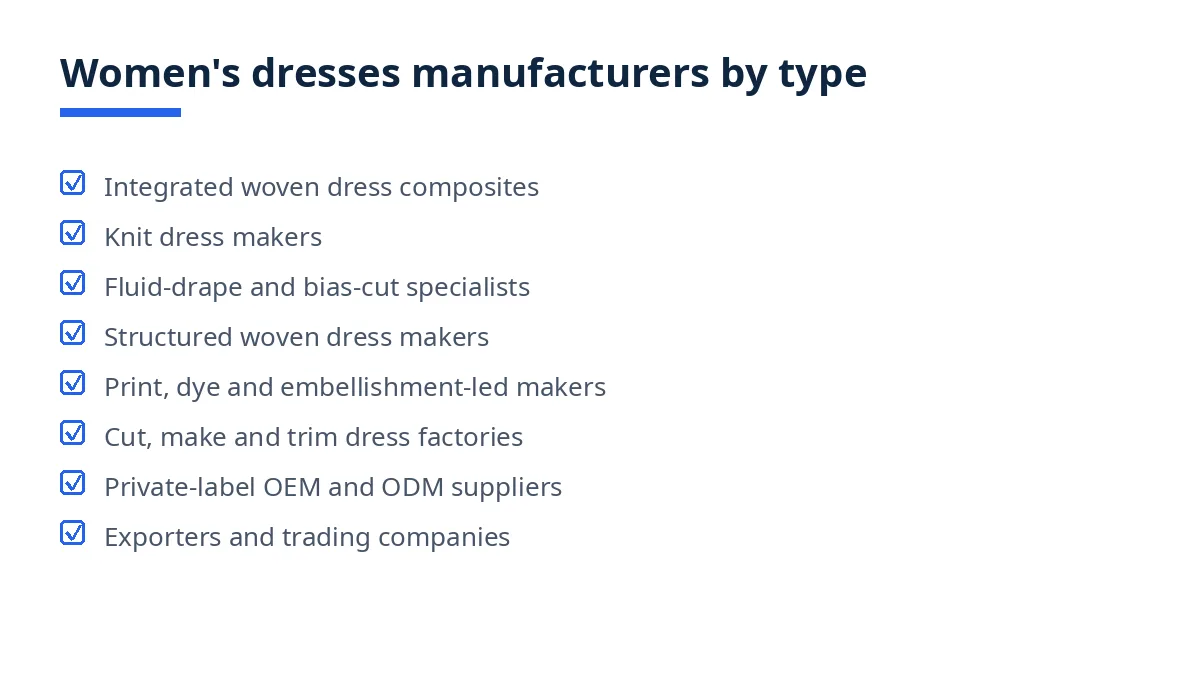
Women's dresses manufacturers in Bangladesh fall into eight types: integrated woven composites, knit dress makers, fluid-drape and bias-cut specialists, structured woven makers, print, dye and embellishment-led makers, cut, make and trim factories, private-label OEM and ODM suppliers, and exporters and trading companies. Match the type to your silhouette, fabric and size range, then check washed fit samples, grading and inspection terms before paying.
On this page
Key takeaways
Women's dresses span woven and knit production: woven exports were US$4,614.80 million and knitwear US$5,963.76 million in the first quarter of fiscal 2026-27, so the supplier pool must be judged by silhouette and fabric, not by one list.
Dress failures are specific: uneven bias-cut hems, linings that pull sheer layers out of shape, prints that shift across sizes, and bodices that fit only the sample size.
Check fit in the smallest, middle and largest sizes, using washed samples in the production fabric, and hang fluid dresses before measuring the hem.
Exportain badges record document and photo checks reviewed by the Exportain team; they are not factory inspections or quality guarantees.
A dress carries more ways to go wrong than most garments, because length, lining and shape all have to survive together. A bodice can measure correctly while the skirt pulls to one side, a sheer outer layer can look right on a hanger while its lining twists underneath, and a print can sit perfectly on a sample while landing in a different place on a larger size. Buying dresses from Bangladesh therefore starts with a narrower question than supplier reputation in general: which kind of maker handles your silhouette, your cloth and your size range, and which dress-specific checks will you run before bulk?
Bangladesh covers both cloth families a dress buyer needs. Ready-made garment exports in the first quarter of fiscal 2026-27 reached US$10,578.56 million, up 6.10 percent year on year, with woven garments at US$4,614.80 million and knitwear at US$5,963.76 million, according to Export Promotion Bureau data reported by The Financial Express.1 That split matters for dresses, because a structured poplin dress and a stretch jersey dress come from different factory skills even when they share a price point. The Bangladesh Knitwear Manufacturers and Exporters Association says it represents approximately 2,540 knitwear member factories,2 while the Bangladesh Garment Manufacturers and Exporters Association describes a base of more than 4,000 factories, with garments reaching more than 150 countries.3
The list below is organized around three dress problems rather than around factory size. First, cloth behavior: how a fabric drapes, stretches, shrinks and holds shade across a long garment. Second, pattern work: how a shape is graded from the smallest to the largest size without losing its proportions. Third, finishing: how hems, linings, prints and embellishment hold up after washing and wear. Match the maker to the problem your dress presents, not to a general ranking.
The list: women's dresses manufacturers in Bangladesh by type
The order here follows the dress itself: woven makers first, then knit makers, then the surface and drape specialists, then the production routes that turn a sample into a shipment. A single company can appear in more than one group.
1. Integrated woven dress composites
These groups keep cloth production or cloth buying, dyeing and sewing inside one organization, so one party answers for both the fabric and the finished dress. That control shows up most clearly on long garments, where a shade difference between two dye lots reads across a full skirt panel even when swatches look alike, and where shrinkage in the cloth changes the finished length. Repeat programs benefit most here, because the same color and hand feel need to return season after season without drifting.
Before committing, ask in writing which stages run in-house and which are bought in, and request the name of the mill or dyeing unit behind your cloth. Then approve a sample of the bulk cloth after washing and drying it the way your customer will treat the dress, and compare its shade and length against the original approval.
2. Structured woven dress makers
Structured makers build dresses that must hold a defined shape: shirt dresses, poplin and twill styles, denim dresses and darted bodices. Their craft is symmetry and flatness rather than flow. Darts should end at matching points on both sides of the body, collars and waistbands should lie flat without rolling, button stands should close without gaping, and a waist seam should meet at the same height at the front, sides and back.
Check a structured sample the way a store would display it, on a form under ordinary lighting, not only flat on a table. Compare the left and right sides of the bodice, look at the topstitching along collars and waistbands, and measure the sample at the points that define the shape across several sizes. Nothing in the design hides pressing faults or uneven stitching.
3. Knit dress makers
Knit makers cut and sew dresses from jersey, rib, ponte and other stretch fabrics, knitting the cloth themselves or buying it to a specification. Their central problem is recovery: a knit dress has no woven structure to hold it, so the pattern must allow for the fabric pulling back after sewing, and the seams must give with the body instead of snapping. Casual midi and maxi dresses, maternity styles and any dress sold on comfort sit in this group.
The decisive sample is a washed one in the production knit, because knit dimensions shift in the wash and an unwashed measurement flatters the result. Confirm also the size range the factory grades as routine work, since a knit dress graded only around a middle size often loses its intended ease at the largest size, where the fabric carries the most tension and the seams face the most strain.
4. Print, dye and embellishment-led dress makers
Surface-led makers build their offer around what goes on the cloth: all-over and placement prints, garment dyeing, embroidery, lace, sequin and bead work, and applique. A dress makes surface work harder than a smaller garment does, because the design runs the full length of the body. An all-over print must meet across the side seam, a placement motif must sit at the same height on every size, and hand-applied decoration must survive washing without shedding, snagging or stiffening the base cloth.
Approve a strike-off on the production cloth first, then a decorated sample in a middle size and one end size, and wash both before approving bulk. Put ownership of the print screens, embroidery files and placement measurements in writing at the same time, so changing supplier later does not mean rebuilding the artwork from scratch.
5. Fluid-drape and bias-cut specialists
Drape specialists work with cloth that moves: viscose, crepe, chiffon and other light woven fabrics, cut on the straight grain for a soft fall or on the bias for a closer, liquid fit. Bias cutting punishes haste, because fabric cut at an angle stretches as it hangs. A dress measured flat can grow longer overnight and finish with a hem that dips at the sides unless the maker rests the cut panels before sewing and levels the hem on a form.
Judge this group by a finished dress in a comparable fluid fabric, not by a catalog photograph. Hang the sample for a day, then check the hem all the way around, watch how the lining settles inside the outer layer, and look at the side seams for twisting. A maker that levels hems only on a flat table has not yet shown it can deliver a dress that hangs evenly in a store.
6. Cut, make and trim dress factories
Cut, make and trim factories, usually shortened to CMT, cut and sew dresses from cloth the buyer supplies or nominates. Their strength is sewing and finishing rather than cloth production, which suits a buyer who already sources a particular crepe, chiffon or printed cloth, or who wants cloth buying kept separate from sewing. Quantities can also be more flexible here than with a composite group.
The trade-off is that cloth risk stays with the buyer, so inspect the cloth before cutting and agree shade, shrinkage and width tolerances in writing. Hold a pre-production sample made from the bulk cloth and the actual trims, and ask about the cutting plan, because a long dress consumes more cloth per piece than a top and a careless marker wastes the fabric that sets the price. Ask how bias-cut panels are rested and hems leveled, since those two steps separate dress-capable CMT units from general sewing lines.
7. Private-label OEM and ODM dress suppliers
Private-label suppliers make dresses under the buyer's own label, under two different arrangements. In an original equipment manufacturer, or OEM, arrangement, the supplier produces to the buyer's tech pack, pattern and grading. In an original design manufacturer, or ODM, arrangement, the supplier offers its own developed styles, which the buyer then labels and adjusts. Brands that need their own labels, tickets, size sets and packing use one or both routes.
An OEM order lives or dies on the pack you send: cloth and lining, how the dress should fall, measurements at every grade, where decoration sits, how hems and finishes should look, and how the dress should be packed. Measure the counter-sample against that pack point by point. An ODM order turns on different questions: whether the styles on offer were developed by that supplier, which sizes they already cover, and who keeps the pattern and grade files when the order is finished. Settle that last point in the contract, not in conversation.
8. Exporters and trading companies
A trading company does not sew your dresses. It places them with partner workshops, combines styles from more than one of those workshops into a single order, and manages the shipment for you. That model helps when no one workshop covers everything in your range, or when each style on its own is too small to place directly. It also means the company you contract with is not the company cutting your cloth, so the checks in the next paragraph matter more here than anywhere else in this list.
With a trading company, the one question to press is identity: which workshop sews which style in your range? Insist that the answer appears in the contract before money changes hands, style by style. A trader's shipping history cannot tell you that, and it cannot tell you whether the workshop behind your flowing viscose style is the same one behind your stiff poplin style. Those workshops may need entirely separate quality checks, so file the workshop identity together with the approved sample and the agreed inspection terms, so all three travel with the order.
Summary table
Type | Suits | Check first |
|---|---|---|
Integrated woven dress composites | Repeat woven programs needing steady shade | Named cloth source and a washed bulk-cloth sample |
Structured woven dress makers | Shirt, poplin, twill and denim dresses | Bodice symmetry and shape measurements across sizes |
Knit dress makers | Jersey and stretch dresses sold on comfort | Washed production-knit sample and grading at the largest size |
Print, dye and embellishment-led dress makers | Printed and decorated dresses | Strike-off, washed decorated samples and artwork ownership |
Fluid-drape and bias-cut specialists | Flowing, wrap and occasion dresses | Hung sample with level hem and settled lining |
Cut, make and trim dress factories | Buyer-supplied cloth and flexible quantities | Cloth inspection, cutting plan and hem leveling |
Private-label OEM and ODM dress suppliers | Own-label brands and ready dress ranges | Tech pack match for OEM and pattern ownership for ODM |
Exporters and trading companies | Mixed dress ranges under one contract | Producing factory named in writing for each style |
How Exportain helps
On Exportain, buyers search published products by keyword and category, filter by badge, sample availability, OEM or ODM capability, MOQ and lead time, and compare supplier profiles showing verification level, location, main products and declared certifications.4 A badge records checks already completed on documents and photographs, so read what it covers before you rely on it.5 Use those filters to narrow the list, then run the dress checks above on the shortlist, keeping the exchange in the message thread so agreed terms stay recorded.
An RFQ carries your dress specification, quantities and destination to suppliers in the category, and the replies come back against that shared specification rather than against separate conversations. Quantity planning by style, color and size mix is covered in the MOQ guide linked below. For shipment paperwork, use the how-to-buy page as your starting reference.4
FAQs
What is the biggest mistake?
Judging a dress by its photograph and its unit price, and skipping the finished-garment checks that show whether it keeps its shape after washing and hanging. A photograph cannot reveal a bias-cut hem that drops overnight, a lining that twists inside a sheer dress, or a largest size that no longer matches the approved fit. A low price on a dress that fails those checks is not a saving.
How can I avoid it?
Send every shortlisted supplier the same dress pack, covering fabric and lining, drape notes, the graded measurement chart, embellishment placement, hem and finish standards, and packing. Approve fit samples in the smallest, middle and largest sizes you plan to sell, wash the samples, and hang fluid dresses before measuring the hem. Agree the sampling rule before production starts: ISO 2859-1:2026 covers sampling for inspection by AQL, so acceptance of a lot follows a stated scheme rather than a single opinion.6
Who is responsible?
The factory answers for making dresses to the agreed specification and the approved sample, including the drape, grading and finishing in that sample. The buyer answers for writing a specification that can actually be measured, and for inspecting against it before shipment. When a fault is disputed, the written pack, the sealed sample and the inspection report settle it, which is why all three should exist before bulk production begins.
Where can I get help?
Start with the membership listings: BGMEA runs a member search on its own site, and BKMEA lists its knitwear members, so registration claims can be checked at the source.2 3 For any audit or fiber claim, go to the certificate issuer rather than relying on a supplier summary. On Exportain, keep questions and answers in the supplier thread so the agreed terms stay in one place.
Next steps on Exportain
Read how supplier verification works on Exportain before you narrow your shortlist, so you know what each badge covers and what still needs your own check. Then read the MOQ guide and the women's dresses quality control checklist to set quantities by style, color and size mix and to plan inspection around drape, grading and finishing. Once the list is down to two or three makers, send your dress specification through an RFQ and compare the replies against the same pack.
Sources
- RMG exports rise 6.10pc to US$10.58b in July-Sept of FY27. The Financial Express, (accessed )
- BKMEA at a Glance. BKMEA (accessed )
- BGMEA | Home. Bangladesh Garment Manufacturers and Exporters Association (BGMEA) (accessed )
- How to source and buy from Bangladesh. Exportain (accessed )
- Supplier verification: Earn trust badges buyers can see. Exportain (accessed )
- ISO 2859-1:2026 — Sampling for Inspection by AQL. American National Standards Institute (ANSI) (accessed )
- MOQ
- supplier verification
- knitwear
- importing from Bangladesh
- Women's dresses
- Private label apparel
- Woven apparel
About the author
Sourcing from Bangladesh?
Post a request for quotation and suppliers on Exportain can send you their quotes directly.
Post an RFQ