

Women's Blouses Price in Bangladesh: FOB Cost Breakdown for Buyers
No single FOB price covers every women's blouse from Bangladesh. This guide breaks the quote into fabric, sleeve and neckline construction, embellishment, size runs, finishing and packing, so buyers can compare quotes on the same specification.
Short answer
There is no single FOB price for women's blouses from Bangladesh. The figure depends on the cloth and its drape, the sleeve and neckline construction, the embroidery or embellishment, and the size split across the order. Ask for the quotation broken into lines, compare replies on the same specification and the same FOB port, and approve a washed pre-production sample before confirming.
On this page
Key takeaways
No single FOB price covers women's blouses from Bangladesh; the figure follows cloth and drape, sleeve and neckline construction, embellishment, and the size split.
Fabric consumption rises with size, so a run weighted toward larger sizes costs more cloth than a middle-size figure suggests; the size split belongs in the quotation.
Embellishment set-up is fixed, so its per-piece effect falls as the run grows; price it per placement with set-up as a separate line.
Compare quotations only on the same tech pack, size split, and FOB port, and approve a washed pre-production sample before confirming.
Exportain verification is a document and photo review, not a factory inspection, and a badge is not a guarantee.
A women's blouse quotation is decided in places a per-piece total hides: the fall of the cloth, the finish at the neckline, the way a sleeve is set, the stitch count of an embellishment, and the spread of sizes across the order. Change one of those and the unit price moves, even when the blouse still looks the same in a photograph. This guide therefore treats the FOB figure as a set of lines to be checked one by one, rather than a single number to push down.
FOB, Free On Board, is one of the Incoterms 2020 rules. Under FOB, the seller delivers the goods loaded on board the vessel nominated by the buyer at the port of shipment, and risk transfers to the buyer at that point.1 The seller handles transport to the port, loading, and export formalities, while the buyer contracts the carrier, pays freight, and handles import formalities.1 The Incoterms 2020 rules as a whole set out 11 rules with a clear allocation of cost, risk, and obligations.2 Ocean freight and the buyer's import duty sit outside an FOB figure, so two quotations compare only when they name the same term and the same port.
Classification comes before price. Heading 6206 covers blouses, shirts and shirt-blouses, women's or girls', not knitted or crocheted, with subheadings split by fiber, including cotton under 620630, man-made fibers under 620640, and silk or silk waste under 620610.3 A blouse in this guide is a woven garment, and the woven base in Bangladesh is large: the Bangladesh Garment Manufacturers and Exporters Association (BGMEA), since its inception in 1983, has around four thousand registered garment factories, of which around 40 percent are knitwear and sweater manufacturers and the rest 60 percent are woven garment manufacturers.4
There is no published standard FOB price for women's blouses from Bangladesh, and this guide states none. Instead, it works through the lines inside a blouse quotation, what moves each line, and how to compare replies on identical terms. Every concrete number in this guide is labelled Example figures and shows arithmetic only, never a market price.
Cost line | What moves it | Fix in your specification |
|---|---|---|
Fabric and drape | Fiber, weave, weight, print or dye, and how the cloth falls after washing | Fiber, construction, weight, print method, wash standard |
Sleeve construction | Sleeve shape, setting method, cuff or hem finish, and sewing time | Sleeve type, cuff detail, seam and stitch spec |
Neckline construction | Collar or neckline shape, facing, binding, and finishing passes | Neckline drawing, facing and binding spec |
Embroidery and embellishment | Stitch count, placement count, thread type, and set-up | Artwork, stitch count, placements, thread spec |
Size run and cutting | Consumption per size and the ratio of sizes in the order | Size chart and quantity per size |
Trims and labels | Buttons, lace, zips, woven labels, hang tags, and their own runs | Trim list, label artwork, tag and carton spec |
Finishing and pressing | Pressing, folding, and quality checks per piece | Press standard, fold method, inspection points |
Packing and delivery to vessel | Polybag, carton, carton marking, and inland transport to the port | Packing method, pieces per carton, named port |
Why this matters for buyers and sellers
What should I know first about women's blouses?
A blouse price follows four things before anything else: the cloth and how it drapes, the sleeve and neckline construction, the embellishment, and the size curve. A fluid viscose crepe and a crisp cotton poplin can share a silhouette and still cut, sew, and press differently, and a blouse that drapes well on a sample can lose its shape after washing if the wash standard was never agreed. Fix the cloth, the neckline, the sleeve, and the wash before you discuss the unit price, because every later comparison depends on those four decisions.
For the buyer, the stakes are margin per size and stock that sells through. A blouse range that is priced on one size and then ordered mostly in larger sizes carries a cloth bill the quotation never described, and an embellished style approved from an unwashed sample can arrive with puckered embroidery the buyer did not price in. For the seller, the stakes are cloth cut for your drape and embellishment set for your artwork, neither of which transfers to another buyer, plus sewing time that rises with sleeve and neckline complexity. A short run still uses the same pattern, marker, and embellishment set-up as a longer one, so cost per piece rises as quantity falls.
Step-by-step: how it works
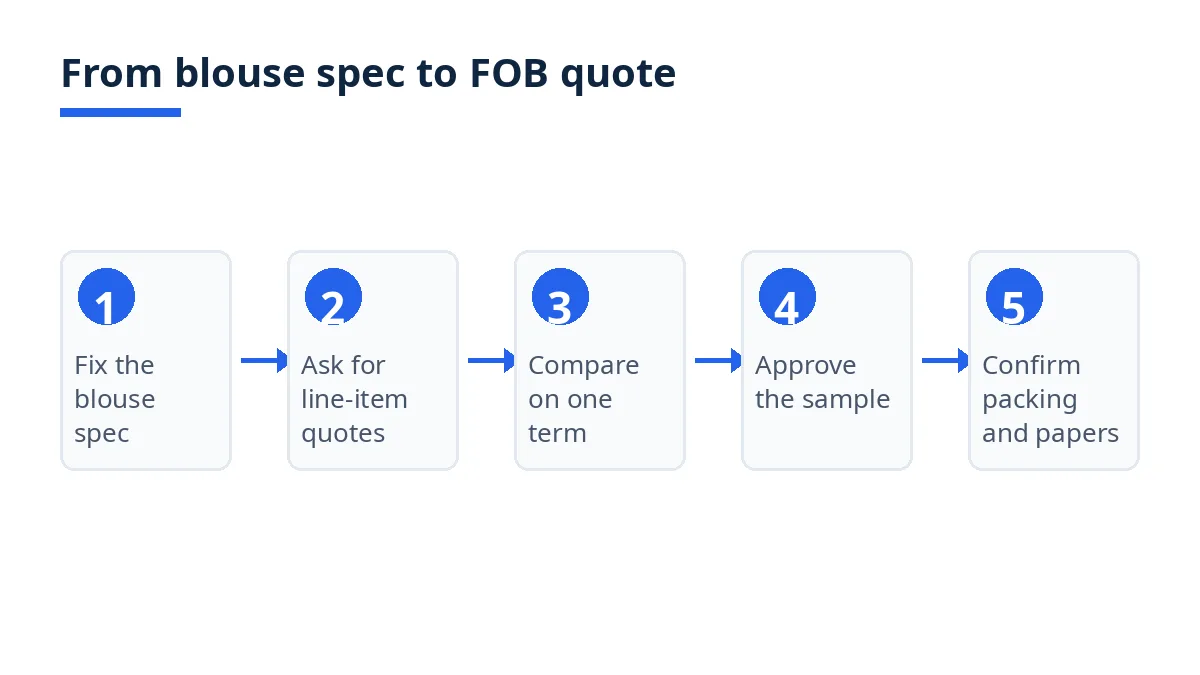
Fix the blouse specification. Send one tech pack to every candidate: fiber and weave, weight, drape requirement, neckline and sleeve drawings with facing and binding details, embellishment artwork with stitch count and placements, size chart with the quantity per size, trim and label list, wash standard, and packing method.
Ask for line-item quotes. Ask for fabric, cutting, sewing, embellishment, trims and labels, finishing and pressing, packing, and delivery to the vessel as separate lines, with consumption stated per size where it varies. A single total cannot be checked, and a line-item reply can.
Compare on one term. Compare replies only on the same specification, the same size split, and the same FOB port. A lower total on a simpler neckline, a plainer sleeve, or a different port is a different offer, not a better price.1
Approve the sample in writing. Order a proto sample, then a pre-production sample in the actual cloth, neckline, sleeve, embellishment, and labels. Measure it, wash it to the agreed standard, check the drape after washing, the neckline shape, sleeve movement, and embellishment hold, then approve or list corrections in writing.
Confirm packing and papers. Agree the fold and press standard, polybag and carton packing, pieces per carton, and carton marking, and confirm who prepares each export paper before the vessel date, so the FOB figure covers everything up to loading.1
Costs, timelines and documents
What are the typical costs and timelines?
There are no typical costs or timelines a guide can state as fact, because each factory prices your cloth, your sleeve and neckline work, your embellishment, your size split, your finishing, and your delivery term. Fabric usually takes the largest share of the cloth-and-sewing lines, but the sleeve and neckline decide sewing time, embellishment decides set-up and stitching time, and the size curve decides total cloth consumption. A quote that folds those lines into one total hides exactly the places where two suppliers differ.
Example figures: a blouse run of 1,000 pieces is split 250 pieces in a smaller size at 1.05 metres each, 500 pieces in a middle size at 1.15 metres each, and 250 pieces in a larger size at 1.30 metres each. Total cloth is 262.5 plus 575 plus 325, which is 1,162.5 metres, an average of 1.1625 metres per piece. Pricing the whole run on the middle size alone gives 1,150 metres and understates cloth by 12.5 metres. The example shows why the size split belongs in the quotation, not beside it.
Example figures: a fixed embellishment set-up of 400 currency units adds 0.80 per piece at 500 pieces and 0.20 per piece at 2,000 pieces. The set-up does not change with quantity, so the per-piece effect falls as the run grows. Ask for set-up as a separate line, and record which set-ups you have paid for, so a repeat order is not charged for them again.
For timelines, sampling depends on cloth availability and correction rounds, and bulk production depends on dyeing or printing, embellishment capacity, trim delivery, and line capacity. Ask for sampling, cloth ready, production, and inspection dates as separate lines, not a single delivery week, and agree what happens to the vessel date if a correction round is needed.
Which documents are needed?
The order papers are the tech pack, the itemized quotation, and the purchase order carrying the size split, the embellishment set-up lines, and the FOB port. For export clearance, the seller's approved Bill of Export carries the enclosed set that Bangladesh Customs specifies, so confirm who prepares each paper before the vessel date.5 Goods shall not be loaded for export unless the export declaration, known as the Bill of Export or Shipping Bill, is submitted to Customs and approved.5
Bangladesh-specific rules and tips
Confirm association claims at the source. If a supplier claims BGMEA membership, confirm it with the association itself. BGMEA represents the readymade garment industry including the woven sector, with around 60 percent of its member factories in woven garments,4 so membership signals an active woven business, not the price on offer or capacity for your blouse.
State fiber content for the destination market. Regulation (EU) No 1007/2011 covers textile fiber names and related labelling and marking of the fiber composition of textile products.6 Put the fiber composition from your tech pack onto the label artwork early, so the label run matches the cloth actually cut, and check the destination market's labelling rules before the label order is placed.
Keep one legal name across every paper. The export declaration names the exporter and the foreign buyer,5 so the name on the trade licence, quotation, proforma invoice, and payment account should match. A mismatch discovered at clearance costs days, not minutes.
Ask which inputs are bought in for your blouse. Buttons, lace, embroidery thread, and some cloths may be bought in for your specification, and a bought-in trim can set both the price and the earliest production date. Confirm trim availability in writing before you confirm the order, and agree the size ratio per colour before cutting starts.
Approve a washed sample for drape cloths. A fluid blouse cloth is judged after washing, not before. If the drape, the neckline shape, or the embellishment changes after the agreed wash, that discovery belongs in the sample stage, where the fix is a correction, not in bulk, where the fix is a claim.
Mistakes and red flags
What are the most common mistakes?
Comparing quotes on different blouses. A lower price on a plain sleeve, a bound neckline instead of a faced collar, or a smaller embroidery placement is a different garment. Compare only replies to the same tech pack, the same size split, and the same FOB port.1
Pricing on the middle size only. Consumption rises with size, so a run weighted toward larger sizes costs more cloth than the middle-size figure suggests. The size split is part of the price, not an accessory to it.
Approving an unwashed sample for a drape fabric. Drape, shrinkage, and embellishment hold show after washing. An unwashed approval transfers that risk to bulk, where it is yours.
Treating embellishment as free. Stitch count, placement count, thread type, and set-up all carry cost, and a second placement doubles placement work even when the artwork is small. Price embellishment per placement, with set-up apart.
A size split agreed in conversation is not an agreed size split. Have the quantity per size, the ratio per colour and any set-up lines written into the order documents, against the split they belong to.
Do not read a profile or a badge as proof of capacity. Treat a profile as the place enquiries start; the verification behind a badge is a document and photo review, not a factory visit, and it promises nothing about capacity, quality or delivery.
Checklist
Before you confirm, every line should be answered in writing.
Tech pack sent: fiber, weave, weight, drape, neckline, sleeve, embellishment, trims, labels, sizes, wash, packing.
Size split stated per size and per colour, with consumption per size where it varies.
Quotation itemized: fabric, cutting, sewing, embellishment set-up and stitching, trims, labels, finishing, packing, delivery to vessel.
Embellishment priced per placement, with set-up as a separate line and paid set-ups recorded.
Quotations compared on the same specification, size split, and FOB port.1
Pre-production sample measured, washed, and approved in writing, including drape, neckline, sleeve, and embellishment hold.
Packing agreed: fold and press standard, polybag, pieces per carton, carton marking.
Export papers assigned: who prepares each paper before the vessel date.5
Label artwork matches the tech pack fiber composition for the destination market.6
Inspection points agreed: neckline shape, sleeve setting, embellishment, pressing, and packing.
How Exportain helps
Put one blouse specification in front of every supplier: browse suppliers, post the tech pack summary, size split per colour, embellishment placements and delivery term as an RFQ on the RFQ board, and ask each reply for its FOB figure broken into lines.
Badges describe a check, not a promise: the check is a document and photo review,7 never a factory inspection. Before you lean on a badge, open how supplier verification works on Exportain; before you set a quantity, open the MOQ definition guide.
FAQs
What should I know first about women's blouses?
Know the four price drivers before the total: cloth and drape, sleeve and neckline construction, embellishment, and the size curve. Blouses in this guide are woven garments under heading 6206, which covers blouses, shirts and shirt-blouses, women's or girls', not knitted or crocheted.3 Fix those four inputs in a tech pack, and every quotation you receive answers the same blouse.
What are the typical costs and timelines?
There are no typical figures a buyer can rely on, because each factory prices your cloth, construction, embellishment, size split, finishing, and delivery term. Fabric, sewing time, embellishment set-up, and packing move the FOB figure, while cloth availability, correction rounds, and line capacity move the timeline. Ask for costs as lines and dates as separate stages, not as one total and one week.
Which documents are needed?
The order documents are the tech pack, the itemized quotation, and the purchase order with the size split and the FOB port. For export clearance, the seller's approved Bill of Export carries the enclosed set that Bangladesh Customs specifies.5 Confirm who prepares each paper before the vessel date, and keep one legal name across every paper.
What are the most common mistakes?
The most common mistakes are comparing quotes on different necklines, sleeves, or embellishment, pricing on the middle size only, approving an unwashed sample for a drape cloth, and reading a badge as a guarantee.8 Each mistake comes from deciding before the specification is fixed, so fix the blouse first and the price follows.
Next steps on Exportain
Before you post your specification, read the MOQ definition guide, then the blouse guides: women's blouses manufacturers in Bangladesh and wholesale women's blouses in Bangladesh.
Sources
- FOB & FAS Incoterms® 2020 explained: Key differences. ICC Academy (accessed )
- Incoterms® 2020. International Chamber of Commerce (ICC) (accessed )
- UNSD Classification Detail: HS Code 6206. United Nations Statistics Division (accessed )
- Bangladesh Garment Manufacturers and Exporters Association (BGMEA). Sidley Austin LLP (accessed )
- Customs Clearance Procedures for Export. Bangladesh Customs, National Board of Revenue (accessed )
- Regulation (EU) No 1007/2011 on textile fibre names and related labelling and marking of the fibre composition of textile products. European Union, (accessed )
- Supplier verification: Earn trust badges buyers can see. Exportain (accessed )
- Trust & Safety Center. Exportain (accessed )
About the author
Sourcing from Bangladesh?
Post a request for quotation and suppliers on Exportain can send you their quotes directly.
Post an RFQ


