

Women's Blouses Exporters in Bangladesh: Verified Supplier Checklist
A numbered checklist for women's blouses exporters in Bangladesh: fabric and drape, sleeve and neckline construction, embroidery and embellishment, size grading, wash and colour evidence, labels and packing, with fixes for common failures.
Short answer
Use this checklist to check a women's blouses exporter in Bangladesh before ordering: compare bulk cloth and drape with the approved sample, measure neckline, shoulder, sleeve and grading across all sizes, pull-test embroidery and embellishment, review wash and colour evidence, confirm maker identity and capacity, and agree acceptance numbers in the purchase order.
On this page
Key takeaways
Agree the sample, tolerances, test methods and acceptance numbers before inspection, and draw the sample at random across sizes, colours and cartons.
Check drape, neckline, shoulder and sleeve hang on a form, not only flat measurements, since a blouse that measures correctly flat can still sit badly when worn.
Pull-test embroidery and embellishment and check shade under one light, because loose surface work and dye-lot changes show plainly on light blouse cloth.
Check grading steps and form fit at the smallest, middle and largest sizes, so the larger sizes keep the sample proportions instead of only widening.
A blouse order fails in places a general garment check misses: a neckline that pulls off the shoulder, a sleeve that twists after washing, embroidery that frays at the edge, or a size run where the larger sizes lose the shape of the sample. This checklist is for buyers placing women's blouses with exporters in Bangladesh, and it puts those blouse-specific checks first, before papers, packing and terms. Work through it against an approved sample and a signed size chart.
Why this checklist matters
Blouses combine a fitted upper body with visible detail work, so small errors show on the wearer at once. The shoulder line, neckline depth, armhole shape and sleeve hang depend on pattern accuracy and careful sewing, and a blouse that measures correctly flat can still sit badly once worn. A change of cloth weight or finish changes how the blouse moves.
Detail work adds a second layer of risk. Embroidery, sequins, lace inserts, pintucks and covered buttons are each a point where thread, placement or finishing can fail, and one uncorrected fault repeats across an order in several colours and a full size range. A checklist applied to samples from different sizes and colours catches those faults while correction is still possible.
Before you start
Do not start until the reference set is complete: an approved sample per style and colour, the purchase order, the size chart with tolerances, the fabric and trim specification, and the packing specification. Agree the sampling plan first. ISO 2859-1 specifies an acceptance sampling system for inspection by attributes, indexed by the acceptance quality limit (AQL), for lot-by-lot inspection.1 Draw the sample at random across sizes, colours and cartons, never from pieces the factory selects, and agree acceptance numbers per defect class in the purchase order.
Check the label plan before bulk labels are printed. Under Regulation (EU) No 1007/2011, a textile product shall be labelled with the name and percentage by weight of all constituent fibres in descending order.2 ISO 3758 establishes a system of graphic symbols for care labelling, based on the most severe treatments that do not cause irreversible damage during care.3 Confirm which market each batch serves, since label wording and care symbols follow the destination market, not the factory default.
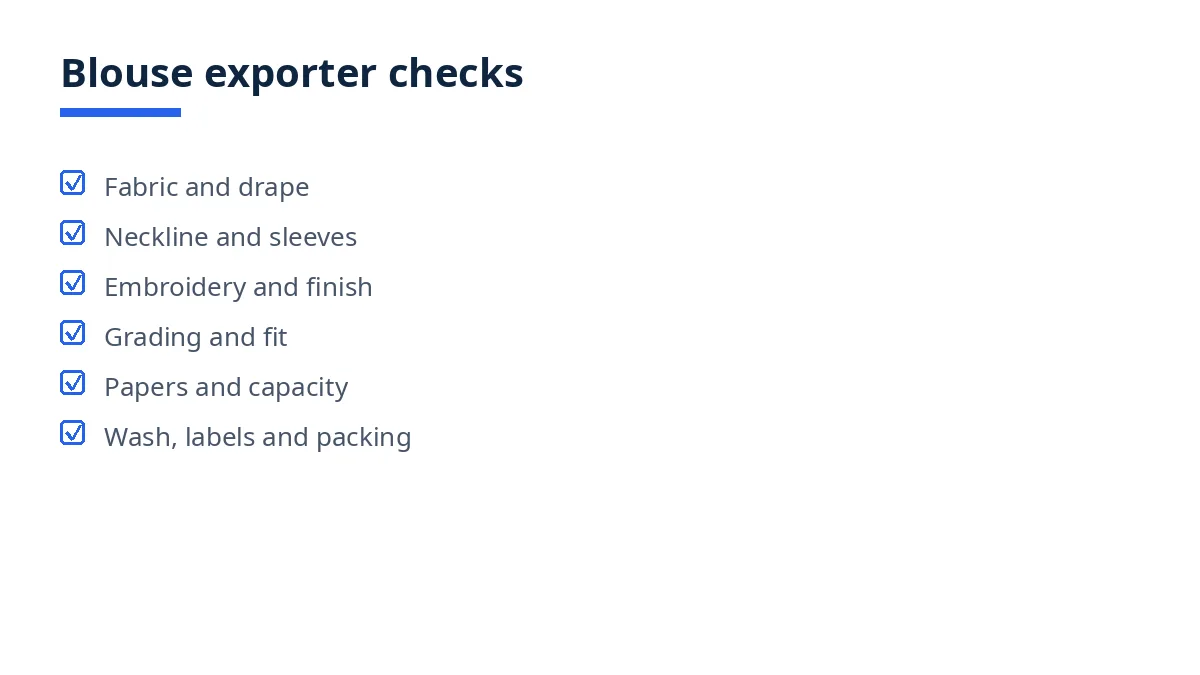
The full checklist (numbered, printable)
A. Blouse fabric, drape and cut
Compare bulk cloth with the sample for fibre, weave, weight, hand feel and finish; record any substitution as a failure.
Hang a finished blouse beside the sample and compare drape through body and sleeves.
Check the cut on the straight grain through front, back and sleeves, watching for twisted seams or rotating sleeves.
Check pattern matching where required, such as stripes or prints meeting at centre front, side seams and sleeve joins.
Check hem and facing edges for even width, flat pressing and secure finishing, with no waviness or raw edges on the face.
Check linings, where specified, against the sample in cloth and colour, and confirm they do not pull the outer cloth.
B. Sleeve, neckline and closure construction
Check neckline shape and depth against the sample and chart on every size sampled, and confirm the facing lies flat without gaping.
Check shoulder seam position and slope, and confirm both shoulders sit evenly when the blouse is hung.
Check armhole shape and sleeve setting: the sleeve head sits smoothly, with no puckering at the cap and no skipped underarm stitches.
Check each sleeve type separately, whether set-in, raglan, puff, cap or three-quarter, for length, cuff width and hang.
Check cuffs, sleeve hems and elastic or buttoned finishes for even width, secure stitching and consistent tension.
Check every closure: centred buttons, cleanly finished buttonholes, smooth zips, and hooks or ties that hold under a firm hand pull.
Check the placket for straightness, even overlap and correct button spacing from neckline to hem, comparing smallest and largest sizes.
C. Embroidery, embellishment and surface finish
Check embroidery against the approved artwork for design, thread colours, stitch density and placement, and confirm backing is trimmed.
Check sequins, beads, lace and applique for secure attachment by gently pull-testing a sample area, with no loose pieces or sharp edges.
Check pintucks, pleats, smocking and gathers for even depth, spacing and direction, matching left and right sides.
Check the whole surface panel by panel for holes, slubs, stains, oil marks, snags and broken yarns, including under collars and inside cuffs.
Check shade within each blouse, between blouses in one colour, and across the colour range, under one light against the approved lab dip.
D. Size grading and fit across the range
Measure length, chest, waist, shoulder, sleeve length and neckline depth in every size, recording actual values against chart tolerances.
Check grading steps stay consistent between consecutive sizes at chest, waist and sleeve, so larger sizes keep the sample proportions.
Fit sampled blouses in the smallest, middle and largest sizes on a form of the named size, checking shoulder, armhole, bust, waist and sleeve hang.
Check darts, princess seams and bust shaping sit at the same relative points across sizes and do not flatten on larger sizes.
Check size labels against measured pieces, confirming each label matches the size, style and colour it is sewn into.
E. Maker identity, papers and capacity
Confirm the legal identity of the party you contract with, including trade licence, tax registration and export registration, and that the document address matches the factory.
Confirm association membership claimed by the maker against the issuing body. BGMEA has reported new membership criteria under which a woven garment factory must have at least 100 machines and at least 15,000 square feet of floor space.4
Confirm who actually makes the blouses, which stages are subcontracted, and where embroidery, washing or embellishment work is done.
Confirm capacity against your order: woven blouse lines, pattern and sample room capability, embroidery arrangements, and workload during your window.
Ask for references from buyers of comparable woven tops, and follow up one about delivery and rework.
F. Wash, colour, care and labels
Review dimensional change evidence where required, for length, chest and sleeve length. ISO 5077 specifies a method for determining the dimensional change of fabrics, garments or other textile articles in specified washing and drying procedures.5
Review colour fastness evidence for washing where required, particularly for dark and bright colours. ISO 105-C06 specifies methods for determining the resistance of textile colour to domestic or commercial laundering using a reference detergent.6
Check care labels against wash evidence and approved wording, using the symbol system in ISO 3758,3 and confirm fibre wording follows Regulation (EU) No 1007/2011 for EU-bound goods.2
Check brand, size, origin and care labels are present, legible, correctly positioned and securely attached, and barcode stickers scan and match the order.
G. Packing, terms and acceptance
Confirm each blouse is folded, bagged and packed as directed, and that sizes, colours and ratios per carton match the packing list.
Weigh and measure sample cartons, check markings and counts against the packing list, and confirm no hard insert creases cloth or crushes embellishment.
Agree payment, delivery and inspection terms in writing, including who handles export clearance, and record acceptance numbers and rework rules for a failed lot.
Agree the acceptance decision in advance: re-inspection after sorting or rework, documented partial acceptance, or rejection.
Common failures and how to fix them
The most frequent blouse failure is a neckline or sleeve that looks right flat but sits wrong when worn, usually because the pattern was graded by widening alone or the sleeve was set under uneven tension. Stop, fit the middle and largest sizes on a form, compare them with the sample, and correct the pattern before more pieces are sewn. Next is embellishment failure: embroidery that frays, sequins that shed, or lace that pulls away. These trace to thread choice, stitch density or backing, so rework a test piece and pull-test it before the bulk is embellished.
Shade differences across a colour run point to more than one dye lot: re-sort colour sets before packing. Grading faults show as a size run that loses the sample shape at the top end: re-measure every size and re-cut the affected sizes. Wavy hems and puckered seams usually start at sewing tension or uneven feeding: re-sew test pieces before the bulk is finished.
Downloadable template / summary table
Use the checklist as the spine of your inspection sheet: each blouse you examine gets its own row, with the agreed tolerances and acceptance numbers written in before you start scoring.
Section | Checks | Evidence |
|---|---|---|
Fabric, drape, cut | Cloth, drape, grain, match, hems | Sample, hang check |
Sleeve, neckline, closures | Neckline, shoulders, sleeves, placket | Measurements, fit check |
Embroidery, finish | Artwork, attachment, pleats, shade | Pull tests, panel check |
Grading, fit | All sizes, grading steps, form fit | Measurements, fit check |
Maker, capacity | Identity, membership, subcontracting | Documents, references |
Wash, colour, labels | Dimensional change, fastness, care | Lab reports, label check |
Packing, terms | Folding, ratios, cartons, acceptance | Packing list, terms |
How Exportain helps
On Exportain, shortlist from suppliers and send the checklist with your enquiry through RFQs; the verification record behind each profile is explained in how supplier verification works on Exportain.
FAQs
When should this checklist be used?
Use it at final inspection, when blouses are finished and packed. For first and larger orders, also use it during production, while faults can still be corrected.
Who should complete it?
The check works whoever runs it — buyer, local agent or independent inspector — as long as every candidate is judged against the same blouse sample, size chart and random draw across sizes and colours.
What are the most common failures?
A gaping neckline, a twisting sleeve, loose embellishment, shade differences across a colour run, and a size range that loses the sample shape at larger sizes are the failures buyers find most often.
Can a third party do it?
Yes, if you share the approved sample, size chart, tolerances and acceptance levels first, and confirm the inspector will check fit on a form, not only flat measurements.
Next steps on Exportain
Before ordering, agree your size chart, tolerances, test methods and label wording, then read the women's blouses manufacturers in Bangladesh guide and the wholesale women's blouses in Bangladesh guide, and post a free RFQ via RFQs to compare quotes from Bangladeshi suppliers.
Sources
- ISO 2859-1:1999 - Sampling procedures for inspection by attributes — Part 1: Sampling schemes indexed by acceptance quality limit (AQL) for lot-by-lot inspection. International Organization for Standardization (accessed )
- Regulation (EU) No 1007/2011 on textile fibre names and related labelling and marking of the fibre composition of textile products. European Union, (accessed )
- ISO 3758:2023 - Textiles — Care labelling code using symbols. International Organization for Standardization (accessed )
- BGMEA sets new membership criteria to ensure factory safety, operational standards. The Financial Express, (accessed )
- ISO 5077:2007 - Textiles — Determination of dimensional change in washing and drying. International Organization for Standardization (accessed )
- ISO 105-C06:2010 Textiles — Tests for colour fastness — Part C06: Colour fastness to domestic and commercial laundering. International Organization for Standardization, (accessed )
About the author
Sourcing from Bangladesh?
Post a request for quotation and suppliers on Exportain can send you their quotes directly.
Post an RFQ


