

Wholesale Terry Bathrobes From Bangladesh: Prices, MOQ and Reliable Suppliers
Wholesale terry bathrobes from Bangladesh, bought as a sized garment range: the size curve, per-line minimums, solid and assorted packs, and replenishment by size that keep every size in stock.
Short answer
Wholesale terry bathrobes from Bangladesh are bought as a sized garment range, not as bulk cloth: the order is agreed per line, meaning per style, size and colour, with a size curve that states how many of each size ship. Agree the curve, the per-line minimums, solid or assorted packs, and replenishment by size before bulk, sample the smallest and largest sizes, and check the shipment carton by carton against the size and colour split.

On this page
Key takeaways
A wholesale bathrobe order is a garment range agreed per line, per style, size and colour, and the size curve, not the total quantity, decides whether the range stays sellable.
Agree per-line minimums and pack types in writing: solid packs hold one size per carton, assorted packs carry a fixed size ratio, and slow sizes need an owner.
Sample the smallest and largest sizes, not only the middle size, and check belt, sleeve and pocket measurements on each sampled size.
Cost follows terry weight, collar construction, colour count, size count, logo work, pack type and delivery term, and timelines run in stages from sample approval to shipment.
A bathrobe is a garment for classification, coded separately from towels and terry fabric, and labels must carry fibre, origin and care information for each destination market.
A wholesale terry bathrobe order is a garment order, not a towel order. The buyer is buying finished garments in sizes, colours and collar styles, not metres of terry cloth or a stack of identical flat pieces. The unit that decides whether the range works is the size curve: how many of each size, in each colour, in each style.
That changes what a good order looks like. A robe range that sells out in medium and large while small and extra-large sit in the warehouse is a broken range, even when the total quantity sold looks healthy. A customer who cannot find their size does not wait for the next bulk shipment; they buy a different range. Wholesale terms for bathrobes therefore have to be agreed per line, meaning per style, per size and per colour, and not as one total quantity with the split left to sort out later.
This guide covers that wholesale channel only: buying finished terry bathrobes from Bangladesh for resale or onward supply, with the size curve, the pack plan and replenishment by size at the centre. It is not a guide to weaving terry fabric or to specifying a single hotel opening. Companion guides linked at the end cover the import sequence, the classification detail and the quality checks that sit alongside this buying work.
Why this matters for buyers and sellers
For a retailer or distributor, the size curve is the range. A shop, a catalogue listing or a hotel supply contract needs every size available at the same time, because a gap in one size is a gap in the range. Replenishment keeps the range alive between bulk orders: the sizes that sell fastest need topping up first, and a rule agreed in advance stops a fast seller from going out of stock while slow sizes accumulate.
For a hotel or spa buyer, the same logic applies to guests rather than shoppers. Guests come in different sizes, and a robe stock that only fits the middle of the range leaves some guests without a usable robe. Such a buyer also needs a replacement rule by size, since robes wear out unevenly and the most-used sizes need replacing first.
For a seller, the size curve explains the minimums. Each size needs its own cutting marker, each colour needs its own dye lot, and each garment carries belt, loops and pocket work that flat linen does not. A curve with many sizes and colours fragments production into small runs, which is why a supplier sets minimums per line rather than on the order total.
Step-by-step: how it works
Work in this order, because each approval locks a decision the next stage depends on.
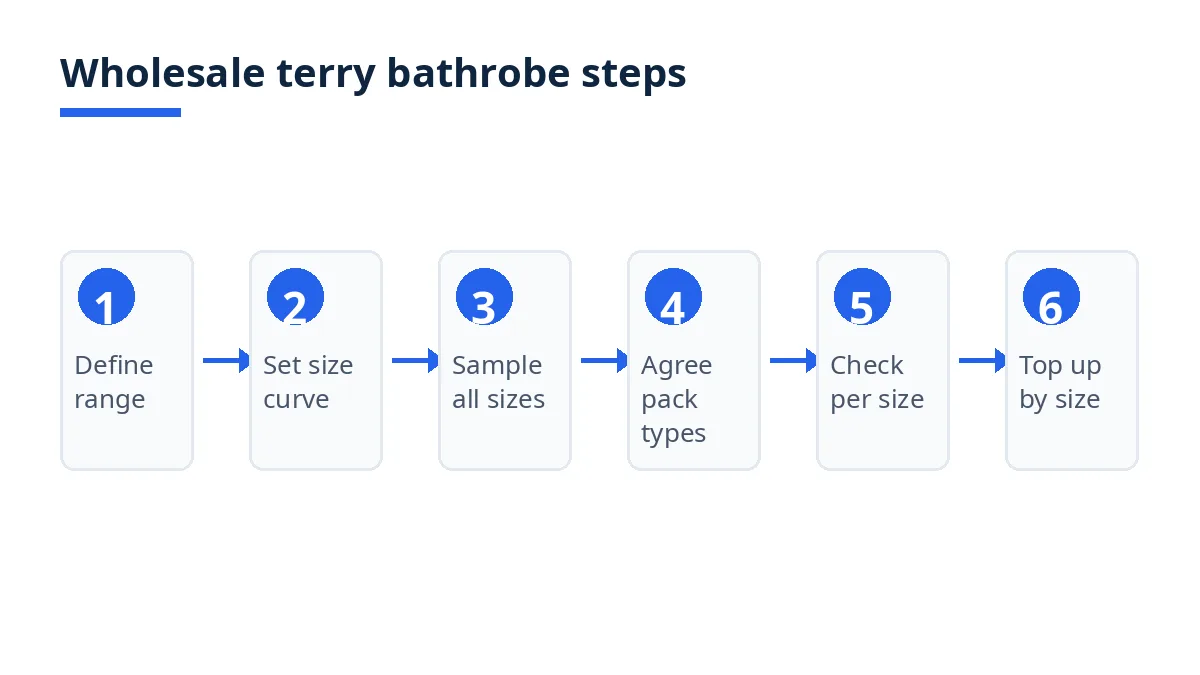
Define the assortment. Name each style, such as shawl collar, kimono or hooded, each size, each colour, the terry weight band, and the details that differ by style: belt, loops, pockets and collar construction. Keep the opening core small, since every extra style, size or colour adds a line to price and check.
Set the size curve. Turn the expected share per size, from past sales or the customer profile, into quantities per size per colour. A curve stated as shares only is not an order; a curve stated as pieces per line is.
Agree per-line minimums and pack types. Ask for the minimum per style, per size and per colour, and agree whether cartons ship as solid packs, with one size per carton, or assorted packs, with a fixed size ratio inside each carton. Record who carries the slow sizes when a ratio leaves some sizes behind.
Sample every size that matters. Approve fit on the smallest and the largest sizes, not only on a middle size, and check belt length, sleeve length and pocket placement on each sampled size.
Confirm labels and packs before bulk. Settle fibre wording, size marking, care instructions and origin marking for each destination market before labels are printed, and confirm that each carton is marked with its size and colour split.
Check the shipment per size. Count cartons against the size and colour split, measure a sample from more than one size, and check shade within each colour lot. A total piece count that matches the order can still hide a missing size.
Replenish by size. Set a reorder trigger per size, not only for the range as a whole, and reorder the sizes that sold. Keep the approved sample, shade reference and size measurements on file so a repeat delivery matches the first.
Costs, timelines and documents
What sets the cost and the timeline
There is no typical wholesale terry bathrobe cost, because the cost follows the assortment, not the product name. Terry weight is one driver, and so are collar construction, belt and pocket work, logo or embroidery work, the number of colours, the number of sizes, the pack type, and the delivery term. The Incoterms 2020 rules set out 11 rules with a clear allocation of cost, risk and obligations.1 Compare quotations only on the same delivery term and the same size curve, since a cheaper quotation for a narrower curve or a different term is not a cheaper range.
Example figures, showing structure only and not market rates: an assortment of 3 colours in 4 sizes, at an example per-line figure of 100 pieces, totals 1,200 pieces. Add one colour at the same example per-line figure and the total rises by 400 pieces. The example shows why the per-line figure, not the total, is the number to negotiate. All figures in this guide are labelled example figures of this kind, and none is presented as a market rate.
Timelines run in stages, not as a single delivery week. Ask for separate dates for assortment approval, sample approval across sizes, bulk production, per-size checking, and shipment. A date for bulk production alone says nothing about when samples will be approved or when the shipment can be checked.
Which documents sit in the order file
The order file is the assortment sheet, the size curve with pieces per line, the pack plan, the per-line minimums, the label proofs, the itemised quotation and the purchase order, with the delivery term on both the quotation and the order. The packing list deserves special attention in a garment order: it must break the shipment down by size and colour, because a packing list that states only a total cannot be checked against the curve on arrival.
The export set is separate. Goods may not be loaded for export unless an export declaration, the Bill of Export or Shipping Bill, is submitted to Customs and approved, and the enclosed documents include the export contract or purchase order where there is no export letter of credit, the commercial invoice, the packing list, the EXP form certified by an authorized dealer, and a certificate of origin issued by the EPB or a Chamber of Commerce and Industry.2
Bangladesh-specific rules and tips
Code the garment, not the towel. A bathrobe is a garment for classification, and it is coded differently from towels and from terry fabric. Women's or girls' bathrobes sit under heading 6208, which covers singlets and other vests, slips, petticoats, briefs, panties, nightdresses, pyjamas, negligees, bathrobes, dressing gowns and similar articles.3 Men's or boys' bathrobes sit under the corresponding heading 6207, which lists bathrobes and dressing gowns alongside singlets, nightshirts and pyjamas.4 Terry towelling fabric itself sits under heading 5802, while toilet linen and kitchen linen of terry towelling sit under heading 6302.4 A robe order must therefore never be coded as towels: confirm the full code per style, gender and fibre with the broker or forwarder before the export set is filed. See the HS code for terry bathrobes guide for the classification detail.
Settle labelling law for each market before artwork. In the EU, Regulation (EU) No 1007/2011 states that a textile product shall be labelled or marked with the name and percentage by weight of all constituent fibres in descending order.5 In the USA, federal law requires that most textile and wool products have a label that lists the fibre content, the country of origin, and the identity of the manufacturer or another business responsible for marketing or handling the product, and under the Care Labeling Rule, manufacturers and importers must provide cleaning instructions.6 Size marking, care symbols and origin marking sit alongside fibre wording, so approve the physical label for each market before bulk, and confirm the position for each market and use rather than assuming one label fits all.
Use the companion guides for the steps around the curve. The how to import terry bathrobes from Bangladesh guide covers the import sequence, and the terry bathrobes quality control checklist covers the piece-level checks that complement the per-size checks here.
Mistakes and red flags
Which mistakes repeat most often
Approving one middle size only. A middle size that fits well says little about the smallest and largest sizes, where belt length, sleeve length and pocket placement are most likely to drift. Sample the ends of the curve, not just the centre.
Agreeing a total quantity with no per-line split. A total without a curve lets each side assume a different split, and the difference surfaces at packing, when one size is short and another is over. The curve belongs in the purchase order, not in a later message.
Accepting assorted packs without knowing the ratio. An assorted pack with an unstated ratio is a curve the buyer did not choose. Ask for the ratio inside the carton, and check it on arrival, before the range is unpacked and mixed.
Judging a repeat shade from a photograph. Shade is judged against the sealed reference from the first delivery, under consistent light, not against a screen image. A repeat order that changes shade without a new approval breaks the range even when every size is right.
Treating a profile or a badge as a capacity promise. Exportain verification is a document and photo review, not a factory inspection, and a badge is not a guarantee of capacity, quality or delivery.7 The protection for a size curve is the written curve, the per-line minimums, the sample approvals and the per-size check.
Red flags in a supplier reply. A reply that will not state per-line minimums, pack ratios, size measurements, or replenishment terms for the same curve is a reply to pause on. So is a reply that quotes a total price without a size curve, since the price cannot be compared until the curve behind it is known.
Checklist
Before you confirm a wholesale terry bathrobe order, every line should be answered in writing.
Assortment sheet written: styles, collar types, sizes, colours, terry weight band, belt, loop and pocket details.
Size curve stated as pieces per line, per style, per size and per colour, not as shares or a total alone.
Per-line minimums agreed per style, per size and per colour, with slow sizes assigned an owner.
Pack plan fixed: solid packs or assorted packs, with the assorted ratio stated per carton.
Samples approved on the smallest and largest sizes, with belt, sleeve and pocket measurements recorded.
Label proofs approved physically per market: fibre wording, size marking, care instructions, origin marking.5 6
Delivery term stated once, on every quotation, compared on the same term.1
Packing list agreed by size and colour, so arrival checks can follow the curve.
Export set agreed: invoice, packing list, EXP form, certificate of origin, Bill of Export.2
Classification confirmed per style, gender and fibre before the export set is filed.3 4
Pre-shipment check agreed per size: carton counts by size and colour, measurements across sizes, shade per colour lot.
Replenishment triggers set per size, with the approved sample, shade reference and measurements kept on file.
How Exportain helps
On Exportain, browse suppliers and post a request for quotation (RFQ) on the RFQ board with your assortment sheet, your size curve in pieces per line, your pack plan and your delivery term, so suppliers quote the same curve on the same terms. Ask each reply for its per-line minimums, its pack ratios, its size measurements by size, and its replenishment terms for the same curve.
Read the badges for what they record. Exportain Verified means Exportain has checked identity, phone, email and business registration, and Export Verified means it has checked the Export Registration Certificate (ERC).7 Factory Verified means it has reviewed photos of the manufacturer factory, while Trading Company Verified means it has reviewed photos of the trading company office or warehouse.7 Verification is a document review by staff, free, and never granted by membership plans.8 It is not a factory inspection,7 8 so curve, sample and inspection decisions stay with you. See how supplier verification works on Exportain.
FAQs
What should I know first about terry bathrobes?
Know first that a terry bathrobe is a sized garment, not a bulk textile. The buying unit is the size curve: the styles, sizes and colours in the range, stated as pieces per line. Before price or delivery terms are compared, the curve, the per-line minimums and the pack plan need to be fixed, because every later decision follows from them.
What are the typical costs and timelines?
There are no typical figures a buyer can rely on, because each supplier prices the assortment, the size curve, the colour count, the logo work, the pack plan and the delivery term for that order.1 Costs and timelines should be given in stages, each with its own date. Example figures in this guide show structure only and are not market rates.
Which documents are needed?
The order documents are the assortment sheet, the size curve with pieces per line, the pack plan, the per-line minimums, the label proofs, the itemised quotation and the purchase order. The export set is the Bill of Export, the commercial invoice, the packing list broken down by size and colour, the EXP form certified by an authorized dealer, and a certificate of origin issued by the EPB or a Chamber of Commerce and Industry.2
What are the most common mistakes?
The most common mistakes are approving a middle size only, agreeing a total quantity with no per-line split, accepting assorted packs without knowing the ratio inside, judging a repeat shade from a photograph, and reading a badge as a capacity promise. A further mistake is comparing quotations that sit on different curves or different delivery terms, since the comparison is meaningless until the curve and the term match.1
Next steps on Exportain
Browse suppliers, then post your assortment sheet, your size curve in pieces per line and your delivery term on the RFQ board so suppliers quote the same curve on the same terms. Before you confirm, read the MOQ guide for the minimum-order mechanics that sit behind the per-line figures in this guide.
Sources
- Incoterms® 2020. International Chamber of Commerce (ICC) (accessed )
- Customs Clearance Procedures for Export. Bangladesh Customs, National Board of Revenue (accessed )
- HS Code 6208 — Women's or girls' bathrobes, dressing gowns and similar articles. Tariffnumber (accessed )
- Terry Towellings HSN Code used for Export Import. Volza (accessed )
- Regulation (EU) No 1007/2011 on textile fibre names and related labelling and marking of the fibre composition of textile products. European Union, (accessed )
- Textile, Wool, Fur, Apparel and Leather Matters. Federal Trade Commission (accessed )
- Trust & Safety Center. Exportain (accessed )
- Supplier verification: Earn trust badges buyers can see. Exportain (accessed )
About the author
Sourcing from Bangladesh?
Post a request for quotation and suppliers on Exportain can send you their quotes directly.
Post an RFQ


