Wholesale Tank Tops From Bangladesh: Prices, MOQ and Reliable Suppliers
No single wholesale tank top price or MOQ in Bangladesh: this guide covers the fabric families and weights, cut and print minimums, athletic and casual segments, and carton assortments that decide what a factory can quote.
Short answer
There is no single wholesale tank top price or MOQ in Bangladesh. Each factory sets its price and minimum per style, per colour and per print for your specification, driven by fabric family and dye lot, neckline and armhole cut, binding, print route and carton assortment. State the segment, fabric and cut in one tech pack, ask for every minimum in writing, and compare quotations only on the same specification and delivery term.
On this page
Key takeaways
There is no single wholesale tank top price or MOQ in Bangladesh: each factory sets its price and minimum per style, per colour and per print for your specification.
Segment first: athletic tanks need stretch, recovery and ventilation, while casual tanks are judged on drape, hand and wash appearance.
Fabric family, cut and edge finish decide the quote: cotton jersey, cotton-elastane rib, slub jersey and polyester-elastane performance blends each carry different dye and print routes.
State the carton assortment in the order: solid-colour, pre-pack or assorted cartons, with pieces per carton and the size ratio inside each carton.
Exportain verification is a document and photo review, not a factory inspection, and a badge is not a guarantee of capacity, quality or delivery.
A wholesale tank top order is decided before any factory names a unit price. The buyer first settles where the tanks will sell, because fitness-studio, fashion and team-kit ranges take different size curves, fabrics and carton plans, even when the garment looks similar on a hanger. A style that moves in small sizes through gym retail can stall in larger sizes through fashion retail, and a carton packed for one channel may need resorting for another.
That ordering matters more for tanks than for sleeved knits because so little fabric hides a poor decision. The neckline, the armhole and the strap carry the fit, and the edge finish carries the appearance after washing. A factory can quote a low figure for a plain body and still miss the strap width, binding shade or size curve that makes the range sellable. What follows therefore starts with channel and assortment, then fabric, cut and print, then quotations, samples and shipment papers.
Why this matters for buyers and sellers
For a buyer, the size curve is the commercial core of a tank program. Fitness retail tends to concentrate in middle sizes with repeat demand in a few core colors, fashion retail spreads wider across sizes and colors with shorter runs per color, and team or promotional orders concentrate in a narrow size band for a single event or season. Each pattern changes the carton plan: replenishment favors solid-color cartons in a full size range, store drops favor pre-packs in a fixed ratio, and a launch range favors mixed-color cartons. When the curve is settled late, bulk arrives in cartons the receiving warehouse cannot put away without breaking and rebuilding them, and the cost of that rework lands on the buyer.
For a seller, the tank's small panels change the economics of a short run. Cutting a racerback or a dropped armhole wastes more cloth around curves than cutting a straight tee body, and binding those curves adds a separate sewing pass plus shade matching between body and binding. A short run still needs its own marker, dye lot per color, screens per artwork and binding sets, so setup cost spreads across fewer pieces. That is why a factory's answer often splits: the garment minimum, the color minimum and the print minimum are separate lines, and the binding line can bind before any of them.
Segment sharpens both sides of that bargain. Athletic tanks live or die on stretch recovery, ventilation and seam comfort during movement, so mesh panels, flatlock seams and polyester-elastane blends enter the specification early. Casual tanks live or die on drape, hand feel and appearance after repeated washing, so cotton jersey, slub texture and garment dye enter instead. A single enquiry that asks for "tank tops" without naming the segment invites quotations for different garments, and the cheapest reply usually describes the simplest one.
Step-by-step: how it works
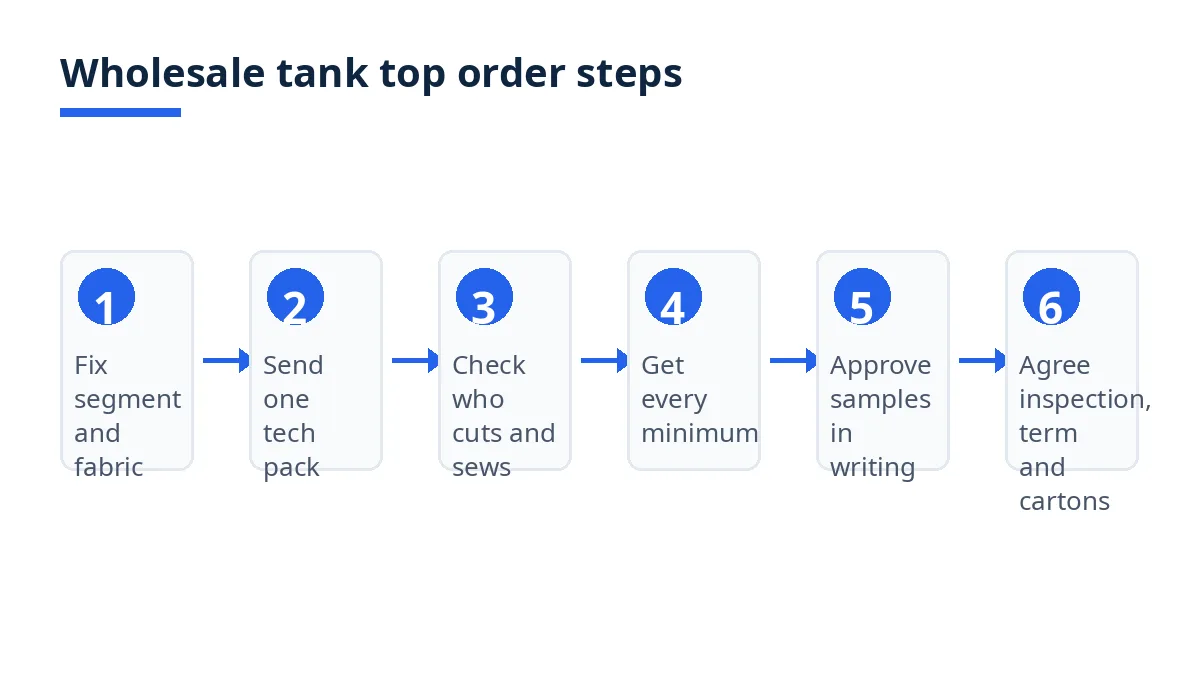
Settle channel, segment and assortment shape first. Name the sales channel, the end use and the wearer, then fix the size curve for each color and the carton type that channel can receive. This decision fixes how many pieces each size and color must carry before fabric is discussed.
Lock the fabric family, weight and color route. State fiber composition, knit construction and weight in grams per square meter, and state whether each color is piece-dyed, garment-dyed or printed. Match the print route to the fiber: screen printing suits cotton-rich cloth, while sublimation suits synthetic-rich cloth, and each route brings its own minimum.
Specify cut, straps and edge finish in drawings, not adjectives. Give neckline shape, armhole depth, strap width, body length and hem shape for every style, plus the measurement chart for every size. State whether necklines and armholes take self-fabric binding, contrast binding or a ribbed band, because each finish changes the sewing plan and the shade risk.
Send one pack to every candidate and collect minimums line by line. Include the segment, fabric, cut, artwork size and placement, label wording, split by style, color and size, and carton plan. Ask for the minimum per style, per color and dye lot, per print design and color, and per binding, label, tag and carton run, and ask which line binds for the split offered. Record whether the company sews in its own plant or places work elsewhere, with legal name and trade license checked against the quotation.
Approve samples in stages, washed and stretched. Check a proto sample for cut and fit, then a pre-production sample in the actual fabric, color, binding and artwork, packed as bulk will be packed. Measure it, wash it, stretch and release the neckline and armholes, and confirm the result in writing or list corrections in writing.
Write inspection, delivery term and cartons into the purchase order. Put inspection level and acceptance values in the order, state one delivery term with a named place per quotation, and write carton type, pieces per carton and size ratio into the same order.
Costs, timelines and documents
Price drivers
No guide can state a wholesale tank top price as fact, because each factory prices the specification in front of it. The table below names the lines that move a quotation and the detail to put in the enquiry for each one.
Driver | What changes the quotation | Put in the enquiry |
|---|---|---|
Channel and size curve | Size range width, ratio per size, carton type | Channel, size curve, carton plan |
Fabric family and weight | Fiber, construction, weight, dye lot per color | Composition, construction, weight, dye route |
Cut and edge finish | Neckline and armhole shape, binding or rib, strap width | Cut drawings, finish, strap and body measurements |
Print route | Screens per artwork color, or sublimation for synthetics | Method, size, placement, colors in the artwork |
Carton assortment | Solid, pre-pack or mixed cartons, pieces per carton | Pieces per carton, ratio, carton type |
Delivery term | Point where cost and risk pass to the buyer | One term and named place1 |
Example figures: a buyer plans 120 pre-pack cartons in a four-size ratio of 2-3-3-2 across sizes S, M, L and XL, which is 10 pieces per carton and 1,200 pieces in total. That split yields 240 pieces in S, 360 in M, 360 in L and 240 in XL. If the buyer's stores actually sell in a ratio closer to 1-2-3-3, the same 1,200 pieces leave the buyer short in XL and long in S, even though the total quantity is unchanged. The example shows assortment structure only, not a typical quantity, price or lead time.
Timelines split the same way. Ask for separate dates for sampling, fabric readiness, dye or print approval, binding shade approval, production, inspection and shipment, rather than one delivery week. Dye and binding-shade approval slip most often, because curved binding shows a shade gap plainly and washing can move body and binding apart.
Documents for the order
Let the purchase order carry the controlling figures, rather than leaving them in messages: the minimums for style, color and print, the inspection level with its acceptance values, and the carton plan. The quotation that precedes it should itemize those same lines, and the pack behind both should define fabric, cut and artwork, so the three papers describe a single order.2
For shipment, confirm the export filing set with the forwarder before the goods move: the filing itself, the commercial invoice, the packing list with carton counts, the EXP form certified by an authorized dealer and a certificate of origin, checked so that names, quantities, values and carton counts agree across invoice, packing list and purchase order.3 A carton-count mismatch between packing list and purchase order is a tank-specific risk, since assortment cartons count by ratio as well as by total.
Bangladesh-specific rules and tips
Start tank checks with the parts that fail first. Approve binding shade on a washed pre-production garment under consistent light, not on a flat swatch, because narrow binding sewn on a curve exposes shade difference that a flat panel hides. Grade the racerback and the dropped armhole across the full size range, not only in the middle size, because strap width and armhole depth behave differently at the ends of the range. Where an athletic style uses mesh panels, fix panel positions in the tech pack and check them on the pre-production sample.
Depth in this category comes from a knitwear base of scale. About 2,540 factories belong to the Bangladesh Knitwear Manufacturers and Exporters Association (BKMEA), a trade body founded in 1996.4 For July to September 2026, the Export Promotion Bureau reported knitwear shipments of $5.963 billion, up 6.88 percent on the year before, inside $10.578 billion of ready-made garment exports.5 A factory that cites membership should still be checked with the association directly, and even a confirmed membership proves only that the firm trades in knitwear, not that it cuts racerbacks cleanly, binds evenly or prints durably.
Two classification and labeling points belong in the tech pack before bulk cutting. Knitted tank tops fall under Harmonized System heading 6109, which covers T-shirts, singlets and other vests, knitted or crocheted, with subheadings divided by fiber, including cotton and other textile materials.6 Confirm the full national code for the exact fiber mix before duty is calculated. For sales into the European Union, Regulation (EU) No 1007/2011 requires the label to carry the name and percentage by weight of every constituent fiber in descending order.7 Elastane in rib, binding or a performance blend counts toward that list, so every component fiber belongs in the tech pack and label wording.
Mistakes and red flags
Buying the size curve last. A program approved on total pieces alone can still fail in stores when the ratio inside each carton misses the channel's demand. Fix the curve and the carton type before the quotation, and write both into the purchase order.
Pricing a sublimated blend like a cotton screen print. A polyester-elastane athletic tank and a cotton casual tank carry different setup costs, different minimums and different wash behavior. Quotations compared across print routes compare different products, so keep the route inside the specification every factory quotes against.
Approving binding fit on an unwashed sample. Rib and binding relax with washing, so a neckline that measures correctly flat can gape in wear. Wash the pre-production sample, stretch and release the neckline and armholes, measure again, and only then approve in writing.
Checking fit only at the middle size. A strap and armhole combination that behaves at size M can still pull at XS or sit loose at XXL, because width and depth do not scale evenly on their own. Insist on measurement reports for the smallest and largest sizes in the range, not just the sample size.
Treating a listing or a badge as evidence of cut or print skill. A listing opens an enquiry; it does not show whether a factory binds a clean armhole or prints without cracking at stretch points.
Checklist
Channel and segment named: fitness, fashion or team use, with wearer and wash standard.
Size curve and carton plan fixed: ratio per size, pieces per carton, solid, pre-pack or mixed cartons.
Pack sent to all candidates covers fiber, weight, cut drawings, straps, hem, size chart, artwork, edge finish and labels.
Print route matched to fiber: screen print for cotton-rich cloth, sublimation for synthetic-rich cloth.
Every minimum quoted as its own line: style, color, print, binding, labels and cartons.
Binding shade approved on a washed pre-production garment under consistent light.
Bulk waits for written approval of the washed pre-production piece.
Quality sampling plan and pass limits settled before bulk is confirmed.2
One delivery term with a named place on every quotation.1
Export filing set settled with the forwarder, with carton counts matching across papers.3
How Exportain helps
Put one specification before several suppliers in a single post on the RFQ board: channel, segment, fabric, cut and carton plan together, so each reply prices the same tank. The MOQ definition guide and how supplier verification works on Exportain explain the terms behind those replies. Supplier records on Exportain rest on a document and photo review, not on a factory visit, so a badge alone answers no question about capacity, quality or delivery.8 9
FAQs
What should I know first about tank tops?
Know the channel, the segment and the size curve before asking for a price. Athletic tanks turn on stretch recovery, ventilation and seam comfort, while casual tanks turn on drape, hand feel and wash appearance. Knitted tanks sit under HS heading 6109, covering T-shirts, singlets and other vests, knitted or crocheted.6 For the European Union, the label must list every fiber by name and percentage by weight in descending order.7
What are the typical costs and timelines?
No typical figures hold across factories, because each one prices the channel's size curve, the fabric family and weight, the cut and binding, the print route, the carton plan and the delivery term for the specification offered.1 Timelines move with sampling rounds, dye or print approval, binding shade approval, production and inspection, so ask for each stage as its own date.
Which documents are needed?
The commercial set is the tech pack, the itemized quotation and the purchase order, each carrying the minimum per style, per color and per print. The production set is the written sample approvals and the inspection report. The shipment set is the export filing set described under Costs, timelines and documents above, with carton counts reconciled across the invoice, packing list and purchase order.3
What are the most common mistakes?
The common failures are fixing the size curve after the price, comparing quotations across different print routes or delivery terms,1 approving neckline and armhole fit before washing, grading only the middle size, and reading a badge as a guarantee. Verification remains a document and photo review, not a factory inspection.8 9
Next steps on Exportain
Start with how to import tank tops from Bangladesh for the import route, then browse suppliers and post the segment, fabric family, cut and carton plan on the RFQ board so replies arrive against one specification.
Sources
- Incoterms® 2020. International Chamber of Commerce (ICC) (accessed )
- ISO 2859-1:2026 - Sampling procedures for inspection by attributes — Part 1: Sampling schemes indexed by acceptance quality limit (AQL) for lot-by-lot inspection. ISO (accessed )
- Customs Clearance Procedures for Export. Bangladesh Customs, National Board of Revenue (accessed )
- BKMEA at a Glance. BKMEA (accessed )
- RMG exports rise 6.10pc to US$10.58b in July-Sept of FY27. The Financial Express, (accessed )
- Classification Detail — HS Code 6109. United Nations Statistics Division (accessed )
- Regulation (EU) No 1007/2011 on textile fibre names and related labelling and marking of the fibre composition of textile products. European Union, (accessed )
- Trust & Safety Center. Exportain (accessed )
- Supplier verification: Earn trust badges buyers can see. Exportain (accessed )
About the author
Sourcing from Bangladesh?
Post a request for quotation and suppliers on Exportain can send you their quotes directly.
Post an RFQ