Wholesale Safety Shoes From Bangladesh: Prices, MOQ and Reliable Suppliers
Wholesale safety shoes from Bangladesh, bought by hazard list and assortment: protection categories, size-run planning, minimum counting bases, bulk sampling, mixed-container consolidation, and the repeat-order file that makes the next buy safer.
Short answer
Wholesale safety shoe buying from Bangladesh starts with a hazard list for each job, not a catalogue page. Assign one EN ISO 20345 category and any optional markings per job, build an assortment of models with a size curve from the wearers, and agree the minimum counting basis, sampling plan, and delivery term in writing. Approve each sample with its label, declaration, certificate, and test evidence for that model, run a trial lot, inspect by lot, and consolidate by model.
On this page
Key takeaways
A protection category is a package of tested properties for one finished model, not a ranking: match the category and optional markings to the hazard list for each job.
Fix the assortment before comparing prices: model lines, size curve from the wearers, colours and trims, and the counting basis for every minimum, all confirmed in writing.
Inspect by lot under a sampling plan agreed before production, with the sample drawn from packed cartons across sizes, including the end sizes.
Consolidate by model: separate packing list lines, carton marks, and a broker-confirmed classification code for each model in a mixed container.
A wholesale order of safety shoes is not a bigger retail order. One purchase can cover several workplaces, several hazard lists, and several size populations at once, and a single wrong assumption about the protection category repeats across every carton. The work that protects a wholesale buy happens before any price is compared: name the hazard for each job, fix the protection category for that job, and build the size run from the people who will wear the shoes. This article sets out that sequence for a buyer ordering safety shoes in bulk from Bangladesh, from the first hazard list to the repeat-order file that makes the second buy faster and safer than the first.
What wholesale buying changes about a safety shoe order
A single pair is judged by whether it fits one wearer and survives one job. A wholesale lot is judged by whether every model matches the job it was bought for, whether the sizes cover the workforce, and whether the documents for each model describe the shoe that arrives. When one model in a mixed lot carries the wrong protection marking, the error is every pair of that model, in every carton.
Start from the hazard list, not from a catalogue page. For the European market, the framework is EN ISO 20345, which specifies basic and additional requirements for safety footwear for general occupational use, with a protective toe cap tested at an impact energy of 200 joules together with a compression test.1 The standard applies to the complete shoe, not to a toe cap on its own: upper, outsole, construction, fit, and protective parts all affect the result, and evidence must relate to the exact finished model and construction that will be supplied.1 A supplier cannot establish conformity by saying a boot uses an EN ISO 20345 toe cap or an S3 sole. The file must name the finished model.
The categories in EN ISO 20345 are packages of tested properties, not a ranking from weak to strong.1 Every category starts with the basic safety requirements, including the 200-joule toe protection, and adds a defined set of properties. Read each row in the table below as a package: a higher-looking code is not better in itself, and a code that adds water resistance says nothing about chemical resistance or electrical insulation.
Category | Construction | Package in brief |
|---|---|---|
SB | Class I or II | Basic requirements, including 200-joule toe protection; optional properties must be marked separately |
S1 | Class I | SB plus closed seat region, antistatic properties, and seat-region energy absorption |
S1P, S1PL, S1PS | Class I | S1 plus penetration resistance, by insert type and test route (P, PL, or PS) |
S2 | Class I | S1 plus water penetration and absorption resistance of the upper |
S3, S3L, S3S | Class I | S2 plus penetration resistance and a cleated outsole |
S4; S5, S5L, S5S | Class II | S4 adds antistatic properties and seat-region energy absorption; S5 adds penetration resistance and a cleated outsole |
S6; S7, S7L, S7S | Class I | S6 is S2 plus whole-footwear water resistance; S7 is the S3 package plus whole-footwear water resistance |
Class I means footwear made from leather or other materials, excluding all-rubber or all-polymeric footwear, while Class II means all-rubber or all-polymeric footwear, such as many moulded safety wellingtons.1 Do not confuse those construction classes with the risk categories of the PPE Regulation, which use the same word for a different system. The letters after S1 or S3 identify the penetration test route: P is a metallic insert tested with a 4.5 mm nail, PL is a non-metallic insert tested with a 4.5 mm nail, and PS is a non-metallic insert tested with a smaller 3.0 mm nail under a different acceptance approach.1 The current European reference is EN ISO 20345:2022 with Amendment A1:2024, corresponding internationally to ISO 20345:2021 with Amendment 1:2024.1 Older markings such as SRA, SRB, and SRC belong to the 2011 edition: the 2022 edition folds a baseline slip test into the standard and reserves SR for an optional additional glycerol-on-ceramic-tile test.1 A sheet that still shows SRC must be read against the edition printed in its documents, not relabelled by the buyer.
For the United States market, the parallel system is ASTM F2413, which covers minimum design, performance, testing, and classification requirements for protective toe cap footwear and can be referenced in purchase contracts so that minimum performance requirements are met, although it is not intended as a detailed manufacturing or purchasing specification.2 Its performance list includes impact and compression resistance for the toe area, metatarsal protection, conductive and electric shock properties, static dissipative properties, puncture resistance, chain saw cut resistance, and dielectric insulation.2 In the usual marking, the highest impact rating I/75 certifies protection from an impact force of up to 75 foot-pounds, and the compression rating C/75 indicates the footwear can endure a compressive load of up to 2,500 pounds before the internal space is compromised.3 Further lines add EH for electrical hazard protection, PR for puncture resistance, and Mt for metatarsal protection, with the standard and year of issue on the first line and the gender and impact/compression ratings on the second.3 Name the edition in the order: a label that reads ASTM F2413-18 describes the 2018 edition, and a later edition must not be assumed from an older label.
Conformity for the European market sits under Regulation (EU) 2016/425, which lays down requirements for the design and manufacture of personal protective equipment so that it can be sold and used throughout the European Union, and which replaced Council Directive 89/686/EEC.4 Under that regulation, personal protective equipment may only be sold and used if it complies with the regulation, including the essential health and safety requirements, and does not endanger health or safety.4 Manufacturers must subject each item to the relevant conformity assessment procedure, keep the declaration and the technical file for 10 years, and provide easily understood use and safety instructions.4 Most general safety footwear is treated as Category II personal protective equipment, with EU type-examination by a notified body under Module B followed by conformity to type based on internal production control under Module C.1
The wholesale file must therefore hold, for each model, the label as marked, the declaration of conformity, the type-examination certificate where required, and the test evidence for the finished construction and each optional property claimed. A CE mark on its own does not say whether a shoe is S1PS, S3S, waterproof, heat resistant, or suited to a chemical hazard. Those answers come from the complete marking and the supporting documents for the exact model.1
The test evidence behind a category is itself part of the wholesale decision. Whole-footwear tests under the European system include sole performance, toe protection, leakproofness for Class II footwear, ergonomic features, and slip resistance.5 The toe impact test uses an impact energy of 200 joules, plus or minus 4 joules, with a striker mass of 20 kilograms, and the clearance after impact is compared with the minimum for the shoe size, while the toe cap must not develop a crack through which light can be seen.5 The compression test applies a load of 15 kilonewtons, recording the lowest height of the toe cap with a modelling clay cylinder.5 Both tests use specimens cut from whole footwear, including sole, linings, and upper in the toe cap region, not loose caps.5 A change of upper, lining, sole, or cap material after approval can therefore change the result, and the file must treat any such change as a new approval, not as a note on the old one.
Build the assortment before you ask for a price
An assortment is the list of models, categories, colours, and sizes that one order must deliver, and it is fixed before quotations are compared. Without it, every supplier quotes a different mix, and the lowest-priced quotation is usually the one that quietly dropped a size, a colour, or a protection property. Build the assortment in three passes: jobs, models, and sizes.
First pass, jobs. List each workplace and job, with the hazards that reach the feet: falling or rolling objects, sharp objects underfoot, wet floors, standing water, hot surfaces, cold floors, live electrical work, or chemical splash. Assign one protection category and any optional markings to each job from the table above, and record who assigned it and on what hazard assessment. A warehouse floor and a construction yard in the same order do not share a category just because they share a buyer. Where a job needs electrical insulation, assess footwear made and tested for that purpose, such as products within EN 50321-1, together with the applicable electrical-safety procedure, and do not substitute antistatic footwear for electrical insulation.1 Where chemical protection is needed, select on EN 13832 evidence and compatibility information for the named chemical, concentration, temperature, contact type, and duration, since the FO symbol covers only fuel-oil resistance of the outsole.1
Second pass, models. Turn each job line into a model line: category, class, toe cap material, penetration insert type where required, upper and outsole materials, closure, ankle height, and colour. Keep the model count low: each additional model adds a sample, a document file, a sampling lot, and a carton series. Where two jobs can honestly share a model, share it and say so in the file; where they cannot, do not let a supplier merge them in a quotation without a written change to the assortment.
Third pass, sizes. A size run is the quantity of each size within a model, and it is planned from the wearers, not copied from a previous order in another market. Lasts set the length, width, and shape of the finished shoe, and a fitting service can assess last dimensions for the intended market, run fitting trials on new ranges, and compare digital last data with foot-measurement records to estimate what share of a chosen population a last should fit.6 Before sampling, ask in writing for the last measurements for every size, which size system is used, the width fitting, and each size's insole length. Then run a wear trial on the smallest, a middle, and the largest size of each model. Grading stretches the shape most at the extremes, so trouble that never shows in the middle size appears at the ends, above all in widths that were never tried on.
Example figures: a size curve for one model of 1,600 pairs across sizes EU 40 to 46 might read 5 percent at 40, 10 percent at 41, 20 percent at 42, 25 percent at 43, 20 percent at 44, 12 percent at 45, and 8 percent at 46. That gives 80 pairs at 40, 160 at 41, 320 at 42, 400 at 43, 320 at 44, 192 at 45, and 128 at 46, totalling 1,600 pairs. Illustration only: the working curve comes from the wearer population and the trial. Every size has a number, the numbers add to the order total, and a supplier who cannot make the end sizes says so before bulk. Agree the size marking on the shoe, the carton, and the packing list before the trial lot.
Decide stock versus custom colours and trims in the same pass; each custom choice can add a separate minimum, and a colour dropped late can break a minimum counted per colour, as covered below.
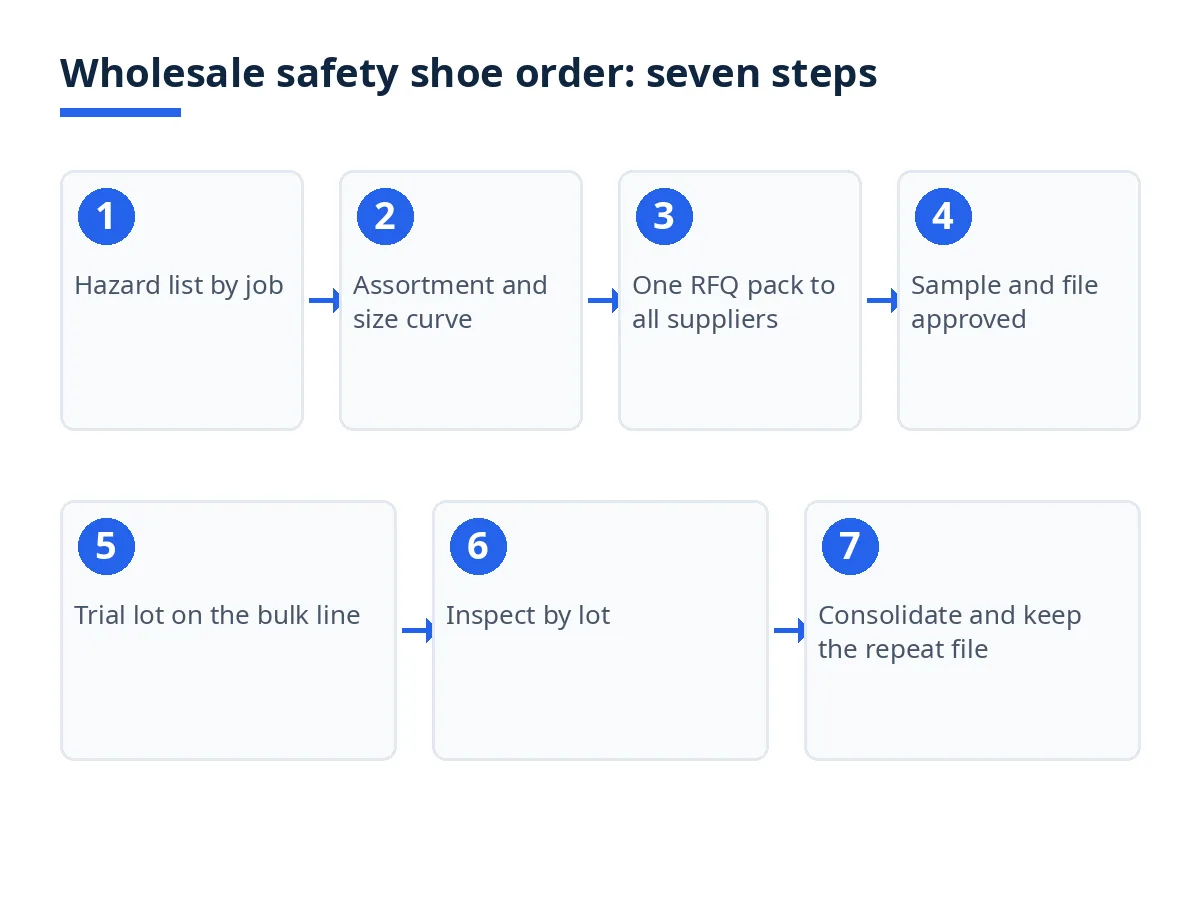
Step-by-step: from a hazard list to a repeatable wholesale order
Work the order in this order, and do not skip a step because the first sample looked right.
List hazards by job. Record each job, its floor, its underfoot debris, its wet, hot, cold, electrical, and chemical exposures, and the category and optional markings assigned to it.
Fix the assortment. Turn the job list into model lines and a size curve per model, with colours, trims, and carton marking agreed.
Send one request pack to every supplier. The same specification, the same size curve, the same document list, and the same delivery term, so quotations arrive on the same basis and can be compared line by line.
Approve the sample and the file together. Approve the physical sample and, in the same step, the label, the declaration of conformity, the certificate, and the test evidence for that exact model. A sample without its file is not an approval.
Run a trial lot on the bulk line. A short run covering the full size range, packed as bulk will be packed, and checked against the approved sample and the agreed sampling plan.
Produce in lots, and inspect by lot. Define each lot by model and size run, inspect during production where protection parts close inside the shoe, and take the final sampling decision on the finished, packed lot.
Consolidate, document, and file. Pack by model and size, mark each carton to its packing list line, confirm the classification for each model with the broker, and close the order into the repeat-order file described at the end of this article.
The diagram below lists the seven steps in order.
How minimums shape the assortment
A minimum order quantity is the smallest quantity a supplier will accept for a product on its normal terms, and the counting basis matters more than the headline number.7 The count may be per order, per style or product, per colour, or per size group, and a money minimum may apply as well.7 Read the unit as carefully as the number: a minimum stated per style and colour is very different from the same number stated across the whole order.7
Three drivers push minimums up before any negotiation starts. Custom material brings the material supplier's minimum into the factory's minimum. Trims bring their own minimums: labels, buttons, hang tags, and packaging come from suppliers with minimums of their own, and a custom label made only in large runs can drive the order minimum.7 Variety adds planning and changeovers with every extra colour, size, or design.7 There is no standard minimum for Bangladesh or for safety shoes that a buyer can safely assume. Each supplier's stated minimum must be read, and the counting basis confirmed in writing before the colour and size mix is fixed.7
Example figures: with a minimum of 400 pairs per style and colour, 2 styles in 2 colours each give 4 style-colour combinations and a smallest order of 1,600 pairs (400 x 4), and at USD 6.40 per pair free on board the order value is USD 10,240 (1,600 x 6.40). Those are illustrations only. The binding numbers are the ones in the accepted quotation. The same minimum counted per order would allow 400 pairs in total, split across styles and colours. Ask, in writing, how the minimum is counted, whether a minimum order value also applies, and whether two styles sharing a material count together. Where a quotation shows only a bare number, treat the counting basis as unanswered.
Price tiers work in steps, not in a smooth line. Tiered pricing means the unit price falls in steps as quantity rises, and the agreed price is the one in the accepted quotation, not the one on a listing.7 Check both sides of every tier break: a slightly larger order at the next tier can cost less in total than a smaller order at the higher unit price, but only if the extra pairs can be sold, stored, or worn. Do not chase a tier break with sizes or colours the workforce does not need. Extra pairs in the wrong sizes are not savings. They are stock that will not move.
Negotiation on a minimum is negotiation on the drivers, not on the number alone. Stock material instead of a custom material, fewer colours, standard trims and packaging, a small-order surcharge, or an honest trial order with a realistic forecast are the usual levers, and each changes the supplier's costs, so each should be raised as a question with a trade-off attached.7 A smaller order usually costs more per unit or needs a simpler specification, and promising future volume that cannot be forecast makes a second small order harder, not easier.7
Bulk quality control at scale
Bulk quality control is a sampling decision, not a promise that every pair was handled. At wholesale scale, no buyer opens every carton, so the control must be agreed before production, written into the order, and applied to lots defined before inspection starts. The inspection discipline for safety shoes is set out in full in the safety shoe inspection checklist, which covers the toe cap, the puncture-resistant layer, the outsole, bonding, pair matching, labels, and packing. What follows is how that discipline is run across a multi-model, multi-size wholesale lot.
Define the lot first. A lot is one model, in one size run, from one production run, packed under one packing specification. Do not let a lot grow to cover two models, or two size runs with different end sizes, because a sampling decision on a mixed lot cannot say which model failed. Before production starts, settle four points in the written order for each lot. First, the defect classes, critical, major, and minor, with photographs showing where the borderline sits. Second, the sampling plan itself, with the figures taken from the agreed standard. Third, each test the buyer requires, stated by method and by the result it must give. Fourth, which protection items the model must carry, which it must not carry, and which are optional. No figure in this article is a universal pass mark: the deciding numbers are the ones the two sides wrote into the order.
The sampling plan most wholesale buyers meet is the attribute sampling system in ISO 2859-1, titled Sampling procedures for inspection by attributes, Part 1: Sampling schemes indexed by acceptance quality limit (AQL) for lot-by-lot inspection.8 Each batch is judged on its own sample, with rules that adapt the sampling stringency based on the lot's recent quality history.8 Three inputs drive the decision: the lot size, the inspection level, and the chosen AQL. The tables in the standard translate those inputs into a sample size, an acceptance number, and a rejection number, and the inspection type in force, whether normal, tightened, or reduced.8 General Level II is the default whenever buyer and supplier do not specify otherwise, Level I requires about 40 percent of the Level II sample size, and Level III roughly 1.6 times Level II.8 Tightened inspection follows repeated rejections, and reduced inspection follows a run of accepted lots.8 Write the standard, the level, and the AQL values for each defect class into the quality clause of the order, and require the inspector to sample from packed cartons in the finished lot, never from pieces the factory selects.
Run checks at three points, not one. During production, check the protection parts that close inside the shoe: toe cap position and seating, penetration insert type, position, and coverage in both shoes, and metatarsal guard position where required. Those parts cannot be checked from the outside once the shoe is finished. At the end of the line, check bonding, stitching, closures, and pair matching on the finished shoe. At final inspection, take the sampling decision on the finished, packed lot, with the sample drawn across sizes and cartons, including the end sizes. Draw the sample across sizes and cartons, including the end sizes, where grading faults sit.
Treat test evidence the same way as the physical checks: by exact model. Impact, compression, penetration, slip, and electrical results each belong to the finished construction tested, and a report for a different upper, sole, or insert does not cover the model in front of you. Hold the report beside the certificate and the declaration, and check that the model, style, and protection set named in each document match the order. Where a document references an older edition of EN ISO 20345, do not relabel the product as meeting the current edition. Ask whether the certificate has been reviewed against the current state of the art, whether a newer certificate or extension exists, and whether the intended placement date and any product changes are covered.1
When a lot fails, the response is fixed in advance: who pays for re-inspection, whether failed lots are sorted, reworked, or rejected, and what happens to passing sizes inside a failed lot. Sorting must be 100 percent for the defect found, with sorted pairs re-sampled under the agreed plan. A failed lot shipped on a discount without a new sampling decision is an uninspected lot with a lower price.
Consolidation and mixed-container logic
A wholesale order rarely fills a container with one model. Consolidation is the decision about how several models, several suppliers, or several buyers' goods share a container, and it must be planned with the assortment, not after production. The two patterns are a full container load, where one shipper takes exclusive use of a container, and a less-than-container load, where cargo from several shippers is combined into one container by a consolidator and each shipper pays for the space occupied.9
In a less-than-container shipment, cargo is delivered to a container freight station, a warehouse near the port of loading, where the consolidator measures and weighs each piece and loads several shippers' cargo into one container.9 The container sails under one master bill, with a house bill issued for each shipper, and at destination the container moves to another container freight station, is stripped, and each consignee clears its own portion.9 The carrier issues the master bill to the consolidator, and the consolidator, acting as a non-vessel operating common carrier, issues a house bill to each shipper.9 Two extra handling points exist that a full container load does not have, and that is where the extra transit time and damage risk come from, and why packaging matters more on a consolidated shipment.9 Palletise and wrap, use edge protectors, mark every piece with the house bill number, and keep the piece count on the packing list equal to the physical count, because the station tally is what the manifest reports and a mismatch triggers a hold.9
Ocean less-than-container freight is quoted on weight or measure, written W/M, and the carrier charges whichever is greater: one cubic metre or one metric ton, converted at the ratio the tariff sets.9 Around the ocean rate sit station handling at both ends, documentation and house bill work, terminal handling, and destination delivery.9 A quote that shows only the ocean leg is not a quote: demand the full line items, and compare the consolidated quote with a full-container quote on the same lane and season. The crossover volume depends on the lane and the season, so compare quotes instead of applying a fixed number, and once a shipment passes about half a container, ask for both quotes, since the full-container total can land lower and comes with fewer handling points.9
Example figures: three models measured at 8 cubic metres and 900 kilograms, 6 cubic metres and 700 kilograms, and 4 cubic metres and 1,100 kilograms give a consolidated total of 18 cubic metres and 2,700 kilograms. On a one-cubic-metre-to-one-tonne ratio, volume governs, so the chargeable figure is 18. An illustration of the weight-or-measure rule only. Each model needs its own packing list line, carton count, weights and measures, and marks, so each station can tally and strip by model without opening another model's cartons.
Mixed-container discipline also covers classification. One container can hold several models, and each model can need a different code. Footwear is classified by the material of the upper and outer sole, by type and purpose, by whether the shoe covers the ankle, by insole length against a 24 centimetre line, by heel height, and by intended wearer.10 The upper is determined by the material covering the greatest external surface area, ignoring accessories and reinforcements, and the outer sole material by the material with the most ground contact, ignoring add-ons such as spikes and protectors.10 Heading 6401 covers waterproof rubber or plastics footwear made without fixing the upper to the sole by stitching, riveting, nailing, screwing, or plugging. Heading 6402 covers the other rubber or plastics footwear, 6403 the leather-upper footwear, and 6404 the textile-upper footwear.10 Read the classification guide for safety shoes before writing the packing list: it applies the cap, upper, sole, and construction tests model by model, because a mixed container packed under one code for all models will fail at the first customs check that opens a carton of a different model. Confirm the full national code for each model with a broker for the entry date, in writing, and keep that confirmation in the repeat-order file.
Costs, timelines, and documents
Wholesale costs are a structure, not a price list. No price, freight rate, duty rate, or lead time is stated in this article, because each depends on the models, the quantities, the lane, and the date. What can be fixed in advance is the structure every quotation should be read against, so that two quotations can be compared without comparing different things.
Cost element | What to ask for in the quotation |
|---|---|
Unit price per model | Price per pair, per model, per colour, on the stated delivery term, with the tier and quantity range it applies to |
Tooling, moulds, and lasts | Whether any charge applies, whether it is one-off or per repeat, and who owns the moulds |
Materials and trims | Whether custom material or custom trims carry a surcharge or a separate minimum |
Sampling and testing | Whether samples, wear trials, and laboratory tests are charged, and who pays for a re-run after a failed test |
Packing and carton marking | Pairs per carton, carton specification, and whether custom carton print is charged |
Inspection | Who engages and pays the inspector, and who pays for re-inspection after a failed lot |
Freight and consolidation | Ocean or air freight, station handling, documentation, terminal handling, and destination delivery as separate lines |
Insurance | Whether transit insurance is included, on what value, and under which delivery term |
Duty and import charges | Who clears import customs and pays duty, under the delivery term named in the contract |
Timelines follow the same discipline. A wholesale timeline is a chain of gates, each with an owner and a decision: sample approval, file approval, trial lot, bulk production, in-line checks, final sampling, consolidation, and sailing. Do not accept a single delivery date for a multi-model order. Ask for the date each model completes, the date each lot is inspected, and the date the consolidated container closes, and record what happens to the sailing if one model misses its gate. Decide in advance whether a late model holds the container or ships separately, and write it into the plan.
Documents travel with the shipment, and each one must describe the same goods. A shipment normally travels with a commercial invoice, a packing list, a bill of lading or air waybill, and a certificate of origin where a preference claim or a buyer requirement calls for one. The invoice should describe each model the way the tariff describes it: the quantity, the shoe type, how it was constructed, the cap material and what it is made of, the upper and sole materials, and whether it covers the ankle.10 For safety shoes, add the model file: the label artwork as marked, the EU declaration of conformity, the type-examination certificate where required, and the test reports for the finished models. Where the destination is the United States, the importer security filing elements for a consolidated shipment include the container stuffing location and the consolidator, so the importer needs both names and addresses before the vessel arrives.9 Keep a copy of every document in the repeat-order file, and check the packing list against the physical carton count at the station tally, not after the container has sailed.
The delivery term decides who carries each of those costs and risks, and it must be named in full in the contract: rule, named place, and version year. The division is fixed: sea/inland-waterway-only rules are FOUR — FAS, FOB, CFR, CIF. CPT is any-mode. DPU is any-mode. DDP is any-mode (seller clears import customs, pays duty). FCA is any-mode.11 The seven any-mode rules can be used for ocean and air shipping, while the four sea and inland waterway rules can be used for sea and inland waterway shipments only.11 For a consolidated shipment handed to a carrier at a freight station before loading, an any-mode rule such as FCA usually reflects the operation better than a sea-only rule written as if the goods were handed over on board. Under DAP the seller arranges shipment to the named place and the buyer assumes import duties, fees, and taxes; under DPU the seller also unloads, and under DDP the seller handles the entire shipment including customs clearance.11 Name the rule that matches the handover point.
Bangladesh-specific rules and tips
Three Bangladesh-specific checks belong in every wholesale file, and each one is a document check, not a claim about a company. First, confirm export standing. On its own site, the Leathergoods and Footwear Manufacturers and Exporters Association of Bangladesh (LFMEAB) describes itself as the trade body for Bangladesh's leather goods, footwear, and synthetic and allied makers and exporters.12 A supplier that claims membership should appear on the association's own member list: check it there. Check any certificate the same way, for the site, the product range, and the period it covers. Membership says the company belongs to the association; it does not prove capacity for a given model, quantity, or date. Capacity is proved by a trial lot on the bulk line.
Second, read the badge record on each supplier profile before shortlisting, and read it for what each badge names. Each badge names the checks behind it, and verification is a review of documents and photographs by Exportain staff, not a factory visit and not a check against a government database.13 Product certifications marked as verified by Exportain have been reviewed by staff and are shown only while they are approved and not past their expiry date, and Gold and Platinum membership plans buy listing capacity and search placement and never grant a trust badge.13 A badge shortens the shortlist. Samples, inspection, and payment terms remain the buyer's work, and a badge is not a guarantee of production capacity, product quality, or delivery.13 Where a certificate matters to the end customer, confirm it with the body that issued it.13
Third, get the labelling and marking position right for the destination, and do not borrow a consumer-footwear label rule for a safety shoe. In the European Union, the footwear labelling directive requires information on three components, the upper, the lining and sock, and the outer sole, with a material named only where it covers 80 percent or more of the relevant area or volume, and the two main materials named where none reaches 80 percent, on a label that is visible, securely attached, and accessible on at least one item in the pair.14 The same summary states that the directive does not cover footwear worn for health and safety at work; that footwear falls under the European Union rules on personal protective equipment.14 Safety footwear therefore takes its marking, declaration, and instructions from the personal protective equipment rules. Ask for the marking as it appears on the shoe, the declaration, and the user instructions, and check them against each other for the exact model.
Classification needs the same care. A safety mark does not settle a code, and a trade name such as composite toe does not state the cap material in the words the tariff uses. Confirm the code for each model with a broker, in writing, for the entry date, and keep the confirmation in the file. Where a preference or relief is claimed, confirm the origin rule and the supporting certificate before shipment.
Mistakes and red flags
The mistakes below repeat across wholesale safety shoe orders. Each one is cheap to prevent at the assortment stage and expensive to fix after the container is packed.
Buying one category for every job. A single S3 model for a warehouse, a yard, and a wash-down area buys the wrong shoe for at least one of them, and the error is discovered by the wearers, not by the file. Assign the category by job, from the hazard list, and keep the assignment in writing.
Copying a size curve from another market. A curve that fits one workforce will starve the end sizes of another. Build the curve from the wearers, trial the end sizes, and re-check the curve on every repeat order, since the workforce changes.
Approving a sample without its file. A sample pair proves the design on one size. It does not prove the certificate covers that model, the declaration names that model, or the test evidence covers that construction. Approve the sample and the file together, or do not approve at all.
Letting the sampling plan stay verbal. A plan agreed in conversation will be remembered differently by each side when a lot fails. Write the standard, the level, the defect classes, and the acceptance numbers into the order, and sample from packed cartons in the finished lot.
Sampling only the middle sizes. Grading faults, mould faults, and tread faults show at the ends of the size run. Draw the sample across sizes and cartons, including the smallest and largest sizes in the lot.
Mixing models in one carton series without separate lines. A mixed carton that cannot be tallied by model cannot be stripped, cleared, or received by model. Pack by model, mark by model, and give each model its own packing list line.
Relabelling an older certificate as current. A document that references EN ISO 20345:2011 is evidence about the 2011 edition. It does not become evidence about the 2022 edition because the catalogue page changed. Ask whether the certificate has been reviewed, extended, or replaced, and record the answer.
Treating a badge as a factory visit. A badge records documents and photographs reviewed by staff. It does not record a visit, a capacity check, or a quality result. The trial lot and the final sampling decision do that work, and no badge replaces them.
Accepting a single delivery date for a multi-model order. One date hides which model is late. Ask for completion, inspection, and consolidation dates per model, and decide in advance whether a late model holds the container or ships separately.
Wholesale order checklist
Use this list to close the order file, not to inspect the shoes. The inspection itself follows the safety shoe inspection checklist linked above. Tick each line only when the named record exists in the file.
Hazard list by job, with the category and optional markings assigned to each job, and the name of the person who assigned them.
Assortment sheet: model lines, categories, cap and insert types, upper and outsole materials, colours, trims, and the size curve per model, with totals that add to the order.
Counting basis for every minimum, confirmed in writing: per order, per style, per colour, per size group, or a minimum order value, and the tier each quantity falls in.
Sample approval record: the approved sample identified by model and size, with the label, declaration of conformity, certificate, and test evidence for the exact model held beside it.
Trial lot record: the run on the bulk line, covering the full size range, packed as bulk, checked against the approved sample, with the result recorded.
Sampling plan in the order: the standard, the inspection level, the defect classes, the acceptance numbers, the sampling point, and the re-inspection payer.
Carton and packing specification: pairs per carton, carton marks, size breakdown inside each carton, and the packing list format, agreed before bulk.
Classification confirmations: the full national code for each model, confirmed by the broker in writing for the entry date, with the origin and preference position recorded.
Delivery term and documents: the rule, named place, and version year in the contract, with the invoice, packing list, transport document, and model file listed by name.
Repeat-order file: every record above, plus the inspection reports, the station tally, and the notes on what changed between the sample, the trial lot, and bulk.
How Exportain helps
Through Exportain, a wholesale buyer can reach Bangladeshi sellers and service providers with one requirement that states the assortment, the protection set, and the inspection scope, so every supplier answers the same questions. Start in the supplier directory, reading what each badge actually records on each profile, and send the same request pack to several suppliers through one request thread.13 Put the same questions to each supplier: the counting basis for the minimum, the size curve the factory can make, the document file for each model, the trial lot timing, and the sampling plan it will accept. Keep the answers beside the approved sample and carry them into the repeat-order file.
Questions wholesale buyers ask about safety shoes
What should I know first before buying safety shoes wholesale from Bangladesh?
Know the hazard list before the assortment, and the assortment before the price. Name the job, category, and optional markings for each workplace, fix the models and the size curve, and agree the counting basis for every minimum. The category is a package of tested properties for a finished model, not a ranking, and each model file must hold the label, the declaration of conformity, the certificate, and the test evidence for that exact model.1 4
What do wholesale costs and timelines depend on?
They depend on the models and quantities, the counting basis for the minimums, the tier each quantity falls in, materials and trims, sampling and testing, packing, inspection terms, freight and consolidation lines, insurance, and the delivery term.7 No price or lead time in a guide replaces a quotation on the buyer's own assortment. Ask for the cost structure line by line, and for completion, inspection, and consolidation dates per model.
Which documents should travel with a wholesale safety shoe shipment?
The commercial invoice, the packing list, the bill of lading or air waybill, and a certificate of origin if a preference claim or a buyer requirement needs one, with the invoice description matching the classification for each model. Add the model file: the label artwork as marked, the EU declaration of conformity, the type-examination certificate where required, and the test reports for the finished models. Manufacturers must keep the technical documentation and the declaration for 10 years under the PPE Regulation, and the buyer's file should hold copies for the models supplied.4
What are the most common mistakes in a wholesale safety shoe order?
Buying one category for every job, copying a size curve from another market, approving a sample without its document file, leaving the sampling plan verbal, sampling only the middle sizes, mixing models in one carton series without separate packing list lines, treating an older certificate as current-edition evidence, reading a badge as a factory visit, and accepting a single delivery date for a multi-model order. Each mistake is prevented at the assortment or order stage, and each one is paid for at the container, the customs check, or the wearer's feet.
Next steps on Exportain
Begin with the directory of suppliers on Exportain, opening each profile's badge record before you shortlist, and read what each badge records on Exportain alongside how a minimum can be counted on Exportain before you fix the colour and size mix. File the assortment sheet, the model files, and the sampling plan together, ready for the next buy.
Sources
- EN ISO 20345 Safety Footwear Standard: Classes & Markings. Anbu Safety, (accessed )
- F2413 Standard Specification for Performance Requirements for Protective (Safety) Toe Cap Footwear. ASTM International (accessed )
- What Is ASTM F2413: Safety Footwear Requirements. CLIMB (accessed )
- Regulation (EU) 2016/425 of the European Parliament and of the Council of 9 March 2016 on personal protective equipment - summary. European Union (accessed )
- Machines for EU safety footwear testing – part 2. SATRA (accessed )
- Footwear fit and comfort. SATRA (accessed )
- MOQ Meaning (Minimum Order Quantity). Exportain (accessed )
- ISO 2859 Sampling Plans. TextileTuts (accessed )
- LCL Container Shipping: How Consolidation Works and When It Pays. InterWF, (accessed )
- Classifying footwear for import and export. GOV.UK (accessed )
- Incoterms 2026: Meaning, Chart & List Of Incoterms. Freightos, (accessed )
- President's Message - LFMEAB. Leathergoods and Footwear Manufacturers and Exporters Association of Bangladesh (LFMEAB) (accessed )
- How Supplier Verification Works on Exportain. Exportain, (accessed )
- Footwear labelling. European Commission, EUR-Lex (accessed )
About the author
Sourcing from Bangladesh?
Post a request for quotation and suppliers on Exportain can send you their quotes directly.
Post an RFQ