Wholesale Puffer Jackets From Bangladesh: Prices, MOQ and Reliable Suppliers
Wholesale puffer jackets from Bangladesh are priced by fill, shell and construction, and MOQ is set per style, color and size run. This guide explains quote structure, MOQ tiers, order sizing and supplier checks, with example figures throughout.
Short answer
Wholesale puffer jackets from Bangladesh are bought by specification, not by headline price: fill type and weight, shell fabric and finish, and quilting decide the unit price, while MOQ is usually set per style, per color and per size run. Send one written specification and a color and size grid to every supplier, compare quotes line by line, approve a pre-production sample, and confirm classification and duties with your broker before ordering.
On this page
Key takeaways
Puffer jacket prices move with fill type and weight, shell fabric and finish, and quilting and trims: compare quotes only against one written specification.
MOQ is usually set per style, per color and per size run. The binding minimum is the one your grid fails, not the headline style total.
Size the order as a color and size grid and check every cell against the supplier minimum before you ask for a quote.
Verification is a sequence you run: association listings, a pre-production sample in production fabric and fill, and an agreed inspection. Exportain badges record document and photo reviews, not factory inspections.
Buying wholesale puffer jackets from Bangladesh is decided by specification before any price is discussed. The fill, the shell fabric, the number of colors and the size curve fix most of the cost, and they fix the minimum quantity too. Two suppliers quoting different numbers for what looks like the same jacket are usually quoting different jackets. This guide shows how to read a wholesale quote: what each part of the price covers, how MOQ tiers work, how to size an order across colors and sizes, and how to check a supplier without relying on a ranked list.
Bangladesh is a large woven-garment supply base. In fiscal 2024-25, woven garments earned $18.19 billion within ready-made garment exports of $39.35 billion, according to Export Promotion Bureau data.1 Puffer jackets sit inside that woven trade.
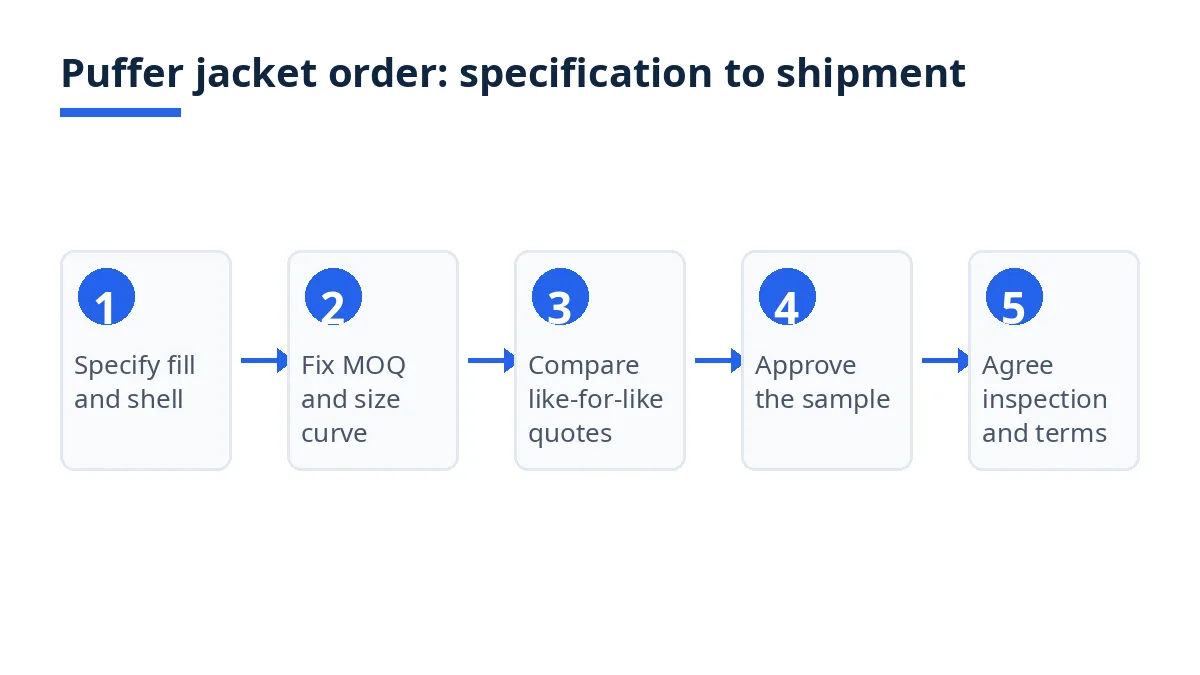
How wholesale puffer jackets from Bangladesh are quoted
A wholesale quote bundles separate costs: shell fabric, fill, lining, quilting, zips and trims, cutting and sewing, packing and the freight term. When a quote arrives as a single number with no breakdown, ask for the breakdown before comparing it with anything else.
What should I know first about puffer jackets?
A puffer jacket is a woven outer shell quilted around an insulating fill, with a lining, a closure and usually a hood or collar. The fill may be down, a down blend or a polyester fill, and the shell is normally a woven polyester or nylon fabric, sometimes with a water-repellent finish. The three decisions that matter most are the fill type and fill weight, the shell fabric and its finish, and the construction details: quilting pattern, baffle or stitch-through construction, zip quality, and pocket and hood details. Each belongs in the specification you send.
The table below shows how those choices move a unit price. The figures are illustrative only.
Example build | What changes | Example figures: unit price |
|---|---|---|
Lightweight polyester-fill jacket, stitch-through quilting, basic zip | Lowest fill and fabric cost, simplest construction | $8.50 |
Mid-weight polyester-fill jacket, heavier shell, branded zip and lined hood | Heavier fabric, more fill, better trims | $12.75 |
Down-blend jacket, baffle construction, water-repellent shell, full trim set | Costliest fill and construction, most components | $19.40 |
Example figures. Every row is still a puffer jacket, so a quote without a specification is not a quote you can use. Send the same specification to every supplier.
Fill, shell and construction choices that move the price
Fill is usually the first cost driver to settle. Down, down blends and polyester fills differ in cost, weight, warmth for a given weight and care requirements, and the fill weight per jacket is the number that decides how warm the garment feels. State the fill type, fill weight and fill distribution you want, and ask how the supplier proves the fill content in the finished jacket. Put it in the specification and check it in the sample.
Shell fabric is the second driver. The shell decides the hand feel, the weight, the color depth and whether water beads on the surface or soaks in. Ask for the fabric composition, weight, construction and finish in writing, and ask whether the fabric is held in stock or bought to order, since bought-to-order fabric adds lead time and can carry its own minimum.
Construction details are where cheaper jackets quietly lose value. Uneven or poorly anchored quilting lets fill move and creates cold spots. Zips that fail under load, snaps that pull out and pocket linings that tear are the failures buyers notice first in use. Specify the zip type, quilting pattern and stitch density, and reinforcement at stress points, and check each on the pre-production sample in production fabric and fill. State the packing standard too: pieces per carton, carton markings, and whether retail-ready packing is included.
MOQ tiers: how quantity, colors and sizes are counted
Minimum order quantity (MOQ) for puffer jackets is rarely a single number. A supplier may set a minimum per style, per color, per size run or per order value, and the binding number is the one you fail to meet. A 1,000-piece style minimum means little if the supplier also requires 300 pieces per color and you want four colors. Ask which minimum applies at each level, in writing, before you plan the range.
MOQ exists because fabric, fill and trims are bought in lots and dyeing runs in batches, so a small order split across too many colors returns to you as a higher unit price or a surcharge. The figures below are illustrative only.
Example figures: order size per style | How the supplier treats it | Example figures: unit price |
|---|---|---|
300 pieces, one color | Below the usual tier, surcharge or refusal is common | $14.20 |
600 pieces, two colors | Meets a small tier, limited color split | $12.75 |
1,200 pieces, three colors | Standard tier, full size run | $11.60 |
3,000 pieces, four colors | Volume tier, lowest unit price in this example | $10.85 |
Example figures. Read the table as a pattern, not a price list. Combining two colors, dropping a slow size or raising the quantity in the strongest color can move an order into a better tier. A longer lead time or a firm second order can matter more than asking for a lower number with nothing offered. See the MOQ guide.
Sizing the order: colors, sizes and the size curve
A wholesale order is a grid: colors across the top, sizes down the side, a quantity in each cell. The size curve is the share each size takes, and it should follow how the jackets will sell, not an even split.
Build the grid before you ask for a quote. Start from the total quantity, split it by color, then apply the size curve within each color. The worked example below uses illustrative numbers only.
Example figures: 1,200 pieces, three colors | XS | S | M | L | XL | Color total |
|---|---|---|---|---|---|---|
Black | 48 | 120 | 144 | 120 | 48 | 480 |
Navy | 36 | 90 | 108 | 90 | 36 | 360 |
Olive | 36 | 90 | 108 | 90 | 36 | 360 |
Size total | 120 | 300 | 360 | 300 | 120 | 1,200 |
Example figures. In this example the strongest color takes 40 percent and the middle sizes take 60 percent of each color. Your curve should come from your sales history or the retailer's order, not from this table.
Check the grid against the MOQ at every level. In the example the smallest cell is 36 pieces; if the supplier's minimum per color per size is higher, the grid fails even though the total looks large. Merge a color, drop a size or raise the total, and re-check.
Reading and comparing supplier quotes
Compare quotes only when they describe the same jacket. Build a comparison sheet with one row per item: fill, shell, lining, quilting, trims, size curve, colors, packing, Incoterm, lead time, payment, sample and inspection terms. Leave a cell blank where the supplier did not answer; a blank cell is a question to ask, not a detail to assume.
The example below shows two quotes for the same specification. The figures are illustrative only.
Example figures: 1,200 pieces, three colors | Supplier A | Supplier B |
|---|---|---|
Unit price, FOB | $11.60 | $10.95 |
Fill stated | Polyester fill, 220 g, stated in writing | Polyester fill, weight not stated |
Shell stated | Fabric weight and finish stated | Fabric named, weight and finish not stated |
Packing | Individual polybag, 20 per carton, included | Carton packing, polybag not stated |
Sample | Pre-production sample in production fabric, included | Sales sample only, pre-production sample charged |
Inspection | Third-party inspection allowed, cost stated | Inspection not mentioned |
Example figures. Supplier B has not stated the fill weight, fabric weight, packing or inspection terms, so the cheaper number buys a less certain jacket. Ask Supplier B to quote the same specification in writing, then compare again.
What are the typical costs and timelines?
There is no standard wholesale price or lead time for puffer jackets from Bangladesh. Cost depends on the specification above; lead time depends on fabric and fill availability, approvals and the shipping route.
Ask each supplier to state the timeline as gates: fabric confirmation, sample approval, production, inspection and shipment. The figures below are illustrative planning figures only.
Example figures: planning timeline | Example duration |
|---|---|
Fabric and trim confirmation | 1 to 2 weeks |
Pre-production sample and approval | 1 to 2 weeks |
Production after sample approval | 4 to 6 weeks |
Inspection and shipment preparation | 1 week |
Example figures. A repeat order on held fabric can run shorter; a new fabric can run longer. If fabric confirmation slips by two weeks, every later gate moves with it.
Documents, classification and duties to confirm before you order
Classification decides the duty treatment, so settle it early. Woven puffer jackets are classified under the Harmonized System, the six-digit international nomenclature maintained by the World Customs Organization and used by more than 200 countries and economies as the basis for customs tariffs.2 The HS code guide for puffer jackets works through the headings in detail, including the split by wearer and by shell fiber. Treat any heading as indicative, and verify the full national code with your customs broker before filing: national tariffs add digits beyond the shared six.
Duty treatment is a broker question, not a supplier promise. For the European Union, Bangladesh currently has duty-free and quota-free access under the Everything But Arms arrangement, and a new Generalized Scheme of Preferences framework is scheduled to take effect on January 1, 2027.3 Access after graduation from least developed country status is under negotiation, so confirm the treatment for your shipment date with your broker. Do not build a retail price on an unconfirmed duty rate.
Which documents are needed?
The exact document list depends on your destination and payment method, so ask your broker and bank to confirm it. The usual set includes the commercial invoice, packing list, bill of lading or airwaybill, certificate of origin where a preference is claimed, and any test or inspection report agreed in the order terms. Product-specific documents, such as a fill-content declaration, belong in the order terms from the start.
The commercial invoice should describe the jackets in the same terms as the specification. Check the draft invoice and packing list before shipment, while corrections are still cheap.
Finding suppliers and checking them, without a ranked list
There is no reliable ranked list of puffer jacket suppliers in Bangladesh. Build a shortlist from records you can check, then test whether each supplier makes the jacket you specified.
Start with the records that exist. The Bangladesh Garment Manufacturers and Exporters Association represents the woven garment sector, and its home page describes more than 4,000 factories serving buyers in more than 150 countries.4 Search its member listings, and cross-check company name, address and product range against the supplier's profile. On Exportain, search the supplier catalog, filter by badges and capabilities, and read what each badge covers before relying on it.5 See how to buy.
Test the shortlist with the same questions for every supplier: which factory will make the jackets, whether it is the company you are speaking to or a subcontractor, what share of the work is in-house, and which similar jackets it made in the last two seasons. Ask for the specification in writing, a pre-production sample in production fabric and fill, and the inspection terms before production starts.
Verification on Exportain is a document and photo review, not a factory inspection: Exportain staff review each submission, approved checks earn badges, and membership plans never grant a trust badge.6 Read the badge descriptions before treating a badge as evidence of capacity or quality, and run your own checks in parallel: the association listing, the certificate issuer, the sample and the inspection report.6 See the supplier verification guide.
Use an RFQ so suppliers answer the same questions in the same format: quantity, specification, destination, Incoterm, certifications and deadline.5 Every quotation on Exportain is versioned, with unit price, MOQ, lead time, Incoterm, payment terms and validity recorded.5
Order errors that cost wholesale buyers money
Each error below is avoidable at the specification stage and expensive to fix after production.
Quoting before specifying: without a fill, shell, color and size specification you receive prices for different jackets and choose the lowest, usually the thinnest. Write the specification first and compare only quotes that answer it.
Approving the wrong sample: a sales sample or a sample in different fabric or fill is not approval of the production jacket. Approve a pre-production sample in production fabric, fill and trims, and keep it sealed as the inspection reference.
Leaving inspection until the cartons are sealed: agree the inspection standard, sampling level, inspector and payer before production, and inspect against the sealed sample. See the puffer jacket quality checklist.
Paying on a promise about duties or delivery: confirm duty treatment with your broker, confirm the freight term in writing, and tie payment to sample approval, inspection and shipment documents.
Ordering a size curve from habit: a curve copied from another season or market leaves slow sizes unsold. Build it from your sales data, check it against the minimum per size, and adjust it before the quote.
What are the most common mistakes?
The most common mistake is treating the unit price as the whole cost. Unit price, packing, sample charges, inspection, freight term and duty treatment together make the landed cost. The second is skipping the written specification to save a few days at the start; the dispute it causes is measured in cartons.
Next steps on Exportain
Search Bangladeshi suppliers for woven outerwear exporters and filter by the badges and capabilities your order needs, then read how supplier verification works on Exportain so you know what each badge covers. When your specification, grid and inspection terms are written, post an RFQ with the quantity, specification, destination and Incoterm, and compare the versioned quotations that come back against the same document.
Sources
- Bangladesh's export earnings stood at $48.28b in FY25. BizBD Review (accessed )
- What is the Harmonized System (HS)?. World Customs Organization (accessed )
- EU invites Bangladesh to share success story in preferential market access. The Financial Express (accessed )
- BGMEA | Home. Bangladesh Garment Manufacturers and Exporters Association (BGMEA) (accessed )
- How to source and buy from Bangladesh. Exportain (accessed )
- Supplier verification: Earn trust badges buyers can see. Exportain (accessed )
About the author
Sourcing from Bangladesh?
Post a request for quotation and suppliers on Exportain can send you their quotes directly.
Post an RFQ