

Wholesale Organic Cotton T-Shirts From Bangladesh: Prices, MOQ and Reliable Suppliers
Wholesale organic cotton T-shirts from Bangladesh need certification paper before price talks: GOTS scope, transaction certificates and label grade, plus fabric weight, dye minimums and size assortments that set the MOQ.
Short answer
Wholesale organic cotton T-shirts from Bangladesh have no single price or MOQ, because each factory prices your label grade, fibre share, fabric weight, colour range and size assortment on its own certified route. Before comparing quotes, fix the GOTS label grade and exact organic percentage, check that the scope certificate covers every processing stage including subcontractors, and agree who issues the transaction certificate for your shipment and when.
On this page
Key takeaways
Fix the GOTS label grade and exact organic fibre percentage first: Organic requires at least 95 percent certified organic fibres, while Made with Organic covers 70 percent up to 95 percent.
Check the scope certificate against your full route, including subcontracted dyeing and sewing, before discussing price.
Agree the transaction certificate arrangement at quotation stage: issuer, timing, and your company named as buyer, since goods without a valid TC cannot be marketed as GOTS-certified.
Dye minimums per colour on approved inputs, fabric weight and the size assortment ratio set the MOQ more than the order total does.
Exportain verification is a document and photo review, not a factory inspection, and a badge is not a guarantee.
An organic cotton T-shirt carries a premium that pays for a paper chain, not only for its cotton. The premium survives only when the transaction certificate quantity covers the quantity shipped, every subcontracted stage sits inside the certified scope, and the printed label grade matches the fiber share actually bought. Price talks before those three points are settled can produce a shirt that looks organic but cannot be sold as organic.
That paper chain turns a T-shirt order into linked minimums: certified yarn lot, dye run on approved inputs, and size assortment each impose their own floor, and the binding floor is rarely the order total.
Why this matters for buyers and sellers
For a buyer, the exposure is a range built around a claim that collapses at the destination, forcing relabeling, discounting, or withdrawal of organic-program stock. For a factory, certified yarn bought against one fiber share and dye inputs approved for one color list cannot be reworked cheaply after ordering.
What should I know first about organic cotton t-shirts?
Settle the label grade in writing before any quotation: it fixes the fiber share for the whole style. The "Organic" grade requires at least 95 percent certified organic fibers, and the "Made with Organic" grade applies from 70 percent up to 95 percent, with the exact certified organic percentage stated wherever the "Made with" grade faces the consumer, with required certification information.1
Then map the scope certificate onto your route, stage by stage. GOTS certification spans ginning, spinning, knitting, dyeing and printing, cutting and sewing, and packaging and labeling, and each stage must be independently certified, in-house or subcontracted.2 A certificate covering knitting but not the subcontracted dyehouse does not support a dyed shirt.
Third, settle the transaction certificate for your shipment. Each shipment of GOTS-certified goods needs a Transaction Certificate (TC) from a GOTS-approved certification body, and goods without a valid TC cannot be marketed or labeled as GOTS-certified.2 The TC carries product description and quantity, certification scope and reference, origin and destination, and certified party details.2 Agree before ordering who applies for it, when it will be issued, and whether your company appears as buyer.
Do not confuse that chain with a substance test. GOTS labeling may be applied only by a Certified Entity, with each label carrying logo, grade, certification body reference, and number, and artwork approved before use.1 OEKO-TEX STANDARD 100 tests for harmful substances instead, checkable through the OEKO-TEX Label Check,3 and says nothing about how cotton was grown, so it cannot replace a scope certificate and a TC.
Classification and destination labeling run in parallel. Heading 6109 of the Harmonized System covers T-shirts, singlets, and other vests, knitted or crocheted; subheading 610910 covers those of cotton.4 In the European Union, Regulation (EU) No 1007/2011 requires labeling with fiber name and percentage by weight in descending order.5 Keep those percentages identical across tech pack, label artwork, and TC; see the HS code for organic cotton T-shirts guide.
Step-by-step: how it works
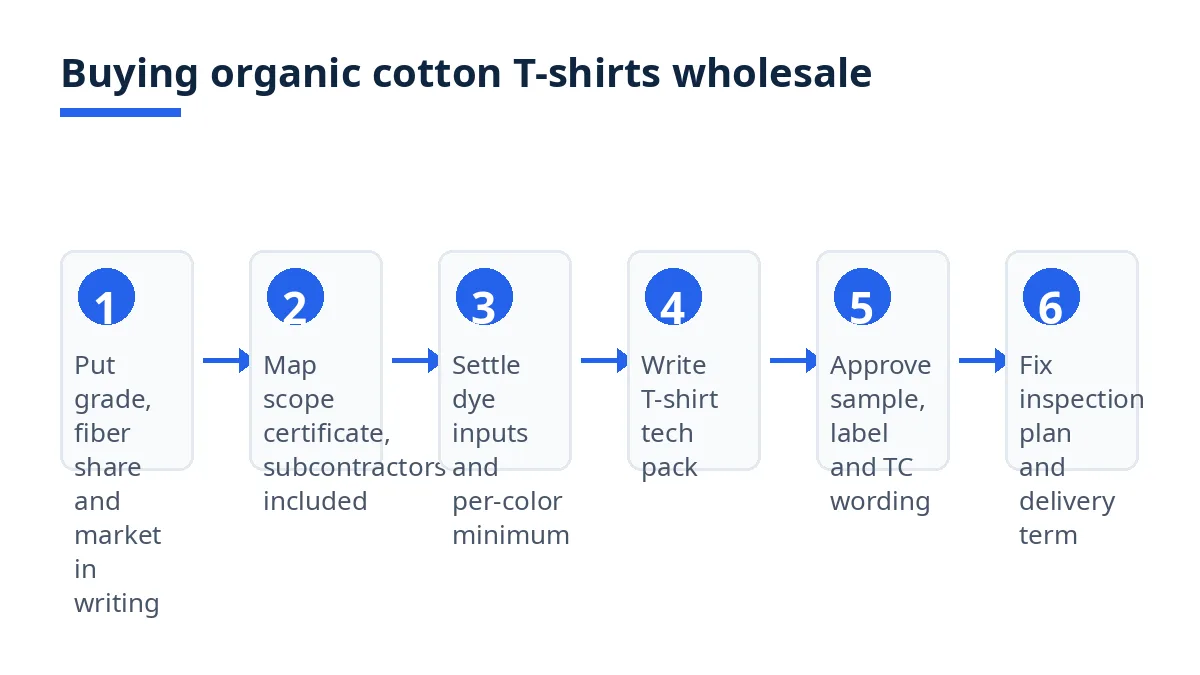
Put the grade, the fiber share, and the selling market in one written line. State "Organic" or "Made with Organic" with exact percentage, remaining fiber content, and selling market. Yarn buying, label artwork, and TC wording all follow from that line.
Map the scope certificate against the full route, subcontractors included. Confirm coverage for knitting, dyeing, printing if the design needs it, and cut-and-sew, and that any subcontracted dyeing or sewing unit holds its own certification for the same stages. Note the certification body and number.
Settle dye inputs and the per-color minimum before choosing colors. GOTS allows only pre-approved dyestuffs, auxiliaries, and finishes, and bans azo dyes that release carcinogenic amines, heavy metals, formaldehyde, and PVC.2 Ask which colors can run on approved inputs and what quantity each color needs.
Write a T-shirt tech pack, not a general knitwear brief. Include fabric construction such as single jersey, weight in grams per square meter, fiber composition, neck construction and rib, measurements for every size, print or dye method, label wording with grade and percentage, size assortment ratio, and packing.
Approve the sample, the label artwork, and the TC wording at the same time. Take a proto sample for fit, then a pre-production sample in the actual certified fabric, color, neck rib, print, and labels. Measure it, wash it, approve it in writing, and agree the TC product description and quantity wording in the same round.
Fix the inspection plan and one delivery term before confirming. Write inspection level and agreed acceptance values into the purchase order, and state one Incoterm with a named place on every quotation. The Incoterms 2020 rules comprise 11 rules allocating cost, risk, and obligations.6 Compare quotations only on an identical term.
For neck, print, and wash points on the pre-production sample, see the organic cotton T-shirts quality control checklist.
Costs, timelines and documents
An organic order has no standard price or minimum that a guide can publish as fact: each factory prices your weight, fiber share, color range, print method, and assortment on its own certified route, and the certified yarn lot, the approved-input dye run, and the TC quantity each carry a floor of their own.
Cost line | Why it moves the price or the floor | Put this in your enquiry |
|---|---|---|
Certified yarn lot | Bought for your fiber share and yarn count | Grade, percentage, yarn count, lot size |
Approved dye run | Each color needs its own approved-input run | Color, dye method, quantity for that color |
Fabric weight and jersey | Grams per square meter drive yarn use | Weight, construction, fiber composition |
Size assortment | Ratio across sizes drives marker use, small-size quantities | Ratio per color, smallest and largest sizes |
Print and label run | Set-up per design, placement, label grade | Method, size, placement, label wording |
TC and sampling plan | TC quantity check plus agreed sampling plan | Buyer name on the TC, inspection level, acceptance values7 |
Delivery term | Term fixes where cost and risk pass | One Incoterm with a named place6 |
Example figures: a buyer orders 1,440 pieces in three colors at 480 pieces per color, with a size ratio of 2-3-3-2 across four sizes. The ratio totals 10 parts, so 480 divided by 10 gives 48 pieces per part, and the sizes run 96, 144, 144, and 96 pieces per color. If the dye minimum per color is 500 pieces, each color falls 20 pieces short. The example shows structure only, not typical MOQ, price, or lead time.
What are the typical costs and timelines?
No typical figures exist that a buyer can rely on: the certified yarn premium, the dye minimum for each color, the weight, the assortment, and the delivery term all shift with the specification. A color needing its own approved-input dye run cannot be added late in small numbers without a surcharge or wait for the next run, so finalize colors before dye booking. For timing, ask for separate dates for yarn ready, dye ready, sample approval, production, inspection, and TC issue.
Which documents are needed?
The commercial papers are the tech pack, itemized quotation, and purchase order, each carrying label grade, fiber percentage, minimum per style and per color, and TC arrangement. The certification papers are the scope certificate, approved label artwork, and TC for the shipped quantity, with your company named as buyer where required. The export filing requires an approved export declaration before goods may be loaded.8
Bangladesh-specific rules and tips
Start from the knitwear base, then narrow to certified capacity. Export Promotion Bureau data put knitwear exports at $5.963 billion for July to September 2026, up 6.88 percent year on year, inside ready-made garment exports of $10.578 billion.9 The sector trade body, the Bangladesh Knitwear Manufacturers and Exporters Association (BKMEA), formed in 1996, counts around 2,540 member factories.10 Several factories can therefore quote a T-shirt, but only a subset can supply under a certified organic label.
Trace every processing site, not just the factory that quotes. Knitting, dyeing, and sewing for one order can sit in three different units, and a unit outside the certified chain breaks the claim even when the finished shirt is identical to a compliant one. Ask for each stage site by name and check it against the scope certificate before yarn is bought.
Read weight and neck rib as money, not as detail. A heavier jersey consumes more yarn per shirt and changes the yarn lot arithmetic, while a neck rib that twists or loses recovery after washing is the defect a buyer notices first on a plain T-shirt. State weight, neck construction, and wash checks in the tech pack, and check the smallest and largest sizes on the pre-production sample.
Keep the TC party, the invoice party, and the payee identical. Export paperwork names both the exporter and the foreign buyer,8 and a TC naming one company while invoice and bank account name another creates a mismatch cheapest to fix before shipment, in writing.
Mistakes and red flags
What are the most common mistakes?
Treating a yarn invoice or a hang tag as proof of an organic shipment. A fabric hang tag, a yarn invoice, or a certificate photograph from another order does not support your shipment. If the TC route is unclear at quotation stage, so is the claim.
Running two label grades inside one style without separating them. Selling some colors as "Organic" and others as "Made with Organic" without separate fiber shares, label artwork, and TC quantities creates a range where one wrong label undermines the rest. Keep one grade per style.
Adding a color after dyeing is booked. A late color on approved inputs needs its own dye run and minimum.
Printing before checking the input list. A print paste or finish outside the approved input list can break certification for shirts that are otherwise compliant. Check each print color and finish against the approved list before the sample is printed.
Reading a badge as a promise about the factory. A badge records a document and photo review, not a factory inspection, and is not a promise about capacity, quality, or delivery.11 12
Dropping the sampling plan to save time. The agreed sampling plan under ISO 2859-1, a system of acceptance sampling plans for inspection by attributes indexed by acceptance quality limit (AQL) for lot-by-lot inspection,7 is the last check before goods become your stock; check TC quantity against shipped quantity at the same stage.
Checklist
Treat this list as a confirmation gate: work through it only after every answer below exists as an agreed document, not as a verbal assurance.
TC arrangement settled: issuer, timing, your company named as buyer.
Scope certificate mapped to knitting, dyeing, printing if used, and sewing, including subcontractors.
Label grade and exact organic fiber percentage fixed, written into tech pack and purchase order.
Dye minimum confirmed for each color on approved inputs, colors finalized before dye booking.
Assortment stated per style, color, and size, smallest and largest sizes checked on the sample.
Tech pack sent: weight, construction, composition, neck rib, measurements, print or dye, label wording, assortment ratio, packing.
Pre-production sample measured, washed, approved in writing; label artwork approved by the certification body.
Sampling plan and acceptance values written into the purchase order.7
Quotations compared on an identical specification and delivery term.6
Paper set agreed: invoice, packing list, EXP form, certificate of origin, export declaration, TC.8
How Exportain helps
Start in the suppliers directory, then put the full specification on the RFQ board: label grade, fiber percentage, weight, color list, and size assortment, asking each reply to state its dye minimum per color and its TC arrangement. Replies quoting against the same specification can be compared on price and terms; replies omitting the dye minimum or the TC route cannot. When a quotation is accepted, Exportain creates one order and issues one proforma invoice from the accepted terms.11
Treat badges as a record of what was reviewed. Exportain verification is a document and photo review by staff, not a factory inspection, and a badge is not a guarantee of capacity, quality, or delivery.11 12 See how supplier verification works on Exportain.
FAQs
What should I know first about organic cotton t-shirts?
Know the label grade, scope certificate, and TC route before asking for a price. "Organic" requires at least 95 percent certified organic fibers, while "Made with Organic" covers 70 percent up to 95 percent.1 The scope certificate must cover each processing stage, including any subcontractor,2 and the shipment needs a TC from a GOTS-approved certification body.2 Knitted cotton T-shirts fall under HS heading 6109, subheading 610910.4
What are the typical costs and timelines?
No typical figures exist that a buyer can rely on: each factory sets price, MOQ, and lead time for its specification. Certified yarn lots, dye minimums per color, weight, assortment, print set-up, and delivery term drive price,6 while yarn availability, dye booking, sample corrections, line capacity, inspection, and TC issue drive the timeline.
Which documents are needed?
The commercial papers are the tech pack, itemized quotation, and purchase order, with label grade, fiber percentage, and minimum per style and per color on both. The certification papers are the scope certificate, approved label artwork, and TC for the shipped quantity. The export set follows the Bangladesh Customs clearance procedure.8
What are the most common mistakes?
The most common mistakes are accepting an organic claim without a TC route, mixing label grades across one range, adding colors after dye booking, approving a print without checking approved inputs, and reading a badge as a guarantee. A badge is not a guarantee of capacity, quality, or delivery,11 and verification is a document and photo review, not a factory inspection.12
Next steps on Exportain
When the specification is settled, open suppliers and the RFQ board and post label grade, fiber percentage, weight, color list, size assortment, asking each reply to state dye minimum and TC arrangement. Before confirming, read how to import organic cotton T-shirts from Bangladesh and the MOQ definition guide.
Sources
- GOTS labelling. Global Standards, (accessed )
- Global Organic Textile Standard (GOTS). ECQA (accessed )
- OEKO-TEX Label Check. OEKO-TEX (accessed )
- Classification Detail — HS Code 6109. United Nations Statistics Division (accessed )
- Regulation (EU) No 1007/2011 on textile fibre names and related labelling and marking of the fibre composition of textile products. European Union, (accessed )
- Incoterms® 2020. International Chamber of Commerce (ICC) (accessed )
- ISO 2859-1:2026 - Sampling procedures for inspection by attributes — Part 1: Sampling schemes indexed by acceptance quality limit (AQL) for lot-by-lot inspection. ISO (accessed )
- Customs Clearance Procedures for Export. Bangladesh Customs, National Board of Revenue (accessed )
- RMG exports rise 6.10pc to US$10.58b in July-Sept of FY27. The Financial Express, (accessed )
- BKMEA at a Glance. BKMEA (accessed )
- Trust & Safety Center. Exportain (accessed )
- Supplier verification: Earn trust badges buyers can see. Exportain (accessed )
About the author
Sourcing from Bangladesh?
Post a request for quotation and suppliers on Exportain can send you their quotes directly.
Post an RFQ


