Wholesale Men's Woven Shirts From Bangladesh: Prices, MOQ and Reliable Suppliers
No single wholesale price or MOQ for men's woven shirts from Bangladesh: what cloth, collar and cuff work, size runs and wash and press minimums set the quote, and how to compare suppliers on the same shirt.
Short answer
There is no single wholesale price or minimum order quantity for men's woven shirts from Bangladesh. Each factory prices your specification, driven by the woven cloth, yarn count and dye method, the collar and cuff construction, buttons and interlining, wash and press minimums, the size run per colour, and the delivery term. Compare quotations only on the same tech pack and Incoterm.
On this page
Key takeaways
There is no single wholesale price or MOQ for men's woven shirts from Bangladesh, because each factory prices your cloth, collar and cuff construction, wash and press minimums and size run per colour.
Woven cloth cost turns on weave, yarn count, weight, fibre and dye method, with yarn-dyed stripes and checks carrying their own warp plan and matching work.
Collar and cuff work is a separate cost line: style, interlining, fusing, button count and stance, approved on a washed and pressed sample, not an unwashed proto.
Order by size run ratio per colour, not by total, and confirm the wash load minimum and pressing minimum per style and colour in writing.
Verification on Exportain is a document and photo review, not a factory inspection, and a badge is not a guarantee of capacity, quality or delivery.
A men's woven shirt is bought twice: once as cloth and once as construction. The cloth sets the hand, the drape and the price per metre, while the collar, the cuff and the button placket decide whether the finished shirt looks like the sample after washing and pressing. An order that fixes only colour and total leaves both decisions open.
The supplier base is broad but unstandardised, which is why precision pays. Woven garment exports reached $4.614 billion in July to September 2026, up 5.11 per cent year on year, within ready-made garment exports of $10.578 billion, according to Export Promotion Bureau (EPB) data.1 Behind that trade sits the Bangladesh Garment Manufacturers and Exporters Association (BGMEA): around 60 per cent of its member factories are woven garment manufacturers, and member factories account for 100 per cent of woven garment exports.2 Many factories can quote, but none of this creates a shared price, minimum or lead time for a shirt.
Why this matters for buyers and sellers
For the buyer, the risk in a shirt order sits at the neck and the wrist. A collar that rolls after the first wash, a cuff that gaps at the button, or a placket that puckers along the buttonholes turns an otherwise correct shirt into a return. Those faults are set at cutting, fusing and sewing, not at packing. Approving the collar and cuff on a washed sample, rather than an unwashed proto, catches faults while they are cheap to correct.
For the seller, a shirt order locks a woven cloth lot, a fusing setting and a sewing line set for one collar shape, one cuff shape and one button stance. Cloth cut for your collar cannot be recut for another buyer's collar, and buttons, interlining and labels bought for your specification cannot be redirected if the order is cancelled. Hence the factory prices cloth, collar and cuff work, wash and press as separate lines, and a short run in many colours costs more per shirt than a longer run in few.
What should I know first about men's woven shirts?
Judge the shirt as it will be worn, washed and pressed. A usable tech pack states the cloth family and weave, the yarn count and cloth weight, the fibre composition, the collar style and collar point length, the cuff style and button count, the placket type, the pocket if any, the fit and the body measurements for every size, the button material and size, the stitch density at the collar and cuff edges, the wash and press method, the label wording, the quantity split per colour and size, and the packing method. No factory can price a shirt from the words men's woven shirt alone: a fused spread-collar poplin shirt and a soft button-down oxford shirt are different cutting, fusing and sewing jobs.
Duty starts with the heading, not the fibre. Chapter 62 of the Harmonized System covers articles of apparel and clothing accessories, not knitted or crocheted, and heading 6205 covers men's or boys' shirts.3 The subheading then turns on fibre, so a cotton shirt and a man-made fibre shirt can carry different duty treatment. Pin down the full national code for your exact fibre mix in your destination tariff before you work out a landed cost. If you sell into the European Union, Regulation (EU) No 1007/2011 states that a textile product shall be labelled or marked with the name and percentage by weight of all constituent fibres in descending order.4
Step-by-step: how it works
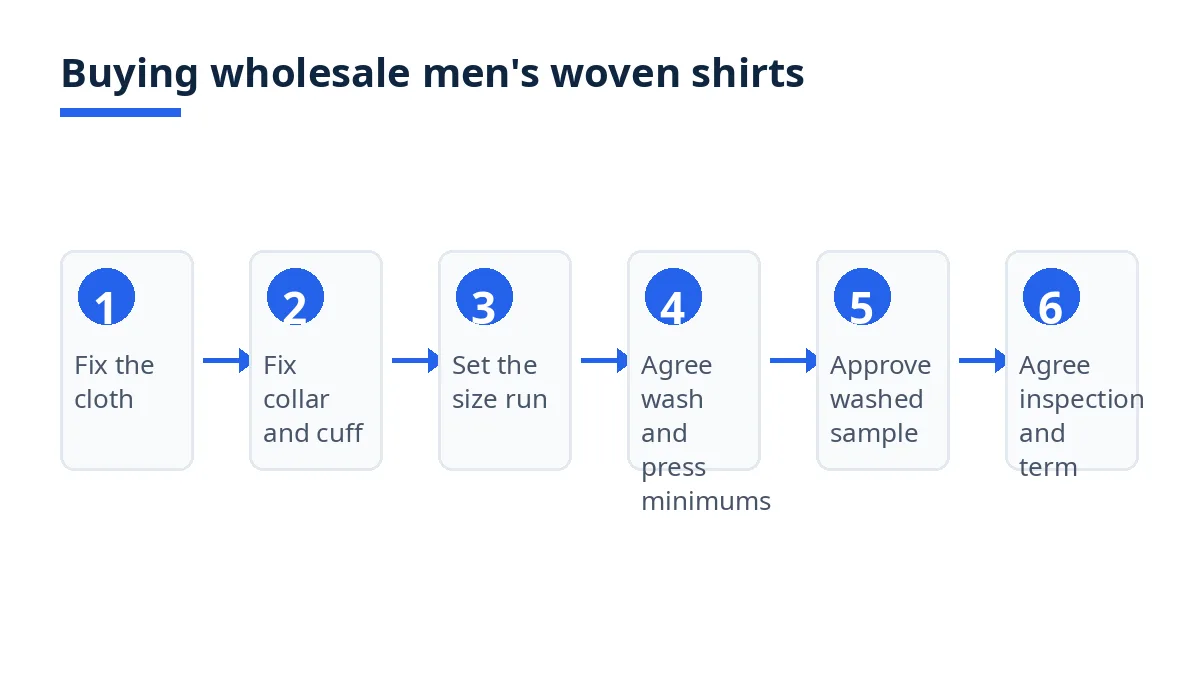
Begin with cloth, and name the dye route in the same breath. State the weave, such as poplin, oxford or twill, the yarn count, the cloth weight and the fibre composition, plus whether the cloth is stocked, mill-dyed to your colour or yarn-dyed for a stripe or check. A yarn-dyed stripe needs its own warp plan, so it carries a different minimum from a solid mill-dyed cloth.
Fix the collar and cuff on paper. State the collar style, point length, collar stand height, interlining type and weight, cuff style, cuff height and button count, and the button stance. Ask the factory to confirm which interlining it stocks and which it must buy in for your order.
Set the size run as a ratio, not a total. Give the quantity per size for each colour, and state whether dress sizes are ordered by neck and sleeve or by S to XXL. A size run heavy in middle sizes and thin at the ends changes the cutting marker and the pressing plan.
Agree the wash and press minimums in writing. Ask for the laundry load minimum per wash recipe and the pressing line minimum per style, and record whether each colour runs in its own load. A small colour can fail the wash minimum even when the order total is large.
Approve a washed and pressed sample. Order a proto sample, then a pre-production sample in your actual cloth, collar, cuff, buttons and labels. Wash and press it by the method the bulk order will use, measure the collar point, cuff and body after washing, and approve or list corrections in writing.
Agree inspection and the delivery term before you confirm. Write the inspection level and acceptance quality limit (AQL) values into the purchase order. ISO 2859-1 defines a system of acceptance sampling plans for inspection by attributes, indexed by AQL for lot-by-lot inspection.5 State one Incoterm and named place for every quotation, since the Incoterms 2020 rules set out 11 rules with a clear allocation of cost, risk and obligations.6
Costs, timelines and documents
What are the typical costs and timelines?
A shirt quotation is a bundle of lines, not a single unit price, so no guide can publish a typical figure. The factory builds its price from your cloth, your collar and cuff construction, your buttons and interlining, your wash and press, your labels and cartons, and the delivery term you choose.6
Cloth and collar move the price most. A finer yarn count costs more per metre and needs more careful handling at the collar, a fused collar adds interlining and a fusing pass, and a two-button or three-button cuff adds sewing and button-attaching time against a single-button cuff. A yarn-dyed stripe or check adds a warp plan and matching across the placket and pocket, which is work a solid cloth never needs. Wash and press add their own lines: a garment wash is charged by load, and a pressed shirt is charged by the pressing line it passes through, so a small colour that cannot fill a load carries the load cost alone.
Lead time is a chain of separate waits rather than one number. Cloth weaving or dyeing comes first, then interlining and button delivery, then cutting, sewing, laundry loads and pressing, then inspection. Get a date for each stage, not a single delivery week.
Cost line | What drives it | State in your enquiry |
|---|---|---|
Woven cloth | Weave, yarn count, weight, fibre, dye method | Weave, count, weight, composition, solid or yarn-dyed |
Collar and cuff | Style, interlining, fusing, button count | Collar and cuff spec, interlining, stance |
Buttons and trims | Material, size, colour match, lot size | Button material, size, colour, spare buttons |
Wash and press | Recipe, load size, pressing line | Wash recipe, press method, minimums per load |
Labels and cartons | Print runs per style and colour | Label wording, tag and carton spec |
Delivery term | Who pays freight and insurance, and where risk passes | One Incoterm and named place |
Example figures: a buyer orders 900 shirts in one colour across six sizes on the ratio 1-2-2-2-1-1. The ratio sums to 9 parts, so each part is 100 shirts, giving S 100, M 200, L 200, XL 200, XXL 100 and XXXL 100, which totals 900 shirts. The same 900 shirts split across three colours at 300 per colour can fail a wash load minimum that a single colour of 900 clears. The example shows structure only, not a typical price, minimum or lead time.
Which documents are needed?
Three papers carry the order: the tech pack, the itemized quotation and the purchase order. Each should carry the cloth, collar and cuff specification, the size ratio per colour, the wash and press minimums and the delivery term. For shipment, ask in writing who files the export declaration with Bangladesh Customs.7
Bangladesh-specific rules and tips
Treat a BGMEA claim as a lead to check, not as evidence about your shirt. If a supplier claims BGMEA membership, confirm it with the association itself. Around 60 per cent of BGMEA member factories are woven garment manufacturers, and BGMEA member factories account for 100 per cent of woven garment exports,2 but that describes the sector, not the collar quality, price or minimum on offer for your order.
Mismatched names stall paperwork. The export declaration names the exporter and the foreign buyer,7 so check that the trade licence, quotation, proforma invoice and payment account all carry the same name before the goods are ready. A mismatch found at shipment stage costs days, while the same check at quotation stage costs minutes.
Ask which inputs are imported for your order. Interlining, buttons and some yarns may be bought in for your specification, and an imported button or interlining can set both the minimum and the earliest sewing date. Agree the collar and cuff measurements after washing before bulk cutting, since a collar that measures correctly before washing can sit differently after it.
Check the stripe and check match before bulk. On a yarn-dyed stripe or check, the pattern must match across the placket, the pocket and the yoke. Ask the factory to show the match on the pre-production sample, since pressing cannot correct a bulk-cut mismatch.
Mistakes and red flags
What are the most common mistakes?
Quoting a shirt without a collar specification. A spread collar, a cutaway collar and a button-down collar need different interlining, fusing and sewing. A quotation that does not name the collar describes a different shirt from the one you plan to sell.
Ordering by total instead of by size run. A total of 900 shirts says nothing about how many necks and sleeves, or how many of each S to XXL size, the factory must cut. A run short at the ends of the range leaves the best-selling middle sizes stranded with slow sizes beside them.
A sample approved dry tells you little. A collar and cuff approved before washing can roll, pucker or shrink after the bulk wash. Approve the sample only after the same wash and press the bulk order will receive.
Price comparisons fail when the shirts differ. A lower price on a coarser yarn count, a soft unfused collar, a single-button cuff or a different delivery term is a different offer. Compare only replies to the same tech pack on the same Incoterm.6
Verbal flexibility evaporates. Any agreed smaller wash load, shared load or pressing arrangement should appear on the quotation and purchase order, with the colour and quantity it applies to, or it will not survive a change of personnel.
Badges do not sew shirts. A profile opens enquiries; it cannot show whether a factory fuses a collar cleanly, matches a stripe or presses to your standard, and a badge guarantees neither capacity, quality nor delivery.8
The final gate is measurement on a pressed, washed shirt. Sampling under ISO 2859-1 checks a lot against an agreed AQL,5 and for shirts that check should include collar point, cuff and body measurements taken after washing and pressing, not before.
Checklist
Before you confirm, every line should be answered in writing.
Collar and cuff specification confirmed: style, point length, interlining, fusing, button count, stance.
Cloth status per colour recorded: stocked, mill-dyed or yarn-dyed.
Size run stated per colour as a ratio, with neck and sleeve sizes for dress shirts or S to XXL for casual shirts.
Wash load minimum and pressing minimum confirmed per style and colour.
Button, interlining, label, tag and carton minimums confirmed apart from the shirt minimum.
Tech pack sent: cloth weave, yarn count, weight, composition, collar, cuff, placket, pocket, fit, buttons, labels, sizes, wash, press, packing.
Pre-production sample washed, pressed, measured and approved in writing.
Inspection level and AQL values in the purchase order, with measurements taken after washing and pressing.5
Quotations compared on the same specification and Incoterm.6
Order documents agreed: tech pack, itemized quotation, purchase order, with export filing responsibility named.7
How Exportain helps
Put the same shirt specification in front of suppliers on Exportain: browse suppliers, post the cloth, collar and cuff specification and size ratio per colour as an RFQ on the RFQ board, and read how supplier verification works on Exportain and the MOQ definition guide before comparing replies. Verification is a document and photo review, not a factory inspection.8 9
FAQs
What should I know first about men's woven shirts?
Know the cloth and the collar before you discuss money. The weave, yarn count, weight and dye method set the cloth price, and the collar style, interlining and cuff button count set the construction price. Men's shirts sit under heading 6205, which covers men's or boys' shirts within chapter 62, articles of apparel not knitted or crocheted.3
What are the typical costs and timelines?
No published figure covers your shirt, since each factory sets its price, minimum and lead time for your specification. Cloth, collar and cuff construction, wash and press, the size run and the delivery term drive the price,6 and cloth readiness, sewing capacity, laundry loads and pressing capacity drive the timeline.
Which documents are needed?
You need three order papers: the tech pack, the itemized quotation and the purchase order, with the cloth, collar and cuff specification and the size ratio per colour on all three. Shipment paperwork follows the export declaration route described in the costs section.7
What are the most common mistakes?
Buyers most often slip on four points: quoting without a collar specification, ordering by total instead of by size run, approving a sample before washing, and comparing quotations on different cloths or terms.6 A badge is not a guarantee of capacity, quality or delivery.8
Next steps on Exportain
Start on the suppliers directory, post your specification and size ratio on the RFQ board so suppliers state minimums per colour and wash load, then read how to import men's woven shirts from Bangladesh, the men's woven shirts quality control checklist and the MOQ definition guide before confirming.
Sources
- Exports up over 6% to $13.1bn in Q1 of FY27. Dhaka Tribune, (accessed )
- BGMEA sets new membership criteria to ensure factory safety, operational standards. The Financial Express, (accessed )
- HSN Code for Mens or boys shirts of cotton. BUSY (accessed )
- Regulation (EU) No 1007/2011 on textile fibre names and related labelling and marking of the fibre composition of textile products. European Union, (accessed )
- ISO 2859-1:2026 - Sampling procedures for inspection by attributes — Part 1: Sampling schemes indexed by acceptance quality limit (AQL) for lot-by-lot inspection. ISO (accessed )
- Incoterms® 2020. International Chamber of Commerce (ICC) (accessed )
- Customs Clearance Procedures for Export. Bangladesh Customs, National Board of Revenue (accessed )
- Trust & Safety Center. Exportain (accessed )
- Supplier verification: Earn trust badges buyers can see. Exportain (accessed )
About the author
Sourcing from Bangladesh?
Post a request for quotation and suppliers on Exportain can send you their quotes directly.
Post an RFQ