

Wholesale Medical Scrubs From Bangladesh: Prices, MOQ and Reliable Suppliers
No single wholesale scrub price or MOQ in Bangladesh: what sets the minimum per colour and size, how pocket build and wash durability move programme cost, and how clinic chains and distributors compare suppliers.
Short answer
There is no single wholesale price or minimum order quantity for medical scrubs from Bangladesh. Each factory prices your fabric, pocket construction, laundering durability, department colours and size split, usually per colour and per size rather than for the order as a whole. Ask for the minimum per colour and per size in writing, approve a wash-tested sample, and compare quotations only on the same specification and delivery term.

On this page
Key takeaways
There is no single wholesale scrub price or MOQ in Bangladesh: each factory prices your fabric, pocket construction, laundering durability, department colours and size split, per colour and per size.
A scrub set is clinical workwear, not a barrier-rated surgical gown: ASTM F2407 addresses gowns, so any protective claim needs its own standard and test evidence.
Programme cost means cost per month of service: wash-life, shade retention across department colours and pocket durability decide the real price, not the first unit price.
Approve a wash-tested sample through the end user's own routine, confirm the minimum per colour and per size in writing, and hold fabric, dye recipes and embroidery files for top-ups.
Exportain verification is a document and photo review, not a factory inspection, and a badge is not a guarantee of capacity, quality or delivery.
A clinic chain does not buy scrub sets one carton at a time. It buys a colour-coded programme that must hold together across wards, sites and hiring rounds: the same navy for one department and the same teal for another, in every size on staff, with replacement sets that match the original batch months later. A distributor faces the same test, stocking a programme clinics can reorder by size and colour without re-approving it. This guide judges a wholesale scrub order on programme cost across its wash life, not on the unit price of the first quotation.
Bangladesh has depth in both constructions scrubs use. The Bangladesh Knitwear Manufacturers and Exporters Association (BKMEA), established in 1996, represents approximately 2,540 knitwear member factories.1 Ready-made garment exports reached $10.578 billion in July to September of fiscal year 2026-27, with woven garments at $4.614 billion and knitwear at $5.963 billion in the same quarter, according to Export Promotion Bureau data reported by The Financial Express.2 Woven scrubs draw on the woven pool, knit on the knit pool. No factory publishes one wholesale scrub price or minimum for every buyer; each prices the fabric, pocket work, wash durability and size split in the enquiry.
Why this matters for buyers and sellers
What should I know first about medical scrubs?
Know what a scrub set is and what it is not. A scrub top and trouser are everyday workwear for clinical staff, cut for movement, frequent laundering and pocket carrying. They are not barrier-rated surgical gowns. ASTM F2407 sets performance, documentation and labelling requirements for surgical gowns used in healthcare facilities, including barrier testing of critical zones and properties such as tensile strength, tear resistance and seam strength.3 That standard addresses gowns, not scrub sets, so quoting scrub sets against a gown barrier level answers the wrong specification. If any piece must meet a barrier standard, name it separately and ask for its test evidence.
For a programme buyer, the cost that matters is cost per month of service. A set washed several times a week wears at pocket corners, waist casing, neckline binding and hem, and a drifting department colour fails the programme even when each garment is individually sound.
For sellers, a programme account is steadier than a single order, but it carries a matching obligation. A factory that keeps the approved fabric, dye recipe, pocket pattern and embroidery file can fill top-ups without re-approving the programme; one that treats each order as a new style cannot. Judge a supplier on whether it will hold those items in writing, not only on the first-order unit price.
Step-by-step: how it works
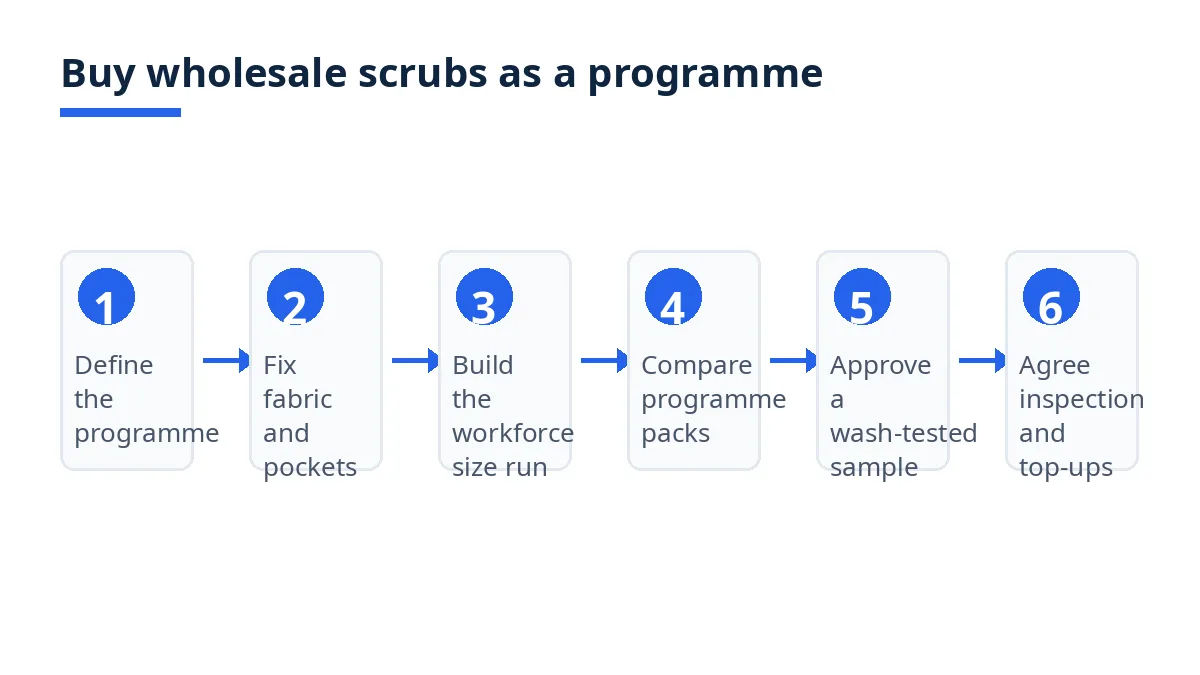
Define the programme, not just the set. List every department colour with a shade reference, the top style and the trouser style for each department, and state whether the order is sets only, or sets plus separate tops and trousers, since separates change assortment and packing.
Fix the fabric, pocket and trim specification. State fibre blend, weight and construction, and whether the fabric is a woven twill or a knit. Then specify every pocket: chest pocket size, trouser side pockets, cargo pockets if any, pen slots and any instrument loop, with corner reinforcement.
Build the size run from the workforce, not a generic chart. Give the quantity per size for tops and trousers separately, state whether the cut is unisex or gendered, and whether tall or petite lengths are included. A programme must cover the smallest and largest wearers on staff.
Send one programme pack to several suppliers. Ask each factory to quote the same fabric, pocket build, colour set, size split, embroidery and packing, with set-up costs apart from the unit price and the minimum per colour and per size.
Approve a wash-tested sample, not a visual sample. Order a pre-production sample in bulk fabric and department colours, with pockets, drawstring and embroidery finished as in bulk. Wash it through the routine the end user will actually use, then check pocket corners, drawstring casing, shade, shrinkage and seam puckering before approving in writing.
Agree inspection, packing and replenishment before confirming. Write the inspection level and AQL values into the purchase order; ISO 2859-1 defines AQL-indexed sampling schemes for lot-by-lot inspection, and AQL is the maximum average percentage of defective items considered acceptable in random sampling.4 Agree packing by colour and size, one Incoterm and named place for every quotation,5 and whether the factory will hold fabric, dye recipes and embroidery files for top-ups and for how long.
See the medical scrubs quality control checklist for pocket, seam and wash points.
Costs, timelines and documents
Programme cost rests on four drivers: scrub fabric, pocket construction, laundering durability and the size run.
Cost driver | What it changes | State in your enquiry |
|---|---|---|
Scrub fabric | Blend, weight and weave or knit set material cost and wash behaviour | Blend, weight, construction, stocked or dyed to order |
Pocket construction | Pocket count, size, reinforcement and pen slots add cutting and stitching time | Pocket map, reinforcement, stitching spec |
Laundering durability | Wash testing, shade retention and seam strength work add cost | Wash routine, cycle target, test method, shade standard |
Size-run costs | Many sizes in small quantities raise cutting cost per piece | Quantity per size, colour and garment |
Department colours | Each colour is a separate dye lot and shade commitment | Colour list, shade references, quantity |
Embroidery and labelling | Logo digitising, placements and label runs are fixed costs | Artwork, placements, label and tag spec |
Delivery term | The Incoterms rule chosen decides who pays freight and insurance | Named Incoterms 2020 rule and place5 |
Fabric cost follows blend and weight; a dyed-to-order department colour carries its dye lot, while a stocked colour may not. Pocket cost follows the pocket map: each added pocket means extra cutting pieces, stitching rows and inspection points, and a bellowed cargo pocket consumes more fabric than a flat patch pocket.
Laundering durability cost is the line programme buyers most often miss. ISO 15797 gives test procedures and equipment for evaluating workwear intended to be industrially laundered, covering properties such as dimensional stability, colour fastness, creasing and seam puckering, with eight washing procedures and two drying procedures.6 Ask which washing procedure the fabric was tested under, then put the sample through the end user's own routine as well; a laboratory procedure and a hospital laundry are not the same wash.
Programme cost per month of service is where those drivers combine. Example figures: a set that survives 75 washes before pocket failure serves roughly twice as long as a set that fails at 35 washes under the same routine, so its programme cost per month of service is roughly half even at the same purchase price. Example figures: a drifting department colour forces early replacement of the whole batch, not just faded sets, because the programme requires matching sets. Treat every such figure as illustrative only. Each factory sets its own price for the specification given, with minimums per colour and per size.
What are the typical costs and timelines?
There are no typical scrub costs or timelines a guide can state as fact, because each factory prices your fabric, pocket map, wash requirement, colour set, size run and delivery term separately.5 Timelines depend on fabric availability first: a stocked scrub fabric can move to sampling at once, while a dyed-to-order department colour sets the earliest cutting date. After fabric, the timeline follows sample corrections, the wash test, grading, sewing capacity and inspection. Ask for fabric ready, sample approval, wash-test result, production, inspection and shipment dates as separate lines.
Which documents are needed?
The order documents are the tech pack with pocket map and size run, the itemized quotation with set-up costs apart from the unit price, the purchase order with size and colour split and inspection plan,4 and the written sample and wash-test approvals. For the Bangladesh export side, confirm the current Bill of Export requirements with Bangladesh Customs before loading.7
Bangladesh-specific rules and tips
Match the construction to the supplier pool. Woven scrubs and knit scrubs come from different factory groups, and a programme mixing the two may need two factories or a supplier that openly places one part elsewhere. Ask which garments are made in-house and which are placed elsewhere, in writing before sample approval. BKMEA represents the knitwear sector,1 so a knit scrub claim can be checked against the association, but membership does not prove capacity for your programme or the price on offer.
Hold the shade per department, not just the fabric name. Two fabrics both described as teal scrub twill can differ visibly, and a replacement set in a drifted shade breaks department colour coding. Keep a sealed shade swatch per department colour from the approved sample, and require bulk shade checks against it before cutting.
Do not let a gown claim stand in for a scrub specification. If a supplier describes scrub sets as barrier-rated, ask which standard, which barrier level and which test report supports the claim. ASTM F2407 covers surgical gowns and their barrier testing,3 and it does not turn a scrub set into a gown. Keep the scrub specification and any protective claim as two separate lines in the tech pack.
Treat the label as part of the set. For sales into the European Union, Regulation (EU) No 1007/2011 requires textile products to be labelled with the name and percentage by weight of all constituent fibres in descending order.8 Scrub labels also carry size, care and department identification, so approve label artwork with embroidery artwork and check it on the smallest sample.
Plan top-ups before the first bulk order ships. Ask in writing whether the factory will hold the approved fabric, each department dye recipe, pocket pattern and embroidery file, what minimum applies to a top-up per size and colour, and how long that hold lasts. Without a replenishment answer, the programme becomes a new sourcing project at every hiring round or wear-out.
Mistakes and red flags
What are the most common mistakes?
Buying scrubs as if they were gowns. A barrier level quoted for a surgical gown does not describe a scrub set. Ask for the actual standard and test report behind any protective claim.3 No named standard means no claim.
Approving a sample without washing it. An unwashed sample hides shrinkage, shade loss, pocket corner fraying and drawstring shrinkage. Wash the pre-production sample through the real routine and approve the washed measurements in writing.6
Ordering sets and separates on the same size curve. Tops and trousers are sized and stocked differently, and a single curve for both produces tops in sizes no one wears and trouser shortages in the sizes actually needed. Build the two curves separately from workforce data.
Splitting department colours too thinly. Each department colour is a dye lot, a shade commitment and a packing split. A programme with many colours in small quantities can clear the order total while falling below the per-colour minimum for one department, drawing a surcharge or removal.
Comparing quotations on different pocket maps. A lower price on a top with one pocket is not a lower price for your five-pocket scrub top. Compare only replies to the same pocket map, fabric, colour set and delivery term.5
Accepting a verbal minimum or top-up promise. Record any agreed minimum, shared dye lot and fabric, dye recipe and embroidery hold on the quotation and purchase order, with the split it applies to.
Reading a profile or badge as proof of scrub capacity. A profile is a starting point for enquiries, and a badge records a document and photo review, not a factory inspection or a wash test.9 Sample approval, wash testing and inspection stay with you.
Checklist
Before you confirm, every line should be answered in writing.
Programme defined: departments, colours with shade references, styles, sets or separates.
Fabric stated: blend, weight, woven or knit, stocked or dyed to order per colour.
Pocket map complete: every pocket, pen slot and loop, with reinforcement and stitching spec.
Size run built per garment from workforce data, including extremes, tall and petite.
Minimum confirmed per colour and per size; binding line named.
Embroidery and label runs priced apart from the unit price; paid set-ups recorded.
Sample washed through the real routine, measured and approved in writing.6
Inspection level and AQL values in the purchase order.4
Quotations compared on the same pocket map, fabric, colour set and Incoterm.5
Packing agreed by colour and size; replenishment hold confirmed.
Export paperwork confirmed with the supplier before loading.7
How Exportain helps
Browse suppliers and post your scrub programme pack, pocket map, department colours and size split as a request for quotation on the RFQ board, so suppliers quote against the same specification and state their minimum per colour and size. Read seller verification and the MOQ definition guide before you confirm, and remember that verification is a document and photo review, not a factory inspection.9 10
FAQs
What should I know first about medical scrubs?
A scrub set is clinical workwear for movement, pocket carrying and frequent laundering, not a barrier-rated surgical gown. ASTM F2407 addresses surgical gowns and their barrier testing,3 so keep any protective claim separate with its own evidence. Programme cost moves on fabric, pocket construction, laundering durability and the size run, with each department colour a separate dye lot and shade commitment.
What are the typical costs and timelines?
No typical figures exist, because each factory sets its price, minimum and lead time for your specification. Fabric, pocket work, wash durability, colour set, size fragmentation and delivery term drive the price,5 and fabric availability, sample corrections, wash testing and line capacity drive the timeline. Ask for each stage as a dated line.
Which documents are needed?
The order documents are the tech pack with pocket map and size run, the itemized quotation, the purchase order with colour and size split and inspection plan,4 and the written sample and wash-test approvals. Confirm the current Bill of Export requirements with Bangladesh Customs before loading.7
What are the most common mistakes?
Common mistakes are treating a scrub set as a barrier gown,3 approving a sample without washing it,6 using one size curve for tops and trousers, splitting department colours below their per-colour minimum, comparing quotations on different pocket maps or terms,5 and reading a badge as proof of capacity.9 A badge records a document and photo review, not a factory inspection.
Next steps on Exportain
Browse suppliers, then post your scrub programme pack, pocket map, department colours and size split on the RFQ board so suppliers state their minimum per colour and size. Before you confirm, read the MOQ definition guide.
Sources
- BKMEA at a Glance. BKMEA (accessed )
- Merchandise exports rise 6.34pc to $13.09b in Q1 FY27: EPB. The Financial Express, (accessed )
- ASTM F2407/F2407M-23 Surgical Gowns for Healthcare Facilities. ASTM International, (accessed )
- ISO 2859-1:2026 - Sampling procedures for inspection by attributes — Part 1: Sampling schemes indexed by acceptance quality limit (AQL) for lot-by-lot inspection. ISO (accessed )
- Incoterms® 2020. International Chamber of Commerce (ICC) (accessed )
- EN ISO 15797:2018 Industrial Washing Tests for Workwear Textiles. CEN, (accessed )
- Customs Clearance Procedures for Export. Bangladesh Customs, National Board of Revenue (accessed )
- Regulation (EU) No 1007/2011 on textile fibre names and related labelling and marking of the fibre composition of textile products. European Union, (accessed )
- Trust & Safety Center. Exportain (accessed )
- Supplier verification: Earn trust badges buyers can see. Exportain (accessed )
- MOQ
- supplier verification
- buyer guide
- Bangladesh sourcing
- bangladesh garments
- Workwear and uniforms
- Medical scrubs
- Wholesale
About the author
Sourcing from Bangladesh?
Post a request for quotation and suppliers on Exportain can send you their quotes directly.
Post an RFQ


