

Wholesale LED Bulbs From Bangladesh: Prices, MOQ and Reliable Suppliers
Wholesale LED bulb buying from Bangladesh is lot buying: tiers per line, assortment balanced by sell-through, driver batches kept consistent, and replenishment planned line by line. This guide shows how to structure the order.
Short answer
Wholesale LED bulbs from Bangladesh are bought as a line list, not as a single total. Each line is defined by wattage, cap, colour temperature and driver type, with its own tier, carton quantity and batch record. Buyers should balance quantities by sell-through, require a stated colour temperature tolerance and driver batch rule, approve a sample from the actual batch, and agree inspection, lot warranty and replenishment terms before confirming.
On this page
Key takeaways
A wholesale LED bulb order is a line list: each line is defined by wattage, cap, colour temperature and driver type, with its own tier, carton quantity and batch record.
Tiers are set per line and counted in pieces, cartons or master cartons, so the counting unit must be stated on every tier.
Assortment quantities should follow sell-through per line, not equal splits, or fast lines run out while slow lines sit in stock.
Batch consistency is a contract term: a stated colour temperature tolerance, a driver batch rule, notice before a batch change, and a batch test record per lot.
Exportain verification is a document and photo review, not a factory inspection, and a badge is not a guarantee of capacity, quality or delivery.
A distributor reorders a fast-selling household bulb and the new cartons arrive with a visibly warmer white than the cartons already on the shelf. Customers notice, returns rise, and the distributor holds two versions of what was sold as one product. That is the central risk in wholesale LED bulb buying.
Wholesale buying from Bangladesh starts with the line list, not the headline price. A wholesale order is a set of lines, each defined by wattage, cap, colour temperature, and driver type, with its own quantity, carton count, and test record.
What should I know first about LED bulbs?
What should I know first about LED bulbs?
A self-ballasted LED lamp is a lamp with integrated means for stable operation, made for domestic and similar general lighting purposes. IEC 62560 covers such lamps with a rated wattage up to 60 W and a rated voltage above 50 V up to 250 V, and it sets safety and interchangeability requirements.1
In the Harmonized System, heading 8539 covers electric filament or discharge lamps, sealed beam lamp units, ultraviolet or infra-red lamps, arc lamps, and light-emitting diode (LED) light sources, with LED lamps under subheading 8539.52.2 See the HS code for LED bulbs guide before you confirm a line list.
Four attributes define every line. Wattage sets power draw and, with luminous flux, light output. Cap sets the fitting the bulb screws or plugs into, and a wrong cap makes a whole carton unsellable in a market that uses a different holder. Colour temperature, in kelvin, sets whether the light reads warm, neutral, or cool. Driver type sets how the lamp handles voltage and dimming, and driver differences between batches commonly cause flicker complaints even when wattage and cap match. Ask for the colour temperature tolerance, the luminous flux range, and the driver batch identifier, and record them on the quotation.
Why this matters for buyers and sellers
For a buyer, the wholesale structure decides how much cash is tied up in slow lines and how often a fast line runs out. A large quantity of a single wattage may carry a lower unit price and still lose money, because slow wattages sit in the warehouse while the fast wattage needs an emergency reorder. For a seller, the structure decides whether a line can be produced at all: a driver run, a cap run, and a carton print run each have their own economics.
The first lot also sets the reference for every later lot. If it used one driver batch and one LED bin, the second lot must match it or the buyer must be told, before shipment, that it does not. Batch consistency is therefore a contract term, and it belongs on the purchase order beside the line list.
Two controls keep that structure honest. Sampling under ISO 2859-1 defines a system of acceptance sampling plans for inspection by attributes, indexed by acceptance quality limit (AQL) for lot-by-lot inspection.3 AQL is the maximum average percentage of defective items considered acceptable during random sampling, and it determines sample sizes and acceptance or rejection thresholds.3 The Incoterms 2020 rules give 11 rules with a clear allocation of cost, risk, and obligations.4 Compare lot prices only on the same term and the same line list.
Step-by-step: how it works
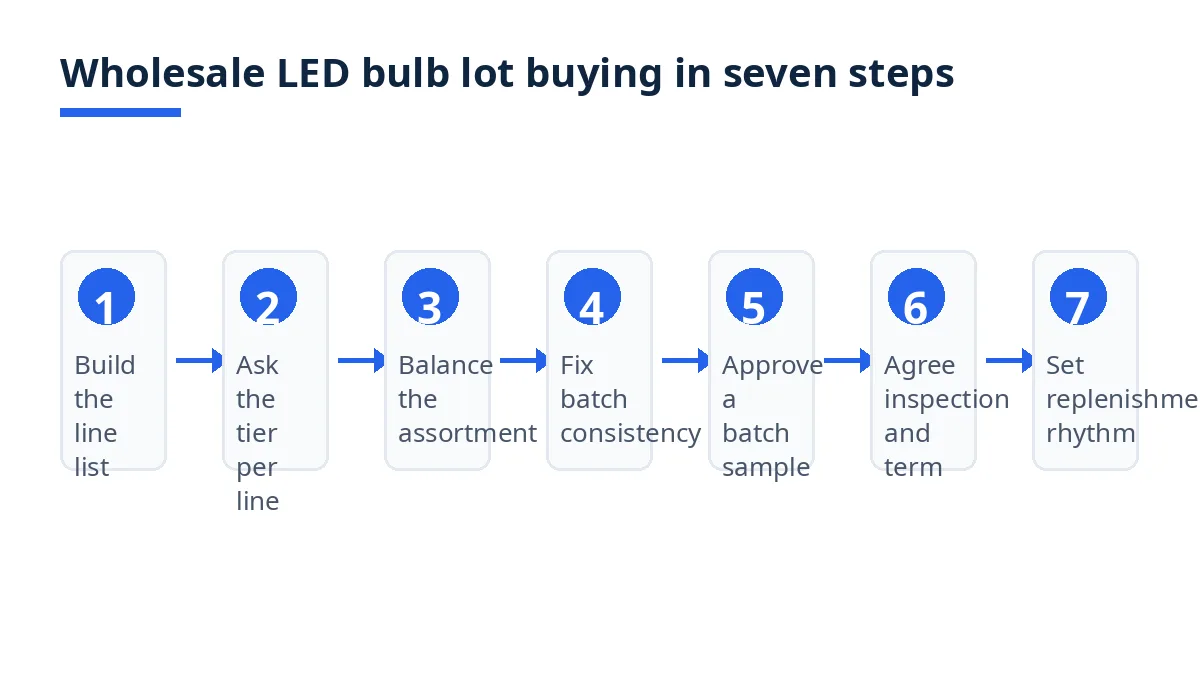
Build the line list before you ask for a price. Every wattage, cap, colour temperature, and driver type is a separate line, with its quantity.
Ask for the tier per line, not per order. Ask where the price changes for each line, and whether tiers count per line, per carton, or per master carton.
Balance the assortment across lines. Set each quantity from sell-through, not from equal splits.
Fix batch consistency in writing. State the tolerance, the driver batch rule, the test record per batch, and what happens on a batch change.
Approve a sample from the actual batch. Test cap fit, colour temperature, and driver behaviour on your market voltage and dimmer type.
Agree inspection, packing, and the delivery term before you confirm. Write the inspection level and AQL values into the purchase order,3 state carton quantities per line, and state one Incoterm and named place per quotation.4
Set the replenishment rhythm with the first order. Agree reorder intervals, safety stock per line, and the notice period for a batch or driver change.
Wholesale tiers and assortment balancing
Wholesale tiers are the quantity bands at which a supplier changes the unit price, and in LED bulbs they are set per line. A tier may be counted in pieces, in cartons, or in master cartons, and the counting unit changes the result. A line quoted per carton with 50 pieces per carton reaches a 500-piece tier at 10 cartons, while the same line quoted per master carton with 200 pieces reaches it at two and a half master cartons, which cannot be shipped whole. Ask for the counting unit on every tier.
Tier level | What it usually means | What to confirm |
|---|---|---|
Per line | Price band for one wattage, cap, and colour temperature | Quantity counted per line, not per order |
Per carton | Price band by inner carton count | Pieces per carton for that line |
Per master carton | Price band by outer carton count | Master carton quantity and whether mixed lines are allowed in one master carton |
Assortment balancing turns a line list into a sellable range. Example figures: a buyer sets 1,000 pieces for a fast household wattage, 400 pieces for a second wattage, and 200 pieces each for two slower colour temperatures of the same wattage. The total is 1,800 pieces, but the order is four lines, not one lot of 1,800. Split equally, the fast line would run out early and the slow lines would sit in stock. The example shows structure only, not a typical quantity, price, or lead time.
Balance by past sell-through per line, the range you must keep complete, and carton rounding per line. A line that exists only to complete a range can be ordered at its minimum carton quantity, while a fast line is ordered to the next tier that actually lowers the unit price. Ask whether a tier price holds when a line is split across two driver batches, and whether a batch change triggers a new sample approval.
Costs, timelines and documents
What are the typical costs and timelines?
There are no typical costs or timelines a guide can state as fact for wholesale LED bulbs, because each supplier prices your line list, driver type, cap, colour temperature, packing, and delivery term separately. Price drivers to test are the LED and driver selection, the cap and housing, the carton structure, the batch test record, and the delivery term.4
For timelines, sampling depends on whether the driver and cap combination is already in production, bulk production on component availability and line capacity, and inspection on the agreed AQL plan.3 Ask for sampling, production, inspection, and shipment dates as separate lines, not a single delivery week.
Example figures: two quotations for the same line list differ in price because one allows a wider colour temperature tolerance, while the other holds a tighter tolerance with a batch test record per lot. The difference is a different specification, not a discount. The example shows structure only, not a typical price or lead time.
Which documents are needed?
For export clearance in Bangladesh, goods may not be loaded unless an export declaration, the Bill of Export or Shipping Bill, is submitted to Customs and approved.5 Enclosed documents include the export contract or purchase order where there is no export letter of credit, the commercial invoice, the packing list, the EXP form certified by an authorized dealer, and a certificate of origin issued by the EPB or a Chamber of Commerce and Industry.5
For the order itself, the documents are the line list, the itemized quotation with tiers per line, the purchase order with batch consistency terms, the sample approval, the batch test record per lot, and the inspection report against the agreed AQL plan.3 Keep the batch test record with the carton labels for each line, so a warranty claim can be traced to a batch.
Bangladesh-specific rules and tips
For the European market, the European Commission lists light sources under Regulation (EU) 2019/2020 for ecodesign and Regulation (EU) 2019/2015 for energy labelling.6 Before the first lot, confirm which regulation and label apply to each line, and ask the supplier for the declared luminous flux, wattage, and colour rendering values that the label and declaration will carry.
On the Bangladesh side, the national standards body has made use of the BSTI label mandatory for seven new products, including LED luminaires.7 A bulb line and a luminaire line are different products, so ask the supplier, in writing, whether your line falls under a mandatory BSTI requirement and what certificate or label applies to it.
Keep one legal name across every paper. The export declaration names the exporter and the foreign buyer,5 so the name on the trade licence, quotation, proforma invoice, and payment account should match. Ask which components are bought in for your lines: a bought-in driver can set both the tier and the earliest production date for a line.
Mistakes and red flags
What are the most common mistakes?
Ordering a total instead of a line list. A single total hides slow lines, a wrong cap, and a mixed colour temperature, and an order without a line list cannot be inspected, replenished, or warranted line by line.
Comparing tier prices on different specifications. A lower tier price on a different driver batch, a wider tolerance, or a different delivery term is a different offer.4 Compare only replies to the same line list on the same term.
Accepting a batch change without notice. A new driver batch or LED bin can change colour or flicker behaviour while wattage and cap stay the same. Require notice before shipment and a new sample when a batch changes.
Mixing colour temperatures in one shelf line. Two deliveries sold under one line code but made to different colour temperatures create returns that no price saving covers. Keep one line code per tolerance.
Treating a profile or a badge as a factory check. Exportain verification is a document and photo review, not a factory inspection, and a badge is not a guarantee of production capacity, product quality, or delivery.8 Sample approval and inspection stay with the buyer.
Skipping the batch test record. Sampling under ISO 2859-1 checks a lot against an agreed AQL,3 and the batch test record ties that result to a specific driver batch. Without it, a warranty claim cannot be traced to the batch that failed.
Agreeing warranty in words, not in lot terms. A warranty that does not state when the clock starts, how defective units are counted, and whether replacements arrive with the next replenishment or as a separate shipment will be disputed at the first claim. Write those terms into the purchase order.
Checklist
Before you confirm a wholesale lot, every line should be answered in writing.
Line list sent: wattage, cap, colour temperature, driver type, quantity per line.
Tier confirmed per line, with counting unit: pieces, cartons, or master cartons.
Carton and master carton quantities confirmed per line, with whole-carton rounding.
Assortment balanced by sell-through per line, not by equal splits.
Tolerance, luminous flux range, and driver batch rule recorded per line.
Batch change rule agreed: notice before shipment, new sample, or new line code.
Sample from the actual batch approved in writing, including cap fit and driver behaviour.
Inspection level and AQL values in the purchase order.3
Quotations compared on the same line list and the same Incoterm.4
Replenishment rhythm agreed: reorder interval, safety stock per line, notice period for batch changes.
Lot warranty terms agreed: warranty clock start, defective counting, replacement route, failed-unit handling.
Export set agreed: invoice, packing list, EXP form, certificate of origin, Bill of Export.5
How Exportain helps
On Exportain, browse suppliers and post a request for quotation (RFQ) on the RFQ board with your line list, tier questions, and batch consistency terms, so suppliers quote against the same lines. When you accept a quotation, Exportain creates one order and issues one proforma invoice from the accepted terms.8
Read the badges for what they record. Exportain Verified means Exportain has checked identity, phone, email, and business registration, and Export Verified means it has checked the Export Registration Certificate (ERC).8 Factory Verified means it has reviewed photos of the manufacturer factory, while Trading Company Verified means it has reviewed photos of the trading company office or warehouse.8 Verification is a document review by staff, free, and never granted by membership plans.9 It is not a factory inspection,8 9 so sample approval, batch records, and inspection stay with you. See how supplier verification works on Exportain.
FAQs
What should I know first about LED bulbs?
Start with the line, not the price. A wholesale line is defined by wattage, cap, colour temperature, and driver type. IEC 62560 covers self-ballasted LED lamps for general lighting with a rated wattage up to 60 W and a rated voltage above 50 V up to 250 V.1 Heading 8539 covers LED light sources, with LED lamps under subheading 8539.52.2
What are the typical costs and timelines?
There are no typical figures a buyer can rely on, because each supplier prices your line list, driver type, cap, colour temperature, packing, and delivery term separately.4 Sampling, component availability, production, and inspection against the agreed AQL plan drive the timeline.3
Which documents are needed?
The order documents are the line list, the itemized quotation with tiers per line, the purchase order with batch consistency and lot warranty terms, the sample approval, the batch test record, and the inspection report.3 The export set is the Bill of Export, commercial invoice, packing list, EXP form certified by an authorized dealer, and a certificate of origin issued by the EPB or a Chamber of Commerce and Industry.5
What are the most common mistakes?
The most common mistakes are ordering a total instead of a line list, comparing tier prices on different specifications or terms,4 accepting a driver batch change without notice, mixing colour temperatures under one line code, and reading a badge as a guarantee.8 A badge is not a guarantee of capacity, quality, or delivery, and a batch change without a new sample is how a replenishment lot stops matching the first lot.
Next steps on Exportain
Browse suppliers, then post your line list and batch consistency terms on the RFQ board so suppliers state their tier per line and their driver batch rule. Before you confirm, read how supplier verification works on Exportain and the MOQ definition guide.
Sources
- IEC 62560:2011 - Self-ballasted LED-lamps for general lighting services by voltage > 50 V - Safety specifications. International Electrotechnical Commission, (accessed )
- HS Code 8539. Flexport (accessed )
- ISO 2859-1:2026 - Sampling procedures for inspection by attributes — Part 1: Sampling schemes indexed by acceptance quality limit (AQL) for lot-by-lot inspection. ISO (accessed )
- Incoterms® 2020. International Chamber of Commerce (ICC) (accessed )
- Customs Clearance Procedures for Export. Bangladesh Customs, National Board of Revenue (accessed )
- Ecodesign. European Commission (accessed )
- Bangladesh Standards and Testing Institution (BSTI). The Daily Star (accessed )
- Trust & Safety Center. Exportain (accessed )
- Supplier verification: Earn trust badges buyers can see. Exportain (accessed )
About the author
Sourcing from Bangladesh?
Post a request for quotation and suppliers on Exportain can send you their quotes directly.
Post an RFQ


