Wholesale Leather Belts From Bangladesh: Prices, MOQ and Reliable Suppliers
Buy wholesale leather belts from Bangladesh as an assortment: fix types, widths, colors, buckle finishes, and the size curve, count the minimum per variant, and approve a sample before bulk.
Short answer
Wholesale leather belts from Bangladesh are bought as an assortment, not a single style: fix the belt types, widths, colors, buckle finishes, and size curve first, then count the minimum per style, per color, and per buckle finish. Compare quotations only on one identical specification, confirm classification at subheading 4203.30, check leather and tannery evidence, and approve a sample in your own leather before the bulk order.
On this page
Key takeaways
A wholesale order is an assortment: belt types, widths, colors, buckle finishes, and a size curve. Price the assortment, not one belt.
Count the minimum per style, per color, and per buckle finish. Example figures: 300 per combination across 4 styles, 3 colors, and 2 finishes is 7,200 pieces.
Belts sit indicatively at HS subheading 4203.30. Confirm the full national code in the destination tariff for each belt type.
A badge records a document and photo review, not a factory inspection or a guarantee. Samples, inspection, and payment terms stay with the buyer.
A wholesale belt order is an assortment, not a single product. A distributor, retail chain, or workwear buyer buys wholesale leather belts from Bangladesh as a range that must sell across sizes, colors, and buckle finishes, then reorder. It starts from the assortment and size curve, counts the minimum across every variant, then turns to price, classification, and supplier checks. All figures here are examples. No factory or market price is stated.
Wholesale belt buying starts with the assortment, not the factory
Wholesale buying means buying finished belts for resale, in volume, under the supplier's range or to an agreed specification. The buying decision is the range itself: belt types, widths, colors, buckle finishes, and how many of each size. A factory that makes an excellent dress belt may be the wrong source for a heavy work belt.
Three buyer shapes buy differently: a distributor needs a broad range with depth across sizes for many doors; a retail chain needs a narrower seasonal drop, shelf-ready; a workwear buyer needs few styles in large repeats, identical order after order. Name your shape in the request for quotation.
Fix the belt before you shortlist anyone: one long strap worn under tension, judged at the waist on hole spacing, buckle seating, keeper hold, and edge finish.1 Settle strap construction, leather type and grain, buckle and keeper specifications, hole count and spacing, tip shape, edge finish, stitching, and lining or backing where fitted, and measure every belt flat, uncoiled, and relaxed, buckle to tip and buckle to each hole.1 A quotation omitting leather type, thickness, finish, and buckle cannot be compared with another.
The three wholesale channels, and when each one fits
Channel | What you buy | When it fits | Main risk |
|---|---|---|---|
Stock lines | The supplier's existing range, in its colors and sizes | A first range, a seasonal top-up, a fast reorder | Least control over leather, buckle, and shade |
Made-to-order wholesale | Your assortment, made to an agreed specification | A defined range you will repeat | Minimum applies per variant; longer wait |
Consolidator | A mixed range assembled from partner factories under one contract | A broad range no single workshop covers | The producing factory differs by style |
Stock lines suit a buyer testing a market; made-to-order wholesale suits a repeat program, with specification, leather, and buckle finish agreed in writing first. A consolidator suits breadth in one order, but ask which factory will make each style and get it named in the order terms before paying a deposit: a badge records checks for the profile holder only, not an inspection of a partner factory.2 A stock line reorders quickly while in production; a made-to-order range only as fast as the same leather and buckle can be sourced again.
Build the size curve before you price anything
A size curve is the split of an order across waist sizes, and the decision that most often strands stock: a belt size is a wearing length, so what matters is buckle to each hole, measured flat and relaxed.1 Agree size run, tolerances, and label markings before you ask for a price.
Example figures: a 1,200-piece order across five waist sizes might curve as 10, 20, 30, 25, and 15 percent in ascending size order. That illustrates the method, not a market pattern: build your curve from your own sales history.
Hole count, spacing, and alignment decide whether each size fastens at the right length, and holes must stay centered and far enough from the edge not to tear out.1 Check the hole run at the first, middle, and last holes, and write spacing and count into the specification.
What moves a wholesale belt price
Five drivers move a wholesale belt price: strap leather, buckle and hardware, construction, quantity per variant, and packing. Leather type, grain, thickness, and finish set the strap cost; buckle metal, size, and finish set the hardware cost; construction covers stitching, edge finishing, and lining.1 Changeovers and material minimums spread across the variant count, not the order total, and belts must be coiled so the strap does not crease or take a buckle mark.1
Example figures: for one illustrated belt, read the unit price as shares of an index of 100: strap leather 45, buckle and hardware 20, assembly 20, packing and inspection 15. Structure only; no real belt will match them exactly.
Compare quotations only on one identical specification, leather, buckle, and packing included. Each quotation states unit price, minimum, lead time, Incoterm, payment terms, and validity.3 Where prices are tiered, check both sides of every price break with example figures: an order just below a break can cost more in total than a slightly larger one.
Count the minimum across the whole assortment
A minimum order quantity is the smallest quantity a supplier will accept on its normal terms, counted per order, per style, or per color, sometimes combined with a minimum order value.3 The same number means very different commitments per color, per buckle finish, or per size group, and a supplier can apply more than one basis at once.
Example figures: 300 pieces per combination across 4 styles, 3 colors, and 2 buckle finishes means a smallest order of 7,200 pieces, not 300. Ask whether sizes share the per-color minimum and whether a buckle finish counts as a separate combination, and state quantity per style, color, and size run, leather and finish, trims, Incoterm, destination, and trial status in the request for quotation.3
Three drivers set the minimum: leather, trims, and variety. Custom leather brings the mill's minimum into the workshop's minimum, labels and buckles carry minimums of their own, and every extra color or finish adds changeovers.3 Levers include fewer colors, stock leather, standard buckles and trims, a surcharge, a shared lot or run, or an honest trial order.3 None is assured: record the answer in the quotation, not in messages.
Classification, leather evidence, and market rules for a resale range
Settle classification before you price. The indicative heading is 4203, articles of apparel and clothing accessories, of leather or of composition leather, with belts and bandoliers at subheading 4203.30.4 5 Confirm the subheading and full national extension in the official schedule for the exact belt type; never file one ten-digit code as universal.5 The United States lists 4203.30.00, a United States line only; the United Kingdom splits 4203.30 into hand-made and other.5
Two boundaries catch wholesale ranges: a strap made to hold a watch falls under heading 9113, not 4203, and belting leather or technical straps sit in heading 4205; a textile or plastics strap is outside heading 4203 even when its finish imitates leather.5 Name the belt type on every document and keep invoice and packing list in the same terms as classification.5 For a borderline belt, apply for a binding decision before shipping.5
Leather evidence matters most on repeat orders. The Leather Working Group audit covers 17 sections, including water and energy use, chemical management, waste and effluent treatment, and health and safety, with thresholds of 85 percent for Gold, 75 percent for Silver, 65 percent for Bronze, and 50 percent for Audited in each section.6 A manufacturer must reach its medal rating in every category or be certified at its lowest, and certification is valid for 24 months; traceability is rated separately, certification does not guarantee no restricted-substance failure, and for Gold and Silver chromium VI must stay below 3 mg/kg.6 Ask for evidence naming your leather and tannery, with scope and expiry, and confirm certificates with the issuing body.
The Leathergoods and Footwear Manufacturers and Exporters Association of Bangladesh (LFMEAB) is the trade body for manufacturers and exporters of leather products, footwear, synthetic, and allied factories in Bangladesh.7 A directory check proves membership only. Lab evidence should name the method and record the result against your specification, including ISO 17075 for colorfastness to rubbing where specified.1
Judge a wholesale supplier on repeat supply, not one shipment
A first shipment proves a belt can be made once; a wholesale supplier must repeat it in the same leather, color, and buckle finish, on the date agreed. Ask how the leather lot is held, what shade standard and light source apply, and what happens to price and lead time when a color is dropped. Grain and shade must hold along the full strap under the agreed light, with defects graded by position and size.1
Read each badge for the checks it records: Exportain Verified (identity, phone, email, business registration); Export Verified (Export Registration Certificate); Factory Verified (reviewed factory photos); Trading Company Verified (reviewed office or warehouse photos); Trusted Trader (completed orders on Exportain with no disputes).2 Verification is a document and photo review by Exportain staff, not a factory visit or a database check, and a badge is not a guarantee of capacity, quality, or delivery.2 Verification is free, and membership never grants a badge.2 Also read the trust and verification checklist, including the payment account line, which records the business bank account checked against the verified company name, with no bank details shown.2
Your own checks still decide the order: check company name and address across the trade license, Export Registration Certificate, quotation, and invoice; approve a pre-production sample in your leather, color, buckle, and edge finish; and agree the inspection plan in writing.1 As a published standard-table example only, a lot of 10,001 to 35,000 belts at General Inspection Level II, code letter M, sample size 315, gives acceptance and rejection numbers of 14 and 15 for major defects at AQL 2.5 and 21 and 22 for minor defects at AQL 4.0: buyer-agreed values, not mandates for belts.1 Put payment terms in writing, confirm bank details through a second channel, and treat any late change as a reason to pause. Exportain is not a party to your trade, does not inspect goods, book freight, or clear customs, and holds money only when both parties agree to a funds hold.2
Delivery terms, documents, and the reorder calendar
Incoterms 2020 allocates cost, risk, and obligations across 11 rules, used globally since 1936 and updated in 2020.8 Write the rule, named place or port, and edition into the contract, for example FOB Chattogram, Incoterms 2020. CIF is reserved for maritime trade with Institute Cargo Clauses (C) as default cover, while CIP requires the higher Clauses (A) cover.8 Under DAP the seller does not unload; under the renamed DPU rule the seller does, the sole difference between the two.8 An FOB price covers goods up to loading at the named port; freight beyond it is not in the unit price.3
Agree the document set before production and keep the belt description identical across every document: invoice and packing list, transport document, origin or preference document where claimed, and lab or inspection reports specified. A binding classification decision should travel with the entry papers, and a correct code alone does not prove a preference claim.5
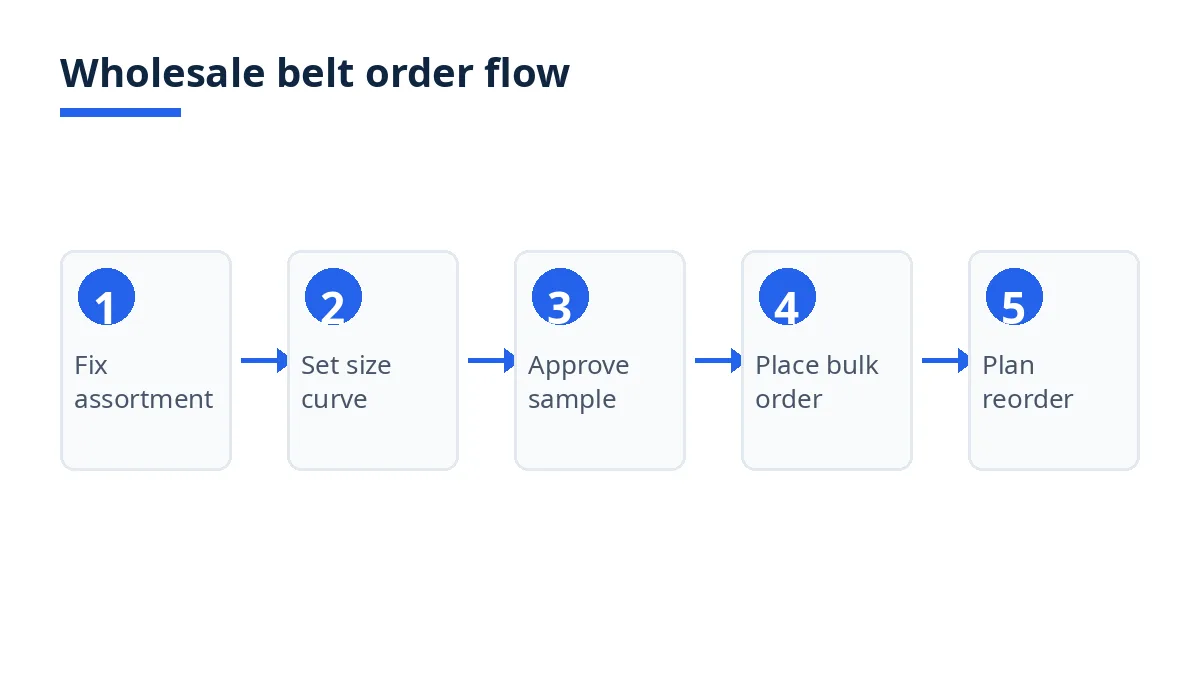
Plan the reorder calendar at the first order: agree assortment and size curve, approve the sample, place the bulk order, inspect the finished packed lot, ship, and set the reorder point from stock cover needed, with a named owner and sign-off per stage. For made-to-order ranges, repeat lead time runs from leather availability.
Mistakes that strand wholesale stock
Averaging the size curve across doors strands unsold sizes. Counting the minimum once understates the commitment. Approving a sample in different leather, color, or buckle than bulk approves a belt you are not buying. Without a shade standard, every reorder becomes an argument.1 A mixed range bought without naming the producing factory per style leaves no route back to the tannery when a style fails, and prices compared with different buckles or packing included reward the thinner specification.
Wholesale belt buying checklist
Name the buyer shape, distributor, retail chain, or workwear buyer, and the doors the range must serve.
Fix the assortment, types, widths, colors, buckle finishes, and size curve, from your own sales history.
Write the specification: leather, construction, buckle and keeper, holes, tip, edge, stitching, and lining.
Count the minimum per style, color, and buckle finish; confirm whether sizes carry one of their own.
Compare quotations on one identical specification and the same fields: price, minimum, lead time, Incoterm, payment terms, validity.
Confirm classification at 4203.30 as indicative, and the full national code in the destination tariff.
Ask for leather and tannery evidence naming your leather, with scope and expiry; confirm certificates with the issuer.
Read each badge for its checks, and check company name and address across every document.
Approve a pre-production sample in your leather, color, and buckle; agree inspection plan and defect classes in writing.
Agree the delivery term, document set, and reorder point before the bulk order ships.
What should I know first about buying wholesale leather belts from Bangladesh?
Know the assortment before the factory: fix types, widths, colors, buckle finishes, and the size curve, then count the minimum per style, color, and buckle finish. Settle hole spacing, buckle seating, keeper hold, and edge finish in writing, and measure every belt flat, uncoiled, and relaxed before judging any price.1
What are the typical costs and timelines for a wholesale belt order?
There is no standard wholesale belt price or lead time to quote. Costs move with leather, hardware, construction, quantity per variant, and packing; timelines move with leather availability, sample approvals, and the delivery term. Example figures only: read the unit price as shares of an index, count the minimum across every variant, and agree lead time per stage in writing. Only quotations on one identical specification can be compared.3
Which documents are needed for a wholesale leather belt order?
Agree the document set before production: invoice and packing list in the same belt terms as classification, transport document, origin or preference document where claimed, and lab or inspection reports specified, plus the specification, the quotation with its counting basis, the sample approval, and the inspection plan. Keep the belt description identical across every document, and any binding classification decision with the entry papers.5
What are the most common mistakes wholesale belt buyers make?
The most common mistakes are one averaged size curve for every door, counting the minimum once, approving a sample in different leather or buckle than bulk, working without a shade standard, a mixed range with no factory named per style, and prices compared with different buckles or packing included. Each is fixed in writing before production.
Next steps on Exportain
Browse Bangladeshi suppliers and filter by badge, sample availability, and channel. Read how supplier verification works on Exportain and the MOQ guide before you order, and check the HS code guide for leather belts and the quality control checklist for leather belts while writing the specification. Then post a free RFQ with assortment, size curve, quantities per variant, destination, and delivery term.
Sources
- Quality Control Checklist for Leather Belts. Exportain, (accessed )
- How Supplier Verification Works on Exportain. Exportain, (accessed )
- MOQ Meaning (Minimum Order Quantity). Exportain (accessed )
- Classification Detail: HS, 2017, Code 4203. United Nations Statistics Division (accessed )
- HS Code for Leather Belts: Classification Guide for Importers. Exportain, (accessed )
- Certification - Leather Working Group. Leather Working Group (accessed )
- President's Message - LFMEAB. Leathergoods and Footwear Manufacturers and Exporters Association of Bangladesh (LFMEAB) (accessed )
- Incoterms® 2020. International Chamber of Commerce (ICC) (accessed )
About the author
Sourcing from Bangladesh?
Post a request for quotation and suppliers on Exportain can send you their quotes directly.
Post an RFQ