Wholesale Kitchen Towels From Bangladesh: Channels and Volume Tiers
Wholesale kitchen towels from Bangladesh run through three channels: direct factory, trading house and stock wholesaler. Learn how each channel works, how volume tiers change the offer, and how to evaluate a channel before you buy.
Short answer
A wholesale buyer in Bangladesh can buy kitchen towels direct from a factory, through a trading house, or from a stock wholesaler. Direct factory supply gives the most specification control but needs a production run; a trading house consolidates a mixed assortment; a stock wholesaler ships fastest from existing stock. Judge each channel on stock or production status, specification control, samples, inspection, replenishment and delivery term.
On this page
Key takeaways
Wholesale kitchen towels from Bangladesh reach buyers through three channels: direct factory production, trading-house consolidation, and stock wholesalers.
Direct factory supply gives the most specification control; trading houses consolidate mixed assortments; stock wholesalers ship fastest from existing stock.
Grade a wholesale towel by construction, GSM band and tested absorbency, not by GSM alone, and confirm the HS subheading and fibre labelling.
Judge every channel on stock or production status, specification control, samples, inspection, replenishment and delivery term, in writing.
Confirm the repeat path before the first order, so a selling towel does not stall after the first shipment.
Wholesale buying of kitchen towels from Bangladesh is a channel decision before it is a product decision. A wholesaler, a retail chain buyer, a hospitality supplier and a distributor all buy in bulk, but they do not need the same channel: one needs stock for resale this month, another needs a towel made to a house specification, and a third needs a mixed assortment that can be replenished without a new production run. This guide explains how the three wholesale channels work, who each one suits, how volume tiers change what you can ask for, and how to evaluate a channel before you commit.
Who buys wholesale kitchen towels, and what wholesale means here
Wholesale, in this guide, means buying kitchen towels in bulk for resale or for supply to other businesses, rather than buying for one household. The wholesale buyer sits in the middle of the chain: it takes towels from a factory, a trading house or a wholesaler, and sells them on to retailers, hotels, restaurants, caterers and institutions.
That position shapes every requirement. A wholesale buyer needs a product that can be sold again: consistent size, color and absorbency from one lot to the next, packing that survives warehousing and onward shipping, and a replenishment path when the first lot sells through. It also carries the assortment risk: if a color sells slowly, the stock sits with the wholesaler, not with the factory.
The three wholesale channels
The three channels differ in who holds the stock, who controls the specification and who handles the work between the loom and your warehouse.
Buying direct from a factory
A direct factory channel means your order is produced for you. You agree the specification, and the factory weaves and finishes the terry, cuts and hems it, and packs it to your instruction. This gives the most control over fabric, size, color and packing, and it is the natural route for a house brand or a specific color range. The trade-off is time: you wait for weaving, dyeing, finishing and packing, and you accept the factory lot sizes for each color.
Buying through a trading house
A trading house buys from factories and sells on to wholesale buyers, often across several product types. It does not usually weave the towel itself. Its value is coordination: it finds factory capacity, consolidates an order across factories or product lines, arranges inspection and shipping documents, and gives the buyer one counterpart for a mixed order. It suits a buyer who wants a mixed assortment or one invoice and one shipment for several lines. The buyer gives up some direct control over the loom and dye lot, and should ask which factory makes each line.
Buying from a wholesaler or distributor
A wholesaler or distributor holds stock and sells from it. The towels already exist in a warehouse, in set colors, sizes and pack formats. This gives the shortest lead time and the smallest practical order, because the buyer is not funding a production run. It also gives the least specification control: you choose from what is stocked, not from what could be woven. It suits a buyer who needs to fill a gap, test a new towel type, or restock a fast-moving line.
Channel | Who holds the stock | Specification control | Lead time pattern | Best fit |
|---|---|---|---|---|
Direct factory | Factory, made to order | Full: fabric, color, size, packing | Longest: production run | Planned house range, set colors |
Trading house | Factories, consolidated | Shared: you set the brief, the house sources it | Mid: coordination plus production | Mixed assortment, one shipment |
Wholesaler or distributor | Wholesaler warehouse | Low: choose from stocked lines | Shortest: ship from stock | Fast restock, market test, gap fill |
What should I know first about kitchen towels?
Terry construction and what it does
A kitchen towel in this guide is a woven terry towel: a fabric with loops on one or both faces that take up water. Loops on both faces hold more water and dry more slowly; a sheared face feels smoother and takes up less water per gram. Ask whether the loops are on one face or both, and whether any face is sheared.
Kitchen towels also come in non-terry constructions, such as flat woven cotton or linen towels. A flat towel dries quickly and folds thin, which suits a buyer selling to caterers. State the construction in the enquiry, not only the word towel.
GSM and absorbency grades
GSM stands for grams per square metre, and it measures fabric weight and density. Higher GSM means a thicker, heavier and more absorbent towel, while lower GSM means a lighter towel that dries faster. One buying guide for terry fabric describes lightweight terry at 300 to 400 GSM, mid-weight terry at 450 to 600 GSM and heavy-weight terry at 650 GSM and above, with heavier towels taking longer to dry.1
GSM alone does not grade absorbency. Two towels at the same GSM can absorb differently if their loop height, yarn and finishing differ, so grade absorbency by testing, not by GSM alone. A practical grading is: light and fast-drying for catering and cleaning use, standard absorbency for everyday household use, and high absorbency for a thicker household or hospitality towel. Tie each grade to a GSM band and a wash test, and ask for a sample of each grade before you set the range.
Classification, fiber labelling and bulk packing
In the Harmonized System, heading 6302 covers bed linen, table linen, toilet linen and kitchen linen. Subheading 6302.60 covers kitchen and toilet linen of terry towelling or similar terry fabrics, of cotton, while subheading 6302.91 covers toilet and kitchen linen of cotton other than terry towelling.2 Confirm the subheading with your customs broker for your exact towel, using the HS code for kitchen towels guide.
If you sell into the European Union, Regulation (EU) No 1007/2011 states that a textile product shall be labelled or marked with the name and percentage by weight of all constituent fibers@@ in descending order.3 Ask for the fiber composition in writing, and check that the label on the packed towel matches the invoice and packing list.
Bulk packing is a wholesale specification in its own right. State the pieces per inner pack and per master carton, whether towels are packed singly, in sets or in bulk, and what the carton marking must show.
How volume tiers change the conversation
Volume tiers show what changes as the order grows, and which channel can serve each tier.
At a small wholesale tier, the buyer is testing or filling a gap. Stock wholesalers and trading houses with existing lines serve this tier, because no production run needs funding.
At a mid wholesale tier, the buyer has a known seller and a repeat pattern. A trading house can consolidate the order, and a factory can run a lot for the core colors while the rest of the assortment comes from stock.
At a large wholesale tier, the buyer can fund production for the full range. Direct factory supply becomes practical for the core lines, because each color carries enough volume for a dye lot and a production run.
Example figures: a buyer orders 600 pieces of a core towel, 300 pieces of a second color and 100 pieces of a slow line. The core line can anchor a production conversation, the second color may need consolidation, and the slow line is best bought from stock. The example shows structure only, not a typical order size, price or lead time.
Ask not only how many pieces you can buy, but how many of each color, size and pack format, and how often you will repeat.
How a wholesale buyer evaluates a channel
Evaluate every channel on the same six points.
Stock or production. Ask whether the towels exist now or will be made for you, and what happens if the first lot sells out. A stock channel should state stock levels and restock timing; a production channel should state lot sizes per color.
Specification control. Ask who sets the fabric, GSM band, construction, size, color and packing. A factory channel should accept your specification in full; a stock channel should state exactly what is stocked.
Sample path. Ask for a sample of the exact towel you will resell, in the exact color and pack format, before you confirm. For a stock channel, ask for a sample from the stocked lot, not from a catalogue. Measure it, wash it, and check the label against the stated fiber composition.3
Inspection. Agree how the lot will be checked before shipment. ISO 2859-1 defines a system of acceptance sampling plans for inspection by attributes, indexed by acceptance quality limit (AQL) for lot-by-lot inspection, and AQL is the maximum average percentage of defective items considered acceptable during random sampling.4 State the inspection level and AQL values in the purchase order.
Replenishment. Ask how a repeat order works: whether the same fabric, color and packing can be repeated, and how long the repeat takes. A channel that cannot repeat a selling towel is a one-off supplier, not a wholesale channel.
Delivery term and documents. State one delivery term for every quotation. The Incoterms 2020 rules set out 11 rules with a clear allocation of cost, risk and obligations.5 Compare channels only on the same term.
Step-by-step: evaluating a wholesale channel
Work through the range line by line.
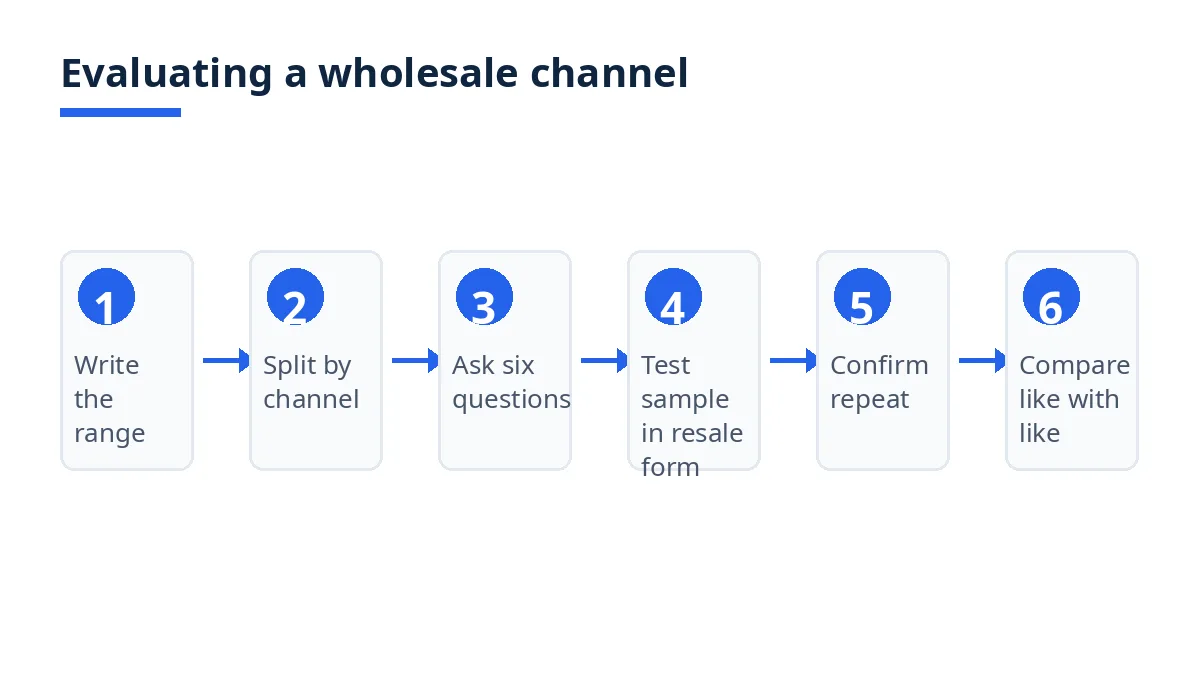
Write the range first. List each towel type, construction, GSM band, size, color and pack format, and mark each line as core, secondary or test.
Split the range by channel. Put core lines towards a factory or trading-house route, and test or slow lines towards stock.
Ask the six evaluation questions. Get stock or production status, specification control, sample path, inspection plan, replenishment path and delivery term in writing.
Test the sample in resale form. Check the sample in its pack format, with its label, after washing.
Confirm the repeat before the first order. Agree in writing how a repeat will be made, what lot size it carries and how long it takes.
Compare like with like. Compare quotations only on the same towel, pack format and delivery term,5 and record which channel serves each line.
Costs, timelines and documents
What are the typical costs and timelines?
There are no typical costs or timelines a guide can state as fact for wholesale kitchen towels, because each channel prices a different thing. A stock wholesaler prices a towel that already exists, with warehousing and immediate availability built in. A factory prices production to your specification. A trading house prices coordination across factories and lines, plus inspection and documents. The delivery term also changes the price, because the Incoterms 2020 rules allocate cost, risk and obligations differently for each rule.5
For timelines, a stock order ships from warehouse availability, while a production order waits for weaving, dyeing, finishing and packing, and a consolidated order waits for the slowest line. Ask for stock availability and shipment dates as separate lines, and ask what happens if one line in a mixed order is late.
Which documents are needed?
For export clearance in Bangladesh, goods may not be loaded unless an export declaration, the Bill of Export or Shipping Bill, is submitted to Customs and approved.6 Enclosed documents include the export contract or purchase order where there is no export letter of credit, the commercial invoice, the packing list, the EXP form certified by an authorized dealer, and a certificate of origin issued by the EPB or a Chamber of Commerce and Industry.6
Before payment, check the proforma invoice against the agreed specification and delivery term,5 the packing list against the agreed pack formats, and the label and fiber composition against the invoice.3 Keep one legal name and one product description across the quotation, invoice, packing list and shipping documents.
Mistakes and red flags
What are the most common mistakes?
Choosing the channel on price alone. A lower stock price and a higher factory price are not the same offer. The factory price buys specification control and a repeat path; the stock price buys immediate availability.
Planning a range around a towel that cannot be repeated. A stock line that sells well and cannot be restocked leaves a gap in the range. Confirm the replenishment path first.
Sending one enquiry to every channel. A factory needs a full specification; a trading house needs the assortment and shipment plan; a wholesaler needs the stocked lines and pack formats you want.
Accepting a sample that is not the resale product. A sample in a different color, size or packing is not evidence for the order. Ask for the sample in resale form, with its label.
Treating a profile or a badge as a channel check. Exportain verification is a document and photo review, not a factory inspection, and a badge is not a guarantee of capacity, quality or delivery.7 8
Comparing quotations on different delivery terms. Quotations on different Incoterms allocate cost and risk differently,5 so use one term for every channel.
Checklist
Range written: towel type, construction, GSM band, size, color and pack format per line.
Channel assigned per line, with a reason.
Stock or production status confirmed for each line.
Sample received in resale form, measured, washed and checked.3
Inspection level and AQL values in the purchase order.4
Repeat path agreed: same fabric, color and packing, lot size and timing.
Quotations compared on the same towel, pack format and delivery term.5
Export set agreed: invoice, packing list, EXP form, certificate of origin, Bill of Export.6
How Exportain helps
On Exportain, browse suppliers and post a request for quotation (RFQ) on the RFQ board with your range, channel and pack formats, so each reply states whether it offers factory production, consolidation or stock. When you accept a quotation, Exportain creates one order and issues one proforma invoice from the accepted terms.7
Read the badges for what they record. Exportain Verified means Exportain has checked identity, phone, email and business registration, and Export Verified means it has checked the Export Registration Certificate (ERC).8 Factory Verified means it has reviewed photos of the manufacturer factory, while Trading Company Verified means it has reviewed photos of the trading company office or warehouse.8 Verification is a document review by staff, free, and never granted by membership plans.7 8 See how supplier verification works on Exportain and the minimum order quantity definition guide.
Next steps on Exportain
Browse suppliers, then post your range, channel mix and pack formats on the RFQ board so suppliers state their channel. Before you confirm, read how to import kitchen towels from Bangladesh and the kitchen towels quality control checklist.
Sources
- How To Choose Terry Fabric: A Complete Buying Guide. Alibaba (accessed )
- HS 2017 - Code 6302: Bed linen, table linen, toilet linen and kitchen linen. United Nations Statistics Division (accessed )
- Regulation (EU) No 1007/2011 on textile fibre names and related labelling and marking of the fibre composition of textile products. European Union, (accessed )
- ISO 2859-1:2026 - Sampling procedures for inspection by attributes — Part 1: Sampling schemes indexed by acceptance quality limit (AQL) for lot-by-lot inspection. ISO (accessed )
- Incoterms® 2020. International Chamber of Commerce (ICC) (accessed )
- Customs Clearance Procedures for Export. Bangladesh Customs, National Board of Revenue (accessed )
- Trust & Safety Center. Exportain (accessed )
- Supplier verification: Earn trust badges buyers can see. Exportain (accessed )
About the author
Sourcing from Bangladesh?
Post a request for quotation and suppliers on Exportain can send you their quotes directly.
Post an RFQ