

Wholesale Generators From Bangladesh: Prices, MOQ and Reliable Suppliers
Wholesale generators from Bangladesh, bought as a tiered volume agreement: one specification per model, tiered quotes, per-model minimums, spares packs, and repeat terms, compared only on the same rating class and scope.
Short answer
Wholesale generators from Bangladesh are bought as a tiered volume agreement for one set model, not as single sets at a discount. State one specification per model, with rating class, output, destination supply, engine and alternator models, enclosure, and control scope. Ask for a tiered quote sheet with a unit price per band, a minimum per model, a test scope, a spares pack, and repeat terms, and compare suppliers only on the same rating class and scope.
On this page
Key takeaways
A wholesale generator order is a tiered volume agreement for one set model, not a single-set price with a discount: bands, a minimum per model, a test scope, a spares pack, and repeat terms.
Compare quotes only inside one ISO 8528-1 rating class, since standby, prime, limited-time, and continuous ratings describe different duties for the same machine.
Ask how the MOQ is counted, per order, per model, or per variant, before planning the model mix, and confirm every figure in the supplier's written quote.
Exportain verification is a document and photo review, not a factory inspection or a guarantee, so run the model, test, and spares checks yourself before committing.
A wholesale generator order is not a retail purchase multiplied. It is a volume agreement for a defined set model, bought in tiers, with a minimum per model, a spares pack, and repeat terms that decide whether the second order costs the same as the first. A buyer who compares wholesale quotes as if they were single-set prices will compare different rating classes and test scopes.
A generating set here means an engine driving an alternator, with its controlgear, switchgear, and auxiliary equipment. ISO 8528-1:2018 defines classifications for the application, rating, and performance of such sets, for land and marine use, and those classifications are intended to help understanding between manufacturer and customer.1 Use that shared language in every wholesale message, so a tier table from one supplier can be read against a tier table from another.
Why this matters for buyers and sellers
For a buyer, the wholesale channel decides how much capital sits in stock and how long a failed set waits for a spare. A distributor needs depth in the models that move; a project buyer needs every set in a batch to match one specification.
For a seller, a wholesale order is a production run, not a shelf sale. Pairing, enclosure work, control configuration, and load testing are planned per model and per batch. A clear tier ladder lets the seller schedule that run and hold a repeat price. A vague order forces the seller to guess at the model, the rating class, and the test scope.
The rating class is the first wholesale distinction, because the same engine and alternator package can carry different ratings for different duties. The four ISO 8528-1 classes are emergency standby power (ESP), prime power (PRP), limited-time running power (LTP), and continuous operating power (COP), each with its own load profile, annual hours, and overload allowance.2 ESP covers backup during outages, limited to 200 hours per year with no overload allowance; PRP covers unlimited hours on a variable load, with a 24-hour average limit of 70 percent and a 10 percent overload allowance for one hour in 12; LTP covers constant load for up to 500 hours per year; COP covers unlimited hours at a constant load. Compare quotes only inside one class: a standby figure and a prime figure for the same machine are not two prices for the same product.
A retail quote prices one set for one delivery. A wholesale quote prices a ladder: a unit price at each band, a minimum per model, a test scope per batch, a spares pack per quantity, and terms for repeats.
Step-by-step: how it works
Work through the wholesale order in this order. Most wholesale disputes start as a specification that was never written down.
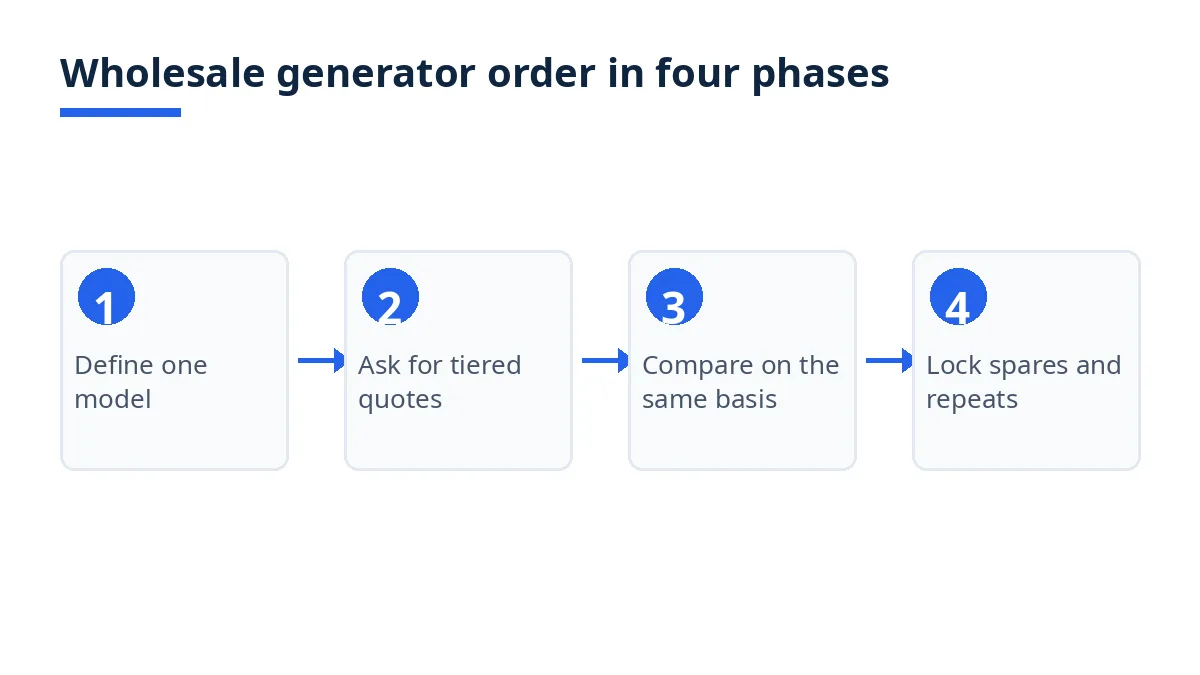
Write one wholesale specification per model: rating class, output in kW and kVA, destination voltage, frequency, and phase, engine model and alternator model, enclosure type, control scope, site conditions, and the largest single load step the set must start.
State the quantity as a tier ladder, not as one total: quantity per model and per variant, and whether a smaller first shipment with a stated repeat is acceptable.
Ask for a tiered quote sheet: unit price per band, minimum per model, delivery term, validity period, test scope, packing description, and spares pack, each on its own line.
Compare quotes on the same basis: rating class, engine and alternator models, enclosure, control scope, test scope, delivery term, and validity.
Ask for model evidence before committing: the datasheet for the exact model, a load test record tied to serial numbers for the batch, and the manuals and spares list.
Agree spares, packing, and consolidation: spares priced with the first shipment, shipment split or consolidated, and marking per set and carton confirmed. Mixed-model consolidation only works when the test and packing regime is the same for every model in the load.
Lock repeat terms before the first order: repeat price basis, how long it holds, repeat minimum, lead time, and notice before a model change.
The diagram below summarises the four phases of the wholesale order, from the model specification to the repeat terms.
Classification belongs in the specification step. Heading 8502 covers electric generating sets and rotary converters, and its subheadings follow the engine type and the output band: subheading 850212, for example, covers diesel generating sets of an output exceeding 75 kVA but not exceeding 375 kVA.3 Confirm the full code for each model with your customs broker.
Costs, timelines and documents
There is no universal wholesale generator price, and this guide states none. Every figure here is labelled as an example, or is an item to confirm in the supplier's written quote. What a buyer can compare is the structure: which drivers move the unit price and what the quote must state before it can be judged.
The price drivers, in order, are the rating class, the engine and alternator pairing, the enclosure, the control scope, the test scope, the packing, the volume tier, and the delivery term. Ask the supplier to state each driver on its own line.
Use a quote-comparison sheet with the same columns for every supplier: model, rating class, engine model, alternator model, enclosure, control scope, test scope, tier band, unit price per band, minimum per model, spares pack, packing, delivery term, validity, and repeat terms.
Delivery terms change the cost picture as much as the unit price does. The Incoterms 2020 rules allocate cost, risk, and obligations between seller and buyer.4 A wholesale comparison must state the rule and the named place for every quote, since a price that ends at the factory gate and a price that ends at the destination port are not comparable figures. For sea freight, the CIF rule is reserved for maritime trade, with Institute Cargo Clauses (C) as the default level of cover.4
Timelines are supplier-stated, per tier, in the written quote, and this guide gives no transit or production figure as a standard. Ask for dated milestones: specification confirmation, production slot, load test, packing, export clearance, and handover to the carrier.
Minimum order quantity needs the same care as price. MOQ means the smallest quantity a supplier will accept for a product on its normal terms, counted per order, per model, or per variant.5 In a wholesale generator order, the binding line is usually per model, or per variant where enclosure, voltage, or control scope differs. Ask in writing how the minimum is counted.
Example figures: a tier ladder for one model
The table below is an example only. Every figure is an example figure, not a supplier's price or minimum, and every line must be confirmed in the supplier's written quote.
Example line | Example figure |
|---|---|
Tier bands for one model | 1 to 4 sets, 5 to 14 sets, 15 sets and above |
Minimum per model | 5 sets, counted per model |
Spares pack | One filter and belt set per 10 sets in the first shipment |
Test scope | Load test record per serial number for the batch |
Repeat terms | Repeat price held for a stated period, repeat minimum stated in writing |
The documents fall into three groups: commercial (quotation, accepted order, commercial invoice, packing list); technical (datasheet per model, load test record per batch, manuals, spares list); and shipment (transport document, insurance document where required, and the export declaration documents in the next section). Confirm in writing which documents ship with the goods.
Bangladesh-specific rules and tips
Bangladesh export clearance starts with an export declaration, known as the Bill of Export or shipping bill, submitted and approved before goods are loaded for export. The declaration states the description of goods, the value, the exporter, the foreign buyer, and the transport operator.6 The documents enclosed with the Bill of Export for all export consignments include the export letter of credit, or where there is no letter of credit, the export contract, purchase order, or export guarantee approved by the negotiating bank; the commercial invoice with a detailed description of goods, signed by the exporter; the packing list with quantity, weight, and packing information; the EXP form certified by an authorised dealer; the certificate of origin; the VAT registration certificate; and the taxpayer identification number.6 Confirm with the supplier which documents the supplier prepares, and which the buyer must supply, before the production slot is booked.
Three tips save wholesale buyers repeated trouble. First, confirm the company name on every document matches the quotation and the invoice, since a name mismatch is a common cause of delay at clearance. Second, state the destination voltage, frequency, and phase in the specification, and ask the supplier to confirm in writing that the quoted model is built for that supply. Third, state the port and the delivery term together, and confirm the packing for the chosen route. Confirm the export documents, the test scope, and the repeat terms before paying any advance.
Mistakes and red flags
The most common wholesale mistakes are specification mistakes, not bargaining mistakes. Comparing a standby price with a prime price is the first, since the two figures describe different duties for the same machine.2 Agreeing a minimum without its counting basis is the second, since a minimum per order and a minimum per variant produce different smallest orders.5 Accepting a tier price without its scope is the third, since the enclosure, control scope, and test scope can each change what the price buys. Treating a test record for a different serial number or model as evidence for your batch is the fourth.
Red flags deserve a pause. A quote with no validity period, a tier table with no per-model minimum, a spares pack priced only after shipment, a repeat price left to a future discussion, or a test scope described only as testing in general, each signal a quote that is not yet a wholesale offer. A badge is also not a substitute for model evidence: Exportain verification is a review of documents and photos by Exportain staff, not a factory visit and not a check against a government database, and a badge is not a guarantee of production capacity, product quality, or delivery.7 Treat the badge as a shortlist aid, and run the model checks yourself.
A final mistake is consolidating models that should not share a load. Mixed-model consolidation saves freight only when every model in the load shares the same test regime, packing, and marking. Where models differ, a split shipment with clear marking is cheaper than a consolidated load that arrives mixed or unmarked.
Checklist
Use this checklist before sending a wholesale request, before accepting a quote, and before authorising shipment.
One specification sheet per model: rating class, output in kW and kVA, destination voltage, frequency, and phase, engine model, alternator model, enclosure, control scope, site conditions, largest load step.
Quantity as a tier ladder, per model and per variant.
A tiered quote sheet from each supplier: unit price per band, minimum per model, delivery term and named place, validity, test scope, packing, spares pack.
A comparison sheet with the same columns for every supplier.
A datasheet for the exact model, a load test record tied to serial numbers, manuals, and a spares list, requested before commitment.
Spares priced with the first shipment; repeat price, validity, repeat minimum, lead time, and model-change notice in writing.
Export documents confirmed: who prepares each document.
Shipment logic confirmed: consolidated or split, with marking per model and carton.
How Exportain helps
Exportain is a marketplace where buyers can browse Bangladeshi suppliers, compare profiles, and post a request for quotation that suppliers answer with quotations. On a supplier profile, the trust and verification checklist shows which document and photo checks Exportain staff have reviewed, and a badge records only those checks: identity, phone, and email, business registration, export registration, and facility photos.7 Membership plans add listing capacity and search placement, and never grant a trust badge.7 Use the checklist at the shortlist stage, then run the model, test, and spares checks in this guide.
A request for quotation should carry the wholesale specification, not only a product name. Give the quantity per model and per variant, the rating class, the destination supply, the delivery term, and the repeat intention, so suppliers can answer with a tiered quote rather than a single-set price. Each Exportain quotation states unit price, MOQ, lead time, Incoterm, payment terms, and validity, and a buyer can counter-offer in the same thread.5
Exportain is not a party to the trade. It does not inspect goods, book freight, or clear customs, and it holds money for a goods order only when both parties agree to a funds hold.7
FAQs
What should I know first about generators?
Know the rating class before the price. A generating set is defined by its engine and alternator pairing, its controlgear, and its duty: standby, prime, limited-time, or continuous.1 2 In a wholesale order, also know the tier structure before the unit price.
What are the typical costs and timelines?
There are no typical wholesale generator costs or timelines stated in this guide, because both depend on the model, the rating class, the enclosure, the test scope, the tier, and the delivery term, and each must be confirmed in the supplier's written quote. Use the example tier table only as a structure check, since every figure in it is an example figure.
Which documents are needed?
The commercial documents are the quotation, the accepted order, the commercial invoice, and the packing list, with quantities per model. The technical documents are the datasheet per model, the load test record per batch, the manuals, and the spares list. The export documents for a Bangladesh shipment include the Bill of Export with its enclosed documents, as listed in the Bangladesh-specific section.6 Confirm before production who prepares each document.
What are the most common mistakes?
Comparing different rating classes as if they were the same product, agreeing a minimum without its counting basis, accepting a tier price without its scope, and treating a test record for a different model or serial number as evidence for your batch. Each mistake is a specification gap, avoidable by writing the model sheet, the tier ladder, and the test scope before accepting a quote. A supplier badge does not remove any of these checks.7
Next steps on Exportain
Browse Bangladeshi suppliers and open each shortlisted profile's trust and verification checklist before requesting quotes. Read how supplier verification works on Exportain to see what each badge does and does not mean, and read MOQ meaning to check how a minimum is counted. Then post a free RFQ with one specification sheet per model, the tier ladder, and the repeat intention, so suppliers can answer with tiered wholesale quotes.
Sources
- ISO 8528-1:2018 — Reciprocating internal combustion engine driven alternating current generating sets — Part 1: Application, ratings and performance. International Organization for Standardization (ISO) (accessed )
- Prime Power vs Standby vs Continuous: Generator Ratings. BLSH Diesel (accessed )
- Classification Detail - HS Code 850212. United Nations Statistics Division (accessed )
- Incoterms® 2020. International Chamber of Commerce (ICC) (accessed )
- MOQ Meaning (Minimum Order Quantity). Exportain (accessed )
- Customs Clearance Procedures for Export. Bangladesh Customs, National Board of Revenue (accessed )
- How Supplier Verification Works on Exportain. Exportain, (accessed )
About the author
Sourcing from Bangladesh?
Post a request for quotation and suppliers on Exportain can send you their quotes directly.
Post an RFQ


