Wholesale Cushion Covers From Bangladesh: Prices, MOQ and Reliable Suppliers
Wholesale cushion covers from Bangladesh, bought in bulk tiers with a planned assortment and repeat replenishment orders, suit retailers and distributors who need steady stock rather than a single custom run.
Short answer
Buying wholesale cushion covers from Bangladesh means ordering an assortment in bulk tiers, planning sizes, colours and designs as one range, and reordering proven sellers on agreed stockist terms, rather than placing a single custom order and starting again each time.

On this page
Key takeaways
Wholesale cushion cover buying means ordering a range in bulk tiers: core, seasonal and test lines, with quantities set per design, size and colour, not as a single order total.
Compare tier prices on the same assortment and the same Incoterms rule, and record tier validity, repeat prices and availability periods as written stockist terms.
Reorder by line on sales evidence at a fixed rhythm, so best sellers stay in stock and slow lines shrink or leave the range.
Exportain verification is a document and photo review, not a factory inspection, and a badge is not a guarantee of capacity, quality or delivery.
Buying wholesale cushion covers from Bangladesh means buying a range, not a single design. A wholesale order groups several sizes, colours and designs into bulk tiers, so one shipment can stock a shelf or a catalogue page for a season. The supplier makes the range in planned lots, the buyer holds stock to sell on, and the next order tops up the lines that sold.
That distinction shapes every decision in this guide. A custom order asks a factory to develop one cover to a new specification. A wholesale order asks a supplier to supply an existing or lightly adapted range at tiered quantities, with assortment, packing and repeat terms agreed up front. If you judge a wholesale offer as if it were a custom order, you will compare the wrong things: the unit price of one design instead of the margin across the range, and a single delivery date instead of a replenishment rhythm.
Why this matters for buyers and sellers
For a buyer, wholesale buying is a stock decision before it is a design decision. Money is tied up in covers on a shelf, not in a single shipment that is already sold. A range that is too wide spreads cash across slow colours and leaves the best sellers out of stock.
For a seller, a wholesale order is a production plan: fabric bought and dyed in lots, covers cut in size runs, cartons packed in set quantities. A clear assortment lets the seller schedule those lots without rework, while stockist terms turn a one-off shipment into a standing arrangement with agreed tiers and repeat pricing.
What should I know first about cushion covers?
Start with the product as it will be classified and labelled, because those two facts travel with every wholesale shipment. A finished cushion cover is classifiable in heading 6304 of the Harmonized System, which covers other furnishing articles, and the explanatory notes place cushion covers there rather than with stuffed cushions.1 A cover sold with its insert already fitted is a different article, so keep covers and filled cushions as separate lines, and confirm the code for each line with your customs broker.
Labelling follows the same discipline. For sales into the European Union, Regulation (EU) No 1007/2011 states that a textile product shall be labelled or marked with the name and percentage by weight of all constituent fibres in descending order.2 That rule matters at wholesale scale because a whole tier carries the same label. Agree the fibre composition and label placement per design before the bulk run, and check them on the first production sample.
A wholesale assortment is usually built from three layers: core lines that sell in every season, seasonal lines tied to a collection or selling period, and test lines in small tiers that earn a larger tier only if they sell. Naming those layers in the order keeps the conversation concrete: cores get depth, seasonal lines get a fixed window, and test lines get a review date.
Step-by-step: how it works
The wholesale cycle below runs from range planning to replenishment, for a buyer who will hold stock and reorder.
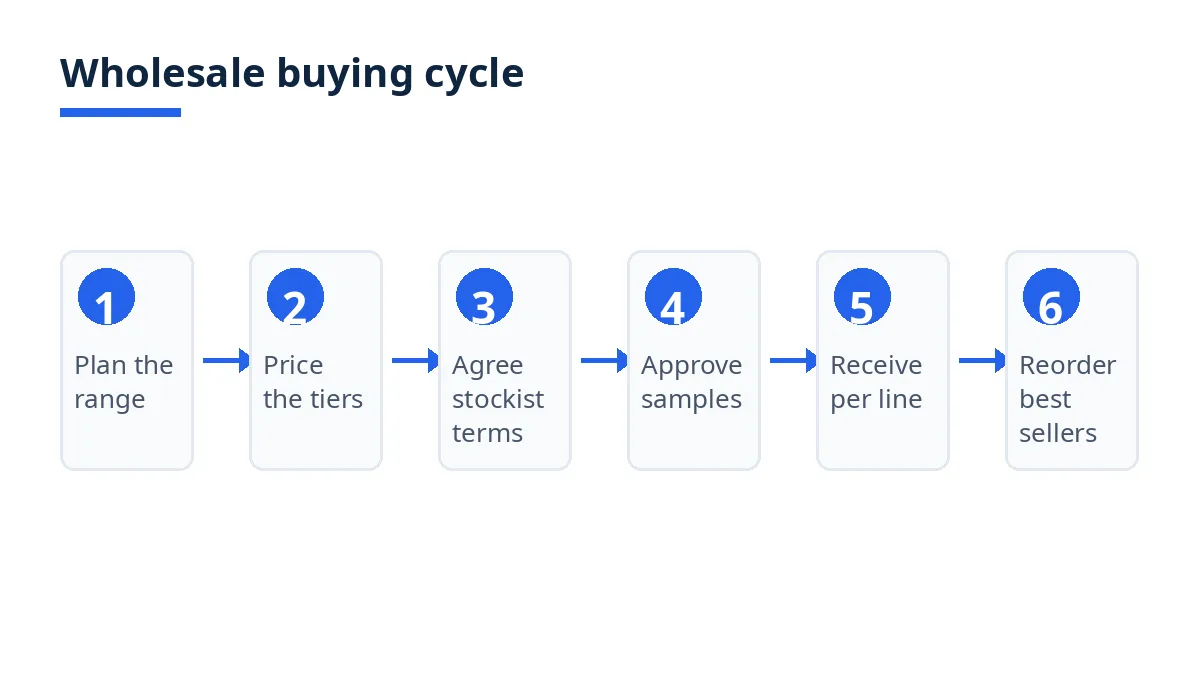
Plan the range on paper first. List each design, size, colour and fabric, then mark it core, seasonal or test. Set the quantity per line, not only the order total, and note which lines must arrive together because customers buy them as a set.
Ask for tiered pricing on the same assortment. Send the full assortment to each candidate supplier and ask for prices at two or three tiers, with the quantity per design and per colour at each tier. Compare tiers on the same assortment and the same delivery term, so a lower price is not hiding a smaller assortment or a different term.
Agree stockist terms in writing. Record the tier prices, the validity period of each tier, whether repeat orders at the same tier keep the same price, how long a design stays available, and what happens when a colour or fabric is discontinued.
Approve the range before bulk production. Check a sample of each design for size, closure, seam finish, print or embroidery placement, and label wording. Approve the samples in writing, design by design.
Receive as an assortment, not as a total. Check the delivery against the assortment list: quantities per design, size and colour, carton markings, and label wording. Record what arrived short or damaged per line.
Reorder by line, on a fixed rhythm. Review sales per design, size and colour at a set interval, then place a replenishment order for the lines that sold, in their agreed tiers. Lines that did not sell are reduced or dropped at the next range review.
Costs, timelines and documents
What are the typical costs and timelines?
There is no typical wholesale price or lead time that holds across designs, fabrics and tiers, because each supplier prices your assortment, not a generic cover. What a buyer can compare is structure: how the unit price changes between tiers, which lines carry a surcharge for a small colour run, whether packing is per cover or per carton, and which delivery term the price is quoted on. The Incoterms 2020 rules set out 11 rules with a clear allocation of cost, risk and obligations,3 so compare every tier price on the same rule and named place.
Example figures: a three-tier structure for one plain cotton cover design might read as 500 covers in the first tier, 1,000 in the standard tier and 2,000 in the deeper tier, with the unit price falling at each tier and the per-colour quantity stated at each tier. Example figures: an assortment of 2,400 covers might split into 1,200 core covers across four colours, 800 seasonal covers across four prints and 400 test covers across two new designs. These example figures show structure only, not a typical price, minimum or lead time.
Timelines follow the same logic. Sampling, fabric readiness, bulk production and inspection are separate stages, and several colours may need separate dye lots, so one late fabric can hold a whole tier. Ask for the stages as separate dates, agree which lines ship together, and record the replenishment lead time separately from the first-order lead time.
Wholesale element | What to agree in writing | Why it matters for stock |
|---|---|---|
Bulk tiers | Quantity per design and per colour at each tier | A tier total can hide a colour too small to run |
Assortment | Design codes, sizes, colours, fabrics, closures | One sheet prevents range drift between orders |
Stockist terms | Tier validity, repeat price, availability period | Repeat orders keep their terms instead of renegotiating |
Packing | Covers per carton, carton markings, set packing | Receiving and shelf stock match the order |
Replenishment | Review interval, reorder lead time, discontinuation notice | Best sellers stay in stock, slow lines are dropped |
Which documents are needed?
For export clearance in Bangladesh, goods may not be loaded unless an export declaration, the Bill of Export or Shipping Bill, is submitted to Customs and approved.4 Enclosed documents include the export contract or purchase order where there is no export letter of credit, the commercial invoice, the packing list, the EXP form certified by an authorized dealer, and a certificate of origin issued by the EPB or a Chamber of Commerce and Industry.4 For a wholesale buyer, the packing list deserves extra attention, because it should break the shipment down by design, size and colour, matching the assortment sheet.
On the buying side, keep the assortment sheet, the tiered quotation, the purchase order with stockist terms, the written sample approvals and the per-line delivery record together. When a short delivery concerns one colour of one design, those papers, not the order total, settle it.
Bangladesh-specific rules and tips
Confirm the assortment against the classification line by line. Heading 6304 covers cushion covers as furnishing articles,1 but inserts, filled cushions and covers in different materials can fall elsewhere. A range that mixes covers with filled cushions needs separate lines, separate codes and separate labels.
Use the inspection plan as a wholesale control, not a one-off check. ISO 2859-1 defines a system of acceptance sampling plans for inspection by attributes, indexed by acceptance quality limit (AQL) for lot-by-lot inspection.5 AQL is the maximum average percentage of defective items considered acceptable during random sampling, and it determines sample sizes and acceptance or rejection thresholds.5 Agree the inspection level and AQL values once, write them into the stockist terms, and apply them to every lot.
Check association claims at the source, and keep them in proportion. The Bangladesh Knitwear Manufacturers and Exporters Association (BKMEA), established in 1996, is the apex trade body for the knitwear sector and represents approximately 2,540 knitwear member factories.6 Cushion covers are home textiles rather than knitwear, so a knitwear claim tells you little about a home-textile supplier's range. Confirm claims with the body itself, and judge a supplier on its assortment, samples and delivery record.
Keep one legal name and one design code system across every paper. The export declaration names the exporter and the foreign buyer,4 so the names on the quotation, invoice, packing list and payment account should match, and design codes should match too: a colour called sage on the assortment sheet and light green on the packing list will confuse receiving and replenishment alike.
Mistakes and red flags
What are the most common mistakes?
Ordering a total instead of an assortment. A wholesale order of 2,000 covers with no split by design, size and colour cannot be produced, priced or received properly. The split is the order.
Judging the range by its cheapest design. A low price on a plain core cover does not mean the prints, larger sizes or small colours are well priced. Compare the margin across the whole assortment, and check the per-colour quantity at each tier.
Leaving stockist terms verbal. Tier prices, repeat terms and availability periods that are not written down are renegotiated when a best seller needs replenishing. Record them on the quotation and the order.
Reordering everything at the same rate. Wholesale stock grows stale when every line is topped up regardless of sales. Reorder by line, on sales evidence, and let slow lines shrink or leave the range.
Treating a profile or a badge as a guarantee. A profile is a starting point for enquiries. Exportain verification is a document review by staff, not a factory inspection,7 and a badge is not a guarantee of production capacity, product quality or delivery.7 Sample approval, per-line receiving checks and the inspection plan stay with the buyer.
Skipping the per-line receiving check. Accepting a shipment on its total count hides a short colour until customers ask for it. Check per design, size and colour at delivery.
Checklist
Before you place a wholesale order, every line below should be answered in writing.
Assortment sheet complete: design codes, sizes, colours, fabrics, closures, core, seasonal or test status.
Tiered prices quoted on the same assortment and the same Incoterms rule and named place.3
Quantity stated per design and per colour at each tier, not only as an order total.
Stockist terms recorded: tier validity, repeat price, availability period, discontinuation notice.
Samples approved in writing, design by design, including fibre labelling for the destination market.2
Inspection level and AQL values agreed and written into the terms.5
Packing agreed: covers per carton, carton markings, set packing where designs sell together.
Export set agreed: invoice, packing list by design and colour, EXP form, certificate of origin, Bill of Export.4
Replenishment rhythm set: review interval, reorder lead time, per-line sales review.
Per-line receiving check planned at delivery, with shortages recorded per design and colour.
How Exportain helps
On Exportain, browse suppliers and post a request for quotation (RFQ) on the RFQ board with your assortment sheet summary, the tiers you want priced and the delivery term, so suppliers quote the same range rather than a single design. Ask each reply for tier prices per design and per colour, stockist terms for repeats, and the replenishment lead time for the same assortment.
Read the badges for what they record. Exportain Verified means Exportain has checked identity, phone, email and business registration, and Export Verified means it has checked the Export Registration Certificate (ERC).7 Factory Verified means it has reviewed photos of the manufacturer factory, while Trading Company Verified means it has reviewed photos of the trading company office or warehouse.7 Verification is a document review by staff, free, and never granted by membership plans.8 It is not a factory inspection,7 8 so sample approval, per-line receiving checks and inspection stay with you. See how supplier verification works on Exportain.
FAQs
What should I know first about cushion covers?
Know the product as a wholesale range: finished covers classifiable in heading 6304,1 labelled with fibre names and percentages in descending order for the European Union,2 and bought as an assortment of sizes, colours and designs in bulk tiers, with stockist and replenishment terms agreed before the first order.
What are the typical costs and timelines?
There are no typical wholesale prices or lead times a buyer can rely on, because each supplier prices your assortment, fabric and tiers, and each delivery term allocates cost and risk differently.3 Compare tier prices on the same assortment and term, ask for sampling, fabric readiness, production and inspection as separate dates, and record the replenishment lead time separately.
Which documents are needed?
The buying papers are the assortment sheet, tiered quotation, purchase order with stockist terms, written sample approvals and per-line delivery record. The export set is the Bill of Export, commercial invoice, packing list, EXP form certified by an authorized dealer, and a certificate of origin issued by the EPB or a Chamber of Commerce and Industry.4
What are the most common mistakes?
The most common mistakes are ordering a total instead of an assortment, judging a range by its cheapest design, leaving stockist terms verbal, reordering every line at the same rate, and reading a badge as a guarantee. A badge is not a guarantee of capacity, quality or delivery,7 and stock stays healthy only when reorders follow per-line sales.
Next steps on Exportain
Browse suppliers, then post your assortment sheet summary, the tiers you want priced and the delivery term on the RFQ board so suppliers quote your whole range on the same terms. Before you confirm, read the how to import cushion covers from Bangladesh guide and the cushion covers quality control checklist.
Sources
- Customs Ruling HQ 953003 - Classification of a pillow shell and a cushion cover; pillow shell is classifiable in Heading 6307; cushion cover is classifiable in Heading 6304. U.S. Customs and Border Protection (accessed )
- Regulation (EU) No 1007/2011 on textile fibre names and related labelling and marking of the fibre composition of textile products. European Union, (accessed )
- Incoterms® 2020. International Chamber of Commerce (ICC) (accessed )
- Customs Clearance Procedures for Export. Bangladesh Customs, National Board of Revenue (accessed )
- ISO 2859-1:2026 - Sampling procedures for inspection by attributes — Part 1: Sampling schemes indexed by acceptance quality limit (AQL) for lot-by-lot inspection. ISO (accessed )
- BKMEA at a Glance. BKMEA (accessed )
- Trust & Safety Center. Exportain (accessed )
- Supplier verification: Earn trust badges buyers can see. Exportain (accessed )
About the author
Sourcing from Bangladesh?
Post a request for quotation and suppliers on Exportain can send you their quotes directly.
Post an RFQ