

Wholesale Curtains From Bangladesh: How the Channel Works
Wholesale curtains from Bangladesh are a channel choice first: direct factories, stockists and trading houses serve different buyers. How volume tiers work, and how to evaluate a channel before ordering.
Short answer
Wholesale curtains from Bangladesh move through three channels: direct factories, wholesalers or stockists, and trading houses or exporters. A direct factory suits a defined repeating assortment, a stockist suits speed and small lots from ready stock, and a trading house suits a mixed assortment under one counterpart. Compare channels on the same specification, unit, volume tier basis and delivery term, and approve a hung sample before confirming.

On this page
Key takeaways
Wholesale curtains from Bangladesh move through three channels: direct factories, wholesalers or stockists, and trading houses or exporters.
A channel choice comes before a supplier choice: stock suits speed and small lots, a factory suits a defined repeating program, and a trading house suits a mixed assortment under one counterpart.
Volume tiers usually apply per design and per colour, not to the order total, so breadth can push every colour into a low tier.
Evaluate a channel in five steps: define the assortment, match the channel to the buyer type, confirm stock or production, agree the delivery term and documents, and approve a hung sample.
Exportain badges record document and photo checks reviewed by the Exportain team; they are not factory inspections or quality guarantees.
Wholesale curtains from Bangladesh reach a buyer through a channel, and the channel shapes who holds stock, who controls the fabric, how a repeat order is filled, and who answers when a colour or drop length is wrong. A stockist quoting ready stock, a factory quoting a made-to-order run, and a trading house quoting a managed program are selling different things.
This guide is for a wholesale buyer: a retailer, a home-textile store, a hospitality or project buyer, a distributor, or an online reseller. It explains the three wholesale channels from Bangladesh, who each channel suits, how volume tiers work, and how to evaluate a channel before committing. It does not rank suppliers or quote a price for your order, because prices, minimums and timelines are set per specification.
Wholesale curtains are a channel decision first
A wholesale order differs from a single purchase in four ways. The buyer orders an assortment, not one design. The buyer needs repeatability, so the second delivery matches the first. The buyer needs a defined unit of sale, whether a pair, a panel or a set, stated the same way on the quotation, the invoice and the packing list. And the buyer carries stock risk, so holding unsold colours costs as much as the unit price matters.
A channel is the route between maker and wholesale buyer. Direct buying gives control over specification and a closer view of production, and asks the buyer to carry coordination, inspection and timing. A stockist gives speed and small-lot flexibility, and limits the buyer to what is already made. A trading house gives coordination across makers, and adds a service layer between buyer and factory floor.
Before contacting any channel, write down the assortment, the unit you buy and sell in, and whether you need stock now, a made-to-order run, or a mix.
The three wholesale channels
Direct from a factory
In the direct channel, the buyer contracts with the maker, sends a specification, agrees a sample, and the factory makes the order. This suits a buyer with a defined assortment that will repeat, because fabric, colour, heading and lining can be locked for repeat runs, and it suits a buyer who wants a fabric or finish that no stockist holds.
The direct channel asks the most of the buyer. The specification must be complete, samples must be approved, and a factory minimum usually applies per design and per colour, not only to the order total. The buyer also needs a delivery term and an inspection plan agreed before production, because there is no intermediary to absorb a mismatch.
Through a wholesaler or stockist
A wholesaler or stockist holds finished curtains, or holds fabric and makes panels to order from stock, and sells in wholesale quantities to retailers and resellers. This suits a buyer who needs speed, a smaller first quantity, or a broad assortment without a production run for every colour.
The trade-off is choice and control. The buyer chooses from what the stockist holds, so fabric, heading and lining options are limited to that stock. A colour that sells well may run out, and a repeat delivery may come from a different fabric lot. Ask whether the stock is a single lot or replenished lots, and how colour and drop are checked between lots. Inspect the hung pair, not a folded sample.
Through a trading house or exporter
A trading house or exporter coordinates production across one or more makers and sells the finished order to the wholesale buyer. This suits a buyer who wants a broad assortment that no single factory covers, or who wants one counterpart for several product types. A trading house can combine a sheer panel from one maker with a lined drape from another and pack them as one assortment.
The trade-off is distance from production. The buyer deals with the trading house, not the factory, so be explicit about who approves samples, who inspects the bulk, and what happens when a maker fails a check. Ask whether the maker is disclosed for each design, whether the buyer may inspect at the factory, and whether the specification, sample approval and inspection terms are written into the contract.
Channel | Who holds the goods | What the buyer controls | When it fits a wholesale buyer |
|---|---|---|---|
Direct factory | Maker, made to order | Specification, fabric, sample approval | Defined, repeating assortment |
Wholesaler or stockist | Stockist, ready or near-ready stock | Choice from available stock | Speed, small lots, broad test assortment |
Trading house or exporter | Makers, coordinated by the trader | Assortment across makers, one counterpart | Mixed assortment, one managed shipment |
Curtains sit in heading 6303, which covers curtains (including drapes) and interior blinds, and curtain or bed valances, split by construction and fibre.1 The classification follows the curtain, not the channel, so the invoice, packing list and export declaration should describe the same goods in the same terms.
Who buys wholesale, and what each buyer needs from a channel
Wholesale buyers are not one buyer type.
Buyer type | Main need | Channel that often fits |
|---|---|---|
Independent retailer | Manageable assortment, reorder of winners | Stockist, or trading house holding a core range |
Chain or larger store | Depth in fewer designs, consistent colour | Direct factory, or trading house with a written repeat specification |
Hospitality or project buyer | One fixed specification for one site | Direct factory, with spare panels confirmed |
Online reseller | Clean product record, repeat supply matching the listing | Any channel, with lot changes disclosed |
Distributor | Full assortment, reorder by design and colour | Trading house, or direct factory with a written program |
Describe your buyer type, assortment and reorder pattern to the channel, and ask it to show, in writing, how it serves that pattern. A channel that answers with a price only has not answered the question.
How volume tiers work in a wholesale order
A wholesale price is usually tiered: the unit price changes as quantity per design, per colour, or per size rises. Tiers are a structure, not a published price list.
Tiers usually apply per design and per colour, not to the order total. An order of 1,000 panels spread across ten colours may sit in a low tier for every colour, while the same 1,000 panels in two colours may sit in a higher tier for both. Tiers also follow the unit you buy in: a tier stated per pair cannot be compared with a tier stated per panel until both are converted to the same unit.
Example figures: one design in three colours, with tiers at up to 100 panels per colour, 101 to 300, and above 300, and the unit price falling at each step. The same design in six colours at 50 panels per colour stays in the first tier for every colour, even though the order total matches a three-colour order at 100 panels per colour. The example shows structure only, not a typical tier, price or minimum.
Use tiers to shape the assortment: cutting a slow colour or combining two close colours into one can move the remaining colours into a higher tier without increasing the total order. Ask every channel for its tier basis in writing: per design, per colour, per size, and per unit.
How to evaluate a wholesale channel
Evaluate the channel before evaluating a single curtain, in five steps, set out in the diagram below.
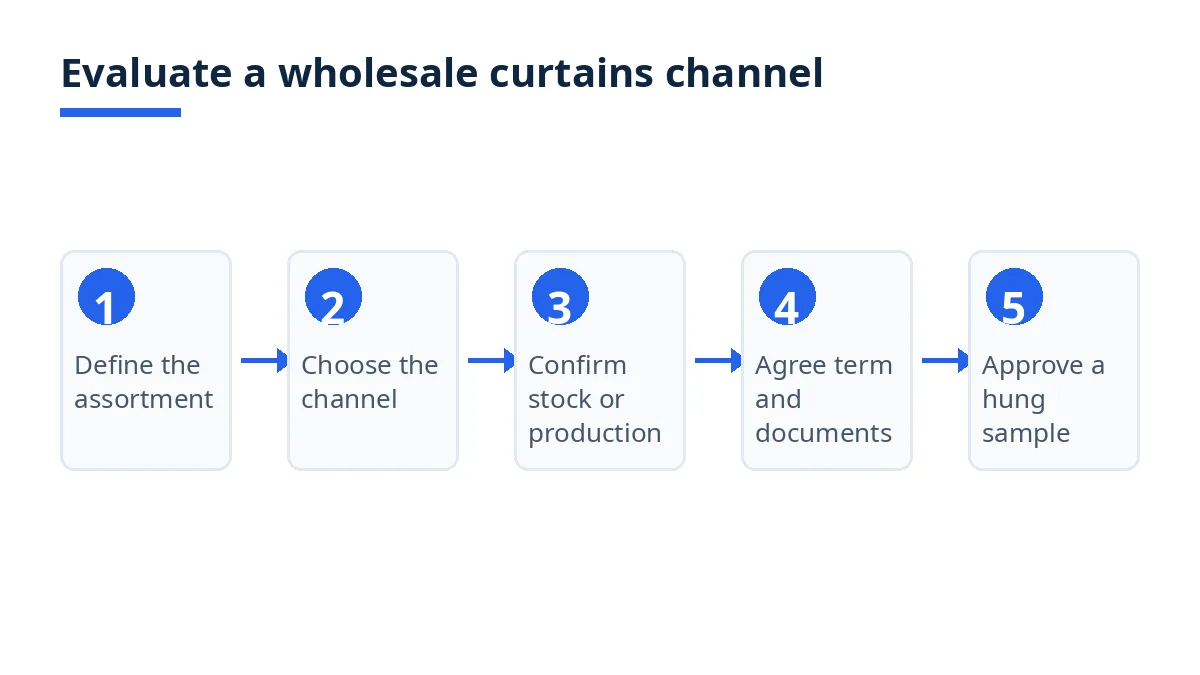
Define the assortment first. Write designs, colours, widths, drops, heading styles, linings and packing as one specification. Send the same specification to every channel.
Choose the channel on fit, not on headline price. Match the channel to your buyer type and reorder pattern: stockist for speed and small lots, factory for a defined repeating program, trading house for a mixed assortment under one counterpart.
Confirm stock or production, in writing. For a stockist, confirm what is held, in which lots, and how a repeat is matched. For a factory or trading house, confirm what is made to order and what fabric is stocked. Confirm the sample that represents the bulk: a hung pair in the production fabric, heading and lining.
Agree the delivery term and the documents before confirming. State one Incoterm and named place for every quotation. The Incoterms 2020 rules set out 11 rules with a clear allocation of cost, risk and obligations,2 so quotations on different terms cannot be compared.
Approve a hung sample and an inspection plan. Hang the pair, work the heading, check the lining drop, and measure width and drop. Write the inspection terms and who inspects into the order.
Beyond the five steps, ask three channel questions: who owns a defect found after delivery, how is a repeat order priced and specified, and how is a discontinued colour or fabric communicated, with how much notice.
Costs and timelines, by channel
This guide does not give a cost breakdown by component, because a component breakdown belongs to a single quotation for a single specification. What matters for a channel choice is what each channel includes, and what the buyer must still arrange.
In a direct factory channel, the quotation usually covers the made-to-order goods and the delivery term agreed. In a stockist channel, the price usually reflects goods already held, so the buyer pays for availability and speed, and should check whether packing suits onward shipment or only retail packing. In a trading house channel, the price usually reflects coordination plus the goods, so ask for the coordination element to be stated separately.
Compare quotations only on the same specification, unit, tier basis, and Incoterm and named place.2 A lower unit price on a different term, lining, or per-panel against per-pair basis is not a lower price. For timelines, ask for separate lines: sample approval, stock or production readiness, inspection, and shipment.
Documents a wholesale buyer should hold
The order documents are the specification, the itemised quotation, the sample approval record, and the purchase order or accepted quotation, each stating the assortment, the tier basis, the unit, the delivery term and the inspection terms.
For export clearance in Bangladesh, goods may not be loaded until a Bill of Export, also called a Shipping Bill, is submitted and approved. The standard export documents include the export contract or purchase order, the commercial invoice, the packing list, the EXP form certified by an authorized dealer bank, and a certificate of origin issued by the Export Promotion Bureau (EPB) or a Chamber of Commerce and Industry.3 Check that description, quantity, unit and value agree across the invoice, packing list and export declaration. Where the buyer sells into the European Union, Regulation (EU) No 1007/2011 states that a textile product shall be labelled or marked with the name and percentage by weight of all constituent fibres in descending order.4 Agree fibre composition as part of the specification.
Keep one legal name across every paper: quotation, proforma invoice, payment account and export documents should match.
Common mistakes in wholesale channel choice
Choosing a channel on unit price alone. A stockist, factory and trading house price cover different things. Compare them only on the same specification, unit, tier basis and delivery term.2
Ordering breadth the channel cannot repeat. A wide assortment with thin colours suits a stockist test, but it can fail a factory tier. Decide whether breadth or repeatability matters.
Treating stock as a repeat program. Ready stock is a present quantity, not a promise of future stock. If the buyer needs a repeat, ask how it is supplied, from which lot, and on what tier basis.
Accepting a verbal tier or sample approval. Record the tier basis, the sample approval, the inspection terms and the delivery term on the quotation and the purchase order.
Letting the channel choose the specification. A heading, a lining or a fibre composition left to the channel will be chosen for the channel, not for the buyer. Write the specification first.
Reading a profile or a badge as a channel check. Exportain badges record document and photo checks reviewed by the Exportain team, and a badge is not a guarantee of production capacity, product quality or delivery.5 6 The channel check is the written specification, the hung sample and the inspection plan, not the badge.
How Exportain helps
On Exportain, browse suppliers and post a request for quotation (RFQ) on the RFQ board stating your assortment, channel preference, tier basis and delivery term, so each channel quotes against the same specification. Quotations on Exportain are versioned, showing unit price, MOQ, lead time, Incoterm, payment terms and validity, and accepting a quotation creates an order record with those terms.7
Read the badges for what they record. Exportain verification is a document review by the Exportain team, not a factory inspection, and membership plans are a separate product that never grant a trust badge.6 A badge is not a guarantee of production capacity, product quality or delivery.5 Sample approval and inspection stay with the buyer. See how supplier verification works on Exportain.
FAQs
What should I know first about curtains?
Know the channel before the curtain. Curtains are made-up textile articles under heading 6303, split by construction and fibre,1 with different labelling duties.4 First state the assortment, the unit, and whether stock, production or a mix is needed, then choose the channel to fit that need.
What are the typical costs and timelines?
There are no typical costs or timelines a guide can state for wholesale curtains, because each channel prices a different thing: ready stock, a made-to-order run, or a coordinated program. Compare costs only on the same specification, unit, tier basis and Incoterm and named place,2 and ask for timelines as separate lines.
Which documents are needed?
The order documents are the specification, the itemised quotation, the sample approval record and the purchase order or accepted quotation. The export set for Bangladesh includes the Bill of Export, the commercial invoice, the packing list, the EXP form certified by an authorized dealer bank, and a certificate of origin issued by the EPB or a Chamber of Commerce and Industry.3
What are the most common mistakes?
The most common mistakes are choosing a channel on unit price alone, ordering breadth that cannot be repeated, treating ready stock as a repeat program, and accepting a tier or sample approval verbally. Write the specification, tier basis and delivery term first.2
Next steps on Exportain
Browse suppliers, then post your assortment, channel preference and delivery term on the RFQ board so stockists, factories and trading houses quote against the same specification. Before you confirm, read how to import curtains from Bangladesh and the curtains manufacturers in Bangladesh guide, and check the HS code for curtains and the curtains quality control checklist.
Sources
- HS, 2012 - Code 6303: Curtains (including drapes) and interior blinds; curtain or bed valances. United Nations Statistics Division (accessed )
- Incoterms® 2020. International Chamber of Commerce (ICC) (accessed )
- Custom Clearance in Bangladesh: Port Procedures and C and F Agent Guide. Bizmend (accessed )
- Regulation (EU) No 1007/2011 on textile fibre names and related labelling and marking of the fibre composition of textile products, Article 9: Multi-fibre textile products. legislation.gov.uk (accessed )
- Trust & Safety Center. Exportain (accessed )
- Supplier verification: Earn trust badges buyers can see. Exportain (accessed )
- How to source and buy from Bangladesh. Exportain (accessed )
About the author
Sourcing from Bangladesh?
Post a request for quotation and suppliers on Exportain can send you their quotes directly.
Post an RFQ


