Using UPAS LC (Usance Payable at Sight) When Buying From Bangladesh: Bank Rules and Tips
A UPAS LC pays a Bangladeshi seller at sight while the buyer pays at maturity. This guide explains the discounting mechanism, the costs and documents to confirm with each bank, and the Bangladesh-specific points to check before shipment.
Short answer
A UPAS LC is a usance letter of credit under which the seller is paid at sight, after presenting documents that comply with the credit, while the buyer repays the bank at the usance maturity date. A nominated bank funds the gap by discounting or prepaying the usance undertaking, so the timing split, not a lower price, is the point to confirm in writing before shipment.
On this page
Key takeaways
A UPAS LC pays the seller at sight against compliant documents, while the buyer repays the bank at the usance maturity date.
The UPAS clause, funding bank, tenor and charge allocation must all be written in the credit; none of them can be assumed.
Opened sources describe usance interest as usually for the applicant's account, but the credit's own allocation governs.
Bangladesh Bank import-side usance periods reported in the press are not a UPAS tenor for a foreign buyer's export order.
A UPAS LC, short for Usance Payable at Sight, is a usance letter of credit that splits payment timing in two. The seller is paid at sight, once it presents documents that comply with the credit, while the buyer repays the bank at the end of the agreed usance period. A bank funds the gap by discounting or prepaying the usance undertaking. That timing split is the point of the structure, and also where most misunderstandings start.
It only helps if the credit says so in clear words. A UPAS clause is an option included by the issuing bank in the documentary credit, at the request of the buyer, authorising the supplier to ask the issuing bank for a payment request while the documentary credit is payable at maturity.1 If the clause, tenor, discounting arrangement and charge allocation are not written down, do not assume them.
Why this matters for buyers and sellers
For a buyer, a UPAS LC offers payment time without asking the seller to wait. The buyer is debited only on the due date stipulated in the documentary credit.1 For a seller, the attraction is payment at sight against compliant documents, rather than waiting until maturity. One guide states the contrast plainly: under a UPAS LC the seller is paid at sight and the buyer repays the bank at the end of the usance period, while under the related UPAU structure the seller is paid at maturity unless it discounts.2
That contrast separates a UPAS LC from a plain usance LC, where the seller waits until maturity. A seller that would refuse a long usance period may accept the same tenor when payment comes at sight. Nothing about the UPAS label removes document discipline, and nothing about it guarantees goods quality, which still needs its own inspection and contract terms.
Step-by-step: how it works
A UPAS transaction follows the ordinary documentary credit sequence, with one added mechanism: the sight payment to the seller is funded before the buyer pays at maturity. Check the availability, nomination and reimbursement wording in your draft.
Agree the commercial terms. Buyer and seller agree the goods, price, Incoterm, shipment terms, usance period and UPAS structure, with the credit subject to UCP 600, the Uniform Customs and Practice for Documentary Credits.2 Record the tenor, document list, latest shipment date and expiry date in the sale contract.
Ask for the UPAS clause in writing. The buyer instructs its bank to open a documentary credit with a UPAS clause in favour of the supplier.1 The clause must authorise a supplier payment request, and state how the sight payment is funded and who bears interest and charges for the usance period.
Check the draft credit before shipment. The seller should check every field against the contract and ask for an amendment before shipping if any field cannot be met.
Ship and present. The seller ships within the latest shipment date and presents the documents the credit requires, together with the payment request that activates the UPAS clause. Two conditions must be met: a payment request must be made by the supplier and sent to the issuing bank during document submission, and the documents must be in line with the credit terms.1
The bank examines the documents. If the documents are in line with the credit, the bank pays the supplier as per the UPAS clause.1 Underlying mechanics vary: a usance draft may be accepted but the beneficiary paid on a sight basis, or a deferred payment undertaking may be incurred but the beneficiary paid on a sight basis, in each case with interest costs for the account of the applicant in the descriptions opened for this guide.3
The buyer pays at maturity. The buyer is not charged until the contractual deadline stipulated in the credit.1 At that date the buyer repays the bank, together with any interest and charges the credit allocates to the buyer.
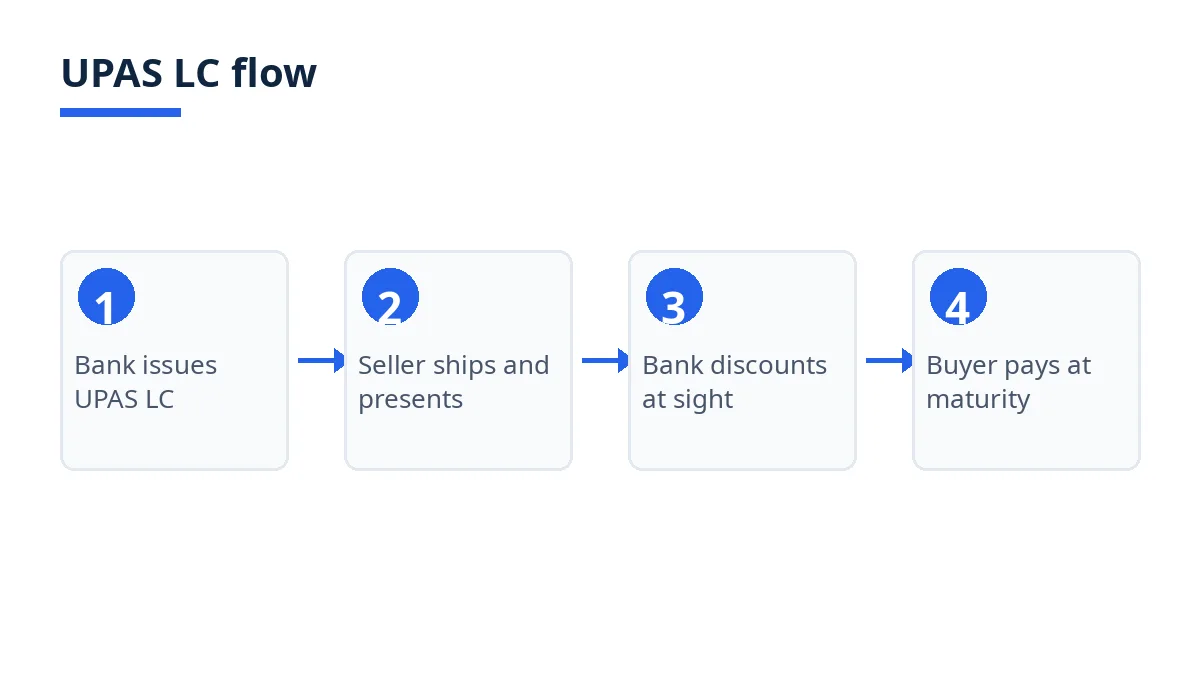
One technical point matters at step 5. Under UCP 600, a nominated bank may prepay an undertaking it has itself issued, but it is not authorised to prepay an undertaking issued by another bank without a separate authorisation from that bank.3 No bank is under any obligation to provide finance under a draft it has accepted or a deferred payment undertaking it has issued.3 Ask which bank funds the sight payment, and what happens if that bank declines.
Negotiation is the related UCP 600 concept behind part of this funding: the purchase by the nominated bank of drafts and documents under a complying presentation, by advancing or agreeing to advance funds to the beneficiary on or before the banking day on which reimbursement is due to the nominated bank.3 If you cannot explain, from the draft credit alone, who pays the seller at sight and who is repaid at maturity, the draft is not ready.
Costs, timelines and documents
No discount rate, fee, usance period or timeline here is a universal figure. Final pricing depends on the issuing bank, the countries involved, the tenor and the amount.2 Get every quote itemised before the credit is issued: issuance, advising, transmission, any confirmation, acceptance commission, usance interest and discounting cost, amendment, discrepancy, reimbursement and payment charges, each allocated to applicant or beneficiary.
On the discounting cost, the sources opened for this guide point the same way but do not create a rule you can rely on without reading your credit. One guide states that under UPAS, interest for the usance period is usually charged to the buyer.2 A training source describes UPAS as allowing the beneficiary to be paid on a sight basis with interest costs for the account of the applicant.3 A Bangladesh report states that the importer is charged interest, acceptance commission and other charges as per the terms of the LC.4 Those descriptions support asking for applicant-borne interest as a starting point, but the credit itself is the authority, and the price should reflect its allocation.
Timelines work the same way. One bank's illustration states that once its documents have been approved and it has received the supplier's payment request, settlement follows within 48 hours.1 That is that bank's illustration, not a market timetable. Confirm the examination timetable, funding timetable and maturity date in your draft credit.
The document set is whatever the credit requires, and only compliant documents trigger payment. Expect a commercial invoice matching the credit, a transport document consistent with the Incoterm, a packing list, an insurance document where the Incoterm requires one, and any inspection certificates or approvals the credit names.2 Present early enough to correct a problem inside the presentation period.
Bangladesh-specific rules and tips
Bangladesh is a letter-of-credit-heavy trade environment. Letters of credit cover more than 80 percent of imports in Bangladesh, according to a Bangladesh trade finance analysis.5 The same analysis describes UPAS letters of credit as particularly popular in Asian markets, including Bangladesh, because they satisfy regulatory comfort with LCs while delivering financing benefits to both sides.5 That does not make a UPAS LC automatic for an export order from Bangladesh.
For a foreign buyer, keep the export order and the LC consistent, since a late or repeatedly amended master LC can compress a Bangladeshi seller's production time. Ask early which bank the seller will present to, and whether that bank has agreed to the UPAS funding arrangement. Do not assume that a UPAS clause used for imports into Bangladesh works identically for exports from Bangladesh: the direction of trade and the banks involved change, so the wording must be drafted for your transaction.
Bangladesh Bank usance figures in news reports need careful reading. A report of a Bangladesh Bank notification states that import of industrial raw materials, including back-to-back import, under suppliers' or buyers' credit was allowed for a usance period of up to 270 days or the cash conversion cycle, whichever is earlier, and that an August 2025 permission for up to 360 days was valid until the last day of that year.6 Those figures describe an import-side facility for industrial raw materials. They are not a UPAS tenor for a foreign buyer's export order, and must not be quoted to a seller as the tenor your bank will allow.
A further caution comes from opened reporting. A 2022 Bangladesh report recorded commercial banks being averse to opening LCs under Export Development Fund, UPAS and deferred-payment systems during a dollar shortage.4 That report is dated, but the lesson stands: bank appetite for UPAS funding is not guaranteed. Confirm appetite early, in writing, with the specific banks in your transaction.
A worked example shows the timing split in practice. The figures below are example figures only, not a quote, a typical tenor or a market rate. A buyer in the Netherlands orders woven jute shopping bags from a Bangladeshi seller for USD 48,000, on a UPAS LC with a usance tenor of 90 days after the bill of lading date, stated only as an example tenor. The seller ships and presents a compliant invoice, bill of lading, packing list and the other documents the credit names, together with the UPAS payment request. The nominated bank discounts the usance undertaking and pays the seller at sight, less any charges the credit allocates to the seller. The buyer repays its bank at the 90-day maturity, with the interest and charges the credit allocates to the buyer. If any document were discrepant, the sight payment would not follow automatically.
Mistakes and red flags
The most common UPAS mistakes are wording mistakes. Treating UPAS as sight payment for the buyer as well gets the structure backwards. Leaving the funding bank unnamed means the sight payment may not happen on the timetable the seller expects. Leaving the interest allocation vague invites a dispute at maturity. Omitting the payment request may fail to trigger the UPAS mechanism, since the clause is activated by a supplier payment request sent to the issuing bank during document submission.1 Preparing documents from the sale contract instead of the credit, assuming confirmation without requesting it expressly, and quoting a reported Bangladesh Bank facility period as if it were the tenor for an export order are further mistakes that are preventable at the draft-credit stage and expensive after shipment.
Red flags include a seller that cannot name its presenting bank, a bank that will not confirm the funding arrangement in writing, a credit that names a tenor but no UPAS clause, and a fee schedule that appears only at maturity. Pause early, while the credit can still be amended.
Checklist
Use this checklist before you ask a bank to issue a UPAS LC, and again when the draft credit arrives.
[ ] The sale contract and draft credit agree on goods, price, Incoterm, ports, latest shipment date, expiry date, document list and usance tenor.
[ ] The UPAS clause is present, authorises a supplier payment request, and states how the sight payment is funded.
[ ] The funding bank is named, and has confirmed it will discount or prepay on the stated terms.
[ ] Interest, acceptance commission and all bank charges are itemised, each allocated to applicant or beneficiary.
[ ] The seller can present every named document, in the form required, inside the presentation period.
[ ] The payment request procedure is written down: who sends it, to which bank, and at which stage of presentation.
[ ] Confirmation is expressly requested or expressly declined, with the cost consequence recorded.
[ ] The maturity date is calculated from the tenor basis in the credit, and diarised with a payment instruction to your bank.
[ ] Quality inspection, if required, is a named LC document, or is handled separately in the contract.
[ ] Both banks have confirmed, in writing, the current rules for the goods and direction of trade.
How Exportain helps
Exportain connects buyers with Bangladeshi suppliers and providers. Payment for goods is settled directly between buyer and supplier on the terms in the accepted quotation, unless both sides agree to a funds hold, which the buyer may pay or decline. Those points matter because the LC is a bank arrangement separate from the marketplace quotation. Agree the payment term, including the UPAS clause, tenor basis and charge allocation, in the quotation record before either side approaches a bank, so the draft credit mirrors a term both sides have already accepted. Exportain does not issue LCs, does not act as a party to the goods contract, and does not guarantee payment, quality or delivery. Banks still decide compliance from the credit alone.
FAQs
What should I know first about UPAS LC?
Know the timing split first: the seller is paid at sight against compliant documents, and the buyer pays at maturity.2 The bank funds the gap. Confirm that the credit contains a UPAS clause, names the funding bank, states the tenor and allocates interest and charges. Without those four items in writing, you do not yet have a workable UPAS arrangement.
What are the typical costs and timelines?
There are no typical costs or timelines that can be quoted safely for every transaction. Final pricing depends on the issuing bank, the countries involved, the tenor and the amount.2 Budget for issuance, advising, transmission, any confirmation, acceptance commission, usance interest and discounting cost, amendment and discrepancy charges, and confirm each item and its allocation. One bank's illustration of settlement within 48 hours after document approval is that bank's illustration only, not a market promise.1
Which documents are needed?
Only the documents the credit names are needed, and they must comply with the credit. Expect a commercial invoice matching the credit, a transport document consistent with the Incoterm, a packing list, an insurance document where the Incoterm requires one, and any inspection certificates or approvals the credit names.2 The seller must also make the UPAS payment request during document submission.1 Prepare every document from the credit wording, and present early enough to correct a problem inside the presentation period.
What are the most common mistakes?
The most common mistakes are assuming the funding bank, assuming the interest allocation, omitting the payment request, preparing documents from the sale contract instead of the credit, and quoting a reported Bangladesh Bank facility period as if it were the tenor for an export order. Each mistake is preventable at the draft-credit stage and expensive after shipment.
Next steps on Exportain
Start with LC meaning (Letter of Credit), then check Exportain payment terms and Exportain buyer protection. When the UPAS wording is agreed in principle, post an RFQ on Exportain and ask quoting suppliers to confirm that their presenting bank can handle a UPAS presentation on your tenor and charge allocation.
Sources
- Documentary credit for importers with UPAS clause. Crédit Agricole CIB (accessed )
- Full Guide to UPAS Letter of Credit & UPAU Letter of Credit. Financely Group, (accessed )
- Back to Basics – Documentary Credit – Document Negotiation & Financing. TradeFinance.training, (accessed )
- Most banks cold-shoulder LC opening. The Financial Express (accessed )
- From LCs to Platforms: Understanding Trade Finance Boundaries. Daily Asian Age (accessed )
- Bangladesh Bank revises industrial raw materials import usance period. Fibre2Fashion, (accessed )
About the author
Sourcing from Bangladesh?
Post a request for quotation and suppliers on Exportain can send you their quotes directly.
Post an RFQ