Using Trade Credit Insurance When Buying From Bangladesh: Bank Rules and Tips
Trade credit insurance for Bangladesh sourcing: how a supplier cover works, what it means for the buyer, and where its limits sit beside a bank undertaking.
Short answer
Trade credit insurance protects the seller, not the buyer, when a covered buyer fails to pay. The insurer sets a credit limit for the buyer, pays the seller a share of a covered loss after the waiting period, and does not act as a bank undertaking or a funds hold. For Bangladesh open account orders, confirm the insurer, structure, limit, and covered risks before shipment, because no guide figure replaces the policy.
On this page
Key takeaways
Trade credit insurance protects the seller as policyholder against a covered buyer's non-payment; it is not buyer protection, not a bank undertaking, and not a held-funds arrangement.
The buyer's credit limit caps the insured part of an order, and sales above the limit, shipments after a withdrawal, or informal extensions beyond the maximum extension period can fall outside cover.
No premium rate, indemnity percentage, waiting period, or timeline in this guide is universal: opened sources describe different figures, so the insurer's written quote and policy govern.
The opened material gives no Bangladesh-specific premium, rate, or timeline, and Exportain's live pages describe no insurance product; its funds holds are not insurance.
A Bangladeshi supplier that offers open account terms asks the buyer to pay after shipment, not before it. For the supplier, that gap is an unpaid receivable. Trade credit insurance is the supplier's tool for that gap: a policy under which an insurer covers the seller when a covered buyer does not pay. It is not a payment promise to the buyer, and it does not change what the buyer owes.
Atradius describes trade credit insurance as a tool that insures accounts receivable and protects a business from unpaid invoices whether due to bankruptcy, insolvency, or other agreed risks, for domestic and export customers.1 The policyholder is the seller. When a claim is paid, the insurer pays the policyholder, not the buyer, and a claim does not release the buyer from a valid debt. A letter of credit is different: a bank undertakes to pay against compliant documents.
Why this matters for buyers and sellers
For a seller, cover can decide whether open account terms are offered at all. Atradius notes that businesses use credit insurance to secure finance and working capital with banks, explore new markets, and offer favorable credit terms, because insured receivables are viewed favorably by lenders.1 A supplier may therefore discuss 60-day or 90-day terms only when its insurer has approved the buyer.
For a buyer, the effects are concrete. First, the buyer will usually need credit approval, with a limit set by the insurer. Assured Trade describes the credit limit as the most the insurer will cover on a particular customer at any one time, set using the insurer's own data, and reducible if a customer weakens.2 A limit below the planned order value caps the insured part of the order. Second, the buyer gains no payment from the policy: if the buyer does not pay a valid invoice, the insurer's payment to the seller does not cancel the buyer's obligation.3 Third, cover does not inspect goods or settle quality disputes. Assured Trade lists disputed invoices, until the dispute is settled in the seller's favor, among the items not covered.2
A letter of credit is a bank undertaking tied to documents. Factoring is the sale of an invoice to a factor for an advance. Trade credit insurance is neither: no bank undertaking is issued and no invoice is sold.
Step-by-step: how it works
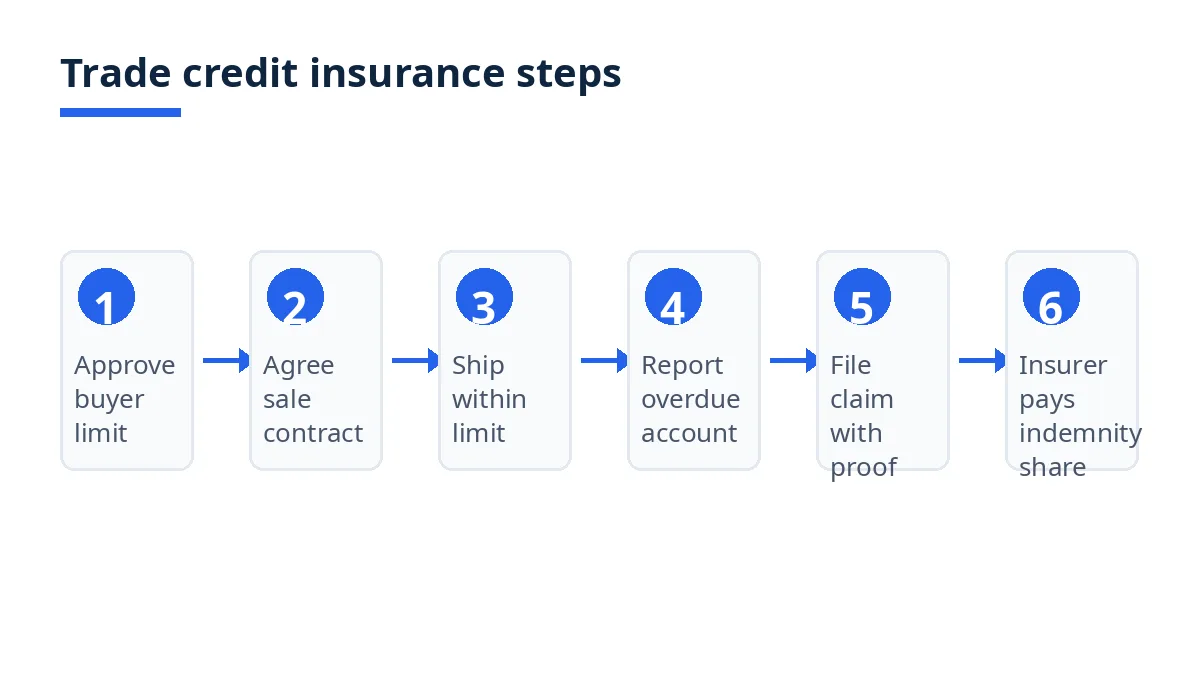
The sequence below describes the usual shape of a policy, as opened sources describe it. The seller's actual policy governs each step.
The seller applies for cover and discloses its buyer book, terms, and loss history. The insurer decides which buyers, structures, and limits it will offer.
The insurer sets a credit limit for each approved buyer. Atradius describes the insurer monitoring customer financial health and applying a buyer rating that guides how much exposure it is prepared to insure.1 Assured Trade adds that limits can be appealed with better information.2
The seller and buyer agree the sale contract, including price, Incoterm, shipment terms, payment term, and dispute procedure. The policy sits beside that contract; it does not replace it.
The seller ships and invoices within the approved limit. Sales above the buyer's credit limit are not covered for the excess.2
The buyer pays by the invoice due date. If payment is late, the seller must follow the policy's reporting and extension rules. The claims guide warns that silent forbearance beyond the maximum extension period is a common self-inflicted coverage problem.3
If the buyer becomes insolvent, or still has not paid when the waiting period ends, the seller files a claim with the documentary package the policy requires. Atradius describes insurers first trying collection, and paying in line with the policy if the debt proves impossible to recover.1
The insurer pays the indemnity share of the covered balance, capped at the buyer's credit limit, and takes over collection and recovery rights, with recoveries shared in proportion to the indemnity.3
The diagram below summarizes the sequence.
Structures change how much of the book is covered. Assured Trade lists four: whole turnover, covering the full insurable book under one policy; key buyer, concentrated on the handful of customers whose failure would hurt most; excess of loss, where the seller carries everyday losses and the insurer takes catastrophic ones; and single situation, where one buyer, contract, or country is insured on its own terms.2 A buyer should ask which structure applies to its order.
Cover also splits by risk type. Commercial risk cover addresses buyer insolvency and protracted default, where the buyer simply fails to pay within a set period after the due date. Political risk cover, where a policy includes it, addresses export risks such as a government blocking payments from leaving the country.2 Do not assume political risk cover is included in every policy.
Three terms decide most claim outcomes. The credit limit caps covered exposure per buyer. The indemnity percentage is the share of the covered loss the insurer pays; the seller keeps the rest, plus any amount above the limit. The waiting period is the interval after the due date before a protracted-default claim becomes payable. The maximum extension period is the grace period after the original due date during which the seller may extend the due date without informing the insurer, as the Allianz Trade glossary defines it.4 Extending beyond that period without consent can reduce or defeat a claim.3
Costs, timelines and documents
No premium rate, indemnity percentage, waiting period, or timeline in this section is a universal figure. Every figure below is an opened source's description of its own product or model, or an example figure labelled as such. The insurer's written quote and policy for the specific seller, buyer, country, and tenor are the only figures that govern a real transaction.
On premium, Assured Trade states that the premium is normally worked out as a rate applied to the turnover insured, and that the rate depends on sector, the quality and spread of customers, loss history, credit control, and how much risk the seller chooses to keep.2 The Allianz Trade glossary adds that credit limit fees are applied on each buyer for whom a credit limit is requested above the discretionary limit amount.4 Confirm what turnover figure the quote uses, and whether credit limit fees and a minimum premium sit on top of it.
On indemnity, opened sources describe different figures, which is itself the warning. Atradius states that if the debt is impossible to recover, the insurer should pay up in line with the policy, often up to 90 percent of the debt.1 Assured Trade states that the insurer pays most of what was owed, usually around 90 percent, and that the seller keeps the rest, along with any amount above the customer's credit limit.2 The claims guide describes the indemnity percentage as typically 85 to 95 percent of the covered amount.3 Those descriptions do not agree into one rate, and none of them is the seller's policy rate. Confirm the indemnity percentage and how deductibles or first-loss amounts change the payable figure.
On timelines, the claims guide states that insolvency claims are payable on proof of the insolvency event, while protracted-default claims are payable after the policy waiting period, commonly 90 to 180 days past due.3 It also states that policies require notice when an account passes a defined overdue threshold, often 60 days past due.3 Those are that guide's descriptions, not a market timetable. Confirm three dates in writing before shipment: the reporting deadline, the maximum extension period, and the waiting period.
Documents are the claim, in practice. The claims guide lists the proof package as the invoices, the signed order or contract, proof of delivery or performance, the account statement, and correspondence evidencing that the debt is undisputed.3 For insolvency, it adds the bankruptcy notice and proof of claim. For export claims, it adds transport documents and any exchange-control evidence.3 Keep one file per shipment, and raise any quality or quantity issue in writing at once, with evidence.
An example, with all figures labelled as example figures only, not a quote or a market average: a buyer in Poland orders jute shopping bags from a Bangladeshi seller for USD 48,000 on 60-day open account terms, under a single-situation policy. The insurer approves an example credit limit of USD 50,000 and an example indemnity of 90 percent. The buyer becomes insolvent before paying, the debt is undisputed, and the claim is verified. The example payable amount is 90 percent of USD 48,000, which is USD 43,200, with the seller retaining USD 4,800.
Bangladesh-specific rules and tips
The opened material gives no Bangladesh-specific premium, rate, indemnity percentage, or timeline for trade credit insurance, and this guide states none. No insurer count, market size, or premium level for Bangladesh is asserted here, because no opened source stated one.
Reporting on a Bangladesh Bank circular dated 7 October 2025 states that the central bank permitted banks to arrange payment undertakings or payment risk coverage from Bangladeshi insurers for exports under open account terms.5 The move builds on an earlier provision under which such exports were permitted only against payment undertakings from designated institutions abroad.5 Under the reported circular, banks can facilitate transactions through foreign currency-denominated policies issued by local insurers, claims for non-receipt of export proceeds need to be settled in foreign currency, reinsurance can be obtained from foreign sources, and banks are authorized to offer post-shipment finance against the insured exports.5
That reporting raises a distinction to check, not a conclusion to assume. A payment undertaking or payment risk coverage arranged through a bank is not automatically the same instrument as a seller's trade credit policy. Ask the seller and its bank, in writing: who is the insurer, what instrument is in place, which buyer and invoice values are covered, and how a claim is settled and in which currency. If the seller cannot name the insurer or the instrument, treat the order as uninsured, and keep a bank undertaking route in reserve for first orders.
Mistakes and red flags
The most common buyer mistake is treating insurance as buyer protection. It is seller protection. A second mistake is assuming the policy pays the full invoice: the indemnity share, the credit limit cap, and any deductible all reduce the payable figure. A third mistake is assuming cover follows the order. Cover follows the approved buyer, the approved limit, and the policy conditions.
Red flags include a seller that cannot name the insurer, the structure, or the buyer's limit; a seller that promises a fixed payout percentage without showing the policy; and a seller that asks the buyer to extend a due date informally, without checking the maximum extension period. Pause on any of these before shipment or payment.
Checklist
Use this checklist before agreeing open account terms with a seller that claims trade credit cover.
[ ] Cover structure confirmed: whole turnover, key buyer, excess of loss, or single situation.
[ ] Buyer's credit limit known, in writing, and covering the full planned order value.
[ ] Covered risks stated: commercial only, or commercial plus political risk for this buyer and country.
[ ] Indemnity percentage, any deductible, and the limit cap stated in the policy summary.
[ ] Reporting deadline, maximum extension period, and waiting period written down.
[ ] Sale contract states payment term, currency, due date basis, and dispute procedure.
[ ] Document file per shipment complete: signed order, invoice, transport document, delivery proof.
[ ] For a Bangladesh open account export, insurer, instrument, and settlement currency named.
[ ] No order shipped above the approved limit or to a materially overdue buyer without a fresh written limit decision.
[ ] Bank undertaking alternative kept in reserve for first orders or orders above the insured limit.
How Exportain helps
Exportain connects buyers with Bangladeshi suppliers and providers. Payment for goods is settled directly between buyer and supplier on the terms in the accepted quotation, unless both sides agree to a funds hold, which the buyer may pay or decline. Those points are stated on Exportain's live buyer protection and payment terms pages. A paid funds hold is kept until the supplier has filed an export clearance document and the buyer has confirmed the trade complete, then released to the supplier.
Neither live page describes an insurance product, and this guide does not present funds holds as insurance. A funds hold is money held until agreed conditions are met, while trade credit insurance is a seller's policy under which an insurer pays the policyholder a share of a covered loss. Exportain does not issue insurance, act as a party to the goods contract, or guarantee payment, quality, or delivery.
FAQs
What should I know first about trade credit insurance?
Know first that trade credit insurance protects the seller, as policyholder, against a covered buyer's non-payment. It insures accounts receivable against bankruptcy, insolvency, or other agreed risks.1 It is not buyer protection or a bank undertaking. The buyer must usually be credit-approved with a limit, and a claim does not release the buyer from paying a valid invoice.
What are the typical costs and timelines?
There are no typical costs or timelines that can be quoted safely for every transaction. Assured Trade states the premium is normally a rate on insured turnover, depending on sector, customer quality and spread, loss history, credit control, and risk kept.2 Atradius describes payment often up to 90 percent of the debt where recovery proves impossible.1 The claims guide describes indemnity typically at 85 to 95 percent, and protracted-default claims payable after a waiting period commonly 90 to 180 days past due.3 Confirm every figure in the seller's policy and the insurer's quote.
Which documents are needed?
Only the documents the policy requires are needed. The claims guide lists invoices, the signed order or contract, proof of delivery or performance, the account statement, and correspondence evidencing that the debt is undisputed, plus bankruptcy notice and proof of claim for insolvency, and transport documents and exchange-control evidence for export claims.3 Keep a complete file per shipment, and raise disputes promptly in writing with evidence.
What are the most common mistakes?
The most common mistakes are treating insurance as buyer protection, assuming it pays the full invoice, shipping above the approved credit limit, extending a due date informally beyond the maximum extension period, and assuming political risk cover is included. Confirm the insurer, structure, limit, covered risks, and waiting period before shipment and before payment.
Next steps on Exportain
Start with LC meaning (Letter of Credit), then Exportain payment terms and Exportain buyer protection. When the insurance question is settled in principle, post an RFQ on Exportain and ask quoting suppliers to confirm whether they hold trade credit cover, what structure and limit apply to your order, and which risks the policy covers.
Sources
- What is Trade Credit Insurance?. Atradius (accessed )
- Credit Insurance. Assured Trade (accessed )
- Trade Credit Insurance Claims: How They Are Paid. Janus Underwriters (accessed )
- Terms - Trade Credit Insurance glossary. Allianz Trade (accessed )
- BB allows exporters to use local insurance for open account exports. The Business Standard, (accessed )
About the author
Sourcing from Bangladesh?
Post a request for quotation and suppliers on Exportain can send you their quotes directly.
Post an RFQ