

Quality Control Checklist for Toiletries From Bangladesh
A numbered QC checklist for toiletries from Bangladesh: fill and net content, pumps, sprays and seals, formula appearance, pH, viscosity, stability and microbiology tests, labels, batch codes and packing, with fixes for common failures.
Short answer
Use this toiletries quality control checklist to check fill and net content, containers, pumps and sprays, formula appearance, laboratory tests, labels and packing on lotions, creams, shampoos, gels and deodorants from Bangladesh before shipment, with tolerances and acceptance numbers agreed in the purchase order.

On this page
Key takeaways
Agree the sample, tolerances, test methods and acceptance numbers before inspection, and draw the sample randomly across batches, variants and cartons.
Test the dispensing system, not just the formula: pumps, sprays, roll-ons, sticks, tube seals and closures each fail in their own way, and leakage is the most common failure.
Check formula appearance, pH, viscosity, stability, microbiology and preservative efficacy against the specification, with every report naming the bulk formula, batch and variant.
Check labels against approved artwork for the responsible person, country of origin, net content, durability, batch code and claims, and record unsupported claims as failures.
If you buy lotions, creams, shampoos, gels or deodorants from Bangladesh, this toiletries quality control checklist gives you a way to check a shipment before it leaves the factory. A toiletry fails in use, not on the shelf: a pump that sticks, a cream that separates, or a cap that leaks in transit. Check product, container, formula and carton against the sample and purchase order.
Why this checklist matters
Toiletries combine a chemical formula with a dispensing container, so one order carries two kinds of risk at once: the formula can change in color, odor, texture or thickness between batches, and the container can fail even when the formula is right.
A written checklist removes interpretation at the inspection table. Each point is checked against the approved sample and the specification, and recorded as pass, fail or not applicable. Agree the sampling plan, test methods and acceptance numbers in the purchase order before inspection begins, rather than debating them over an open carton. ISO 2859-1 specifies the acceptance sampling system for inspection by attributes, indexed by acceptance quality limit (AQL).1
Before you start
Do not begin until the references are complete: an approved sample of each variant, the formula specification, the container and closure specification, approved artwork for each market, the packing specification, and the purchase order with tolerances and acceptance numbers. Draw the sample randomly across batches, variants and cartons, never factory-selected pieces.
Confirm which destination rules apply before the labels are printed. For the EU, Regulation (EC) No 1223/2009 requires cosmetic products to bear, in indelible, easily legible and visible lettering, the responsible person's name and address, country of origin for imported products, nominal content, date of minimum durability, batch reference, precautions for use, and ingredient list.2 For the United States, confirm facility registration, product listing and safety substantiation under the Modernization of Cosmetics Regulation Act of 2022, under which facilities must register with the Food and Drug Administration and renew every two years, and each marketed product must be listed with its ingredients.3 Where the buyer asks for evidence of good manufacturing practice, ISO 22716 provides guidance for documenting and regulating the production, control, storage and shipment of cosmetic products.4
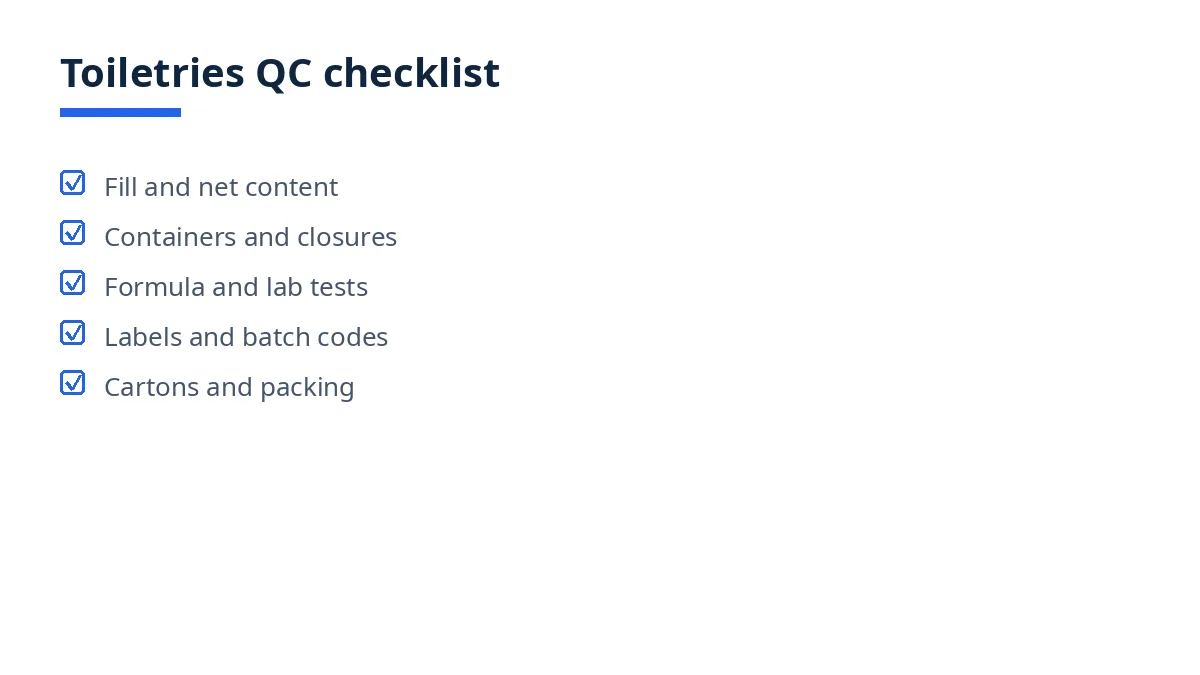
The full checklist (numbered, printable)
Identity, fill and net content
Check each unit against the sample for identity, variant, fragrance and shade; confirm no variant was substituted in bulk.
Weigh or measure net content of units against the declared content and purchase order tolerance; record actual values, not pass marks alone.
Check fill levels, headspace, air pockets and trapped bubbles across the sample: underfilled bottles, half-empty tubes and short sticks show before weighing, and bubbles change the dispensed amount or the look of a clear product.
Confirm label net content matches measured content and the purchase order unit for every size.
Containers, pumps, sprays and closures
Check containers for cracks, dents, scratches, flash, sharp edges and molding defects, inside and out, including base and shoulder.
Check caps, closures and flip-tops for correct fit, full thread engagement and smooth opening and closing, with no cross-threading or stripped threads.
Test each pump through its full stroke several times: it must prime, dispense a consistent amount, and engage or release as specified.
Test each spray or mist head for an even pattern, with no dripping, spurting, clogging or off-center jet.
Test roll-on and stick mechanisms: the ball must roll freely without falling out, and the stick must advance, retract and hold position.
Check tube seal integrity at the crimp and shoulder, and squeeze tubes to confirm no leakage at the seal or cap.
Check tamper-evident seals, shrink bands and induction seals where specified; confirm they are intact on every unit.
Invert bottles, tubes and jars for the period named in the inspection plan; check for leakage at cap, pump, seal and seam.
Check closures against the sample for color, material and finish; record any substitution in bulk as a failure.
Formula appearance, color, odor and texture
Open units of each variant and check color, clarity or opacity, and consistency against the approved sample, under the same light.
Check creams and lotions for separation, graininess, lumps and watery layers; stir or shake only where the product directions say to do so.
Check gels for clarity, stringiness and trapped bubbles, and shampoos for expected flow and foam character against the sample.
Check odor of each variant against the sample: rancid, sour, chemical or missing fragrance notes are failures, not variations.
Check deodorant sticks and balms for surface bloom, sweating, cracking and crumbling; confirm the stick holds shape at the specified temperature.
Check opened units for contamination: foreign particles, fibers, mold spots and surface or neck discoloration.
Laboratory tests
Review pH evidence for each formula against the specified range; confirm the report names the bulk batch and variant tested.
Review viscosity evidence for lotions, creams, shampoos and gels against the specified range, using the specified method and temperature.
Review stability evidence where required, covering appearance, color, odor, pH and viscosity after the agreed storage conditions.
Review microbiological evidence against the agreed limits: under ISO 17516, a total aerobic mesophilic count of not more than 10^3 CFU per gram or milliliter is considered acceptable for most cosmetic products, and not more than 10^2 CFU per gram or milliliter for products intended for children under three years, the eye area or mucous membranes, with Escherichia coli, Staphylococcus aureus, Pseudomonas aeruginosa and Candida albicans expected to be absent in 1 gram or 1 milliliter.5
Review preservative efficacy evidence where required: under ISO 11930, the product is inoculated with specified bacteria, yeast and mould, and counts are measured at defined intervals, including 7, 14 and 28 days.6
Confirm every laboratory report names the bulk formula, batch, variant and test method, and that the tested sample matches the shipped lot.
Labels, batch codes and claims
Check each label against approved artwork for product name, variant, fragrance, net content, directions, warnings, responsible person's name and address, and country of origin for imported products.2
Check the ingredient list against the approved formula for order, spelling and the names the destination market requires, including any fragrance allergens it requires to be named individually.
Check the date of minimum durability or period-after-opening symbol against the specification, and confirm the format matches the destination market's rules.2
Check the batch or lot code on every unit: it must be legible, match the carton and packing list, and be traceable to production.
Scan barcodes on units, and confirm each scan returns the product and variant named in the purchase order.
Check every pack claim, such as a moisturizing, antibacterial or long-lasting claim, against the evidence the buyer agreed; record unsupported claims as failures.
Check outer cartons and shippers for the same product name, variant, quantity and batch information as the units inside, with no mixed variants unless allowed.
Packing, cartons and storage
Check units are packed in the specified orientation, count and inner packaging, with dividers or trays if specified, and that nothing can puncture, crush or leak onto another unit.
Check carton strength, taping, strapping and markings, and confirm sample cartons are weighed and measured and the carton count matches the packing list before release.
Common failures and how to fix them
The most frequent failure is leakage, usually from a cap that does not fit the bottle neck, a pump seal seated unevenly, or a tube crimp closed at the wrong temperature. Stop, test closures on units from more than one carton, compare closure and neck against the sample, and only then restart packing. Next is separation or graininess in creams, pointing to a formula or mixing problem in one batch: segregate that batch and re-inspect it alone.
Pump and spray failures usually trace to one component lot: a spring, a ball valve or a dip tube cut to the wrong length. Label errors, especially a wrong variant, net content or batch code, are cheapest to prevent and most expensive to fix after dispatch: re-check artwork approval and first printed labels before the full label run.
Above the agreed acceptance level, options are re-inspection after sorting or rework, documented partial acceptance, or rejection.
Downloadable template / summary table
Copy the checklist into your inspection sheet, add specification ranges, tolerances and acceptance numbers, and record a result per unit.
Section | Checks | Evidence |
|---|---|---|
Identity and fill | Variant, net content, fill level | Weights |
Containers and closures | Cracks, caps, pumps, sprays, seals, leakage | Function and inversion tests |
Formula appearance | Color, odor, texture, separation | Sample comparison |
Laboratory tests | pH, viscosity, stability, microbiology | Reports per batch |
Labels and claims | Artwork, ingredients, durability, batch, claims | Artwork check, scans |
Packing and cartons | Orientation, counts, markings | Packing list |
How Exportain helps
Exportain is a B2B marketplace connecting buyers with Bangladeshi suppliers of toiletries and personal care products, so the specifications behind this checklist can be agreed at the enquiry stage. Use inspection services when you plan the check, and read the AQL acceptance quality limit explainer and the pre-shipment inspection guide before you set the sampling plan. Supplier profiles show which document and photo checks have been recorded, not factory inspections. Exportain is not a party to the goods contract and does not inspect goods.
FAQs
When should this checklist be used?
Use it at final inspection, when goods are finished, filled and sealed. For larger and first orders, also use it during production, while problems can still be corrected.
Who should complete it?
The buyer, a local agent or an independent inspector can complete it, using the approved sample, formula and container specifications and a random sample.
What are the most common failures?
Leakage from caps, pumps and tube seals, separation in creams, pump and spray failures, shade and fragrance drift, and label errors in variant, net content or batch code are the failures buyers find most often.
Can a third party do it?
Yes, if you share the approved samples, formula and container specifications, tolerances and acceptance levels first, with actual measurements and batch numbers reported, not pass marks alone.
Next steps on Exportain
Before production starts, agree formula ranges, container specification, label artwork and acceptance numbers, then read the AQL acceptance quality limit explainer and the pre-shipment inspection guide, and plan the check with inspection services. You can also post a free RFQ via RFQs and compare Bangladeshi supplier quotes.
Sources
- ISO/TC 69/SC 5/WG 2 - Sampling procedures for inspection by attributes. International Organization for Standardization (accessed )
- Regulation (EC) No 1223/2009 of the European Parliament and of the Council of 30 November 2009 on cosmetic products (recast). European Union (accessed )
- MoCRA Requirements for Cosmetics Importers: 2026 Guide. Argents (accessed )
- ISO 22716 | Good Manufacturing Practices for Cosmetics. Intertek (accessed )
- Importance of Microbiological Quality to Cosmetics. SGS (accessed )
- Cosmetic PET & Microbiology Lab. Auriga Research (accessed )
About the author
Sourcing from Bangladesh?
Post a request for quotation and suppliers on Exportain can send you their quotes directly.
Post an RFQ


