How Much Does Third-Party Inspection Cost in Bangladesh?
Third-party inspection cost in Bangladesh has no single price. This guide explains how a general engagement is scoped, booked, and reported, what moves the quote, and how to compare itemised quotes.
Short answer
Third-party inspection cost in Bangladesh has no single price. The total follows the agreed scope, pricing model, inspector days and sites, product complexity, report detail, and any travel or re-inspection, so compare itemised written quotes for the same scope and confirm every figure and turnaround in the firm quote.

On this page
Key takeaways
Third-party inspection is an independent check by a firm separate from buyer and seller, and it verifies a defined scope at a defined stage rather than replacing supplier quality control.
The quote follows the pricing model, inspector days and sites, product complexity, report detail, travel, and re-inspection terms, so compare itemised written quotes for the same scope.
Agree the scope, checklist, defect list, payer, fail terms, and report format in writing before the visit, and confirm every figure and turnaround in the firm's written quote.
A usable report lets you reconstruct the decision from its scope, counts, measurements, and photographs; authorise shipment in writing on a pass, or agree correction and re-inspection on a fail.
Third-party inspection cost in Bangladesh has no single price. The total follows the engagement you agree: the scope, the pricing model, the inspector days and sites, the product complexity, the report detail, and any travel or re-inspection. This guide explains how a general third-party engagement is set up, what moves the quote, and how to read the report.
Why this matters for buyers and sellers
A third-party inspection is an independent check by a firm separate from both buyer and seller. Under the conformity assessment framework, a Type A inspection body provides third-party services and is expected to be independent of the other parties involved, with impartiality and independence among its general requirements.1 That independence is the point: the inspector reports what was observed against the agreed criteria, not what either commercial side hopes to hear.
Three kinds of inspection are commonly distinguished. First-party inspection is carried out by the manufacturer itself, second-party inspection by the buyer or the buyer's own quality team, and third-party inspection by an independent company, usually hired by the buyer.2 Supplier quality control and third-party inspection therefore do different jobs: the supplier owns process control, correction, and prevention, while the third party verifies a defined scope at a defined stage and produces a written record the buyer can act on. One does not replace the other.
For buyers, the value is decision evidence before money and shipment move further. A buyer sourcing from Bangladesh is often buying from a factory it has never visited, with specifications that can be read two ways. An independent visit tests whether the goods presented match the order, the specification, and the approved reference, while correction is still possible at the factory. That matters most on a first order with a new supplier, on a high-value order, when earlier shipments showed recurring defects, and when the buyer cannot send its own staff.
For sellers, a clear engagement can also protect the factory. When the checklist, defect list, tolerances, and pass criteria are written down before the visit, the factory knows exactly what it will be judged against, and a clean report becomes evidence it met the agreed standard. Problems usually arise not from the inspection itself but from criteria settled after the visit.
Third-party inspection is a general engagement covering several stages of an order. It is not the same as three neighbouring services, quoted and arranged separately: piece-by-piece checking of every unit, approval of samples before bulk production, and laboratory testing of product properties. This guide stays on the general engagement: scope, booking, inspector day, and report.
Step-by-step: how it works
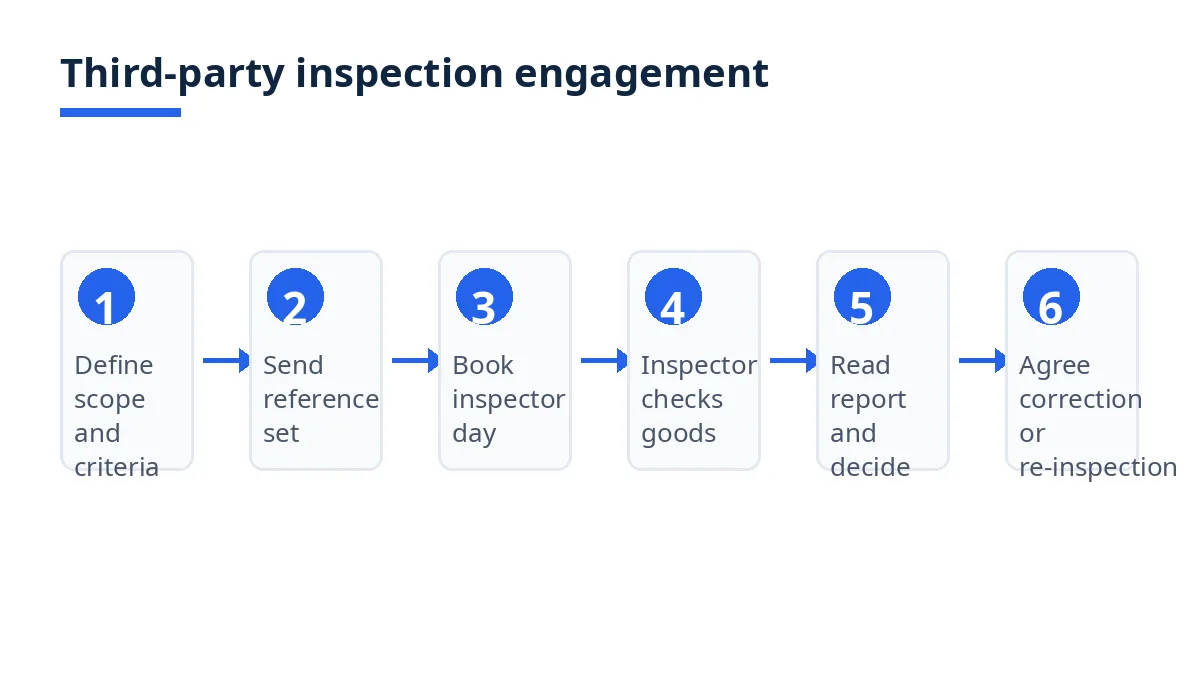
Agree the engagement in the purchase order. Before production finishes, record in writing that goods will be inspected by an independent firm, what scope it will check, which checklist and defect list apply, who pays, who pays for a re-inspection after a failure, and what happens after a fail: correction, replacement, or a new shipment date.
Choose the stage or stages. An engagement may cover one visit or several across the order, from early production checks through a final check of finished goods to supervision of loading. Each visit is normally quoted separately.
Send the reference set. The inspector can only check against what you supply. Send the purchase order, the current specification revision, the approved sample record, the measurement chart with tolerances, the defect list with reference photographs, the artwork and labelling files, and the packing instruction. A missing tolerance or an outdated revision makes the result hard to defend.
Book the visit and confirm readiness. Book once the supplier confirms a realistic completion date and the goods are at the agreed stage of readiness. Confirm the factory address, contact person, working hours, and inspector access on the day. A visit booked before the goods are ready wastes the inspector day and leaves the shipment unchecked.
Run the inspector day. The inspector confirms the quantity and identity of the goods presented, checks the agreed scope against the reference set, records measurements, classifies defects under the agreed list, and photographs findings. Where sampling is used, AQL judges the lot from a random sample under ISO 2859-1, and the linked guide explains that method in full.3
Receive the report and decide. The report should let you reconstruct the decision: what was checked, against which criteria, with what counts, measurements, and photographs, and with what result. On a pass, authorise shipment in writing. On a fail or a hold, agree the correction and whether a re-inspection is required before shipment. Do not let failed goods ship on a verbal assurance.
Keep the report with the shipment record. File it with the purchase order, the specification revision, and the packing documents, as evidence for the shipment decision, any claim, and the next order's supplier review.
Costs, timelines and documents
What drives the cost
No single third-party inspection fee applies across Bangladesh. A quote is built from the items below, and changing any one of them changes the total. Use this list to compare quotes line by line, and confirm every figure and turnaround in the firm's written quote.
Pricing model. Firms commonly price by inspector day, by piece, by container for loading supervision, or by retainer for repeat work, and the model shapes how the total moves with order size.4 Compare models, not just headline totals.
Inspector days and sites. More units, more styles, more checks per unit, or more factory sites normally mean more inspector days. A second site in a different city adds both time and travel.
Product complexity. Simple, uniform goods take less inspector time than goods with many variants, tight tolerances, functional tests, or detailed labelling checks.
Report detail. A short summary and a full photographic report with counted findings and measurements are different deliverables. Confirm the format before accepting the quote.
Travel and timing. Distance from the inspector's base, an overnight stay, and a weekend or holiday visit can all change the total. Confirm whether travel is included or charged separately.
Re-inspection. A failed visit usually leads to a second visit. Decide in the purchase order who bears that cost.
Separate services. Laboratory testing and other specialist checks are normally priced separately from the visit itself. Do not assume they are included.
Example figures
Every dollar figure in this section is an Example figure. The figures below are invented to show how a quote is built up, not prices from any firm and not market rates. Use them to practise reading a quote, then replace every number with the figures in the written quotes you receive for your own scope.
Example engagement | What is included | Example figures total |
|---|---|---|
Example A: single site, one inspector day, one knitwear order | One inspector day, travel within the local area, full photographic report | Example figures: 340 dollars |
Example B: two factory sites, two inspector days, plus travel | Two inspector days, inter-city travel, full photographic report | Example figures: 890 dollars |
Example C: single inspector day plus a re-inspection visit | First visit, correction by the supplier, one re-inspection visit, two reports | Example figures: 610 dollars |
Example figures only: the three examples differ because the days, sites, and re-inspection visit differ, not because the goods differ in value. A cheaper headline total that excludes travel, the full report, or the re-inspection visit can cost more in total than a higher all-inclusive quote. Compare included items first, then totals.
Example timeline only, not a promise: a booking confirmed several working days ahead of the visit, with the report delivered a few working days after it, is a common shape for planning, but no timeline here is a universal rule. Confirm the booking lead time, report delivery date, correction window, and re-inspection terms in writing, and build a buffer before your shipment date so a failed visit does not force a rushed decision.
Documents to prepare
Purchase order with the inspection clause, the firm, the scope, and the payer for the visit and any re-inspection
Current specification revision, measurement chart with tolerances, and defect list with reference photographs
Approved sample record and artwork, labelling, and packing files
Packing instruction, including assortment, carton marks, and shipping marks
Report format requirement, stating the counts, measurements, photographs, and result wording you expect
Bangladesh-specific rules and tips
Bangladesh production is concentrated in and around Dhaka, Gazipur, and Narayanganj for garments and textiles, with Chattogram as the main port city. Confirm which city the inspector travels from and whether travel to your factory is included, because a factory far from the inspector's base is where travel terms most often surprise buyers. For a multi-site order, ask whether one inspector covers all sites or each site needs its own visit.
Confirm the factory working calendar in writing, including weekly and public holidays, and agree what happens if the visit must move. Access also needs a named contact and a confirmed arrival time: an inspector who cannot enter the production area or reach the goods presented cannot complete the scope, and the visit may still be charged. Where loading supervision is included, confirm its location and timing separately, since loading may happen at a different site or on a different day.
Keep the checklist in the language the inspector and the factory both work in, and settle any translation of defect terms before the visit. A term that means one thing to the buyer and another to the factory produces disputes no report can settle afterwards. For a regulated destination market, confirm separately whether any requirement needs a laboratory result or certificate beyond the inspection report, and arrange that work as its own engagement.
Inspection reports serve as formal quality records, documenting scope, findings, and corrective actions where applicable, and supporting traceability and supplier performance review.5 Keep the report with the order, and use it when you decide whether to repeat with the supplier or tighten the next scope. Exportain's inspection services page currently shows "No services published in this category yet", so use that page only with that caveat in mind: inspection services.
Mistakes and red flags
Booking before the goods are ready. A visit to incomplete goods cannot judge the shipment. Confirm readiness in writing before confirming the date.
A vague checklist. A scope that says "check quality" without a specification revision, tolerances, and a defect list leaves every finding open to argument.
Comparing quotes with different scopes. A quote that excludes travel, the full report, or re-inspection terms is not comparable with an all-inclusive quote. Compare line by line for the same scope.
Accepting a verbal result. A phone call saying the goods passed is not a shipment decision. Wait for the written report with counts, measurements, and photographs, and authorise shipment in writing.
No re-inspection terms. If the purchase order says nothing about who pays for a visit after a failure, that argument happens under shipment pressure. Settle it before production finishes.
A report you cannot reconstruct. A result with no scope, counts, measurements, or photographs cannot be checked, disputed, or reused. Reject that format before booking, not after delivery.
A conflict of interest. Be cautious if the same party that stands to gain from a pass or a fail is also judging the goods. The engagement's value rests on independence, so confirm who the firm works for.
A sample the factory selected. The goods checked should represent the lot under the agreed method, not a set chosen to look its best. If the selection method is unclear, ask before accepting the result.
Checklist
Inspection clause in the purchase order, with scope, firm, payer, fail terms, and re-inspection payer
Current specification revision, measurement chart with tolerances, and defect list with reference photographs
Approved sample record, artwork, labelling, and packing files sent to the firm
Factory address, contact person, working hours, and access confirmed for the visit day
Booking confirmed only after the supplier confirms readiness at the agreed stage
Pricing model, included items, travel terms, and report format confirmed in the written quote
Report received with scope, counts, measurements, photographs, and a clear result
Shipment authorised in writing on a pass, or correction and re-inspection agreed on a fail
Report filed with the purchase order and packing documents
How Exportain helps
Exportain does not itself inspect goods. Its role is to connect buyers with providers and to give the buyer a structured way to request the service: define the scope first, then ask providers for itemised written quotes for the same scope. A request that states the product, stage, sites, checklist, and report format produces comparable quotes, while a request that only asks for a price produces totals that cannot be compared.
When your scope is ready, read the pre-shipment inspection guide for the final-stage visit, and the AQL guide for the sampling method. Exportain's inspection services page currently shows "No services published in this category yet", so treat that page as a category listing with that caveat, not as a list of available providers: inspection services.
FAQs
What should I know first about third-party inspection?
Know that third-party inspection is an independent check by a firm separate from buyer and seller, judging defined goods against a written checklist and defect list. Fix the scope, stage, sites, payer, fail terms, and report format in writing before the visit, and confirm every figure and turnaround in the firm's written quote.
What are the typical costs and timelines?
There is no typical cost or timeline for every order, because the quote follows the pricing model, inspector days, sites, product complexity, report detail, travel, and re-inspection terms. Compare itemised written quotes for the same scope, and treat every figure and turnaround as a quote item to confirm.
Which documents are needed?
You need the purchase order with the inspection clause, the current specification revision, the measurement chart with tolerances, the defect list with reference photographs, the approved sample record, the artwork and labelling files, the packing instruction, and the report format requirement.
What are the most common mistakes?
The most common mistakes are booking before the goods are ready, working from a vague checklist, comparing quotes with different scopes, accepting a verbal pass, leaving re-inspection terms unset, and accepting a report that cannot be reconstructed from its scope, counts, and photographs.
Next steps on Exportain
Start with the scope, not with a price request: write the product, stage, sites, checklist, and report format, then ask for itemised quotes for the same scope. Read the pre-shipment inspection guide and the AQL guide before you finalise the criteria. When the scope is ready, post a free RFQ.
Sources
- Conformity assessment bodies. International Organization for Standardization (accessed )
- What Are Third Party Inspections?. Intouch Quality (accessed )
- ISO 2859-1:2026 — Sampling procedures for inspection by attributes — Part 1: Sampling schemes indexed by acceptance quality limit (AQL) for lot-by-lot inspection. ISO (accessed )
- How Much Does Product Inspection Cost? 2026 Pricing. Tetra Inspection (accessed )
- Importance of Third-Party Inspection in Quality Assurance. ECQA (accessed )
About the author
Sourcing from Bangladesh?
Post a request for quotation and suppliers on Exportain can send you their quotes directly.
Post an RFQ