

Quality Control Checklist for Terracotta Crafts From Bangladesh
Terracotta crafts quality control checklist for Bangladesh orders: clay body and firing, cracks, crazing and glaze faults, batch colour, size, weight and wall thickness, water absorption, food-safety lead and cadmium testing, labels and breakage-proof packing, with fixes for common failures.
Short answer
Use this terracotta crafts quality control checklist to check the clay body and firing state, cracks, crazing and glaze coverage, colour across fired batches, size, weight and wall thickness, water absorption and frost suitability, and lead and cadmium test evidence for tableware, plus labels and breakage-proof packing, before shipment from Bangladesh. Agree tolerances, test methods and acceptance numbers in the purchase order.

On this page
Key takeaways
Agree the sample, tolerances, test methods and acceptance numbers before inspection, and draw the sample at random across shapes, colours, firings and cartons.
Judge terracotta by its fired body and glaze: cracks, crazing, pinholes, thin walls and colour drift between firings are the defects that matter most.
Separate food-contact tableware from decorative pieces, and treat lead and cadmium statements as confirm-by-testing until the report for that glaze, colour and lot is read.
Pack glazed surfaces apart with rims and handles protected, heavy pieces at the bottom, and handling marks on the correct carton faces.
Use this checklist when you inspect terracotta crafts from Bangladesh before shipment: planters, pots, tableware, tiles, figurines and decorative pieces made from fired clay. A pot can look sound and still crack after firing, craze under glaze, absorb water through an unglazed foot, or vary in colour from one firing to the next. Check the fired body, glaze and packing, not only shape and decoration, and agree every tolerance and test in the purchase order first.
Why this checklist matters
Terracotta is a low-fired, porous clay body in most Bangladeshi craft production, and that porosity shapes every risk that follows. An unglazed or thinly glazed surface takes up water, a thick wall dries and fires unevenly, and a glaze that does not fit the clay body develops fine cracks, called crazing, after cooling.
A written checklist keeps those risks visible. Each item is checked against the approved sample, size chart and packing specification, recorded as pass, fail or not applicable, with measurements, not ticks alone. Acceptance numbers are agreed per defect class in the purchase order. ISO 2859-1 specifies sampling schemes indexed by acceptance quality limit (AQL) for lot-by-lot inspection by attributes.1
Before you start
Do not begin until references are complete: an approved sample for each shape and colour, the purchase order and packing specification, a size chart with tolerances for height, diameter, wall thickness and weight, and a list of which pieces are food-contact tableware and which are decorative only.
Agree the sampling plan in advance,1 and draw the sample at random across shapes, colours, firings and cartons, not from a display row the maker has selected. Confirm each sample's firing state: bisque ware is fired once without glaze, glazed ware has had a second firing. Never compare a bisque sample with a glazed bulk piece as if they were the same product. If a lead or cadmium test is required, name the method, laboratory and destination limit in the purchase order.
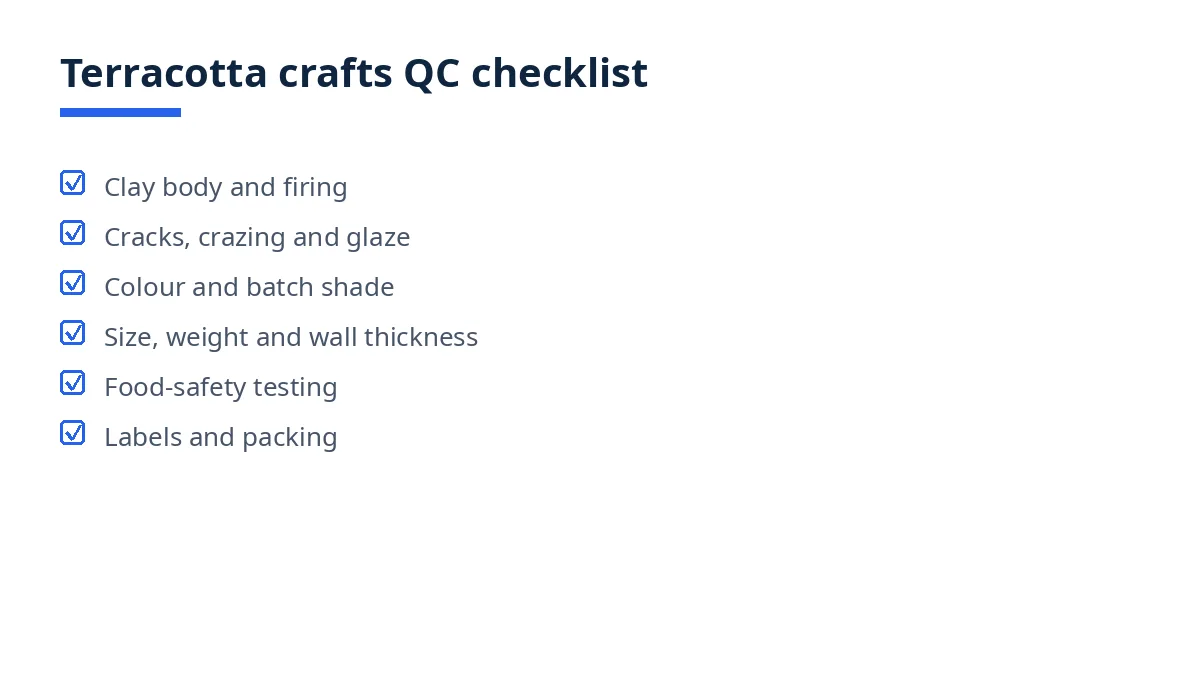
The full checklist (numbered, printable)
Clay body and firing
Check sampled pieces against the approved sample for clay colour, texture and finish; note bisque or glazed.
Tap sampled pieces lightly; a dull thud can signal an internal crack or incomplete firing.
Check the foot and base for a clean, level seat, with no rocking and no rough, untrimmed clay.
Check rims, handles, spouts and applied decoration for secure attachment, with no movement or separation at the joint.
Check for firing faults: bloating, blistering, warping, slumping and black coring at an edge or unglazed area.
Check that planter drainage holes are open, centred where required, and free of blockage or debris.
Check that saucers, lids and paired pieces fit, and that a lid sits level without rocking or a gap.
Cracks, crazing and glaze coverage
Under strong, even light, inspect sampled pieces for body cracks, handle and joint cracks, and star cracks at feet and holes.
Inspect glazed surfaces for crazing, a network of fine glaze cracks, and record whether it is on the food-contact surface or exterior.
Check glaze coverage on rims, handles, spouts, feet and interiors for bare patches, thin spots, crawling or drips.
Check for pinholes, bubbles and glaze blisters, especially on plates, inside bowls and on food-contact surfaces.
Check that glaze does not extend onto a foot ring or base where an unglazed foot is required, and that pieces do not stick together.
Check painted and printed decoration for smudging, missing elements, wrong colours and misplaced decoration.
Check the underside and interior for glaze dust, kiln debris, sharp spurs and rough edges.
Colour, size, weight and wall thickness
Compare colour across pieces from different firings under the same light, against the sample and agreed shade range.
Group pieces by firing batch where marks exist, and check whether one batch drifts lighter, darker, redder or greyer.
Measure height, top and base diameter and any stated capacity; record actual values against the chart tolerance.
Measure wall thickness at rim, side and base; flag pieces markedly thinner than the sample, since thin walls break and fire unevenly.
Weigh sampled pieces and compare the range with the sample; a sudden change can signal a thinner wall or different clay mix.
Check symmetry by turning each piece on a flat surface and sighting the rim and profile; record warping, leaning and oval rims.
Check that sets match: plates stack without rocking, bowls nest as specified, and matched pieces share colour and finish.
Water absorption, frost and outdoor use
Confirm in the purchase order whether the piece is for indoor, sheltered outdoor or frost-exposed outdoor use.
Where water absorption testing is agreed, confirm the method, laboratory and limit in writing before testing, per shape and glaze.
Check unglazed surfaces, feet and planter interiors for water staining, efflorescence and salt marks from wetting.
Check planters and outdoor pieces for a sealed or glazed interior where required, and for cracks letting water reach the clay body.
Do not accept a frost-suitability claim on appearance alone; it needs agreed test evidence for that shape, clay and glaze.
Food safety for tableware
Separate food-contact pieces from decorative pieces at inspection; pack only pieces with agreed evidence as tableware.
Check that food-contact surfaces are smooth, fully glazed where required, and free of crazing, pinholes and unglazed clay.
Review the lead and cadmium test report for the sampled shapes, glazes and colours; confirm it names the bulk glaze, colour and lot. ISO 6486-1:2019 specifies a test method for the release of lead and cadmium from ceramic ware, glass ceramic ware and glass dinnerware in contact with food.2
For the United States, check the report against the destination action levels named in the order. The Food and Drug Administration compliance policy guide for pottery sets lead guidelines by category, examined on six units, including 3.0 micrograms per millilitre for flatware as an average of six units and 0.5 micrograms per millilitre for cups and mugs for any one of six units.3
Where the destination is in Europe, check the report against the destination limit named in the order. Council Directive 84/500/EEC sets lead and cadmium limits by category, reproduced in the England Regulations implementing it: 0.8 milligrams per square decimetre of lead and 0.07 milligrams per square decimetre of cadmium for articles that cannot be filled, 4.0 milligrams per litre of lead and 0.3 milligrams per litre of cadmium for other articles that can be filled, and 1.5 milligrams per litre of lead and 0.1 milligrams per litre of cadmium for cooking ware and storage vessels over three litres.4
Treat any food-safety statement as confirm-by-testing, never as a passed claim, until the report for that glaze, colour and lot is read.
Labels, marking and packing
Check that each piece and carton carries the labels and marks the order requires, including origin, care and food-use marking.
Check barcodes and carton labels for correct shape, colour, size and quantity, and confirm contents match the packing list.
Check inner packing piece by piece: each item wrapped or separated so glazed surfaces do not touch, with rims and projections protected.
Check carton strength, dividers and void fill; heavy pieces at the bottom, lighter above, with no loose movement when tilted.
Check that cartons carry the handling marks the order requires, such as fragile and this-way-up, on the correct faces.
Weigh and measure sample cartons, and check count, gross weight and markings against the packing list and shipping marks.
Common failures and how to fix them
The most frequent failure is crazing after glazing, usually because glaze and clay body shrink at different rates on cooling. Compare crazed pieces with the approved sample and firing record, check whether one glaze batch or kiln position is affected, and do not ship crazed food-contact pieces on a visual re-check alone. Next is a cracked base or handle, from uneven drying, a thin wall at the joint or rough handling after firing: segregate the affected shape, inspect it across the lot, and rework or remake it.
Colour drift across a fired batch is the failure buyers notice at unpacking. Sort sets by firing batch before packing, and hold any batch outside the agreed shade range for a separate decision. Breakage in transit usually traces to packing: glazed surfaces touching, rims unprotected, or heavy pieces packed above light ones. Re-pack a test carton and shake it by hand before repacking the lot.
Downloadable template / summary table
Copy the checklist into your inspection sheet, add tolerances and acceptance numbers, and record a result per shape, colour and batch.
Section | Checks | Evidence |
|---|---|---|
Clay body | State, seat, joints, firing faults | Sample, photos |
Cracks and glaze | Cracks, crazing, coverage, pinholes | Light check, photos |
Colour and size | Batch colour, dimensions, weight | Measurements, batch notes |
Water and frost | Agreed use, absorption test | Test reports |
Food safety | Surface, lead and cadmium reports | Reports per lot |
Labels and packing | Marks, barcodes, carton strength | Packing list |
How Exportain helps
Exportain is a B2B marketplace connecting buyers with Bangladeshi suppliers of terracotta crafts and home decor, so the specifications behind this checklist can be agreed at the enquiry stage. Use inspection services when you plan the check. Supplier profiles show which document and photo checks have been recorded, not factory inspections. Exportain is not a party to the goods contract and does not inspect goods.
FAQs
When should this checklist be used?
Use it at final inspection, when goods are finished, fired, glazed and packed. For larger and first orders, also use it during production, while a glaze or firing problem can still be fixed.
Who should complete it?
The buyer, a local agent or an independent inspector can complete it, using the approved sample, size chart and a randomly drawn sample.
What are the most common failures?
Crazing, cracks at handles and bases, colour drift between firings, thin walls, water-absorbing unglazed feet, and breakage from glazed surfaces touching.
Can a third party do it?
Yes, if you share the approved references, tolerances, test methods and acceptance levels first, and for food-contact pieces, the destination limits and reports as well.
Next steps on Exportain
Before production starts, agree your size chart, wall-thickness and weight tolerances, batch shade range and food-safety test plan, then read the AQL acceptance quality limit explainer and the pre-shipment inspection guide, and plan the check with inspection services.
Sources
- ISO 2859-1:1999 - Sampling procedures for inspection by attributes — Part 1: Sampling schemes indexed by acceptance quality limit (AQL) for lot-by-lot inspection. International Organization for Standardization (accessed )
- ISO 6486-1:2019 - Ceramic ware, glass ceramic ware and glass dinnerware in contact with food - Release of lead and cadmium - Part 1: Test method. International Organization for Standardization (accessed )
- CPG Sec. 545.450 Pottery (Ceramics); Import and Domestic - Lead Contamination. U.S. Food and Drug Administration (accessed )
- The Ceramic Articles in Contact with Food (England) Regulations 2006. legislation.gov.uk, (accessed )
About the author
Sourcing from Bangladesh?
Post a request for quotation and suppliers on Exportain can send you their quotes directly.
Post an RFQ


