

Tank Tops Price in Bangladesh: FOB Cost Breakdown for Buyers
No standard FOB price exists for tank tops from Bangladesh. This guide breaks down what fabric weight, binding, dyeing, print and carton count do to a quotation, and how to compare quotes on the same specification, term and port.
Short answer
There is no standard FOB price for tank tops from Bangladesh. Each factory prices your specification, so compare itemized quotations on the same basis: fabric weight and fibre mix, neck and armhole binding, dyeing and print method, trim list, colour split, packing and the named FOB port. Ask for the build-up in lines, approve a washed pre-production sample in writing, and put the term, port and inspection plan on the purchase order.
On this page
Key takeaways
There is no standard FOB price for tank tops from Bangladesh; each factory prices your fabric weight, construction, dye and print method, trim list, colour split and packing.
A tank uses less cloth than a T-shirt but more edge finishing per piece: neck and armhole binding, strap width and back style move the price more than the cloth bill suggests.
Dye lots, print colour count and carton count are tank-specific cost drivers: a dyed-to-order colour, a multi-colour print and heavy packing each add lines a plain tank does not carry.
Compare quotations only on the same tech pack, Incoterm and named FOB port, with the build-up in lines, and approve a washed pre-production sample in writing before confirming.
A summer order of tank tops can look deceptively cheap per piece and still lose money in the carton. The garment weighs almost nothing, so a buyer sees a small cloth quantity and expects a small price. The remaining work, however, is concentrated in two curved edges, a strap that must hold its width through washing, and a print area that invites extra colours. Those places, plus packing, decide whether the quote is realistic.
This guide takes tank-top pricing apart from the edges inward, starting with binding, straps and print, because those lines move first when a design changes, and only then looking at cloth weight, dye lots and freight. No single published figure covers every tank top from Bangladesh, so the numbers here are labelled example figures and show only how a quotation adds up.
Tank tops belong to the knitwear output of Bangladesh. A public overview from the Bangladesh Knitwear Manufacturers and Exporters Association puts its knitwear membership at about 2,540 factories, which gives a sense of the size of the factory base a buyer is enquiring into .1 For customs purposes, a knitted tank is grouped with singlets and other vests under heading 6109, and the subheading then turns on fibre: cotton tanks fall under 610910 and tanks of other textile materials under 610990.2 Settle that fibre split in the first enquiry, since it feeds both the cloth price and the import declaration.
Why this matters for buyers and sellers
For a seller, a tank order is a volume job with thin material and much handling. Cutting is fast, but each garment still passes through binding work on two curves, a strap check, and packing that handles many more pieces per hour than a heavier garment. A factory pricing a tank is therefore pricing line minutes and carton handling as much as cloth, and a second binding colour can absorb the margin the light cloth seemed to create.
For a buyer, the risk runs the other way. Tank tops usually sit at a low retail price, so a few cents per piece across a 6,000-piece drop is a larger share of margin than the same few cents on a jacket order. A binding that rolls after one wash, a strap that narrows, or a print that cracks cannot be corrected by renegotiating freight, and a mid-season replacement run costs more than the saving a thinner cloth appeared to offer.
Step-by-step: how it works
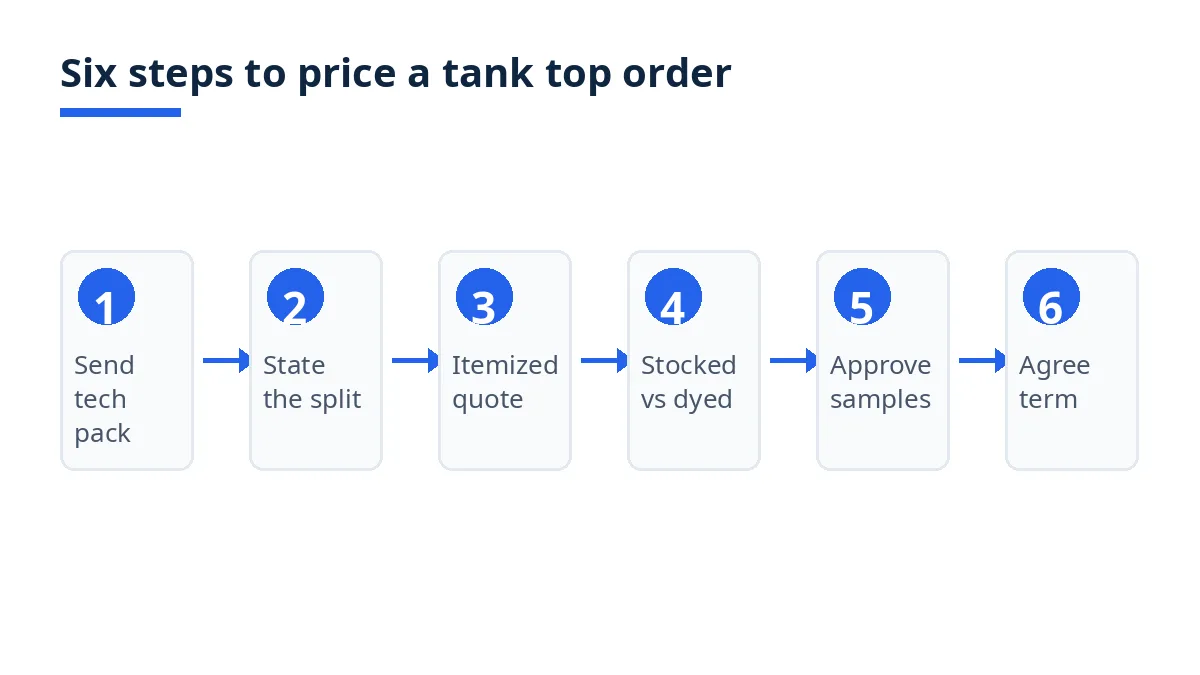
Lock the edge and strap specification first. Record neckline shape, strap width, back style, and whether each edge is bound, ribbed or hemmed, with a tolerance for strap width after washing. Edge choices drive sewing minutes, so they belong at the top of the enquiry.
Decide dye and print before asking for a price. State whether each colour is stocked or dyed for the order, and give print artwork with its colour count and print size. A dyed-to-order colour and a multi-colour print each create set-up work a plain stocked tank never carries.
Set the split and the carton together. State the order breakdown by style, then by colour, then by size, with a single size ratio for every colour, plus pieces per carton and the in-carton assortment rule. A late split forces repacking and repricing.
Ask for a line-by-line quotation in one currency and one term. Request separate lines for cloth and dyeing, binding and trims, cutting and sewing, print, finishing and testing, packing, and transport to the port with export handling, with the port named beside the term.
Test the sample where tanks fail. Order a proto sample, then a pre-production sample in the exact cloth, colour, binding and print. Measure it, wash it, and re-measure neck, armholes and straps, checking the smallest and largest sizes for fit and edge roll.
Put the agreed lines on the purchase order. Write the edge specification, colour split, print details, carton rule, inspection plan and delivery term on the order itself, so later changes are priced as changes.
Costs, timelines and documents
A tank quotation reads most clearly with edge and decoration lines first, since those are the lines a buyer can change without changing the garment category. The table below follows that order.
Quotation line | Question that moves this line for a tank | What usually pushes it up |
|---|---|---|
Binding and trims | Is each edge bound, ribbed or hemmed, self-fabric or contrast? | Contrast binding, a second binding colour, extra labels and hang tags |
How many colours, how large is the artwork, which method? | Extra screens and passes, large artwork, a second print position | |
Cloth and dyeing | What weight and fibre mix, stocked or dyed for this order? | Heavier cloth, elastane content, a dyed-to-order colour, a small dye lot |
Cutting and sewing | How wide are the straps, how many sizes in the range? | Narrow straps needing careful handling, a wide size range, curved back styles |
Finishing and testing | What wash and print checks are included, on how many pieces? | Wash testing on bound edges, print durability checks, a larger sample |
Packing | How many pieces per carton, individually bagged? | Individual polybags, tissue, printed cartons, mixed assortments |
Transport to port and export handling | Which port, and how many cartons move? | A distant factory, a high carton count, port handling per carton |
Example figures, in US dollars per piece: 0.42 for binding and trims, 0.28 for print, 0.95 for cloth and dyeing, 0.48 for cutting and sewing, 0.15 for finishing and testing, 0.22 for packing, and 0.18 for transport to port and export handling. The example figures add to 2.68 per piece (0.42 + 0.28 + 0.95 + 0.48 + 0.15 + 0.22 + 0.18 = 2.68). For an order of 6,000 pieces, the example figures give an order value of 16,080 dollars (6,000 x 2.68 = 16,080). These are example figures only, shown to demonstrate the arithmetic of a quotation, not a market price or a price any supplier will offer.
Run the same arithmetic in reverse on a rival quotation. If a rival figure is lower, look first at the edge and print lines: a hemmed edge in place of binding, one print colour instead of three, or stock labels instead of a custom label run can explain the gap without any cloth change. If those lines are identical and the total is still far lower, ask in writing what has been left out before treating the lower figure as comparable.
Example figures for cartons: the same 6,000-piece order packed at 150 pieces per carton needs 40 cartons (6,000 / 150 = 40). Packed at 300 pieces per carton, it needs 20 cartons (6,000 / 300 = 20). Halving the carton count halves carton material and handling, but only with bulk packing; individual bagging and tissue push the count back up and add labour per piece, which is why the carton rule belongs in the quotation.
Timelines follow the same lines as the price. Sampling waits on cloth availability and correction rounds for edge and print, bulk work waits on dye lots and print capacity, and dispatch waits on carton assembly. Ask for four separate dates, for sample approval, cloth readiness, bulk completion and inspection, rather than one delivery week that hides which stage slipped.
On delivery terms, the Incoterms 2020 set contains 11 rules allocating cost, risk and obligations between seller and buyer.3 Under its FOB rule, the seller places the goods on board the vessel at the port the parties name, and the buyer takes over from that point. A quotation naming a different port, or leaving the port out, cannot be ranked against a clean FOB quotation for the same port. The FOB guide explains the term.
Paperwork falls into two groups. The order group is the tech pack, the line-by-line quotation and the purchase order carrying the edge specification, colour split, print details, carton rule and inspection plan. The shipment group, to be settled with the supplier and the freight forwarder before dispatch, is the commercial invoice, the packing list and the certificate of origin. A buyer selling into the European Union should also settle label wording at tech-pack stage: EU rules require fibre names with weight percentages, listed heaviest first, and a label rewritten after production means a relabelling run.4
Bangladesh-specific rules and tips
Check a membership claim directly with the association. A supplier may describe itself as a knitwear association member, and the association overview cited above gives the scale of that membership.1 Treat the claim as a prompt to confirm the membership itself, not as evidence about price or delivery reliability.
Pin down fibre classification before the first quotation. Cotton tanks and tanks of other materials sit under different subheadings within heading 6109, as noted above.2 Confirm the subheading for the exact blend with a customs broker, since it travels with the goods into the import declaration and duty calculation, and a blend changed after sampling can shift the line.
Fix EU label wording before cutting. Where the destination is the European Union, fibre names and weight percentages on the label must follow EU textile labelling rules, ordered by descending weight.4 Agreeing that wording at tech-pack stage costs nothing extra; correcting it after packing does not.
Mistakes and red flags
Letting print colours creep after the price is agreed. A tank front invites decoration, and each added colour adds a screen and a pass. A quotation agreed for one colour and then artworked in three is a different order, so freeze artwork and colour count at sample stage.
Paying for heavy packing on a light garment. Individual bags, tissue and printed cartons can erase the freight advantage of a featherweight product. If retail presentation does not need that packing, bulk packing at a higher pieces-per-carton figure is a legitimate saving, provided the choice is recorded.
Changing strap or back style after sampling. A racer back, a wider strap or a deeper neckline changes binding length and sewing minutes. A style change after the pre-production sample should be repriced line by line.
Ranking quotations that use different terms. A figure that ends at the vessel and a figure that includes onward freight are not rivals. Bring every quotation onto the same term and the same named port before ranking.3
Accepting one unexplained total. A single figure hides whether the saving came from thinner cloth, a hemmed edge, fewer print colours or lighter packing. Ask for the lines and record any later change against the line it affects.
Reading a platform profile as a capacity promise. A supplier profile is a place to start enquiries. It does not by itself show that a factory can produce a particular binding style at a particular price or date, and any badge shown records a document and photo review, not a guarantee of quality, capacity or delivery.5 Sample approval and inspection therefore stay with the buyer.
Skipping the wash test to save a week. Binding roll, strap narrowing and print cracking appear after washing, not on a flat sample. A price confirmed before the washed pre-production sample is approved is a price for goods whose main failure modes have not yet been seen.
Checklist
Work through this list in order, getting a written answer to every item before you confirm.
Edge and strap specification locked: neckline shape, strap width and tolerance after washing, back style, and the finish for neck and armholes.
For every colour, note its dye position in writing: whether it is a stock cloth colour or a colour that must be dyed as its own lot for this order.
Print frozen: artwork, colour count, print size and method, with set-up shown apart from the unit figure.
Agree the full split up front: how many pieces of each style, colour and size, a single size ratio for every colour, and the rule for assortments inside each carton.
Line-by-line quotation received, in one currency, with the port named beside the term.3
Cloth weight and fibre mix confirmed, with the heading 6109 subheading checked for that blend.2
Washed pre-production sample signed off in writing, with smallest and largest sizes checked.
Put the inspection approach, including how many pieces are checked and at which stages, on the purchase order itself.
Settle the dispatch papers early: the origin certificate first, then the commercial invoice and packing list, plus the label wording for the destination market.4
Before dispatch paperwork, confirm the proforma invoice states the currency, the payment terms, and the total value for the whole order.
How Exportain helps
Use Exportain as the enquiry route rather than as a price reference: browse suppliers and post the edge specification, colour split, carton rule and named port on the RFQ board, asking each reply for its line-by-line quotation. For what platform badges record, see the how supplier verification works on Exportain guide, and the MOQ definition guide for how minimums interact with price.5 6
FAQs
What should I know first about tank tops?
Know the edge before you ask for a price. A tank is priced less by its cloth quantity than by its neck and armhole finishing, strap width and back style, dye and print choices, and the cartons its packing creates. Settle those points in the first enquiry, and state the fibre mix, since cotton and other materials fall under different subheadings of heading 6109.2
What are the typical costs and timelines?
No usable typical figure exists, because each factory prices the edge work, print, cloth weight, dye lot, trim list, colour split and packing of a specific order, and sets lead time from cloth availability, dye lots and print capacity. Compare quotations line by line on the same term and port, and ask for sample, cloth-ready, production and inspection dates separately.3
Which documents are needed?
The order papers are the tech pack, the line-by-line quotation and the purchase order, carrying the edge specification, colour split, print details, carton rule and inspection plan. The shipment papers to settle before dispatch are the commercial invoice, the packing list and the certificate of origin, with label wording agreed for the destination market, including EU fibre-labelling rules.4
What are the most common mistakes?
The most common mistakes are letting print colours grow after agreement, paying for heavy packing on a light garment, changing strap or back style after sampling, ranking figures on different delivery terms, accepting a single unexplained total, and treating a profile or badge as a guarantee.5
Next steps on Exportain
Post the edge specification, colour split, carton rule and named port on the RFQ board, then read the tank tops quality control checklist before approving the washed sample, and how to import tank tops from Bangladesh for the wider import sequence.
Sources
- BKMEA at a Glance. BKMEA (accessed )
- Classification Detail — HS Code 6109. United Nations Statistics Division (accessed )
- Incoterms® 2020. International Chamber of Commerce (ICC) (accessed )
- Regulation (EU) No 1007/2011 on textile fibre names and related labelling and marking of the fibre composition of textile products. European Union, (accessed )
- Trust & Safety Center. Exportain (accessed )
- Supplier verification: Earn trust badges buyers can see. Exportain (accessed )
About the author
Sourcing from Bangladesh?
Post a request for quotation and suppliers on Exportain can send you their quotes directly.
Post an RFQ


