

Top Tank Tops Manufacturers in Bangladesh: How to Find and Verify Them
Tank top supply in Bangladesh is organized by cut, fabric and end use: seven factory types, what each suits, what drives price and MOQ, and how to verify each one before ordering.
Short answer
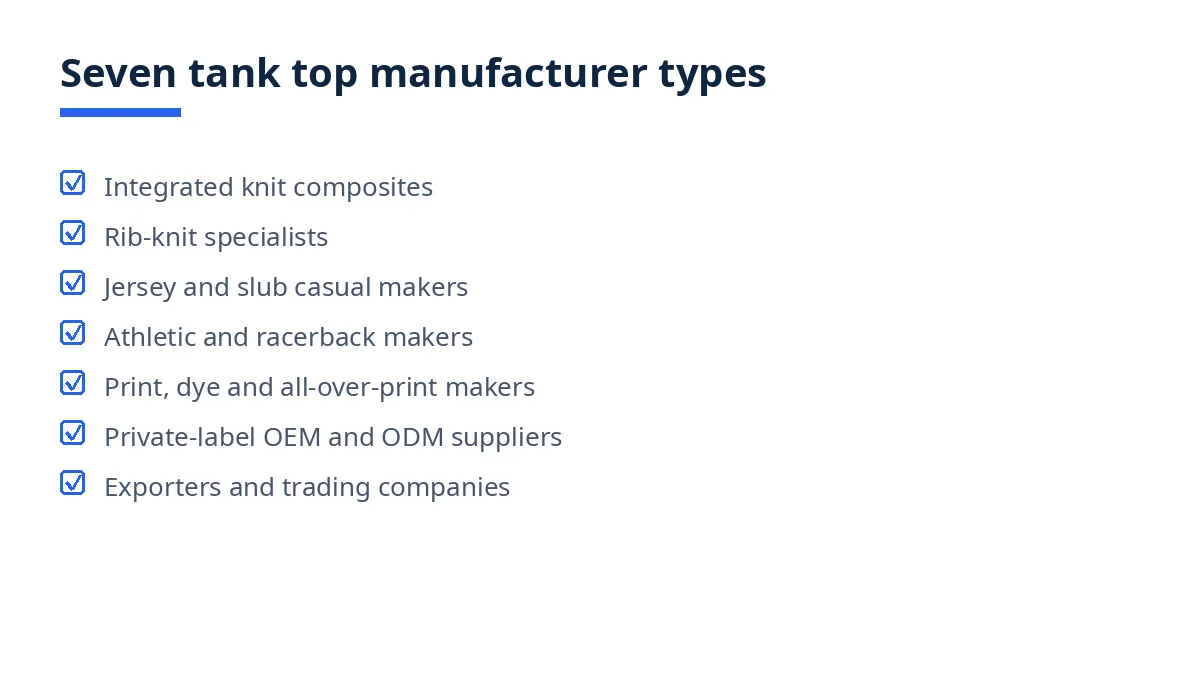
Tank tops manufacturers in Bangladesh fall into seven types: integrated knit composites, rib-knit specialists, jersey and slub casual makers, athletic and racerback makers, print and dye-led makers, private-label OEM and ODM suppliers, and exporters and trading companies. Match the type to your cut, fabric and end use, then verify membership, documents, a washed sample and inspection terms before paying.
On this page
Key takeaways
Tank tops are knitted garments, so the supplier pool is the knitwear sector: BKMEA represents approximately 2,540 knitwear member factories.
Cut and fabric decide the match: rib recovery at the neckline and armhole, jersey and slub drape and twist, and racerback strap geometry each point to a different factory type.
Put strap width, armhole depth and neck drop with tolerances in the tech pack, and measure the washed production-fabric sample against them before approving bulk.
Price and MOQ are set per style and color: fabric construction, cut, decoration and packing move the quote more than location does.
Exportain badges record document and photo checks reviewed by the Exportain team; they are not factory inspections or quality guarantees.
A tank top leaves a factory nowhere to hide a weak point. With no sleeves, no collar structure and only a narrow band of fabric across the shoulder, the points a buyer must judge are few and unforgiving: strap position, underarm shape, neck depth, and fabric behaviour after washing. Shortlist factories whose everyday production already repeats those details well.
The buying question is narrower than it first looks: which factory type already makes tanks close to yours? Rib, loose jersey, racerback and printed fashion tanks each reward different machines, skills and finishing steps, and the profiles below sort suppliers on that basis, after a short guide to reading a factory the way a tank buyer should.
Tank tops sit inside the knitwear sector, so the supplier pool is a knitwear pool. Export Promotion Bureau (EPB) data for the first quarter of fiscal 2026-27 put ready-made garment exports at US$10.578 billion, with knitwear accounting for US$5.963 billion, a rise of 6.88 per cent on the same quarter a year earlier.1 The Bangladesh Knitwear Manufacturers and Exporters Association (BKMEA) describes approximately 2,540 member factories.2 Those totals say nothing about any single factory, but they explain why sorting by type matters: a shortlist built on price alone mixes factories doing very different work.
Key points to take away
Read a factory on fabric, cut and finishing together. A supplier strong on one of the three can still fail a tank on the other two.
Rib, jersey and slub each fail in a different place, so the washed sample has to be cut from the fabric that will run in bulk.
Strap width, armhole depth and neck drop belong in the tech pack with tolerances, and the washed sample is measured against those numbers, not against a photograph.
Dye lots, print placement and binding quality show up faster on a sleeveless garment, so approve shade bands and artwork strike-offs before bulk.
Price and minimum order quantity (MOQ) follow style and colour count. Compare suppliers on an identical specification, and treat any gap as a question about what was left out.
How to read a tank top factory
What the fabric tells you
Start with the knit, because it decides which faults to look for. Rib stretches and springs back, so it suits a close fit that must hold its shape at the neckline and underarm through wear and washing. Jersey hangs more softly and suits a relaxed classic tank, while slub adds a deliberately uneven yarn texture that reads as casual. In the wash, rib can lose recovery if yarn or gauge is wrong, jersey can twist at the side seams, and slub can look faulty to a buyer who never agreed what normal variation looks like. Ask which fabrics a supplier handles weekly, and what its wash test shows.
What the cut tells you
Next, look at the pattern from the back as well as the front. A classic tank is a straight shape with a modest armhole, and its risks sit mainly in strap width and neck depth. A racerback is a different problem: the straps converge at the back, the armhole is deeper and more shaped, and small errors in strap spacing change how the garment sits on the shoulder. Binding matters in both shapes, since a bound neckline or armhole either lies flat and recovers or rolls and gaps. Ask for the back measurements on the pattern, not only a front photograph, and check them on a form and flat.
What the finishing tells you
Finally, judge the finishing a sleeveless garment cannot disguise. Dyeing has to hold shade across lots, because a tank shows a shade break across the chest at once. Printing has to land in the same place on every size, measured from fixed seams rather than by eye. Together with hems, labels and packing, these steps separate a factory that sews tanks from one that finishes them well.
Tank top manufacturer types in Bangladesh
The seven profiles below describe supplier types, not named companies and not a ranking. One company can cover more than one profile. Use the checks at the end of this guide on whichever type you shortlist.
Vertically integrated knit composites
These groups knit, dye and finish fabric, then cut, sew and pack garments under one organisation. Their practical advantage for tanks is shade control across repeat colours: when the same rib or jersey must return in a later season at the same shade, keeping dyeing inside the group removes one handoff where shade can drift. Such lines usually suit repeat programs rather than a single small test order. Before committing, confirm in writing which stages the group itself performs for your style, because one that knits in-house but sends dyeing elsewhere controls less of your shade than its description suggests.
Rib-knit specialists
These factories build their weeks around ribbed knitwear, including fitted tanks and camisole styles where recovery is the product. Their machines, gauges and binding methods are chosen for a neckline and armhole that spring back after stretching, which is exactly where a fitted tank is judged. They fit close-fitting programs and any style that must stay close to the body without adjustment. Ask which rib gauges run regularly, how necklines and armholes are bound, and what the washed sample measures at the neckline, armhole and hem before and after washing. A specialist answers from recent rib production; a general knit factory answers from its catalogue.
Jersey and slub casual makers
These cut-and-sew knit factories regularly make classic-cut casual tanks in cotton jersey and slub jersey, in solid colours and straightforward prints. They suit basics programs, promotional tanks and summer ranges where drape and a relaxed shape matter more than stretch recovery. Their characteristic risk is twist and texture rather than recovery: jersey can rotate at the side seam after washing, and slub can be mistaken for a fault. Agree the slub tolerance in writing before sampling, check the washed sample for twist, and judge the garment on drape.
Athletic and racerback makers
These makers organise production around sport and training tanks, with shaped armholes, converging back straps and mesh panels cut for movement. They suit gym, running and team ranges, where back shape and strap position decide whether the garment stays put. Their work cannot be approved from a front view alone, so request the back pattern numbers: strap width at the shoulder, spacing between straps at the back, and armhole depth, checked flat and on a form. Wash the sample and re-check strap placement afterwards, and confirm whether mesh panels are knitted on site or bought in.
Print and dye-led makers
These suppliers organise around colour and artwork, offering garment dyeing, piece dyeing, screen printing and all-over prints on tanks they sew or take in as blanks. They suit fashion, graphic, tie-dye and washed-look ranges. A tank front is a narrow panel, so a print error has nowhere to hide and a shade break is obvious. Approve artwork as a strike-off on the production fabric in the production colour, agree print size and placement from fixed points such as the neckline seam and side seam, and approve dyed styles against a bulk-lot shade band rather than a single swatch. Wash-test the decorated sample for colour transfer onto light colours worn beside it.
Private-label OEM and ODM suppliers
These suppliers make tanks under the buyer's label. Under an original equipment manufacturer (OEM) arrangement they produce to the buyer's tech pack; under an original design manufacturer (ODM) arrangement they offer their own tank patterns for the buyer to label. They suit brands and retailers needing their own labels, size sets, hangtags and packing, and importers wanting a ready range without developing every pattern. For OEM work, the tech pack does the heavy lifting: fabric and construction, strap width, armhole depth, neck drop, hem finish and tolerances, with the counter-sample judged against it line by line. For ODM work, confirm the offered styles are the supplier's own patterns, and settle pattern and grading ownership in the order terms.
Exporters and trading companies
These export-licensed companies sell tanks sewn in partner factories and handle export documentation for the buyer. They suit mixed orders, tanks bought alongside other knitwear, and quantities spread across cuts and colours that no single sewing line would take under one contract. Their convenience comes with one question to answer before any deposit: which factory sews each cut. Get the producing factory named in the order terms for every style, and inspect that factory for the cut it will make, since a trading company's overall export record says nothing about the line sewing a rib tank or a printed tank. For any audit or fibre claim, confirm the certificate with the issuing body, check the factory address on it matches the producing site, and check expiry and scope. The Bangladesh Garment Manufacturers and Exporters Association (BGMEA) site lists the audit and certification frameworks used across the sector.3
Summary table
Type | Suited to | First check |
|---|---|---|
Vertically integrated knit composite | Repeat multi-colour programs needing stable shade | Which stages run in-house for your style |
Rib-knit specialist | Fitted tanks where neckline and armhole must recover | Washed sample measured before and after |
Jersey and slub casual maker | Relaxed classic tanks and basics ranges | Twist after washing and agreed slub tolerance |
Athletic and racerback maker | Training, gym and running tanks | Back pattern numbers checked on a form |
Print and dye-led maker | Graphic, dyed and fashion tanks | Artwork strike-off, shade band and wash test |
Private-label OEM / ODM | Own-label brands and ready ranges | Tech pack match and pattern ownership |
Exporter / trading company | Mixed orders under one contract | Producing factory named for each cut |
What moves price and MOQ
Tank pricing follows the specification, not the factory postcode. Fabric construction comes first: rib, jersey weight and slub yarn each consume different material and finishing, and a heavier or more complex knit costs more before a single seam is sewn. Cut comes second: a racerback with bound armholes and mesh panels needs more pattern work, more joining steps and an extra fabric than a straight classic tank, so it prices above the classic shape in the same fabric. Colour count comes third, because each colour is its own dye lot with its own setup, which is why a range split across several colours carries a higher total commitment than the same tank in one colour. Decoration, labels, packing and any required testing add further lines.
Quantity spreads fixed setup costs across more pieces, which lowers unit prices at higher volumes, but MOQ itself is set per style and per colour, not per factory. Send every shortlisted factory the same specification, delivery term and packing requirement, then ask about any line that differs. A low-looking quote usually omits something: a lighter fabric, unbound armholes, fewer print placements, or a different delivery term. For how MOQ works across a range, read the guide to MOQ in the supply chain.
Knitted tank tops fall under heading 6109, covering T-shirts, singlets and other vests, knitted or crocheted: cotton under 610910, other materials under 610990.4 See the HS code guide for tank tops.
Checks before you pay
Registration record. A knitwear exporter should appear in the BKMEA or BGMEA member records.2 Treat that listing as a starting point only: it shows registration in the trade, and proves nothing about tank capability, quality or finances.
Paperwork and badges. Request the trade licence, Export Registration Certificate (ERC) and factory or office photographs. On Exportain, profile badges reflect document and photo checks reviewed by the Exportain team, not a factory inspection or a quality guarantee.5
Production-fabric sample, washed. Approve a pre-production sample made from bulk fabric and trims, wash it, and measure strap width, armhole depth, neck drop, chest width and body length against the size chart. Keep the approved sample as the reference for bulk.
Inspection level agreed in advance. Set the acceptance quality limit (AQL) and inspection level in the order, before production starts. The ANSI summary of ISO 2859-1 describes sampling plans keyed to AQL values for lot-by-lot inspection, giving an inspector a published rule to accept or reject against.6 The tank tops quality control checklist turns that level into garment checks for this product.
Written terms before payment. Agree inspection and shipment conditions in writing before settling; Exportain is not a party to the goods contract.7
How Exportain helps
Supplier profiles, search filters and quotation requests on Exportain give a structured starting point for comparing knitwear suppliers and quoted terms.7 Use it alongside the checks above, not instead of them.
FAQs
What is the biggest mistake?
Picking a tank supplier on price before checking whether its type matches the tank. A rib specialist, a casual jersey maker and a racerback maker do different work, so their quotes are not quotes for the same thing. Match type to cut and fabric first, then compare prices inside that type.
How can I avoid it?
Send every supplier the same written specification: fabric and construction, strap width, armhole depth, neck drop, decoration, labels and packing, with tolerances. Name the producing factory in the order terms, approve a washed production-fabric sample, and put the inspection level in writing before production.
Who is responsible?
Responsibility splits at the specification. The factory must make tanks to the agreed specification and approved sample. The buyer must make that specification complete and measurable, including tolerances for strap width, armhole depth and neck drop, and inspect bulk against it before shipment.
Where can I get help?
Different questions have different sources. Registration can be checked against BKMEA and BGMEA listings, a certificate claim against its issuer, and a shipment against an independent inspection report.2 Keep the exchange in one Exportain conversation, and check what a profile badge actually covers before treating it as proof of capability.5
Next steps on Exportain
Put the specification from this guide into a single RFQ with quantity, destination and delivery term, and compare replies on identical terms. For the badge and verification detail behind that comparison, read how supplier verification works on Exportain first.
Sources
- Merchandise exports rise 6.34pc to $13.09b in Q1 FY27: EPB. The Financial Express, (accessed )
- BKMEA at a Glance. BKMEA (accessed )
- BGMEA | Home. Bangladesh Garment Manufacturers and Exporters Association (BGMEA) (accessed )
- Classification Detail — HS Code 6109. United Nations Statistics Division (accessed )
- Supplier verification: Earn trust badges buyers can see. Exportain (accessed )
- ISO 2859-1:2026 — Sampling for Inspection by AQL. American National Standards Institute (ANSI) (accessed )
- How to source and buy from Bangladesh. Exportain (accessed )
About the author
Sourcing from Bangladesh?
Post a request for quotation and suppliers on Exportain can send you their quotes directly.
Post an RFQ


