Switches and Sockets Lead Time From Bangladesh: Production and Shipping Timeline
No single switches and sockets lead time from Bangladesh: the mould, plate finish, metal parts, testing and shipping gates that set the timeline, and how to plan each stage.
Short answer
There is no single switches and sockets lead time from Bangladesh. The timeline is set by specification and plate design, mould work, contact and terminal metal parts, assembly, electrical safety testing and certification, packing, export clearance and transit. Plan around dated commitments for each stage, not a single promised date, and treat any late finish, gang or terminal change as a re-plan.
On this page
Key takeaways
There is no single switches and sockets lead time from Bangladesh, because each order is set by mould work, plate finishes, metal parts, testing and shipping gates.
A late change to a plate finish, gang layout, terminal type or socket shutter can restart part of the chain, so plan around dated stage commitments.
Mould position and contact material stock are the two earliest gates to lock, before samples are approved.
Switches sit under IEC 60669-1 and socket-outlets under IEC 60884-1, with BDS IEC 60669-1 on the BSTI mandatory list.
Exportain verification is a document and photo review, not a factory inspection, and a badge is not a guarantee.
A switches and sockets order from Bangladesh does not move at one speed. The product looks simple on a wall, but its timeline is set by a chain of gates: specification and plate design, mould work, contact and terminal metal parts, assembly, electrical safety testing and certification, packing, export clearance and transit. A late change to a plate finish, a gang size, a terminal type or a socket shutter can restart part of that chain, so plan around the gates, not around a single promised date.
This guide explains each stage, what to ask for in writing, which documents to prepare, and which mistakes most often add weeks. Every duration here is an illustrative range for planning only, not a supplier promise. Replace each line with the dated commitment from your own supplier for your own order.
For classification, heading 8536 covers electrical apparatus for switching or protecting electrical circuits, or for making connections to or in electrical circuits, including switches, plugs, sockets and lamp holders, for a voltage not exceeding 1,000 V.1 IEC 60669-1 applies to manually operated general purpose switches, for alternating current only, with a rated voltage not exceeding 440 V and a rated current not exceeding 63 A, for household and similar fixed electrical installations.2 IEC 60884-1 applies to plugs and fixed or portable socket-outlets for alternating current only, with a rated voltage greater than 50 V but not exceeding 440 V and a rated current not exceeding 32 A, for household and similar purposes.3
What should I know first about switches and sockets?
Know the variant before you ask for a date. A switch is not one product: one gang or several gangs, one way or two way, with or without a dimmer or an indicator, in a stated plate color and finish, for a stated mounting box. A socket adds pin pattern and shutter type, single or double outlet, switched or unswitched, with or without USB charging, and a stated terminal type. Each variable can change the mould, the metal parts, the test route or the packing. Send the full variant list with the first enquiry, not after the quotation arrives.
Why this matters for buyers and sellers
For the buyer, lead time decides project dates, site work and cash flow. Switches and sockets are usually fitted late in a build, so a factory delay lands directly on the finishing schedule, and a wrong plate size or pin pattern found on site cannot be fixed by a quick substitute. For the seller, lead time protects the production plan: moulds run in planned blocks, contacts are stamped and formed against your specification, and test slots are booked against agreed standards, so a late change to a finish, a gang layout or a terminal type restarts part of that chain.
Two controls keep the schedule honest. The first is a written inspection and test plan agreed before production, naming which routine tests run on every lot and which type test evidence covers the design. The second is one delivery term for every quotation: the Incoterms 2020 rules set out 11 rules with a clear allocation of cost, risk and obligations.4 Compare timelines only on the same term.
Step-by-step: how it works
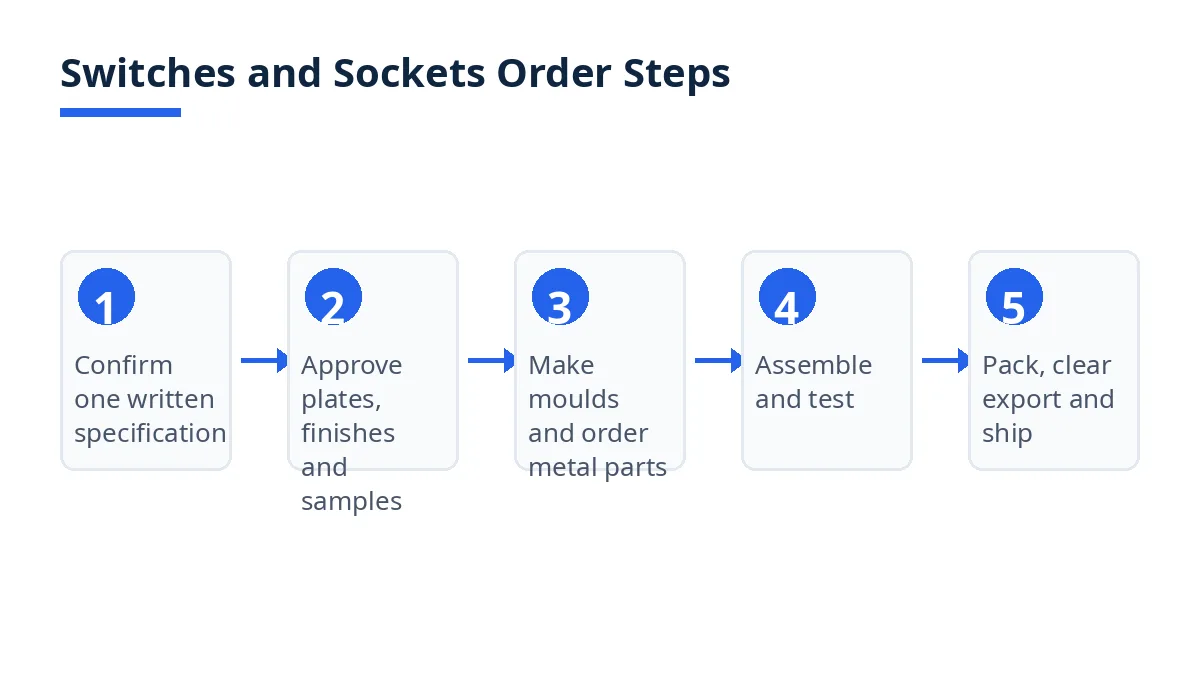
Confirm one written specification per variant. State the switch or socket type, gang count and layout, rating, pin pattern for sockets, shutter type, terminal type, plate material, color and finish, mounting box size, applicable standard, marking and destination markets. Name the test and certification route for each market before sampling.
Approve plates, finishes and samples in stages. Order a sample in the actual plate material, color and finish, with the actual mechanism and terminals. Fit it into the stated mounting box, check the rocker or socket face action, and approve or list corrections in writing.
Lock mould and tooling work early. Ask whether the mould for each plate, rocker and housing already exists, needs modification, or must be made new. A new mould is the longest single gate in many switches and sockets orders, and a mould change after approval is a new sample, not a small fix.
Lock contact and terminal metal parts. Ask which contact and terminal materials are stocked, which are ordered in, and what each order quantity covers. A contact material change after approval changes the electrical test results, so treat it as a re-plan.
Run assembly with hold points. Agree hold points for first-piece approval, in-process checks on mechanism action and terminal fit, and routine electrical tests on finished units. Record failures by cause: moulding, metal parts, assembly, marking or packing.
Test and certify before packing. Confirm which routine tests run on every lot and which type test evidence covers the design, and record the test evidence that will accompany the shipment.
Pack, clear export and ship on the agreed term. Pack by variant with clear carton marking, prepare the export set, and confirm the vessel booking, the named place under the chosen Incoterm,4 and the document set the buyer needs for import clearance. See the switches and sockets quality control checklist for plate, mechanism and terminal points.
Costs, timelines and documents
What are the typical costs and timelines?
There is no single typical cost or timeline for switches and sockets from Bangladesh, because plate material and finish, gang layout, rating, pin pattern, shutter and terminal type, order quantity, test route and delivery term each move the figure.
Example figures: the table below shows how one order can be planned. It is illustrative only, and each line should be replaced by the supplier's dated commitment for your order.
Stage | Example duration | What gates it |
|---|---|---|
Specification and quotation | 1 to 2 weeks | Complete variant list, plate finish and market list |
Samples and finish approval | 2 to 4 weeks | Mould position, correction rounds, finish matching |
Mould work and metal parts ordering | 3 to 6 weeks | New or modified moulds, contact material stock |
Assembly and in-process checks | 2 to 4 weeks | Line capacity, variant changeovers, rework |
Safety testing and certification | 2 to 5 weeks | Test slots, test evidence, certification route |
Packing and export clearance | 1 to 2 weeks | Carton supply, variant marking, booking |
Transit to destination | 2 to 5 weeks | Route, vessel schedule and destination port |
For costs, ask for separate lines: plate and housing material, mould and tooling charges where they apply, contact and terminal metal parts, mechanism parts, assembly, testing and certification, packing, inland transport, freight and insurance under the chosen term.4 A lump sum hides which gate is expensive, so ask how long the quoted price holds.
Which documents are needed?
For export clearance in Bangladesh, goods may not be loaded unless an export declaration, the Bill of Export or Shipping Bill, is submitted to Customs and approved.5 Enclosed documents include the export contract or purchase order where there is no export letter of credit, the commercial invoice, the packing list, the EXP form certified by an authorized dealer, and a certificate of origin issued by the EPB or a Chamber of Commerce and Industry.5
For the switches and sockets themselves, keep a separate file: the agreed specification per variant, sample and finish approvals, mould records, contact and terminal material records, routine test reports by lot, type test evidence where required, standard and certification records for each market, the inspection report, and the carton and marking schedule. The buyer also needs the import set for the destination market, including tariff classification under heading 8536.1
Bangladesh-specific rules and tips
Check the standard route before you fix the schedule. The Bangladesh Standards and Testing Institution mandatory list carries switches for household and similar fixed electrical installations as BDS IEC 60669-1, and two-pin and three-pin plugs and socket-outlets as BDS 102 and BDS 115.6 Confirm which Bangladesh Standard applies to your type, and whether your destination market asks for the IEC route, the BDS route, or both, because a second route can add a separate test slot.
Match the plate and box before production starts. A plate that does not fit the mounting box on site is a failed delivery even when the mechanism is correct. Confirm the gang size, box depth and fixing centers in writing, and fit the approved sample into the stated box. A box change after mould approval can mean a plate change and a new mould.
Ask which inputs are stocked for your order. Plate resin, contact material, terminal screws, springs and carton stock may be stocked or ordered in for your specification, and an ordered-in input can set both the earliest production date and the price validity window. Agree the variant quantities per plate color and finish before production, because a finish change after assembly wastes finished stock.
Keep one legal name across every paper. The export declaration names the exporter and the foreign buyer,5 so the name on the trade licence, quotation, proforma invoice and payment account should match. A name mismatch is a common cause of a clearance delay that looks like a production delay.
Mistakes and red flags
What are the most common mistakes?
Comparing timelines on different delivery terms. A timeline quoted EXW ends at the factory gate, while a timeline quoted DDP ends at the buyer site. Compare only replies to the same specification on the same Incoterm.4
Changing the finish, gang layout or terminal type after approval. A new plate color, a different gang count or a different terminal can mean new mould work, new metal parts and new test settings. Treat any such change as a re-plan, with a new dated commitment.
Approving a finish without a physical sample. Screen colors shift between devices and light. A plate color approved without a physical sample in the actual material and finish is rework waiting at inspection.
Ignoring shutter and pin pattern details. A socket with the wrong pin pattern or shutter type for the destination market is unusable on site even when it passes its electrical tests. Confirm the pin pattern, shutter type and rating for each market before sampling.
Accepting a verbal delivery date. Record the dated commitment per stage: sample date, mould ready date, material ready date, production dates, test date, inspection date and loading date. A single delivery week hides which gate slipped.
Treating a profile or a badge as a test result. A profile is a starting point for enquiries. It does not test whether a factory can make your switch or socket to the agreed standard, and a badge is not a guarantee of capacity, quality or delivery.7 8
Skipping the lot-by-lot test record. Routine test reports tied to lot numbers are the last control before the goods become your installed stock. A shipment without them leaves a fault to be found on site.
Checklist
Before you confirm, every line should be answered in writing.
Specification sent per variant: type, gangs, rating, pin pattern, shutter, terminals, plate material, color and finish, box size, standard, marking.
Test route named per market: IEC route, BDS route, or both, with routine and type test evidence listed.2 3 6
Mould position recorded per plate and housing: existing, modified, or new, with a mould ready date.
Contact and terminal stock positions recorded: stocked or ordered in, with price validity dates.
Physical finish sample and mechanism sample fitted to the stated box and approved in writing.
Production dates agreed per stage, not as a single delivery week.
Inspection plan agreed, with test results recorded per lot.
Quotations compared on the same specification and Incoterm.4
Export set agreed: invoice, packing list, EXP form, certificate of origin, Bill of Export.5
Carton marking and variant quantities per plate color and finish agreed before packing.
How Exportain helps
On Exportain, browse suppliers and post a request for quotation (RFQ) on the RFQ board with your variant list, plate finishes and delivery term, so suppliers quote against the same specification. Ask each reply for its stage-by-stage dates, mould position, contact material stock position, and test evidence per lot. When you accept a quotation, Exportain creates one order and issues one proforma invoice from the accepted terms.7
Read the badges for what they record. Exportain Verified means Exportain has checked identity, phone, email and business registration, and Export Verified means it has checked the Export Registration Certificate (ERC).7 Factory Verified means it has reviewed photos of the manufacturer factory, while Trading Company Verified means it has reviewed photos of the trading company office or warehouse.7 Verification is a document review by staff, free, and never granted by membership plans.8 It is not a factory inspection,7 8 so sample approval and test records stay with you. See how supplier verification works on Exportain.
FAQs
What should I know first about switches and sockets?
Know the variant before you ask for a date. Gang count and layout, rating, pin pattern and shutter type for sockets, terminal type, plate material, color and finish, and mounting box size all move the timeline, because mould work, metal parts, assembly and testing each run on their own schedule. Switches sit under IEC 60669-1,2 socket-outlets sit under IEC 60884-1,3 and both sit under heading 8536 for tariff purposes.1
What are the typical costs and timelines?
There are no typical figures a buyer can rely on, because each factory sets its price and lead time for your specification. Plate material and finish, gang layout, rating, pin pattern, terminal type, test route and delivery term drive the price,4 and mould work, metal part ordering, assembly capacity and test slots drive the timeline. Use the illustrative ranges for planning, then replace each line with the supplier's dated commitment.
Which documents are needed?
The order documents are the specification per variant, itemized quotation and purchase order, with stage dates and mould position on both. The export set is the Bill of Export, commercial invoice, packing list, EXP form certified by an authorized dealer, and a certificate of origin issued by the EPB or a Chamber of Commerce and Industry.5 The product file adds sample approvals, mould records, routine test reports by lot, type test evidence where required, and the carton schedule.
What are the most common mistakes?
The most common mistakes are comparing timelines on different delivery terms,4 changing the finish, gang layout or terminal type after approval, approving a finish without a physical sample, and reading a badge as a guarantee. A badge is not a guarantee of capacity, quality or delivery.7
Next steps on Exportain
Browse suppliers, then post your variant list, plate finishes and delivery term on the RFQ board so suppliers state their stage-by-stage dates. Before you confirm, read how to import switches and sockets from Bangladesh and the Incoterms guide for shipments from Bangladesh.
Sources
- Heading 8536 — Electrical apparatus for switching or protecting electrical circuits. GOV.UK (accessed )
- NEN-EN-IEC 60669-1:2018 Switches for household and similar fixed electrical installations - Part 1: General requirements. NEN (accessed )
- IEC 60884-1:2022 - Plugs and socket-outlets for household and similar purposes, Part 1: General requirements. International Electrotechnical Commission (accessed )
- Incoterms® 2020. International Chamber of Commerce (ICC) (accessed )
- Customs Clearance Procedures for Export. Bangladesh Customs, National Board of Revenue (accessed )
- BSTI product list: products brought under the mandatory certification marks scheme. Bangladesh Standards and Testing Institution (BSTI) (accessed )
- Trust & Safety Center. Exportain (accessed )
- Supplier verification: Earn trust badges buyers can see. Exportain (accessed )
- Bangladesh sourcing
- BSTI certification
- Switches and sockets
- Electrical accessories
- Export checklist
- Buyer guides
- Lead time
About the author
Sourcing from Bangladesh?
Post a request for quotation and suppliers on Exportain can send you their quotes directly.
Post an RFQ