How Much Does Social Compliance Audit Cost in Bangladesh?
Social compliance audit cost in Bangladesh has no single price: what SMETA, BSCI, SA8000 and WRAP examine, what drives auditor days, and how to read the report and corrective action plan.
Short answer
A social compliance audit has no single Bangladesh price. The total depends on the programme and pillar scope, the site and workforce size, interpreter need, travel, report writing, programme fees, and corrective-action verification. SMETA produces a report and corrective action plan, BSCI a rating from A to E, and SA8000 and WRAP certificates. Compare itemized totals for the same scope, never day rates alone.
On this page
Key takeaways
A social compliance audit assesses labor standards, working conditions, health and safety, and business ethics against a code. It is not a product inspection and not a general factory audit.
SMETA delivers a report plus a Corrective Action Plan Report, amfori BSCI delivers a rating from A to E, and SA8000 and WRAP deliver certificates. Do not file one deliverable as another.
Auditor days are driven by workforce size, site count, pillar scope, interpreter need, and the verification step. Compare itemized totals for the same scope, never day rates alone.
Read every finding against its evidence, agree an owner and deadline for each corrective action, and confirm whether verification is a desktop review or a return visit.
A social compliance audit checks how a factory treats its workers, not whether its products meet your specification. It assesses labor standards, working conditions, health and safety, and business ethics against a stated code, using documents, a site tour, and worker interviews. That scope is what separates it from a product inspection, which samples finished goods, and from a general factory audit, which may also cover machinery, capacity, and quality systems. A clean report is not a product guarantee.
Why this matters for buyers and sellers
For the buyer, a social compliance audit answers a question a product inspection cannot: whether the factory that makes your order meets the labor and safety standards your customers and your own code require. A factory can ship a lot that passes sampling while holding wage, hours, or safety records that would fail a code review.
For the seller, the audit is also a shared record. A SMETA report is owned by the audited site and can be shared with more than one client through the Sedex platform, so one audit can serve several buyers instead of each buyer commissioning its own visit.1 That sharing only works when the scope is stated plainly: which programme, which pillars, which site, and which workforce.
Step-by-step: how it works
Work through these steps in order, and keep every answer in writing.
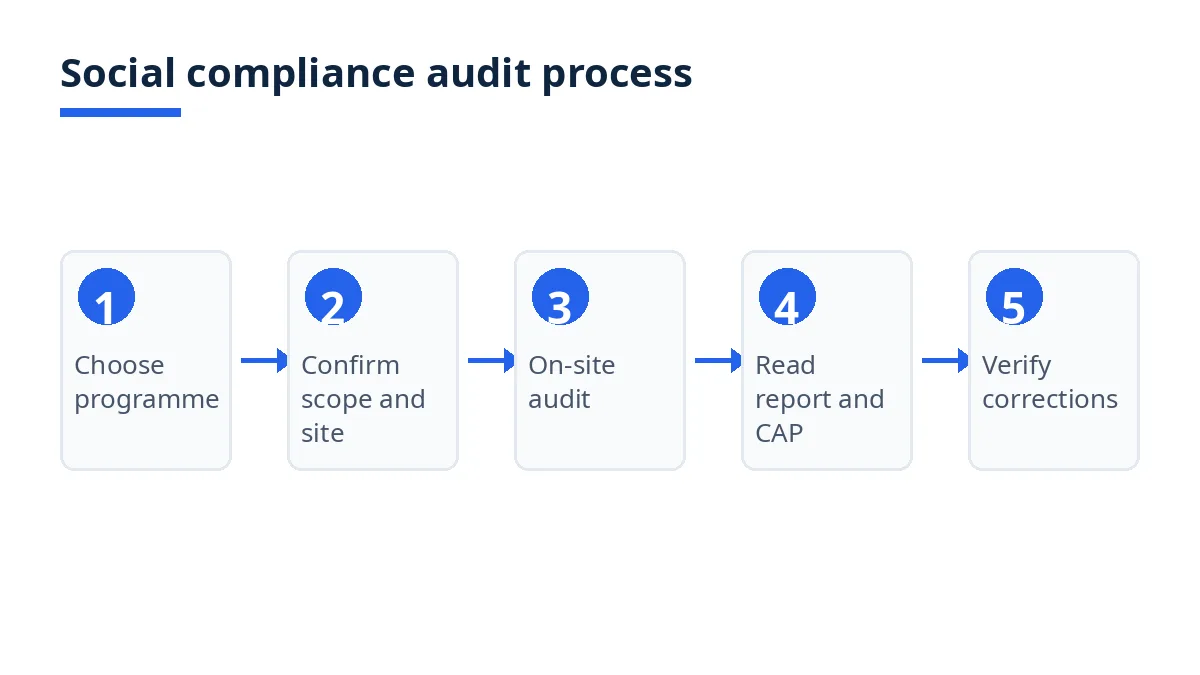
Choose the programme your buyer accepts. Do not assume one programme substitutes for another. A buyer that requires amfori BSCI monitoring will not accept a WRAP certificate in its place unless it says so in writing, and a SMETA report is a report, not a certificate.
Name the site and the workforce exactly. Give the factory address, the number of buildings in scope, the production processes, the total worker count, the shift pattern, and any subcontracted work. Social audit time grows with the workforce to be sampled and the sites to be walked, not with the order quantity.
State the pillar scope. For SMETA, confirm two-pillar or four-pillar before quoting, since the four-pillar version adds environment and business ethics to the labor standards and health and safety pillars.1
Send the document pack before the visit. Include labor and safety policies, employment contracts, wage and hours records, health and safety procedures, and any prior audit reports with their corrective action plans.
Host the on-site audit. A SMETA assessment runs from an opening meeting through a site tour, document review, and worker and management interviews, to a pre-closing meeting and a closing meeting that reviews the Corrective Action Plan Report (CAPR).1
Read the report finding by finding. Check each finding against its evidence, agree an owner and a deadline for each corrective action, and record whether verification will be a desktop review or a return visit.
Close the corrective actions and keep the evidence. A finding without a verified correction stays open on the record, and an open finding is what the next buyer will ask about first.
Costs, timelines and documents
Programme comparison: what each code examines
SMETA is a standardized social audit conducted for Sedex members, assessed against local legal requirements, the Ethical Trading Initiative (ETI) Base Code, and the buyer's own code of conduct where one applies.1 Its two mandatory pillars are labor standards, covering child labor, freedom of association, working hours, living wage, and discrimination, and health and safety; the four-pillar version adds environment and business ethics.1
Amfori BSCI monitoring assesses a producer against the amfori BSCI Code of Conduct across 13 performance areas, including the social management system, workers' involvement and protection, freedom of association and collective bargaining, fair remuneration, decent working hours, occupational health and safety, no child labor, no precarious employment, no bonded or forced labor, protection of the environment, and ethical business behavior.2 Full audits cover all 13 areas, follow-up audits cover only the areas that need new evidence of progress, and each audit results in a rating from A to E.2
SA8000 is different in kind: it is a certifiable social accountability management system owned by Social Accountability International (SAI), built on International Labor Organization conventions, the Universal Declaration of Human Rights, and the UN Convention on the Rights of the Child.3 Its topics include child labor, forced labor, safety and health, freedom of association, collective bargaining, discrimination, disciplinary measures, working time, compensation, and management systems, with regular surveillance of the system and of workers' labor conditions.3 A certificate is issued only when the assessment reveals no major nonconformities.3
WRAP is a factory-based certification programme for clothing, footwear, and other sewn products, certifying facilities against 12 principles covering laws and workplace regulations, forced and child labor, harassment and abuse, compensation, hours, discrimination, health and safety, freedom of association, environment, customs compliance, and security.4 A facility that passes receives an annual Certification of Compliance.4
Programme | Deliverable | Scope in one line |
|---|---|---|
SMETA | Report plus Corrective Action Plan Report, shared through Sedex | Labor standards and health and safety, plus environment and business ethics in the four-pillar version |
amfori BSCI | Rating from A to E on the amfori platform | 13 performance areas against the Code of Conduct |
SA8000 | Certificate from an accredited certification body, with surveillance | Certifiable management system across nine topic areas |
WRAP | Annual Certification of Compliance | 12 principles for sewn-goods manufacturing |
What drives the cost
A quote for a social compliance audit is usually built from auditor days, and five drivers set the day count. First, workforce size: a larger workforce means a larger worker-interview sample and more wage and hours records to reconcile. Second, site count: each additional building, and each subcontracted site in scope, adds tour and document time. Third, pillar scope: a four-pillar SMETA audit and a full 13-area BSCI audit take longer than a two-pillar SMETA audit. Fourth, language: worker interviews in Bengali need interpreter time where the auditor does not work in the factory's language. Fifth, verification: a desktop review of corrective-action evidence costs less auditor time than a return visit, and a follow-up audit is a separate priced item.
On top of auditor days, a quote may carry travel, report writing, interpreter fees, a programme or platform fee, and the cost of the verification step. Compare quotes only when every one of those lines is shown, for the same programme, pillars, site, and workforce.
Example figures: how a quote adds up
Example figures: take an example day rate of 320 dollars, a two-day on-site audit, and a half day of report writing, for a total of 2.5 auditor days. At the example rate, the auditor-day line is 800 dollars, before travel, interpreter time, and any programme fee. Add an example interpreter day of 150 dollars and example travel of 120 dollars, and the example total becomes 1,070 dollars. None of those figures is a market rate; they show how the lines combine.
Example figures for a second site: if the same factory group adds a second site with its own workforce and records, the on-site days roughly double for that scope, while report writing grows by a smaller amount. That is why naming every site before quoting matters more than negotiating the day rate.
Timelines
Confirm three dates in writing: the audit date, the report delivery date, and the corrective-action deadline. Timelines differ by programme design. Amfori BSCI full audits take place every two years and cover all 13 performance areas, with follow-up audits in between covering only the areas that need new evidence.2 SA8000 certificate validity is maintained through announced audits at six-month intervals with a positive result.3 WRAP certification is annual.4 A SMETA report has no certificate expiry to manage; its value ages with the findings, so buyers commonly ask for a current report and a closed corrective action plan.
Documents to prepare
Prepare the factory name and address, buildings and processes in scope, worker count and shift pattern, and the programme and pillar scope in one written brief. Add labor and safety policies, employment contracts, wage sheets, attendance and overtime records, health and safety procedures and training records, grievance records, and any prior audit reports with their corrective action plans. Confirm worker interview access and the interview language before the audit date, and confirm who owns the report and who may receive it.1
Bangladesh-specific rules and tips
Check hours records against the Labour Act, not only against the payroll summary. For covered adult workers, ordinary working time is generally eight hours per day and 48 hours per week, with permitted additional work up to ten hours per day and 60 hours per week, and an average weekly working time not exceeding 56 hours over a year.5 Overtime under section 108 is paid at twice the ordinary rate of basic wage, dearness allowance, and any ad hoc or interim wage, not automatically twice gross salary.5 An auditor will look for attendance, overtime, and pay records that reconcile, and paying the double rate does not by itself make an excessive schedule lawful.5
Reconcile the four records before the auditor does. The working-time notice and schedule, the actual attendance and breaks, the instructions behind any extra hours, and the wage calculation with payment evidence should tell one consistent story.5
Price travel from the auditor's base, not from Dhaka by default. A factory in Gazipur, Narayanganj, or Chattogram may be local to one provider's auditor and a full travel day for another's. Ask which base the auditor travels from and whether travel time is billed as auditor days.
Do not let a social audit substitute for a product check. A factory with a closed corrective action plan can still ship a lot that fails your specification. The purchase order should name both where both are required: the social audit for workplace conditions, and the product inspection before shipment.
Mistakes and red flags
Treating a SMETA report as a certificate. The SMETA deliverable is a report plus a Corrective Action Plan Report shared through Sedex.1 SA8000 and WRAP, by contrast, issue certificates.4 3
Treating a BSCI rating as a product approval. A rating from A to E reflects how far the producer has integrated the Code of Conduct into daily operations.2 It is not a judgement on product quality, capacity, or delivery.
Comparing day rates instead of totals. A lower day rate with more days, separate travel, a separate report charge, and a paid verification visit can exceed a higher all-inclusive rate.
Accepting a quote without a stated programme and pillar scope. Two providers can quote different jobs under the label "social audit" when one prices two pillars and the other prices four.
Accepting a summary instead of the full report. A summary hides which findings are open, who owns them, and how verification will happen.
Booking the audit after the order is placed. An audit after placement can still find problems, but the buyer has already committed. The audit's value is highest before the first order, at annual review, or before a volume increase.
Assuming one site covers the group. A factory group may operate several sites under one company name. An audit of one site says nothing about another site's workforce or safety record.
Reading an SA8000 certificate as a product statement. SA8000 certification is not product certification and provides no direct statement on product quality.3
Checklist
Before you book, confirm every line in writing.
Programme named: SMETA, amfori BSCI, SA8000, or WRAP, with pillar scope where it applies.
Site named exactly: address, buildings, processes, subcontracted work, and shift pattern.
Workforce size stated, so the interview sample and auditor days can be estimated.
Quote in components: auditor days, report writing, travel, interpreter, programme fee, and verification terms.
Totals compared on the same programme, pillars, site, and workforce, not day rates alone.
Report language, contents, delivery date, and recipient confirmed in writing.
Corrective-action process agreed: owner, deadline, evidence, and verification method.
Follow-up and re-audit payer and method agreed before the audit.
Full report and corrective action plan filed with the supplier record, separate from any product inspection report.
How Exportain helps
Exportain does not audit factories itself. Its supplier verification is a document and photo review by staff, not a factory inspection or a social compliance audit, and a badge is not a guarantee of production capacity, product quality, or delivery.
Post a free RFQ on Exportain and write the programme, pillar scope, site, and report you expect into the request. For the audit itself, contract directly with the audit firm or certification body and read its report against the grading rules of the programme used. Before you set product-check values, read the pre-shipment inspection guide and the AQL guide, since those describe the separate product inspection.
FAQs
What should I know first about social compliance audit cost?
Know the programme and pillar scope before you ask for a price. SMETA, amfori BSCI, SA8000, and WRAP are different jobs with different deliverables, priced on auditor days, travel, interpreter time, report writing, programme fees, and verification. There is no single Bangladesh market price, so compare totals for the same scope, site, and workforce size.
What are the typical costs and timelines?
There are no typical costs or timelines a guide can state as fact. Costs move with workforce size, site count, pillar scope, interpreter need, travel, and the verification step, and timelines differ by programme: BSCI full audits run on a two-year cycle with follow-up audits in between,2 SA8000 validity is maintained through audits at six-month intervals,3 and WRAP certification is annual.4 Use the example figures in this guide to compare quote structures, not as prices to expect.
Which documents are needed?
Send the factory address, building and process details, worker count and shift pattern, programme and pillar scope, plus labor and safety policies, employment contracts, wage and hours records, and health and safety procedures.1 Add any prior audit reports with their corrective action plans, and confirm worker interview access, interview language, and who owns and receives the report before the audit date.
What are the most common mistakes?
The most common mistakes are treating a SMETA report as a certificate, treating a BSCI rating as a product approval, comparing day rates instead of totals, accepting a quote without a stated programme and pillar scope, accepting a summary instead of the full report, and booking the audit after the order is placed.1 2 4 3
Next steps on Exportain
Start with the product check that sits beside the audit: read the pre-shipment inspection guide for how finished goods are sampled and judged, and the AQL guide for how acceptance limits are set. Then post a free RFQ on Exportain stating the programme, pillar scope, site, and report you expect.
Sources
- SMETA Audit for Global Supply Chain. UL Solutions (accessed )
- amfori BSCI | SGS Bangladesh. SGS (accessed )
- SA8000® Certification Mark. TÜV SÜD (accessed )
- WRAP Certification Services for Ethical Sourcing. TÜV SÜD (accessed )
- Overtime and Extra Hours Regulations to the Labour Act. Payroll Bangladesh (accessed )
- supplier verification
- pre-shipment inspection
- quality control
- buyer guide
- Bangladesh sourcing
- Factory certification
About the author
Sourcing from Bangladesh?
Post a request for quotation and suppliers on Exportain can send you their quotes directly.
Post an RFQ