

Quality Control Checklist for Soaps From Bangladesh
A soap-specific QC checklist for bar, tablet and liquid soaps from Bangladesh: weight and fill, appearance, lather and pump tests, lab tests, ingredients, claims, labels and packing, with fixes for common failures.
Short answer
Use this soaps quality control checklist to check bar, tablet and liquid soaps from Bangladesh before shipment: form, weight and fill, appearance, colour and scent, lather and pump function, lab tests for total alkali, total fatty matter and free caustic alkali, ingredient lists, claims and labels, and packing and cartons, against tolerances and test methods agreed in the purchase order.
On this page
Key takeaways
Agree the form, weight or fill, test methods, label wording and acceptance numbers in the purchase order before inspection, and draw samples across forms, scents, variants and lots.
Judge soap by use as well as sight: check lather, rinse, bar wear, pump dispensing and leakage, because a bar or bottle that looks right can still fail in use.
Name the lab method on every report for total alkali, total fatty matter and free caustic alkali, and confirm each report names the product, variant, batch and lot tested.
Proof labels against the formula and the destination market rules before bulk printing, because a wrong ingredient order or an unsupported claim can hold a whole shipment.
A soap bar that looks right in the carton can still fail in use: it cracks across the middle, turns soft and mushy after a few washes, smells stale, or its pump clogs and leaks in transit. This soaps quality control checklist is built around how soap is used and shipped, catching failures before the order leaves Bangladesh.
Why this checklist matters
Soap is judged by hand, nose and use, not only by sight. Weight decides whether the buyer receives the declared bar or fill. Surface, colour and scent decide whether the batch matches the sample. Lather, rinse and bar wear decide whether the product performs after the first wash. Labels and claims decide whether the soap can be sold in its destination market.
A written checklist also stops a common dispute after delivery about what was agreed. When form, weight, test methods and label wording are written into the purchase order first, inspection becomes a comparison against that record, not a fresh argument at the packing table.
Before you start
Do not start inspection until the references are complete: an approved sample for each form and scent, the purchase order and pack, the declared weight or fill for each variant, the ingredient list, the label artwork for the destination market, and the packing specification. Record which variant each sample covers, because bar, tablet and liquid soaps from one order are different products for inspection.
Agree the sampling approach, test methods and acceptance numbers in the purchase order before goods are finished. ISO 22716:2007 gives guidelines for the production, control, storage and shipment of cosmetic products, covering quality aspects of the product while not covering personnel safety or environmental protection.1 A factory visit note is not a substitute for named lab methods and written acceptance levels.
The full checklist (numbered, printable)
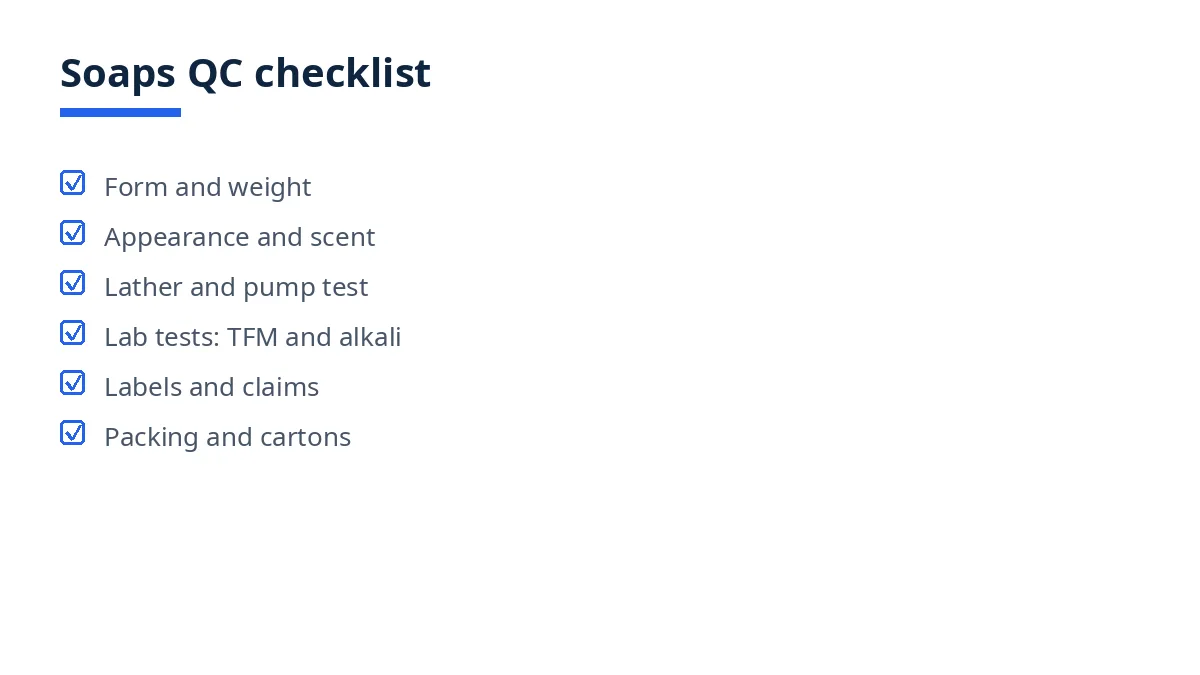
Form, weight and fill
Confirm each sampled unit's form against the purchase order: bar, tablet or liquid, plus its scent and variant.
Weigh sampled bars and tablets individually against the declared weight, recording actual weights, not pass marks alone.
Check tablet packs for the declared count, uniform size and shape, and no broken tablets loose in the pack.
Check liquid fill by weight or volume as the purchase order states, and confirm consistency across sampled bottles.
Measure sampled bar length, width and thickness against the pack figure, noting any bar thinner at one end.
Appearance, colour, scent and feel
Check sampled bars and tablets for cracks, chips, dents, air holes, bloom, spots and uneven edges, face, sides and back.
Check colour against the approved sample under the same light, within a batch and between lots.
Check scent against the approved sample, recording any stale, rancid, chemical or missing scent as a failure against the sample.
Check the surface by hand for grit, roughness, stickiness or a mushy feel, comparing suspect pieces directly with the sample.
Check liquid soap for separation, cloudiness, particles, colour change or off smell, shaking or inverting only as the supplier directs.
Lather, rinse, wear and dispensing
Run a lather and rinse check on sample bars against the sample, using the same water and method per piece, recording lather, rinse feel and residue.
Where the purchase order requires it, run a short use check on sample bars: note cracking, splitting, softening or mushiness versus the sample.
Check pumps and caps: each pump primes, dispenses consistently, does not clog or sputter, and locks or closes as designed.
Check bottles inverted and on their side for leakage at pump, cap and seal, confirming caps stay tight after reclosing.
Where required, check tablet soap in use: it holds its shape, does not crumble on first use, and matches the sample for hardness.
Laboratory tests for composition
Review total alkali and total fatty matter evidence where lab testing is required. ISO 685:2020 specifies a method for the simultaneous determination of both in soaps, including liquid soaps, excluding compounded products.2
Review free caustic alkali evidence where required. ISO 456:1973 specifies two methods for commercial soaps, excluding compounded products: an ethanol method and a barium chloride method.3
Agree the pH method in the purchase order before testing, including solution and temperature, and record it on every report.
Agree the moisture and volatile-matter method in the purchase order where moisture affects hardness or weight, and record it on every report.
For liquid and cosmetic soaps, ask for the microbiological and stability evidence the buyer or destination requires, named by method and lab, with product, variant, batch and lot on every report.
Ingredients, claims and classification
Compare the pack ingredient list with the agreed formula, flagging any unapproved substitution, missing ingredient or changed order.
Check every pack claim against the classification it creates. The FDA explains that a product marketed only as soap, made mainly from alkali salts of fatty acids whose cleaning action comes from those salts, is treated as soap, while a product intended to moisturise, deodorise or treat a skin condition falls under cosmetic or drug rules instead.4
Check no claim promises an unsupported result, and correct any treatment, germ-killing or skin-condition claim not cleared for the destination market.
For the EU, check ingredients against the lists for prohibited, restricted and authorised substances. Regulation (EC) No 1223/2009 sets out rules for cosmetic products placed on the market, including those lists.5
Check fragrance and allergen labelling against destination rules, confirming any allergen declaration matches the formula on file.
Labels and packs for the destination market
For the EU, check the label for the items Regulation (EC) No 1223/2009 requires, including the responsible person's name and address, country of origin for imports, nominal content, durability or period-after-opening information, precautions, batch reference, function and ingredient list.5
Check responsible-person details, batch code, durability date and ingredient list are legible, in the destination language, and identical across wrapper, bottle label and outer pack.
For toilet-soap variants under Bangladesh rules, check whether the BSTI standard mark applies. BSTI made its mark mandatory for glycerine, liquid and transparent toilet soap among 36 products in its 2023 list.6
Check barcodes scan and match the purchase order, and confirm scent, variant, weight or fill and count match the unit inside.
Packing and cartons
Check wrappers and seals: each bar and tablet fully wrapped, seals complete, no wrapper torn, loose or stained.
Check liquid bottles for protective seals, caps and any required inner seal, and confirm none is packed wet, sticky or damaged.
Confirm inner-pack counts, assortments and mixed-scent ratios match the packing specification, and each carton holds the stated assortment.
Check carton markings, carton count and packing list against each other, weighing and measuring sampled cartons where required.
Confirm cartons protect the goods: bars not crushed, liquid bottles standing as directed, no carton damp, stained or softened.
Common failures and how to fix them
The most frequent bar failure is cracking or crumbling. Stop, compare cracked bars with the sample, check whether damage clusters in one lot or carton layer, and segregate that group before more cartons are sealed. A soft or mushy bar points the other way: compare it with the sample after the same use check, and re-check moisture and storage before accepting the lot.
A scent or colour shift across a batch usually points to more than one production lot being mixed. Re-sort complete packs by lot before shipment, and re-check scent and colour lot by lot rather than averaging the result. For liquid soap, the most costly failure is leakage: a pump that passes upright can still leak on its side. Test sampled bottles in the position they will travel in, replace faulty pumps and caps, and re-test before the carton is closed.
Label failures are the easiest to prevent and the hardest to fix after printing. A wrong ingredient order, a missing batch code or a claim that changes the product classification can hold a whole shipment. Proof the label against the formula and destination rules before bulk printing, and re-proof it after any formula or claim change.
Downloadable template and summary table
Copy the checklist into an inspection sheet, add the declared weight or fill, test methods and acceptance numbers from the purchase order, and record a result per sampled unit.
Section | Checks | Evidence |
|---|---|---|
Form, weight and fill | Form, weight, count, fill, size | Weighing and fill records |
Appearance and scent | Cracks, colour, scent, surface | Sample comparison |
Use and dispensing | Lather, wear, pump, leakage | Use and pump tests |
Lab tests | Total alkali, fatty matter, free alkali, pH, moisture | Lab reports by batch |
Ingredients and claims | Formula, claims, classification | Formula and label proof |
Labels and packs | EU label items, BSTI mark, barcode | Label proof |
Packing | Wrappers, seals, counts, cartons | Packing list |
How Exportain helps
Exportain is a B2B marketplace connecting buyers with Bangladeshi suppliers of soaps and toiletries, so the specifications behind this checklist can be agreed at the enquiry stage. Use inspection services when you plan the check, and share the approved sample, weight or fill, test methods and label artwork before production starts. Supplier profiles show which document and photo checks have been recorded, not factory inspections. Exportain is not a party to the goods contract and does not inspect goods.
FAQs
When should this checklist be used?
Use it at final inspection, when goods are finished and packed. For larger and first orders, also use it during production, while formula, scent and pump faults can still be corrected.
Who should complete it?
The buyer, a local agent or an independent inspector can complete it, using the approved sample, purchase order and label artwork, plus lab reports for composition tests.
What are the most common failures?
Cracked or crumbling bars, soft or mushy bars, scent or colour shifts between lots, leaking pumps, and label errors such as a wrong ingredient order or unsupported claim are the failures found most often.
Can a third party do it?
Yes, if you share the approved references, test methods, acceptance levels and label artwork first, with lab reports naming product, variant, batch and lot.
Next steps on Exportain
Before production starts, agree your form, weight or fill, test methods and label wording, then read the AQL acceptance quality limit explainer and the pre-shipment inspection guide, and plan with inspection services. You can also post a free RFQ via RFQs and compare quotes from Bangladeshi suppliers.
Sources
- ISO 22716:2007 - Cosmetics — Good Manufacturing Practices (GMP) — Guidelines on Good Manufacturing Practices. International Organization for Standardization (accessed )
- ISO 685:2020 - Analysis of soaps — Determination of total alkali content and total fatty matter content. International Organization for Standardization (accessed )
- ISO 456:1973 - Surface active agents — Analysis of soaps — Determination of free caustic alkali. International Organization for Standardization (accessed )
- Frequently Asked Questions on Soap. U.S. Food and Drug Administration (accessed )
- Regulation (EC) No 1223/2009 of the European Parliament and of the Council of 30 November 2009 on cosmetic products (recast). European Union (accessed )
- Use of BSTI standard mark made mandatory for 36 new products. The Daily Star, (accessed )
About the author
Sourcing from Bangladesh?
Post a request for quotation and suppliers on Exportain can send you their quotes directly.
Post an RFQ


