

How Much Does Shrinkage Testing Cost in Bangladesh?
Shrinkage testing measures how much a fabric or garment changes in length and width after washing and drying. This guide explains the ISO and AATCC methods to book, how to read a shrinkage report, what moves a lab quote in Bangladesh, and the terms to agree in writing before specimens leave the factory.
Short answer
Shrinkage testing measures how much a fabric or garment changes in length and width after washing and drying, reported separately for each direction and judged only against the tolerance in the buyer specification. This guide explains the ISO and AATCC methods to book, how to read a shrinkage report, what moves a lab quote in Bangladesh, and the terms to agree in writing before specimens leave the factory.

On this page
Key takeaways
Shrinkage testing reports length change and width change separately, as a percentage from measurements at the same reference points before and after washing and drying.
ISO 3759 covers preparation, marking, and measuring, ISO 6330 covers domestic washing and drying procedures, and in the AATCC family TM135 covers fabrics while TM150 covers garments.
No figure in this guide decides a pass: the buyer specification governs acceptance, and every result is judged against the tolerance written into the purchase specification.
A lab quote follows test sets, constructions, sizes, methods, wash and dry procedures, cycle counts, preparation, report detail, and retest terms, so compare itemized written quotes for the same scope and hold shipment until each tested construction is cleared in writing.
Shrinkage testing measures how much a fabric or garment changes in length and width after washing and drying, reported separately for each direction and judged only against the tolerance in the buyer specification. This guide explains the ISO and AATCC methods to book, how to read a shrinkage report, what moves a lab quote in Bangladesh, and the terms to agree in writing before specimens leave the factory.
A shrinkage result is a measurement, not a verdict on its own. The test marks reference points on a specimen, measures the distance between those points, washes and dries the specimen under a named procedure, and measures the same points again. ISO 3759 covers that preparation, marking, and measuring for fabric specimens and garments in tests for dimensional change, and it applies to woven and knitted fabrics and made-up textile articles, with treatments including washing and steaming, following procedures such as ISO 6330.1 The change is reported as a percentage for length and for width separately. A negative figure means shrinkage, and a positive figure means growth, with the percentage calculated as the difference between the final and original distance, divided by the original distance, multiplied by one hundred, as the opened AATCC 135 explanation states.2
That separation matters for fit: a fabric can shorten in length while growing slightly in width, and a single averaged figure would hide the direction that changes the garment.
The ISO and AATCC families are not interchangeable result for result. ISO 6330 specifies domestic washing and drying procedures for textile testing, and the opened laboratory guide describes its use for length and width change after washing and drying, with drying by line, flat, drip, or tumble methods.3 In the AATCC family, TM135 covers dimensional changes of fabrics after home laundering and TM150 covers garments, as listed in the AATCC standards index.4 Name the exact method and edition in the booking, because a fabric result and a garment result answer different questions.
Why this matters for buyers and sellers
For a buyer, a size that holds at the factory and moves after home laundering becomes a fit complaint, a return, or a lost repeat order, often visible only after the goods reach the consumer. A laboratory result, taken before bulk shipment, gives the buyer a dated record tied to a named method, construction, and tolerance, so a dispute can be settled against paperwork rather than impressions. The record also protects the care label: a label that promises a routine the fabric cannot hold will fail in the consumer's home.
For a seller, the same record protects good work. When the tested construction matches production, a result inside tolerance shows the fabric held its dimensions, and a result outside tolerance, with length and width shown separately, tells the finishing team where to look first.
Keep neighboring checks apart, because each is quoted and reported separately.
Seam-strength cost covers a separate cost guide for a different laboratory test.
Colorfastness cost covers a separate cost guide for a different laboratory test.
Fabric 4-point scoring covers a separate fabric roll scoring scope.
Piece-by-piece sorting covers a separate unit-by-unit segregation scope.
Sample inspection covers a separate approval specimen scope.
General lab testing covers a separate wider laboratory package scope.
This guide covers only shrinkage testing.
Step-by-step: how it works
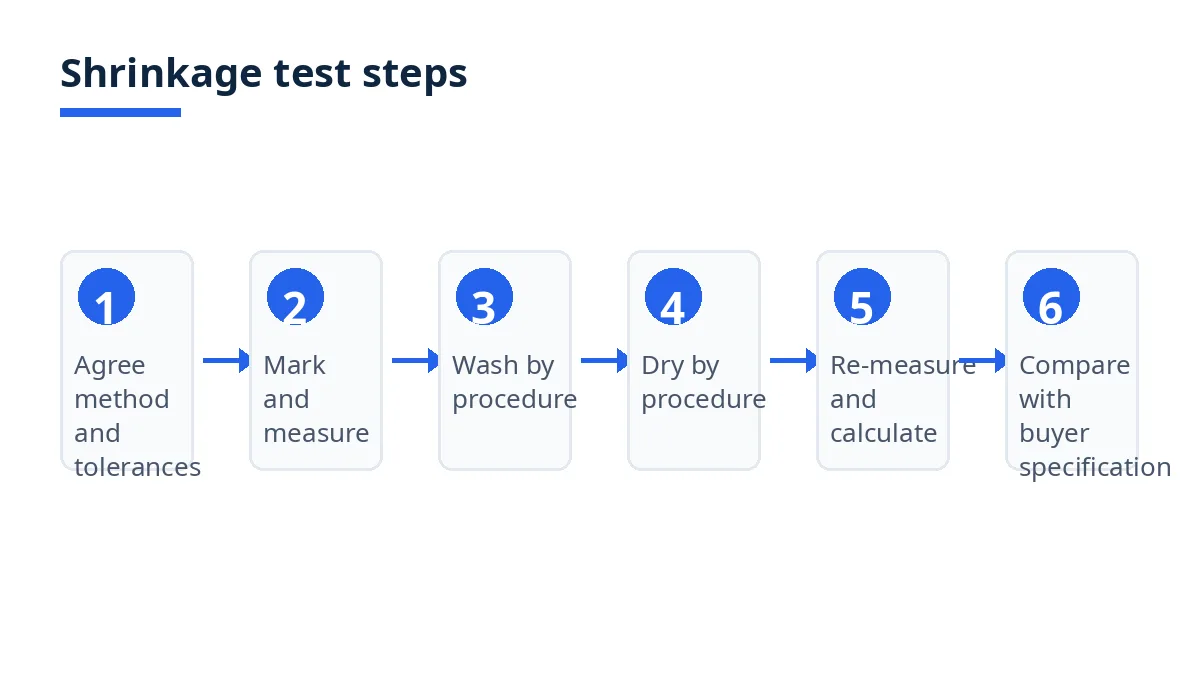
Agree the method, edition, wash and dry procedures, cycle count, and tolerances in writing. Name the method family, exact method and edition, washing and drying procedures, machine type, cycle count, and length and width tolerances for each construction. The tolerances are a buyer specification in the purchase specification, and no figure in this guide replaces them. A method tells a laboratory how to produce a number, as the opened AATCC 135 explanation stresses, and it does not say whether a given percentage is acceptable, since that threshold comes from the buyer specification, end use, or care claim, agreed in writing before the first bulk order.2
Choose the specimen source and keep constructions separate. Test fabric or a finished garment as agreed, and keep every construction, size, fabric lot, and dye lot separate. AATCC TM135 is written for fabric, while garments are covered by AATCC TM150, so book the method that matches what will actually be measured.2 4 Do not average a woven construction with a knit construction, or a large size with a small size.
Prepare and mark specimens before any washing. Specimens are selected to represent the bulk of the textile, and pairs of reference points are marked on each specimen, with the distance between each pair measured before and after treatment.1 For fabric piece goods, the opened ISO 3759 text directs that specimens not be cut from within 1 meter of either end of the roll or piece good, and that specimens be taken from areas with different lengthwise and widthwise yarns.1 Condition specimens before the first measurement, and record the measuring positions so the same points are measured again after treatment.
Wash under the named ISO 6330 or AATCC procedure. ISO 6330 specifies standardized washing and drying methods that simulate domestic laundering, and the opened laboratory guide lists a defined machine type, controlled water temperature, specified detergent, and standardized washing cycle among the procedure elements.3 The AATCC 135 explanation describes washing conditions from cool and gentle to hot and vigorous, with a standard reference detergent, and specimens laundered with ballast so the total load weight matches the method.2 Confirm wash temperature, agitation, detergent, load, and machine type in the booking.
Dry by the named procedure, and do not substitute a drying method silently. Drying options in the opened AATCC 135 explanation include tumble, line, drip, screen, and flat drying, and each one produces a different result on the same fabric.2 The opened ISO 6330 laboratory guide lists line, flat, drip, and tumble drying, and states that the drying method significantly influences dimensional change results.3 A report that omits the drying procedure cannot be compared with another report.
Re-condition, re-measure, and calculate length and width separately. After laundering, specimens are conditioned again and re-measured at the same reference points, and the percentage change is calculated for length and for width separately.2 Show the original distance, final distance, and calculated change for each direction. Repeat cycles, when booked, show whether the fabric settles or keeps moving.
Compare each direction with the buyer specification and hold shipment on a fail. Judge length and width separately against the tolerance in step 1, for every construction and size tested. Results in the opened ISO 6330 laboratory guide are compared with applicable customer specifications or product standards, and acceptance limits vary with fabric type, garment category, customer requirements, and product specifications, rather than sitting in the method itself.3 On a fail, agree the correction, retest specimen source, and retest scope before the bulk lot ships, and keep the failed report with the retest report.
Costs, timelines and documents
No single shrinkage testing fee applies across Bangladesh. A lab quote is built from test sets, constructions, sizes, methods, wash and dry procedures, cycles, specimen preparation, report detail, photographs, specimen handling, and retest terms. A quote for one construction and one cycle cannot be compared with a quote for three constructions and repeated cycles, and a quote that leaves retesting out looks cheaper until a fail makes a retest necessary.
Pricing models: per test set, per construction, or a package
Labs commonly quote per test set, per construction, or as a package for agreed styles and procedures, sometimes with a separate charge for preparation, conditioning, or an urgent report. Ask what the quoted unit includes: preparation, conditioning, cycles, report, photographs, and one retest, or none of these.
Example figures: how a quote adds up
Every money figure in this table is an Example figure, invented to show the arithmetic, not quoted from any lab and not a market rate. Confirm every figure in the lab written quote.
Example case | Example figures arithmetic | Example figures total |
|---|---|---|
Example A: one construction, fabric test, one wash and dry cycle, standard report | Example figures: 2 test sets at 90 plus 1 report at 50 | Example figures: 230 |
Example B: two constructions, fabric and garment tests, repeated cycles, photographs included | Example figures: 4 test sets at 90 plus 1 report at 50 plus photographs at 25 | Example figures: 435 |
Example C: one construction plus a retest after a length movement | Example figures: 2 test sets at 90 plus 1 report at 50 plus 1 retest set at 90 | Example figures: 320 |
Example A and Example C differ only in the retest set. Example B costs more because it tests more sets across two constructions with repeated cycles.
Example timeline only, not a promise
Example timeline only. This timeline is an illustration, not a promise and not a lab turnaround. Confirm every date in the lab written booking confirmation. Agree the method, procedures, cycle count, and tolerances before sending specimens, send specimens that match production, and receive the written report before authorizing shipment. Agree correction or retesting for a failed test set before the bulk lot ships.
Documents to prepare
Send the lab a reference set before testing: the purchase order with style, construction, size range, and quantity; the care label and intended wash and dry conditions; the named method and edition; the length and width tolerances; the specimen list by style, construction, size, fabric lot, and test; the report format; the payer, fail, and retest terms; and a shipment hold instruction until each construction is cleared in writing.
Bangladesh-specific rules and tips
Shrinkage testing in Bangladesh usually runs through a commercial textile laboratory rather than at the factory. Intertek describes ISO 17025-accredited laboratories in Dhaka, Chattogram, and Gazipur, with textile testing capabilities that include dimensional stability.5 Ask a lab which methods and editions its accreditation covers, and whether it covers fabric testing, garment testing, or both.
For the service listing, note this caveat exactly: the Exportain inspection services page currently renders "No services published in this category yet", so use the link as a category page to watch rather than as a list of available providers. The link is inspection services with that caveat stated.
Plan around the factory calendar and courier time, not only lab time. Confirm when constructions are ready, the courier route, and the lab booking date in one plan, and keep the lot identity on every specimen label.
Mistakes and red flags
Booking a test with no named method or edition. Insist the method family, exact method, and edition appear in the booking, and that fabric and garment tests are not mixed.
Accepting one averaged percentage for length and width. Ask for length and width change separately, for each construction and size.
Comparing an ISO result with an AATCC result. Confirm the method family in every report before comparing figures.
Mixing constructions, sizes, or fabric lots into one averaged result. Keep test sets separate.
Treating a method figure as a pass mark. Judge every result against the purchase specification.
Shipping before the report arrives. Hold shipment until each test is cleared in writing.
Booking a single cycle and assuming repeated laundering will behave the same. Book repeated cycles where the care claim requires them.
Red flags: no method, no drying procedure, no cycle count, a single averaged percentage, a retest from a different lot, and no original and final distances.
Checklist
Method family, exact method, and edition named for every test, current edition confirmed by the lab.
Fabric and garment methods kept apart, with TM135 for fabrics and TM150 for garments where the AATCC family is used.
Wash and drying procedures, machine type, detergent, load, and cycle count named in the booking.
Length and width tolerances written for each construction and size in the purchase specification.
Specimens labeled by style, construction, size, fabric lot, and test, duplicate set kept at the factory where agreed.
Original and final distances recorded at the same reference points, length and width calculated separately.
Written quote received with test sets, constructions, procedures, cycles, report detail, photographs, and retest terms.
Report received before shipment, with method, edition, procedures, cycle count, and length and width results.
Failed tests corrected and retested from the same production lot before shipment.
How Exportain helps
Exportain connects international buyers with Bangladeshi sellers and service providers. Write the constructions, methods, procedures, cycle counts, and tolerances into the order, then ask the seller which laboratory will run the tests and whether its accreditation covers the method you named.
For the service listing, note this caveat exactly: the Exportain inspection services page currently renders "No services published in this category yet", so use the link as a category page to watch rather than as a list of available providers. The link is inspection services with that caveat stated. Also read the pre-shipment inspection guide, which explains sampling of finished goods beside a laboratory result.
FAQs
What should I know first about shrinkage testing?
Shrinkage testing measures how much a fabric or garment changes in length and width after washing and drying, reported separately for each direction. ISO 3759 covers preparation, marking, and measuring, ISO 6330 covers domestic washing and drying procedures, and in the AATCC family, TM135 covers fabrics and TM150 covers garments. The result only has meaning beside a written buyer specification, because no figure in this guide decides a pass.
What are the typical costs and timelines?
There is no typical fee or turnaround that applies across Bangladesh, because a quote follows test sets, constructions, sizes, methods, procedures, cycle counts, preparation, report detail, and retest terms. Use the Example figures table to see how a quote adds up, and confirm every figure and date in the lab written quote before sending specimens.
Which documents are needed?
Send the purchase order, the care label and intended wash and dry conditions, the named method and edition, the length and width tolerances, the specimen list by style, construction, size, fabric lot, and test, the report format, and the payer, fail, and retest terms.
What are the most common mistakes?
The most common mistakes are booking a test with no named method or edition, accepting one averaged percentage for length and width, comparing an ISO result with an AATCC result, averaging different constructions or lots into one result, treating a method figure as a pass mark, and shipping before the report arrives.
Next steps on Exportain
Post a free RFQ on Exportain, describing the construction, sizes, named methods, wash and dry procedures, cycle counts, and tolerances you want tested. Read the pre-shipment inspection guide for finished-goods sampling beside the lab result, and the Acceptance Quality Limit guide for how sampling decisions are set.
Sources
- ISO 3759:2007 - Textiles — Preparation, marking and measuring of fabric specimens and garments in tests for determination of dimensional change. International Organization for Standardization (accessed )
- AATCC 135 Explained: Dimensional Changes of Fabrics After Home Laundering. Langping Textile (accessed )
- Dimensional Stability Testing | ISO 6330. METS Laboratories (accessed )
- Standard Test Methods and Procedures. AATCC (accessed )
- Softlines Bangladesh. Intertek (accessed )
About the author
Sourcing from Bangladesh?
Post a request for quotation and suppliers on Exportain can send you their quotes directly.
Post an RFQ


