

Shorts Price in Bangladesh: FOB Cost Breakdown for Buyers
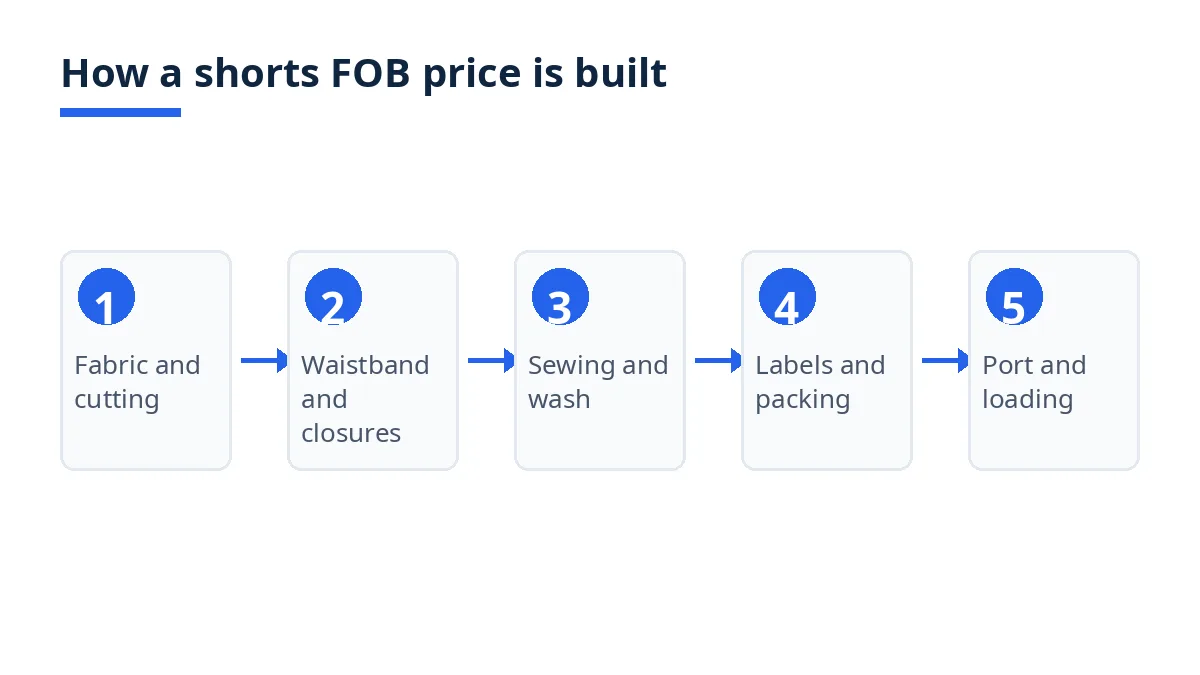
A shorts FOB price in Bangladesh is built piece by piece: fabric and cutting, waistband and closures, wash, labels, packing and delivery to the vessel. This guide breaks down each component, what moves it, and how to compare quotations on the same basis.
Short answer
A shorts FOB price in Bangladesh is the sum of everything needed to make the pair and place it on board the vessel at the named Bangladeshi port: fabric and cutting, waistband and closures, sewing, wash where used, labels, packing, inspection, inland transport and export clearance. Fabric is usually the main cost driver, and every extra pocket, wash step or size split moves the total. Compare quotations only on the same style, fabric and delivery term.
On this page
Key takeaways
A shorts FOB price covers making the pair and placing it on board at the named Bangladeshi port; ocean freight and import clearance sit outside it.
Fabric is usually the main component, and its cost moves with consumption per pair, cloth weight and whether the fabric is stocked or dyed to order.
Waistband work, pockets and bartacks, wash and sewing operations are the next movers: each added operation or finish raises the price even on the same cloth.
Example figures in this guide show structure only, not market rates; compare quotations only on the same style, fabric, size split and delivery term.
Exportain verification is a document and photo review, not a factory inspection, and a badge is not a guarantee.
A shorts FOB price in Bangladesh is the sum of everything needed to make the pair and place it on board the vessel at the named Bangladeshi port: fabric and cutting, waistband and closures, sewing, wash where used, labels, packing, inspection, inland transport and export clearance. Fabric is usually the main cost driver, and every extra pocket, wash step or size split moves the total.
That boundary is what FOB means. The Incoterms 2020 rules give each rule a clear allocation of cost, risk and obligations.1 FOB is a sea and inland waterway rule used with a named port of shipment: the seller carries the risk, cost and responsibility of getting the goods to that port and loaded on board, and once the goods are on board the buyer carries the main carriage and the import clearance.2
Shorts belong to the woven bottoms base in Bangladesh. The Bangladesh Garment Manufacturers and Exporters Association (BGMEA) represents the woven garments, knitwear and sweater sub-sectors, and states that around 60 percent of its member factories are woven garment manufacturers and that its member factories account for 100 percent of woven garment exports.3 A shorts order therefore sits with factories set up for woven cutting, waistband setting, fly construction and pocket work.
Classification frames the price before any cost line is read. Woven shorts sit in heading 6203 for men and boys and heading 6204 for women and girls, with 6203.42 and 6204.62 as the cotton lines, while knitted shorts sit in headings 6103 and 6104.4 A woven chino short, a knitted jersey short and a swim short in one order carry different cost structures and should be priced as separate styles.
Why this matters for buyers and sellers
For the buyer, the FOB breakdown decides where negotiation can actually move the price. A lower total from a lighter cloth, a missing wash step or a shorter size range is a different garment, not a saving on the same garment. For the seller, the breakdown protects the run: fabric dyed for your color, a waistband cut to your chart and labels printed with your brand cannot be sold to another buyer, so a short run still carries the full set-up behind it.
What should I know first about shorts?
Start with construction, not with a target price. A plain twill chino short, a cargo short with flap pockets and a washed denim short differ in fabric consumption, operations and finishing before any factory margin is added. The cargo short adds pocket cutting, flap setting, extra topstitching and bartacks at each stress point, and the denim short adds a wash process that changes size, shade and hand feel and must be approved on a washed sample. Ask for the price broken into components for each style.
Step-by-step: how it works
Ask for each component in the same order from every candidate.
Send one tech pack to every candidate. State construction, fabric composition and weight, waistband type, fly and closure, pocket count and position, inseam and rise, size chart with tolerances, wash instruction, labels and packing.
Ask for the FOB price by component. Request fabric, pocketing and lining, waistband and closures, sewing, wash, labels and tags, packing, testing and inspection share, and delivery to the vessel as separate lines, with the named port stated.
Check what the fabric line assumes. Record whether the cloth is stocked or dyed to order, the cut consumption per pair, and whether cutting waste for your size range is included.
Approve samples in the finished state. Approve a proto sample for construction, then a pre-production sample in the actual fabric, color, waistband, wash and labels. Measure it washed where a wash applies, and approve or list corrections in writing.
Agree inspection before you confirm. Write the inspection plan and acceptance levels into the purchase order, following ISO 2859-1, which defines acceptance sampling plans indexed by acceptance quality limit (AQL).5
Confirm the FOB boundary in writing. State the Incoterm and named port, and what sits outside the price: main carriage, insurance and import clearance are for the buyer under FOB.2
Costs, timelines and documents
What are the typical costs and timelines?
There is no single typical FOB price for shorts, because no two styles share the same fabric, operations and finish. The components below are the full list to ask for.
Shell fabric and cutting. Fabric is usually the main cost line. Its cost moves with consumption per pair, which rises with a longer inseam, a wider leg opening and a broader size range, and with cloth weight and whether the cloth is stocked or dyed to order. A marker that fits few sizes also wastes more cloth per pair than one that fits a full size range.
Pocketing, lining and interlining. Pocket bags, waistband interlining and any lining add cloth and cutting time. A cargo short with deep flap pockets uses more pocketing than a plain short with side pockets only.
Waistband, drawcord and closures. This is the shorts-specific line that buyers underprice. A fixed waistband with a fly, button and zip differs from an elasticated waistband with a drawcord, eyelets and finished cord ends, and belt loops, bartacks and fly shield work each add operations.
Sewing. Sewing cost follows the operation count: seams, topstitching rows, pocket setting, fly setting, waistband setting, hemming and bartacking. A cargo short with six pockets and flap topstitching carries more operations than a plain short.
Wash, dye and finishing. A garment wash, enzyme wash or stone wash adds a process plus shrinkage and shade control, and a garment-dyed short adds a dye lot with its own minimum and shade risk.
Labels, tags and packing. Woven labels, size labels, hang tags, polybags and cartons are ordered in their own runs, and carton size and pairs per carton set the packing share per pair.
Testing and inspection share. Testing and inspection are usually charged as a share per pair or per shipment. Agree the level and AQL values before production, since ISO 2859-1 uses AQL to determine sample sizes and acceptance and rejection thresholds.5
Delivery to the vessel. The FOB tail covers inland transport from the factory to the port, port handling, export clearance and loading on board.2 It is small beside fabric, but it decides whether two quotations share the same boundary: a price that stops at the factory gate is not an FOB price.
Example figures: the two worked examples below show structure only, not market rates. The plain short totals USD 6.00 per pair and the washed denim cargo short totals USD 9.50 per pair, and the gap comes from fabric, operations and wash, not from margin alone.
Component, per pair | Example figures: plain twill chino short | Example figures: washed denim cargo short |
|---|---|---|
Shell fabric and cutting | USD 2.60 | USD 3.40 |
Pocketing and lining | USD 0.25 | USD 0.40 |
Waistband, drawcord and closures | USD 0.45 | USD 0.70 |
Fly, buttons and rivets | USD 0.30 | USD 0.55 |
Sewing | USD 1.10 | USD 1.65 |
Wash and finishing | USD 0.00 | USD 1.20 |
Labels and tags | USD 0.15 | USD 0.20 |
Polybag and carton share | USD 0.20 | USD 0.25 |
Testing and inspection share | USD 0.10 | USD 0.15 |
Inland transport, port handling and export clearance | USD 0.35 | USD 0.40 |
Factory overhead and margin | USD 0.50 | USD 0.60 |
FOB total, example figures | USD 6.00 | USD 9.50 |
For timelines, there is no single figure a guide can state. Ask for sampling, production, inspection and vessel loading as separate dates, not a single delivery week.
Which documents are needed?
For export clearance in Bangladesh, goods may not be loaded unless an export declaration, the Bill of Export or Shipping Bill, is submitted to Customs and approved.6 Enclosed documents include the export contract or purchase order where there is no export letter of credit, the commercial invoice, the packing list, the EXP form certified by an authorized dealer, and a certificate of origin issued by the EPB or a Chamber of Commerce.6
Keep the tech pack, component quotation, purchase order, approved sample record, inspection plan and packing list in one file.6
Bangladesh-specific rules and tips
Confirm association claims at the source. If a supplier claims BGMEA membership, confirm it with the association itself. BGMEA represents the woven, knitwear and sweater sub-sectors,3 so membership signals an active garment business, not the FOB price on offer.
Keep one legal name across every paper. The export declaration names the exporter and the foreign buyer,6 so the name on the trade licence, quotation, invoice and payment account should match.
Price the wash on a washed sample. A denim or garment-dyed short changes size and shade in washing. Agree the wash recipe, shade standard and post-wash tolerances before bulk, or the wash line will be renegotiated after the goods are cut.
Label fiber content for the destination. If you sell into the European Union, Regulation (EU) No 1007/2011 states that a textile product shall be labelled or marked with the name and percentage by weight of all constituent fibers in descending order.7 Agree the wording at sampling stage and check that the percentages match the fabric you bought. See the HS code for shorts guide for the cotton, synthetic and swimwear lines.4
Ask which inputs are imported for your order. Drawcords, eyelets, zips, rivets and some cloth may be bought in for your specification, and an imported trim can set both the cost line and the earliest production date. Agree the size ratio per color before production, since a short size range changes cutting waste.
Mistakes and red flags
What are the most common mistakes?
Comparing totals on different boundaries. One quotation may stop at the factory gate, another may run to the vessel. Under FOB the seller carries cost and risk to loading on board,2 so compare only quotations that state the same Incoterm and named port. See the FOB meaning guide and the landed cost guide.
Comparing totals on different cloth. A lighter twill, a narrower leg or a missing wash step produces a lower total for a different garment. Ask what fabric weight, construction and finish each price assumes before calling one quote cheaper.
Accepting a single-line price. A single total hides whether the waistband, wash or packing sits inside it. Ask for the component split, and record any agreed change on the quotation and purchase order.
Treating the wash as free. A wash adds process cost and shrinkage risk. A quotation that prices a washed denim short at the level of a plain twill short has omitted the wash or assumed a different garment.
Reading a badge as a price guarantee. A profile is a starting point for enquiries. It does not test whether a factory can make your short at the quoted price, and a badge is not a guarantee.8
Skipping inspection to save time. Sampling under ISO 2859-1 checks a lot against an agreed AQL,5 the last control before the goods become your stock. Removing it moves the cost of defects to your warehouse.
Checklist
Before you confirm, every line should be answered in writing:
Tech pack sent: construction, fabric, waistband, fly, pockets, inseam, rise, sizes, wash, labels, packing.
FOB price received by component, with the named port stated.2
Fabric status per color recorded: stocked or dyed to order, with consumption per pair.
Waistband, drawcord, eyelet, fly, button and rivet inputs itemized, not bundled.
Wash recipe, shade standard and post-wash tolerances agreed on a washed sample.
Labels and packing confirmed: label wording, polybag, pairs per carton, carton marks.
Inspection level and AQL values in the purchase order.5
Quotations compared on the same style, fabric, size split and term.1
Export set agreed: invoice, packing list, EXP form, certificate of origin, Bill of Export.6
Price changes recorded on the quotation and purchase order, never verbally.
How Exportain helps
On Exportain, browse suppliers and post a request for quotation (RFQ) on the RFQ board with your tech pack summary, component list and named port, so suppliers quote against the same specification and FOB boundary. Ask each reply for its component split, not only its total. When you accept a quotation, Exportain creates one order and issues one proforma invoice from the accepted terms.8
Read the badges for what they record. Exportain Verified means Exportain has checked identity, phone, email and business registration, and Export Verified means it has checked the Export Registration Certificate (ERC).8 Factory Verified means it has reviewed photos of the manufacturer factory, while Trading Company Verified means it has reviewed photos of the trading company office or warehouse.8 Verification is a document and photo review by staff, free, and never granted by membership plans.9 It is not a factory inspection,8 9 so sample approval and inspection stay with you. See the shorts quality control checklist.
FAQs
What should I know first about shorts?
Start with construction. A plain twill short, a cargo short and a washed denim short differ in fabric consumption, operations and finishing before any margin is added, so price them as separate styles. Woven shorts sit in headings 6203 and 6204, with 6203.42 and 6204.62 as the cotton lines.4
What are the typical costs and timelines?
There are no typical figures a buyer can rely on, because each factory prices your fabric, waistband, pockets, wash, labels, packing and delivery to the vessel for your specification. Example figures in this guide show structure only: fabric is usually the main cost line, and waistband work, pockets, sewing and wash are the next movers. Ask for each stage as a separate date.
Which documents are needed?
The order documents are the tech pack, component quotation and purchase order, with the FOB term and named port on both. The export set is the Bill of Export, commercial invoice, packing list, EXP form certified by an authorized dealer, and a certificate of origin issued by the EPB or a Chamber of Commerce.6
What are the most common mistakes?
The most common mistakes are comparing totals on different delivery boundaries,2 comparing totals on different cloth or wash, accepting a single-line price with no component split, and reading a badge as a guarantee.8
Next steps on Exportain
Browse suppliers, then post your tech pack summary, component list and named port on the RFQ board so suppliers state their FOB price by component. Before you confirm, read how to import shorts from Bangladesh.
Sources
- Incoterms® 2020. International Chamber of Commerce (ICC) (accessed )
- Incoterms explained: FOB. School of Export (accessed )
- BGMEA at a glance. Bangladesh Garment Manufacturers and Exporters Association (BGMEA) (accessed )
- HS Code for Shorts: Classification Guide for Importers. Exportain (accessed )
- ISO 2859-1:2026 - Sampling procedures for inspection by attributes — Part 1: Sampling schemes indexed by acceptance quality limit (AQL) for lot-by-lot inspection. ISO (accessed )
- Customs Clearance Procedures for Export. Bangladesh Customs, National Board of Revenue (accessed )
- Regulation (EU) No 1007/2011 on textile fibre names and related labelling and marking of the fibre composition of textile products. European Union, (accessed )
- Trust & Safety Center. Exportain (accessed )
- Supplier verification: Earn trust badges buyers can see. Exportain (accessed )
About the author
Sourcing from Bangladesh?
Post a request for quotation and suppliers on Exportain can send you their quotes directly.
Post an RFQ


