Top Shorts Manufacturers in Bangladesh: How to Find and Verify Them
Shorts supply in Bangladesh is organized by factory type, not by ranking: seven types, what each suits, and the shorts-specific checks - waistband, drawcord, stretch recovery and wash durability - to run before ordering.
Short answer
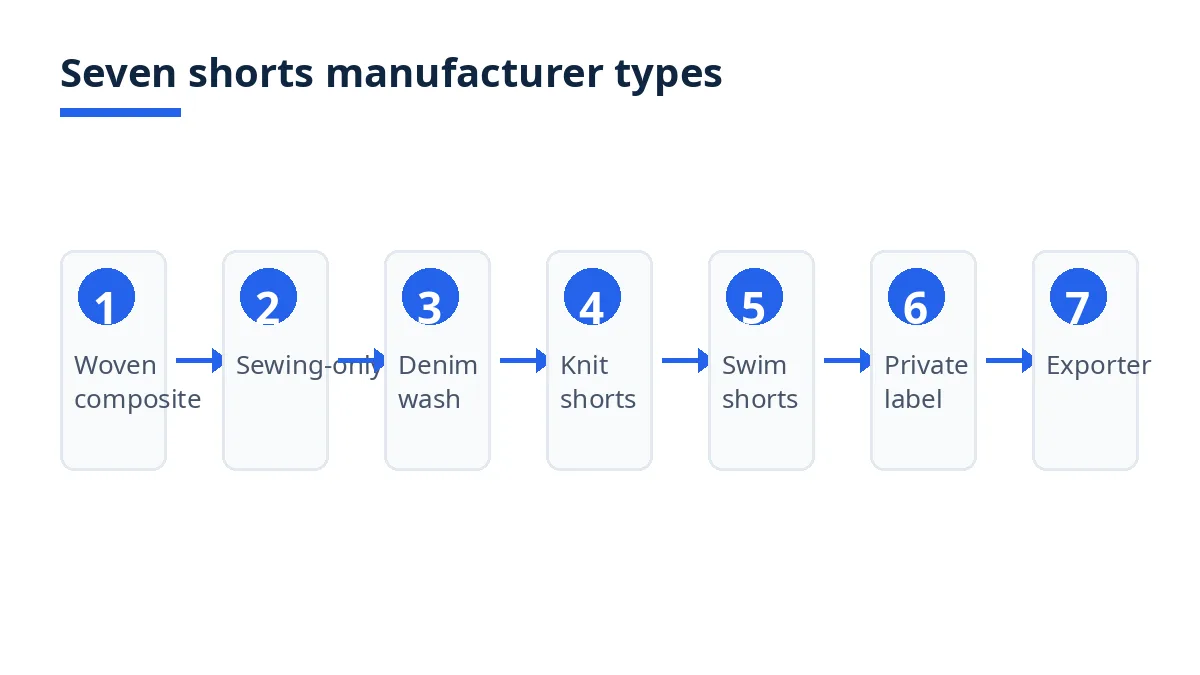
Shorts manufacturers in Bangladesh fall into seven types: integrated woven composites, sewing-only woven factories, denim wash specialists, knit shorts specialists, swim shorts makers, private-label OEM and ODM suppliers, and exporters and trading companies. Match the type to your shorts style, then run waistband, drawcord, stretch recovery and wash durability checks on a washed sample in bulk fabric before paying.
On this page
Key takeaways
Shorts span both sides of Bangladesh garment production: woven exports reached US$4.614 billion and knitwear exports US$5.963 billion in the first quarter of fiscal 2026-27, according to Export Promotion Bureau data.
Seven factory types make and sell shorts from Bangladesh, from integrated woven composites and denim wash specialists to knit shorts makers, swim shorts makers, private-label suppliers and trading companies.
No single type fits every shorts style: match the type to your construction, wash finish and waistband before comparing offers.
Run four shorts-specific checks on every washed sample in bulk fabric: waistband fit and stitching, drawcord length and finishing, stretch recovery before and after washing, and wash durability of measurements and shade.
Agree the AQL inspection level and the shorts defect list before production, and treat Exportain badges as document and photo reviews, not factory inspections or quality guarantees.
Buyers searching for shorts manufacturers in Bangladesh are choosing from a supply base that covers both sides of the garment trade. Shorts sit in woven and knitted production at once: chino, cargo and denim shorts come from woven lines, while jersey, fleece and swim shorts come from knit lines. In the first quarter of fiscal 2026-27, woven garment exports from Bangladesh reached US$4.614 billion and knitwear exports reached US$5.963 billion, within ready-made garment exports of US$10.578 billion, according to Export Promotion Bureau (EPB) data.1 With a pool that size, the useful question is not who ranks first. It is which type of factory fits your shorts, and which shorts-specific checks that factory must pass before you pay.
A shorts order fails in different places than a shirt or trouser order. The waistband carries the fit, the drawcord carries a safety question on children's styles, stretch fabric must recover after wear, and a wash finish changes measurements and color. Those four points decide whether a factory is right for your style, and they are the thread running through the seven types below. One company can sit in more than one type, and the type matters more than the sales pitch: it tells you what the supplier controls, what you must check yourself, and where a shorts order goes wrong.
The list: shorts manufacturers in Bangladesh by type
The seven types below cover the ways shorts are actually made and sold from Bangladesh. Read each one for three things: what the supplier is, who it suits, and the shorts check that decides whether to order from it.
1. Vertically integrated woven composites
What they are. Groups that weave or source fabric, dye and finish it, then cut, sew and pack garments within the same company. A chino or cargo short stays inside one organisation from fabric to carton.
Who they suit. Buyers with larger, repeat programs who need the same twill or canvas quality across seasons and colorways. In-house dyeing gives the factory direct control over shade, which is where repeat shorts orders usually fail.
Shorts check. Ask which stages are in-house and which are subcontracted, and get the answer in writing. A factory that sews but sends dyeing out is not integrated for your order, however it describes itself. Check that its current production includes woven bottoms, not only tops or basic trousers, because waistband setting, fly construction and pocket bartacking use different operations.
2. Sewing-only woven factories (cut, make and trim)
What they are. Factories that cut and sew garments from fabric supplied by the buyer or bought from a local mill against the buyer's specification. Their skill is garment construction, not fabric production.
Who they suit. Buyers running smaller or more flexible quantities, buyers who already source their own fabric, and buyers testing a new chino or cargo style before committing to a composite factory's volumes.
Shorts check. Fabric quality becomes your responsibility, so inspect the fabric before cutting, agree shrinkage and shade tolerances in writing, and hold a pre-production sample made from the bulk fabric. Ask which fabric mills the factory works with and what happens if a fabric lot fails inspection. Measure the waistband, rise, inseam and leg opening on the sample, because a small rise or inseam error changes how a short sits.
3. Denim and wash specialists
What they are. Factories built around denim shorts and their wash finishes: stone wash, enzyme wash, bleaching and softening, run in their own laundry or a laundry they control closely.
Who they suit. Denim shorts programs, vintage and faded finishes, and any range where the wash is the reason for the order rather than an afterthought.
Shorts check. Approve the sample only after the actual wash finish, never before it, because washing changes inseam length, waistband fit and color. Wash-test the approved sample again for shrinkage and colorfastness, and agree the wash recipe and tolerance in writing so bulk matches the sample. A specialist answers wash questions from current laundry runs; a generalist answers from a catalogue.
4. Knit shorts specialists
What they are. Knit factories whose regular production is jersey and fleece shorts: running shorts, training shorts, loungewear and fleece shorts, with elasticated or drawcord waistbands.
Who they suit. Sportswear, athleisure and loungewear ranges, and any program where stretch, softness and shrinkage control matter more than a tailored waistband.
Shorts check. Stretch recovery is the deciding test: stretch the waistband and leg opening, release, and measure how far each returns toward its original size, then repeat after washing. The knitwear trade body, the Bangladesh Knitwear Manufacturers and Exporters Association (BKMEA), says it represents approximately 2,540 knitwear member factories, so knit capacity is wide, but a knit factory that mainly makes T-shirts is not automatically a shorts factory.2 Ask which shorts styles it runs every month and check side-seam and waistband elastic control on a sewn pair from current production.
5. Swim and board shorts makers
What they are. Suppliers set up for swimwear construction: quick-dry fabrics, mesh linings, drainage eyelets where the design includes them, and drawcord or elastic waistbands built for water.
Who they suit. Swimwear brands, resort ranges and board-short programs, where the garment is built for water rather than for a tailored fit.
Shorts check. Keep swim checks separate from tailored checks: a board short that passes waist and inseam measurements can still fail on a lining fault. Check the mesh lining where one is fitted, the drawcord and its end finishing, pocket drainage where the design includes it, and colorfastness agreed for the style. Confirm the lining fabric and its attachment on the pre-production sample, not on a sales photograph.
6. Private-label OEM and ODM shorts suppliers
What they are. Suppliers set up to make shorts under the buyer's label. Original equipment manufacturers (OEM) produce to your tech pack; original design manufacturers (ODM) offer their own patterns and styles for you to label.
Who they suit. Brands and retailers who need their own labels, size sets, packaging and barcodes, and importers who want a ready shorts range without developing every pattern.
Shorts check. For OEM work, send a complete tech pack covering fabric, waistband construction, drawcord specification, pocket layout, measurements and packing, and judge the counter-sample against it line by line. For ODM work, check that the offered styles are the supplier's own and confirm labeling rules for your market. Agree who owns patterns and grading files in the order terms, and who owns the screens and embroidery files if the style is decorated.
7. Exporters and trading companies
What they are. Export-licensed companies that sell shorts made in partner factories rather than their own sewing lines. They aggregate capacity across several factories and handle export documentation for the buyer.
Who they suit. Buyers ordering several shorts types at once, buyers whose quantities are too small or too mixed for one factory, and buyers who want one contract and one contact.
Shorts check. Ask which factory will sew each style, and get the factory named before you pay a deposit. The trading company's export record does not tell you which sewing line makes your shorts. Visit or independently inspect the producing factory, and make the order terms name it. Then run the same waistband, drawcord and wash checks on goods from that factory, not on a sample from another line.
Shorts-specific checks to run on every sample
Whatever type you choose, run these four checks on the pre-production sample made in bulk fabric and trims, and keep one sealed sample as the reference for the shipment inspection.
Waistband. Measure the waistband at rest and stretched, check that stitching is even and the band sits flat, and confirm fly, button, snap or elastic closure alignment. On elasticated bands, check that the elastic recovers after stretching and does not twist inside its casing.
Drawcord. Pull the cord through its channel, check its length on both sides, confirm the ends are finished so they cannot fray into the casing, and check that a continuous cord is bartacked so it cannot be pulled out. For children's styles, check your destination market's rules before approving: the United States Consumer Product Safety Commission bulletin on drawstrings sets waist drawcord limits for children's upper outerwear, including a maximum of three inches of cord outside the channel when the garment is expanded to its fullest width and bartacking for a continuous string, and it states that shorts are not upper outerwear, so confirm which rule your market applies to children's shorts rather than assuming the bulletin covers them.3
Stretch recovery. For knit and stretch-woven shorts, stretch the waistband, leg opening and any elasticated panel, release, and measure the return. Repeat after washing, because recovery after one wash is the figure that predicts how the short behaves in wear. Record the method and the result in the approval note so bulk can be judged against the same test.
Wash durability. Wash the sample by the care method you will print on the label, then measure waist, rise, inseam and leg opening again, and compare shade against the unwashed reference. A sample approved unwashed tells you nothing about the short your customer receives, and washed measurements are the ones the shipment inspection should use.
Set the inspection standard in the order before production. ISO 2859-1 specifies sampling schemes indexed by acceptance quality limit (AQL) for lot-by-lot inspection, and AQL is the maximum percentage of defective items considered acceptable in a lot, so an inspector can accept or reject a shipment against a published rule instead of an opinion.4 Name the defect list for shorts in the same document: waistband faults, drawcord faults, pocket and bartack faults, measurement faults and shade faults, each classed as critical, major or minor.
Summary table
Type | Best for | Main check before ordering |
|---|---|---|
Vertically integrated woven composite | Large repeat chino and cargo programs | Which stages are truly in-house |
Sewing-only woven factory (CMT) | Smaller runs, buyer-supplied fabric | Fabric inspection before cutting |
Denim and wash specialist | Washed denim shorts | Sample approved after the actual wash |
Knit shorts specialist | Sportswear and loungewear shorts | Stretch recovery before and after washing |
Swim and board shorts maker | Swimwear and resort ranges | Lining, drainage and colorfastness |
Private-label OEM / ODM | Own-label brands and retailers | Tech pack match, pattern ownership |
Exporter / trading company | Mixed orders, one contract | Producing factory named in writing |
How Exportain helps
Exportain is a B2B marketplace for sourcing from Bangladesh. Buyers search published products by keyword and category, and can filter to suppliers holding the Exportain Verified badge, sample availability and OEM or ODM capability, and sort by MOQ or lead time.5 Each supplier profile shows its verification level, location, main products and the certifications the supplier has declared.5 Buyers then post a request for quotation (RFQ) stating quantity, target price, destination, Incoterm, required certifications and deadline, and suppliers in that category quote against it.5
Use the badges as a starting filter, not a conclusion. Verification on Exportain is a document and photo review by the Exportain team, not a factory inspection, and membership never grants a badge.6 A badge is not a guarantee of production capacity, product quality or delivery.7 Run the verification sequence above on your shortlist, including the suppliers you found on the platform, and keep the whole exchange in the RFQ and message thread so the agreed terms are recorded.
For the garment-level checks that follow this guide, read the shorts quality control checklist. For the ordering and shipping steps that come after you choose a type, read the guide to how to import shorts from Bangladesh and the woven garments sourcing guide.
FAQs
What is the biggest mistake buyers make when sourcing shorts from Bangladesh?
Choosing a supplier by the quoted price before checking the factory type. A sewing-only factory quoted on buyer-supplied fabric, a trading company quoting another factory's capacity, and an integrated factory quoting its own dyed twill are three different offers at three different prices. Compare the same specification from the same type of supplier, then verify the one you choose with the waistband, drawcord, stretch and wash checks.
How can I avoid it?
Write one specification covering fabric construction, waistband type, drawcord specification, pocket layout, measurements, labels and packing, and send the identical document to every supplier you quote. Name the producing factory in the order terms, approve a washed pre-production sample in bulk fabric, and set the AQL inspection level and the shorts defect list in writing before production starts.
Who is responsible for quality, the factory or the buyer?
Both, at different points. The factory is responsible for making shorts to the agreed specification and the approved sample. The buyer is responsible for making that specification complete and checkable, and for inspecting against it before shipment. When a dispute starts, the side with the written specification, the sealed sample and the inspection report is the side whose version counts.
Where can I get help verifying a supplier?
Start with the records that exist: BGMEA runs a member search on its own site, and BGMEA lists the frameworks factories in Bangladesh are assessed against, including BSCI, WRAP, SMETA, ICS, the Higg Index, ZDHC, GOTS and OEKO-TEX.8 For knit shorts, BKMEA membership is the knitwear sector's basic registration signal.2 On Exportain, read what each profile badge covers before relying on it, and message the supplier through its profile so your questions and the answers stay in one thread.6
Next steps on Exportain
Browse Bangladeshi suppliers and filter the shorts listings by badge, MOQ and OEM or ODM capability. Before you rely on any badge, read the Trust and Safety Center so you know what each check covers and what it does not. Then post a free RFQ with your shorts specification, waistband and drawcord requirements, quantity, destination and Incoterm, and compare the versioned quotations that come back.
Sources
- Merchandise exports rise 6.34pc to $13.09b in Q1 FY27: EPB. The Financial Express, (accessed )
- BKMEA at a Glance. BKMEA (accessed )
- Drawstring Bulletin: Drawstrings on Children's Upper Outerwear. U.S. Consumer Product Safety Commission (accessed )
- ISO 2859-1:2026 — Sampling for Inspection by AQL. American National Standards Institute (ANSI) (accessed )
- How to source and buy from Bangladesh. Exportain (accessed )
- Supplier verification: Earn trust badges buyers can see. Exportain (accessed )
- Trust & Safety Center. Exportain (accessed )
- BGMEA | Home. Bangladesh Garment Manufacturers and Exporters Association (BGMEA) (accessed )
About the author
Sourcing from Bangladesh?
Post a request for quotation and suppliers on Exportain can send you their quotes directly.
Post an RFQ