

How Much Does Seam Strength Testing Cost in Bangladesh?
Seam strength testing pulls a sewn seam apart until it fails and records the maximum force and failure mode. This guide explains the methods, report reading, Bangladesh quote drivers, and terms to agree before booking.
Short answer
Seam strength testing pulls a sewn seam apart, at a right angle to the stitching, until it fails, and records the maximum force at rupture together with how it failed. This guide explains the grab and strip methods, what a report should show, what moves the lab quote in Bangladesh, and what to agree in writing before samples leave the factory.
On this page
Key takeaways
Seam strength testing pulls a sewn seam perpendicular to the stitching until rupture and records the maximum force together with the failure mode: thread rupture, fabric rupture, yarn slippage, or a combination.
The ISO grab method and the ASTM woven-fabric sewn-seam method are the named standards to book by, with the standard, edition, seam assembly, and acceptance figure written into the purchase specification before testing.
No universal force figure decides a pass: the buyer specification governs acceptance, and seam efficiency compares the seam maximum force with the fabric maximum force measured by the same type of test.
A lab quote follows specimen sets, directions, standards, preparation, report detail, and retest terms, so compare itemised written quotes for the same scope and hold shipment until each tested style is cleared in writing.
Seam strength testing pulls a sewn seam apart, at a right angle to the stitching, until it fails, and records the maximum force at rupture together with how it failed. This guide explains the grab and strip methods, what a report should show, what moves the lab quote in Bangladesh, and what to agree in writing before samples leave the factory.
A seam can fail even when the fabric itself is strong. The thread can break, the fabric can tear beside the stitch line, or the yarns can slip away from the stitching, and each failure points to a different correction, so a seam test reports the failure mode, not only a force number.
Two named standards frame most bookings. ISO 13935-2 specifies methods for the determination of seam maximum force of sewn seams when the force is applied perpendicularly to the seam, and describes the method known as the grab test, mainly applicable to woven textile fabrics, for straight seams only, using constant-rate-of-extension testing machines.1 ASTM D1683 measures sewn seam strength in woven fabrics by applying a force perpendicular to the sewn seams, and is used when the maximum breaking force to rupture and a seam efficiency measurement are required.2 The ISO page for the 2014 edition shows that edition as withdrawn, so name the standard and edition in the booking and ask the lab to confirm the current edition. A seam test does not predict actual wear performance of a seam, as ASTM D1683 states.2
Why this matters for buyers and sellers
For a buyer, a seam that opens in the first weeks of use becomes a return, a complaint, or a lost repeat order, and the cause is often invisible on a finished garment that looks correct. A laboratory seam result, taken before bulk shipment, gives the buyer a dated record tied to a named standard, a named seam, and a named acceptance figure, so a dispute can be settled against paperwork rather than against impressions of how a garment feels.
For a seller, the same record protects good work. When the tested seam matches production, a passing result shows that the factory seam, as sewn, met the agreed figure, and a failing result, with its failure mode, tells the factory where to look first.
Keep neighbouring checks apart, because each is quoted and reported separately.
A general third-party engagement covers the booking, scope, and reporting of an independent visit.
Fabric 4-point scoring scores fabric rolls by defect size before cutting.
Piece-by-piece sorting checks every unit in an agreed scope and segregates defective units one by one.
Sample inspection judges approval samples before bulk work proceeds.
General lab testing measures a sample in a laboratory across a wider test package.
This guide covers only the sewn-seam tensile test: specimen preparation, the grab or strip pull, force at rupture, and report reading.
Step-by-step: how it works
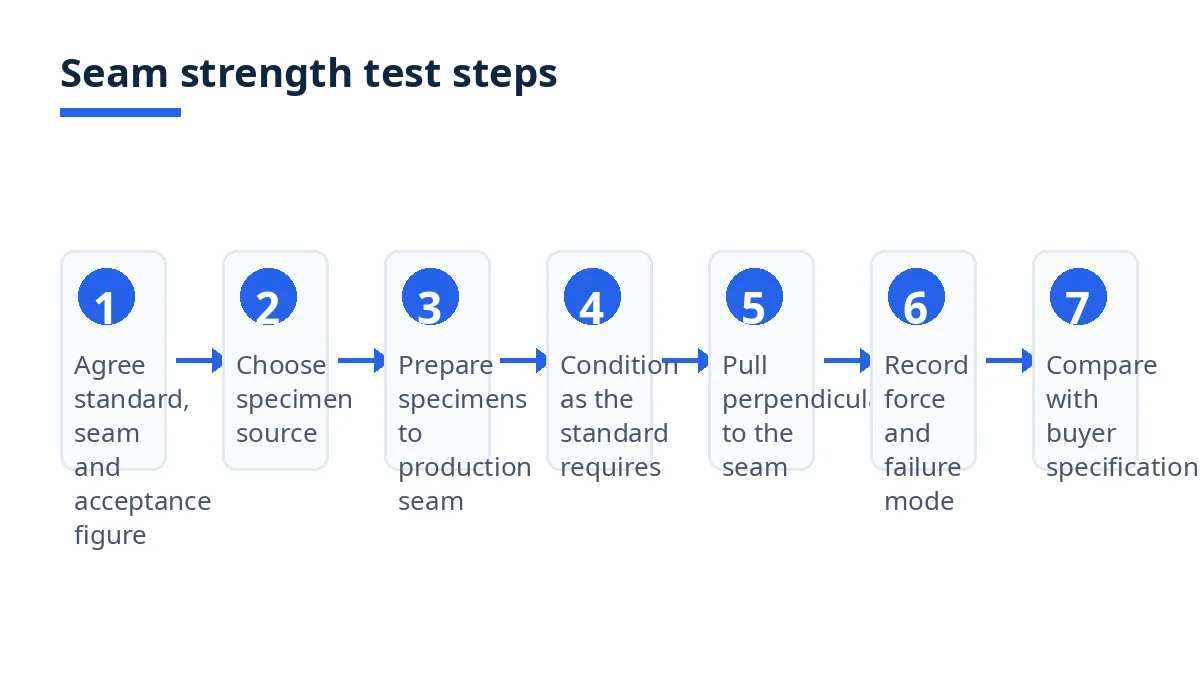
Agree the standard, the seam, and the acceptance figure in writing. Name the standard and edition, the seam type, stitch type, thread, and stitch density, and the acceptance figure in force units, with the direction of pull stated. The acceptance figure is a buyer specification, agreed with the seller and written into the purchase specification, and no universal pass figure in this guide replaces it.
Choose the specimen source. Seams may be taken from a previously sewn article or prepared from fabric samples, as the parties agree, under both named standards.1 2 A specimen cut from a finished garment tests the production seam as made, while a specimen sewn for the test must reproduce production exactly, including thread, stitch type, seam type, and stitch density, or the result describes a different seam.
Prepare the specimens to the agreed seam assembly. Record the fabric, fabric direction, seam allowance, needle, thread, seam type, stitch type, and stitch density for every specimen set, and keep specimens from different styles, colours, or fabric lots separate. A mixed set, averaged into one number, hides the weakest seam in the group.
Condition the specimens as the named standard requires. Record the conditioning used and the machine type, because a result without its conditions cannot be repeated or compared with a later result. Constant-rate-of-extension machines are the machine type specified for the ISO grab method.1
Mount the specimen and pull perpendicular to the seam. In the grab method, only the central part of the specimen is gripped, while in the strip method, described in ISO 13935-1, the full width is gripped, so confirm which method the booking uses before comparing two reports. The pull runs perpendicular to the seam, in the warp direction or the filling direction as agreed, and continues until rupture.
Record the maximum force and the failure mode. Note whether the sewing thread ruptured, the fabric ruptured beside the seam, yarns slipped and displaced from the stitching, or a combination occurred, because ASTM D1683 is used to identify the threshold at which stitching failure occurs without damage to the fabric, so the product can be repaired, and separately to identify the force at which slippage and displacement of warp or filling yarns occur.2 A report that gives only a force number, with no failure mode, cannot guide a correction.
Compare with the buyer specification and judge seam efficiency. Seam efficiency compares the seam maximum force with the fabric maximum force measured by the same type of test, and ASTM D1683 Procedure B works from an 85 percent seam efficiency figure downward in 5 percent steps to check whether yarn displacement occurs, as a standard procedure for investigating slippage, not as a universal pass mark.2 Judge every set against the figure written in step 1.
Costs, timelines and documents
No single seam strength testing fee applies across Bangladesh. A lab quote is built from the number of specimen sets, specimens per set, directions tested, standards named, specimen preparation, machine time, report detail, courier or sample handling, and retest terms. A quote for one specimen set cannot be compared with a quote for three specimen sets, and a quote that leaves retesting out looks cheaper until a fail makes a retest necessary.
Pricing models: per specimen set, per specimen, or a package
Labs commonly quote per specimen set, per specimen, or as a package for agreed styles and directions, sometimes with a separate charge for specimen sewing or an urgent report. Ask what the quoted unit includes: preparation, conditioning, testing in one direction or both, the written report, photographs of failed specimens, and one retest, or none of these.
Example figures: how a quote adds up
Every money figure in this table is an Example figure, invented to show the arithmetic, not quoted from any lab and not a market rate. Confirm every figure in the lab written quote.
Example case | Example figures arithmetic | Example figures total |
|---|---|---|
Example A: one style, one direction, standard report | Example figures: 1 specimen set at 120 plus 1 report at 40 | Example figures: 160 |
Example B: two styles, two directions, photographs included | Example figures: 4 specimen sets at 120 plus 1 report at 40 plus photographs at 30 | Example figures: 550 |
Example C: one style plus a retest after a thread failure | Example figures: 1 specimen set at 120 plus 1 report at 40 plus 1 retest set at 120 | Example figures: 280 |
Example A and Example C differ only in the retest set, which is why a quote that leaves retesting out looks cheaper until a fail makes it necessary. Example B costs more than Example A because it tests more specimen sets, not because the test itself changed.
Example timeline only, not a promise
Example timeline only. This timeline is an illustration, not a promise and not a lab turnaround. Confirm every date in the lab written booking confirmation. Agree the standard, seam assembly, and acceptance figure before sending samples, send specimens that match production exactly, and receive the written report before authorising shipment of the tested styles. Agree correction, resewing, or retesting for a failed specimen set before the bulk lot ships.
Documents to prepare
Send the lab a complete reference set before testing: the purchase order with style, fabric, colourway, and quantity; the seam assembly record with thread, seam type, stitch type, and stitch density; the named standard and edition; the acceptance figure with direction and units; the specimen list by style, colour, fabric lot, and direction; the report format; the payer, fail, and retest terms; and a shipment hold instruction until each tested style is cleared in writing.
Bangladesh-specific rules and tips
Seam testing in Bangladesh usually runs through a commercial textile laboratory rather than at the factory. Intertek describes ISO 17025-accredited laboratories in Dhaka, Chattogram, and Gazipur, integrated with its global network, serving textiles, garments, apparel, and home textiles.3 QIMA lists seam strength for sewn articles among its physical and mechanical textile tests.4 Ask a lab which standards and editions its accreditation covers for seam testing specifically.
Send specimens that the lab can trace back to production. Label every specimen with style, colour, fabric lot, seam position, and direction, and keep a duplicate set at the factory so a disputed result can be checked against the same lot.
For the service listing, note this caveat exactly: the Exportain inspection services page currently renders "No services published in this category yet", so use the link as a category page to watch rather than as a list of available providers. The link is inspection services with that caveat stated.
Plan around the factory calendar and courier time, not only lab time. Confirm the date when production seams are ready, the courier route, and the lab booking date in one plan, and build a buffer day into the shipment plan for a retest.
Mistakes and red flags
Testing a specimen sewn differently from production. Insist that thread, stitch type, seam type, and stitch density match production exactly.
Accepting a force number with no failure mode. Ask whether thread, fabric, or slippage failed, because each failure needs a different correction.
Comparing a grab result with a strip result. Confirm the method in every report before comparing numbers across labs or orders.
Leaving the acceptance figure unwritten. Write the figure, direction, and units into the purchase specification before testing.
Mixing styles or fabric lots into one averaged result. Keep specimen sets separate so the weakest seam stays visible.
Shipping before the report arrives. Hold shipment of the tested styles until each set is cleared in writing.
Red flags include a report with no named standard or edition, a force number with no units, photographs that cannot be matched to a specimen label, a missing failure mode, a pass statement with no acceptance figure beside it, and a retest that uses specimens from a different lot without saying so.
Checklist
Standard and edition named in the booking, with the current edition confirmed by the lab.
Seam assembly recorded: thread, seam type, stitch type, stitch density, seam allowance, and needle.
Acceptance figure written with direction, force units, and buyer specification reference.
Specimen source agreed: finished garment seam or production-matched sewn specimen.
Specimens labelled by style, colour, fabric lot, seam position, and direction.
Method confirmed: grab or strip, and warp or filling direction.
Written quote received with specimen sets, directions, report detail, and retest terms.
Report received before shipment, with maximum force, failure mode, and pass or fail against the written figure.
Failed sets corrected, resewn, and retested from the same production lot before shipment.
How Exportain helps
Exportain connects international buyers with Bangladeshi sellers and service providers. Start from the purchase specification, not from a lab booking alone: write the seam, standard, and acceptance figure into the order, then ask the seller which laboratory will run the test.
For the service listing, note this caveat exactly: the Exportain inspection services page currently renders "No services published in this category yet", so use the link as a category page to watch rather than as a list of available providers. The link is inspection services with that caveat stated. For finished-goods decisions, read the pre-shipment inspection guide, which explains how a sampling inspection of finished, mostly packed goods fits beside a laboratory seam result.
FAQs
What should I know first about seam strength testing?
Seam strength testing measures the maximum force at rupture when a sewn seam is pulled perpendicular to the stitching, and it reports how the seam failed. The two named methods are the ISO grab method and the ASTM woven-fabric sewn-seam method, and the result only has meaning beside a written buyer specification, because no universal force figure in this guide decides a pass. For finished-lot decisions, sampling under the Acceptance Quality Limit (AQL) system is a separate decision from a seam-test result, as explained in the linked Acceptance Quality Limit guide.5
What are the typical costs and timelines?
There is no typical fee or turnaround that applies across Bangladesh, because a quote follows specimen sets, directions, standards, preparation, report detail, and retest terms. Use the Example figures table in the costs section to see how a quote adds up, and confirm every figure and date in the lab written quote and booking confirmation before sending specimens.
Which documents are needed?
Send the purchase order, the seam assembly record, the named standard and edition, the acceptance figure with direction and units, the specimen list by style, colour, fabric lot, and direction, the report format, and the payer, fail, and retest terms. A lab can only test the seam described in those documents, so a missing thread, stitch type, or stitch density leaves the lab to guess at the production seam.
What are the most common mistakes?
The most common mistakes are testing a specimen sewn differently from production, accepting a force number with no failure mode, comparing a grab result with a strip result, leaving the acceptance figure unwritten, averaging different styles or fabric lots into one number, and shipping before the report arrives. Each mistake makes the report hard to act on, even when the laboratory work itself was correct.
Next steps on Exportain
Post a free RFQ on Exportain at https://exportain.com/rfqs, describing the style, fabric, seam, named standard, and acceptance figure you want tested. Read the pre-shipment inspection guide for finished-goods sampling beside the lab result, and the Acceptance Quality Limit guide for how sampling decisions are set. Then agree the seam assembly, quote, and retest terms in writing before specimens leave the factory.
Sources
- ISO 13935-2:2014 - Textiles - Seam tensile properties of fabrics and made-up textile articles - Part 2: Determination of maximum force to seam rupture using the grab method. International Organization for Standardization (accessed )
- ASTM D1683/D1683M-22 - Standard Test Method for Failure in Sewn Seams of Woven Fabrics. ASTM International (accessed )
- Softlines Bangladesh. Intertek (accessed )
- Textile & Fabric Testing for Quality Control. QIMA (accessed )
- SIST ISO 2859-1:2003 - Sampling procedures for inspection by attributes, Part 1: Sampling schemes indexed by acceptance quality limit (AQL). International Organization for Standardization, (accessed )
About the author
Sourcing from Bangladesh?
Post a request for quotation and suppliers on Exportain can send you their quotes directly.
Post an RFQ


