

Quality Control Checklist for Seagrass Baskets From Bangladesh
A numbered QC checklist for seagrass baskets from Bangladesh: shape, size and nesting, fibre dryness, moisture and odor, weave and braid defects, dye and paint, handles and liners, labels and packing, with fixes for common failures.
Short answer
Use this seagrass baskets quality control checklist to check shape, size and nesting, fibre dryness, moisture and odor, weave and braid, dye and paint, handles and liners, labels and packing on seagrass baskets from Bangladesh before shipment. Agree size tolerances, moisture limit, defect classes and acceptance numbers in the purchase order, and judge every piece against the approved sample.

On this page
Key takeaways
Agree the approved sample, size tolerances, moisture limit, defect classes and acceptance numbers in the purchase order before inspection, and draw the sample at random across cartons, colors and sizes.
Check dryness, mold and odor first: a basket still damp at packing can arrive stained or misshapen, and damp usually affects a whole carton rather than one piece.
Work panel by panel on weave and braid, because a broken strand, slipped strand or uncut end is easy to miss on a finished basket.
Treat color and paint as sample comparisons under the same light, since seagrass color mellows with age and a finish already peeling at inspection will only get worse in transit.
If you buy seagrass baskets from Bangladesh, this checklist gives you a practical way to check a shipment before it leaves the factory. Seagrass fails differently from rigid materials: a basket can look right and still carry damp fibre, loose braid, peeling paint or a shape that collapses when lifted. Work through the checks in order, against the approved sample, and record each result as pass, fail or not applicable.
Why this checklist matters
Seagrass is a pliable, hand-woven fibre, and most of its quality risk sits in the fibre and the weave. Once split and well dried, it is durable, soft and lightweight, with a supple, firm texture for hand weaving, and its natural greenish beige turns brown over time.1 That same fibre is sensitive to damp: molds can appear if seagrass is exposed to high humidity.1 Seagrass is spread on racks to dry in the sun, which removes moisture and helps keep a consistent color finish before it is turned into yarn.2 A basket still damp at packing can arrive stained or misshapen, with little left to fix at the warehouse.
Before you start
Do not begin until the reference set is complete: an approved sample for each style and color, the purchase order and packing specification, a size chart with tolerances, and a signed defect list stating which defects are critical, major or minor. Agree the sampling plan in advance. ISO 2859-1 specifies sampling schemes for inspection by attributes, indexed by acceptance quality limit, for lot-by-lot inspection.3 Your acceptance numbers are the ones you and the supplier agree and write into the purchase order, not a default the standard assigns to baskets.
Draw the sample at random across cartons, colors and sizes, never accepting a sample the factory selects. Check pieces under the same light used for the approved sample, and photograph each failure next to it.
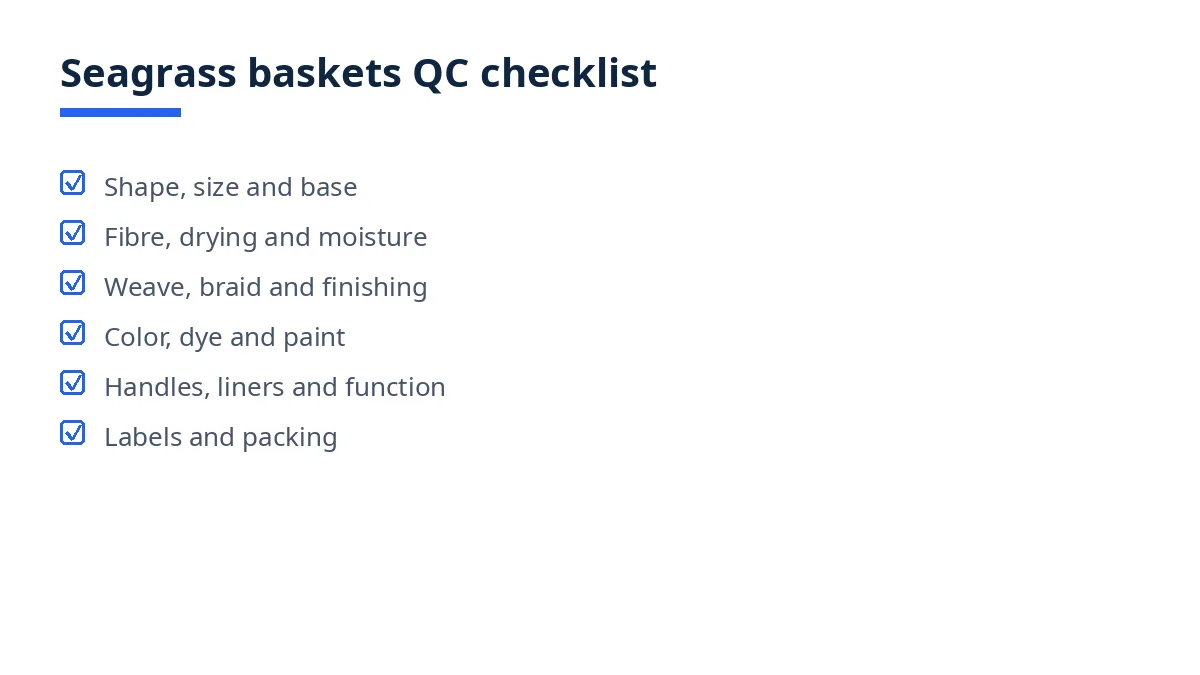
The full checklist
Shape, size and base
Measure height, top size and base size on each sampled basket, on a flat surface, without pressing or pulling the sides.
Check the shape against the sample from above and from the side: the rim is level, the sides rise evenly, and the basket does not lean or bulge.
Set the basket on a flat surface and check that the base sits flat without rocking, and holds its contents without sagging.
Where the design uses a metal frame, check that it is fully covered, does not poke through the weave, and holds the sample shape. Seagrass products may need added frame support for sturdiness.4
Check nesting where baskets are sold or packed as a set: each size nests into the next without forcing, and the set stacks to the specified height.
Compare every measurement with the chart tolerance and record actual values, not pass marks.
Fibre, drying, moisture and odor
Check the fibre against the sample: the strands are the agreed thickness and finish, with no coarser or mixed fibre substituted in bulk.
Feel and smell each sampled basket. Seagrass has a natural straw-like smell when new, which fades over a few weeks.1 A sharp chemical, sour damp or musty smell is a failure to record.
Check for mold and mildew outside, inside, under the base and inside any rim roll, where damp collects first. Black stains are one way wet seagrass shows mold damage.1
Check moisture where your purchase order sets a limit, using the method named in the order, and record the reading per basket. Example figures: one wholesale supplier states a moisture requirement of 12 percent to 23 percent for high-quality seagrass baskets.1 That is an attributed supplier figure, not a universal rule.
Check that baskets are fully dry before packing: no damp patch, no cold damp feel inside the weave, and no condensation inside the packing. Seagrass is not waterproof.1
Check for insect damage or webbing, and shake out dust and loose debris.
Weave, braid and finishing
Work around each basket panel by panel, inside and out, checking for broken weaving, gaps where a strand has slipped, and loose ends. Uncut and broken weaving are defects a wholesale inspection lists for seagrass baskets.1
Check braid and twisted-rope work where the design uses it: the braid is even, the twist holds, and rope ends are secured rather than fraying loose. Seagrass rope is formed by braiding or twisting split strands together.1
Check the rim: it is finished as in the sample, with no sharp cut ends, no snagging loose strand, and no rim roll that unwinds when pulled gently.
Check trimming: excess strands are cut clean, with no long uncut ends outside, inside or on the base. Trimming is part of finishing.1
Check shaping: without a frame, some seagrass baskets are prone to deformation, so a basket that has lost its sample shape fails even if the weave is intact.1
Pull handles, loops and attached trim gently by hand to confirm they are secured, and check that stitching at attachment points is complete, with no skipped or broken stitches.
Where glue shaping was specified, check that the shape holds when the basket is lifted by its handles and set down, with no glue showing as a stain or residue. Soaking in glue is used to make some woven baskets hold their shape and resist mold.1
Color, dye and paint
Check color against the approved sample and dye lot, piece by piece and across the set, under the same light. Seagrass can be dyed in various colors, and its natural color mellows with age, so agree in advance how much variation is allowed.1
Check dyed baskets for uneven dye, pale patches, dark streaks and dye that rubs off on a dry white cloth.
Check painted baskets for even coverage, and for paint already peeling or chipping at the rim, base and handles. Paint peeling on seagrass can occur over time, so a finish already lifting will only get worse in transit.1
Check that color variation within one basket, between baskets in a set, and between cartons stays inside the range agreed against the sample.
Note that seagrass cannot be bleached to a lighter tone.1 A bulk basket lighter than the sample through bleaching or fibre substitution is a failure, not a color variation.
Handles, liners and function
Check handles for the agreed drop, position and attachment, and lift each sampled basket by its handles with the load the purchase order names.
Check liners, inserts and plant pots where specified: they fit, sit level, and do not force the sides out of shape or hide a weave defect. A planter basket needs the insert the specification names, since seagrass is not waterproof.
Check that lids, where specified, fit, close level, and match in weave and color.
Labels and packing
Check labels for content, spelling, placement and legibility against the purchase order: product name, size, color, quantity, care wording and market wording your destination requires.
Check barcodes where used: they scan, and the scanned size, color and set contents match the purchase order.
Check packing against the specification: each basket is protected as directed, nested sets are packed as sets, and tissue, bags or dividers are present.
Check that no hard insert, tight strap or sharp carton edge can crease or cut the weave in transit, and that baskets are not packed damp.
Check carton count, assortment and markings against the packing list, weigh and measure sample cartons, and confirm the goods match the marks outside.
Common failures and how to fix them
Mold and damp are the most costly failures, because they usually affect a whole carton rather than one piece. If sampled baskets smell musty, show black stains or read damp, stop and check the storage and packing area, not just the baskets. Dry, re-inspect and re-check moisture on a fresh sample before anything ships.
Broken and loose weaving is the next most common failure. A single broken strand can often be repaired, but a run of broken weaving across several baskets points to fibre too dry or brittle at weaving, or to handling damage after weaving. Segregate the affected pieces and re-inspect that group on its own.
Deformed baskets usually trace to missing frame support, skipped glue shaping, or packing that crushed the shape. Compare the failed basket with the sample, and re-shape and re-check a test piece before the bulk is packed. Peeling paint and uneven dye point to finishing: re-check the finish batch, not just the single basket. Above the agreed acceptance level, the options are re-inspection after sorting or rework, documented partial acceptance, or rejection. A failed lot should not ship on a promise to fix it at destination.
Downloadable template and summary table
Copy this checklist into your inspection sheet with your purchase-order figures.
Section | Checks | Evidence |
|---|---|---|
Shape and size | Height, diameter, base, nesting | Measurements, photos |
Fibre and moisture | Dryness, mold, odor | Readings |
Weave and finish | Breaks, braid, rim, shaping | Panel check |
Color and paint | Dye evenness, peeling, variation | Sample comparison |
Handles and function | Handle hold, liners, lids | Lift check |
Labels and packing | Labels, barcodes | Packing list |
How Exportain helps
Exportain is a B2B marketplace connecting buyers with Bangladeshi suppliers of seagrass baskets and home decor, so these specifications can be agreed at the enquiry stage. Use inspection services when you plan the check. Supplier profiles show which document and photo checks have been recorded, not factory inspections.
FAQs
When should this checklist be used?
Use it at final inspection, when goods are finished and largely packed. For larger and first orders, also use it during production, while faults can still be corrected.
Who should complete it?
The buyer, a local agent or an independent inspector can complete it, using the approved sample, size chart and a random sample.
What are the most common failures?
Mold and damp fibre, broken weaving, deformed shape, peeling paint, uneven dye and uncut strand ends are the failures buyers find most often.
Can a third party do it?
Yes, if you share the approved references, tolerances, moisture limit and acceptance levels first. Final inspection can be carried out by a supplier team or by third parties.1
Next steps on Exportain
Before production starts, agree your size chart, tolerances, moisture limit, defect list and label wording, then read the AQL acceptance quality limit explainer and the pre-shipment inspection guide.
Sources
- Seagrass For Weaving: From Natural Fibers To Wholesale Seagrass Baskets. Artex Nam An (accessed )
- Seagrass Farming. Natural Woven Coffins (accessed )
- ISO 2859-1:1999 - Sampling procedures for inspection by attributes — Part 1: Sampling schemes indexed by acceptance quality limit (AQL) for lot-by-lot inspection. International Organization for Standardization (accessed )
- Rattan vs. Seagrass: What Is the Difference?. Far Eastern Handicraft (accessed )
About the author
Sourcing from Bangladesh?
Post a request for quotation and suppliers on Exportain can send you their quotes directly.
Post an RFQ


