Top School Uniforms Manufacturers in Bangladesh: How to Find and Verify Them
Bangladeshi school uniform supply is organized by factory type, not by ranking: seven types, what each suits for school orders, and how to check cloth, sizes, crests and wash durability before ordering.
Short answer
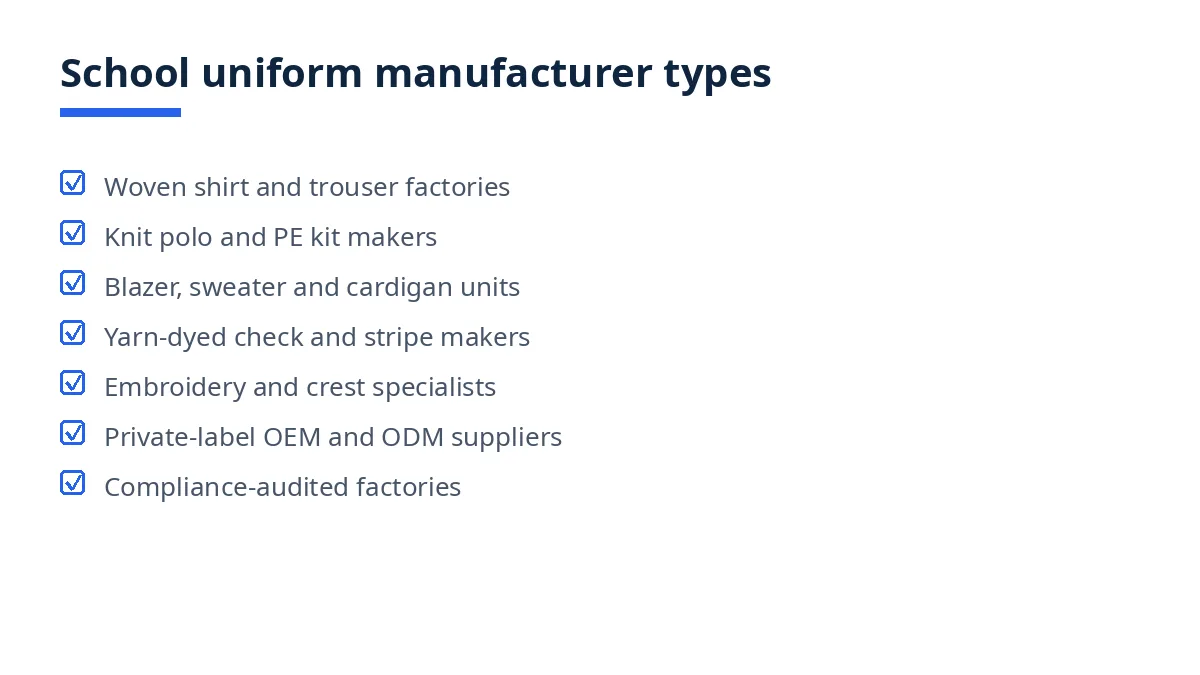
School uniforms manufacturers in Bangladesh fall into seven types: woven shirt and trouser factories, knit polo and physical education kit makers, blazer and sweater units, yarn-dyed check and stripe makers, embroidery and crest specialists, private-label OEM and ODM suppliers, and compliance-audited factories. Match the type to your garments and size run, then verify cloth, washed samples, crest accuracy and inspection terms before paying.
On this page
Key takeaways
School uniforms are mostly woven garments plus knit polo and sports kit: woven exports reached US$4,614.80 million in the first quarter of fiscal 2026-27, according to Export Promotion Bureau data.
Fabric comfort and wash durability decide a school contract: cloth should endure repeated washing, with adjustable waistbands and growth allowances built into the size run.
Crests and checks need their own checks: thread color standards for embroidery and stored color recipes for yarn-dyed patterns keep reorders matching across terms.
Small term-time reorders are part of the contract, so confirm repeat quantities, mid-range size availability and reorder lead times before the first bulk order.
Verification is a sequence the buyer runs: association membership, document review, a washed sample in production cloth with the crest stitched on, and an agreed inspection standard before payment.
A school uniform order is different from an ordinary apparel order because the same garments are worn five days a week, washed repeatedly, outgrown mid-year, and reordered in small top-up quantities before each term. A fashion shirt factory can still fail a school contract if collars curl after twenty washes or its size run leaves no room for growth. Buyers sourcing school uniforms from Bangladesh therefore need to judge suppliers on school-specific performance, not on general garment capacity alone.
Bangladesh is a large base for this work. In the first quarter of fiscal 2026-27, woven garment exports reached US$4,614.80 million, up 5.11 per cent year on year, within ready-made garment exports of US$10,578.56 million, according to Export Promotion Bureau (EPB) data.1 Woven shirts, trousers and skirts form the core of most school uniforms, while knit polo shirts and physical education kits come from the knitwear sector, where the Bangladesh Knitwear Manufacturers and Exporters Association (BKMEA) represents approximately 2,540 member factories.2 The choice facing a buyer is not which factory is biggest. It is which type of maker matches the garments, sizes and reorder pattern in the contract.
Fabric choice sets the ceiling for everything else. School uniform cloth must balance comfort against repeated washing: cotton and cotton-rich cloth breathes well in warm classrooms, while polyester-cotton blends hold shape and resist wrinkling better across a school week.3 Industry guidance cited in a school uniform fabric guide suggests cloth should endure at least 50 wash cycles without major degradation, with 65/35 polyester-cotton blends offering a common balance and heavier drill or twill cloth of 200-300 gsm suiting trousers and skirts.3 The same guide notes practical details that belong in a specification: adjustable waistbands for growing children, ample seam allowance for alterations, and no loose drawstrings that create hazards for younger pupils.3 Put those requirements in writing before quoting, because a factory cannot meet a wash standard or a growth allowance it was never asked for.
The list: school uniforms manufacturers in Bangladesh by type
The seven types below describe how school uniforms are actually produced and sold from Bangladesh. A single company can cover more than one type, and a type label on a profile is a starting point for questions, not proof of capability. For each type, check the school-specific risks: fabric comfort in warm classrooms, size coverage across year groups, crest and color accuracy, wash durability, and the ability to supply small repeat quantities on a term timetable.
1. Woven shirt and trouser factories
What they make. Formal school shirts, blouses, trousers, skirts and pinafores in woven cotton and polyester-cotton cloth, cut and sewn in size runs that span primary and secondary year groups.
Why schools order from them. These factories handle the garments pupils wear most often, so they repeat the same styles in several colors and hold collar, cuff and waistband construction consistent across sizes. Their cutting rooms are set up for graded patterns, which matters when one order must cover a six-year-old and a sixteen-year-old in the same school colors.
What to check. Ask for the cloth specification by garment: fiber blend, weight and dye method for shirts separately from trousers, since the two garments wear differently. Order a washed sample in the production cloth and measure it after washing, checking collar shape, seam twist and shrinkage against the size chart. Confirm the size run in writing, including whether the factory grades patterns in-house, and how it handles mid-range sizes that sell out first.
2. Knit polo shirt and physical education kit makers
What they make. Polo shirts, T-shirts, shorts, track tops and fleece tops for daily wear and physical education, knitted and sewn from jersey, pique and fleece.
Why schools order from them. Knit garments stretch and breathe during activity, and a knit maker can supply the polo shirt and the sports kit in one order, keeping the school color consistent across both. These makers are also used to repeat orders in a single house color with a small embroidered crest.
What to check. Confirm whether knitting, dyeing and sewing sit in the same group or are split across units, because shade drift between the polo and the shorts usually traces back to separate dye lots. Wash-test the sample for pilling on the chest and underarm areas, where school bags and movement wear cloth fastest. Agree a growth allowance in the size chart: a polo that fits exactly in September and cannot be worn by January creates a reorder problem the school will blame on the buyer.
3. Blazer, sweater and cardigan units
What they make. School blazers, V-neck sweaters, cardigans and tank tops, often in wool blends, acrylic or cotton-acrylic yarns, with ribbed cuffs and hems.
Why schools order from them. These garments carry a school's formal identity and the highest unit price, so buyers usually order them from makers whose regular work is structured knitwear or tailored outer layers rather than from a general sewing line. A specialist unit understands shaping, lining and button placement at a level that shows in the finished blazer.
What to check. Ask which yarns the unit runs every month and what happens to sizing when a heavier yarn is substituted. Request a sample in the exact yarn and color, and check elbow wear, cuff recovery after stretching, and button security. For blazers, confirm whether the unit cuts and sews in-house or sends tailoring out, and get the answer recorded in the order terms.
4. Yarn-dyed check and stripe cloth makers
What they make. Woven cloth and finished garments in yarn-dyed checks, stripes and tartans: the patterned skirts, pinafores, dresses and ties that identify many schools at a glance.
Why schools order from them. A school check must match across skirts, dresses and ties ordered months apart, and only yarn-dyed production gives that pattern stability, because the color is in the yarn before weaving rather than printed on the surface. These makers hold pattern repeats and color recipes that a piece-dye unit cannot reproduce reliably.
What to check. Ask for a woven sample showing at least one full pattern repeat, and compare it against the school's reference swatch under daylight, not only under factory lighting. Agree the repeat size and the stripe sequence in the specification, and confirm how the maker stores the recipe for reorders. Check wash fastness on the darkest color in the check, since a bleeding navy or maroon stripe can stain lighter panels in the same garment.
5. Embroidery and crest specialists
What they make. School crests, house badges, monograms and names, embroidered directly onto shirts, blazers and polo shirts, or produced as sew-on badges.
Why schools order from them. The crest is the part of the uniform parents inspect first, and a specialist controls thread colors, stitch density and placement measurements across thousands of garments. Schools with several houses or year-group badges need a maker who can keep each design distinct without mixing thread colors between houses.
What to check. Approve a stitched sample on the production garment, not on plain backing cloth, and wash it to check puckering around the crest and thread fraying at the edges. Confirm who holds the digitized crest files and how placement is measured on each size, since a crest placed by eye drifts as sizes change. Agree a thread color standard with numbered references, so a reorder in a new term matches the original.
6. Private-label OEM and ODM uniform suppliers
What they make. Complete school uniform ranges under a buyer's or a school's own label: shirts, trousers, knitwear and accessories developed from the buyer's tech pack (OEM) or adapted from the supplier's own uniform styles (ODM).
Why schools order from them. A uniform retailer or a school group buying for several sites needs one supplier to coordinate cloth, sizes, crests and packing across the whole range, with consistent labeling for each site.
What to check. For OEM work, send a full tech pack covering cloth, construction, sizes, crest placement and packing, and judge the counter-sample against it line by line. For ODM work, check that the offered styles are genuinely the supplier's own and confirm how sizes grade across the range. Agree who owns the patterns, grading files and crest artwork if the buyer changes supplier later, and put that ownership in the order terms before the first bulk order.
7. Compliance-audited factories
What they make. Any of the garments above, in factories that hold current audits or certifications under the schemes their buyers require. The Bangladesh Garment Manufacturers and Exporters Association (BGMEA) lists frameworks factories are assessed against, including BSCI, WRAP, SMETA, ICS, the Higg Index, ZDHC, GOTS and OEKO-TEX.4
Why schools order from them. School contracts, especially for public-sector buyers and retail chains, often require documented labour, safety and chemical standards, and a certified-fiber claim such as organic cotton must rest on a valid certificate. An audited factory can supply the paperwork a school board or a retail compliance team asks for alongside the garments.
A certificate counts only inside its scope. Verify the certificate number with the issuing body, check that the factory address on it matches the producing site, and confirm the expiry date and the exact product category it covers. For children's garments, also confirm the destination market's safety rules, such as restrictions on drawstrings and small parts noted in school fabric guidance.
What moves the price and the minimum order quantity on a school uniform order is the specification, not the country of origin. Cloth blend and weight, the number of sizes in the run, crest placements, and packing by school or by site each add cost, and each style and color carries its own minimum quantity because dye lots and cutting lays are set per style. Ask every shortlisted supplier to quote the same specification and the same delivery term, then compare line by line. For how minimum quantities work across a range, read the guide to MOQ in the supply chain.
Summary table
Type | Best for | Main check before ordering |
|---|---|---|
Woven shirt and trouser factories | Everyday shirts, trousers, skirts | Washed sample, cloth by garment, full size run |
Knit polo and PE kit makers | Polo shirts, sports kits | Dye-lot shade match, pilling, growth allowance |
Blazer, sweater and cardigan units | Formal blazers, knitwear | Exact yarn sample, cuff recovery, button security |
Yarn-dyed check and stripe makers | Patterned skirts, dresses, ties | Full pattern repeat, color recipe for reorders |
Embroidery and crest specialists | Crests, house badges | Stitched sample on the garment, washed, thread standard |
Private-label OEM / ODM suppliers | Full ranges under one label | Tech pack match, pattern and artwork ownership |
Compliance-audited factories | Public-sector and retail contracts | Certificate scope, address, expiry, product category |
How Exportain helps
Find suppliers on Exportain by keyword and category, filtering by badge, sample availability and OEM or ODM capability, then sort by MOQ or lead time.5
Badges filter a shortlist; they do not conclude it. Exportain verification is a document and photo review by the Exportain team — not a factory inspection — and no membership buys a badge. Run the school-specific checks above on your shortlist, and keep the exchange in the RFQ thread so agreed terms are recorded.
FAQs
What is the biggest mistake?
Ordering on price and delivery date before fixing the school details that cause returns: the cloth blend, the wash standard, the size run with growth allowance, the crest thread colors, and the term-time reorder quantity. A uniform that passes a first inspection but fades, shrinks or runs out of mid-range sizes before the end of term fails the contract even though the shipment itself was on time.
How can I avoid it?
Write one specification covering cloth blend and weight, size range and growth allowance, crest placement and thread colors, wash testing, packing by site, and the reorder quantity per term, and send the identical document to every supplier you quote. Approve a washed pre-production sample in production cloth with the crest stitched on, and set the inspection standard in writing before production starts. ISO 2859-1 specifies sampling schemes indexed by acceptance quality limit (AQL) for lot-by-lot inspection, so an inspector can accept or reject a shipment against a published rule instead of an opinion.6 Name the producing factory in the order terms.
Who is responsible?
Both sides, at different points. The factory is responsible for making garments to the agreed specification and the approved sample, including color consistency across reorders. The buyer is responsible for making that specification complete and checkable, covering sizes, wash performance and crest accuracy, and for inspecting against it before shipment. When a dispute starts, the side holding the written specification, the sealed sample and the inspection report is the side whose version counts.
Where can I get help?
Ground the check in records that already exist: BGMEA member listings for registration and its listed audit frameworks, the certificate issuer for any audit or fibre claim, and an inspection provider for the pre-shipment check.4 On Exportain, read what each profile badge covers before relying on it, and message the supplier through its profile so your questions and the answers stay in one thread.7 For the ordering steps that follow shortlisting, the guide to importing school uniforms from Bangladesh covers the process after supplier selection, and the school uniforms quality control checklist turns wash, size and crest checks into garment-level items.
Next steps on Exportain
Filter the uniform listings on Bangladeshi suppliers by badge, MOQ and OEM or ODM capability, then post a free RFQ carrying your school uniform specification, size run, crest details, quantity per term and destination — and compare the versioned quotations that come back.
Sources
- RMG exports rise 6.10pc to US$10.58b in July-Sept of FY27. The Financial Express, (accessed )
- BKMEA at a Glance. BKMEA (accessed )
- How to Choose Fabric for School Uniforms. Fabric for Uniform, (accessed )
- BGMEA | Home. Bangladesh Garment Manufacturers and Exporters Association (BGMEA) (accessed )
- How to source and buy from Bangladesh. Exportain (accessed )
- ISO 2859-1:2026 — Sampling for Inspection by AQL. American National Standards Institute (ANSI) (accessed )
- Supplier verification: Earn trust badges buyers can see. Exportain (accessed )
About the author
Sourcing from Bangladesh?
Post a request for quotation and suppliers on Exportain can send you their quotes directly.
Post an RFQ