

Quality Control Checklist for Sanitary Ware From Bangladesh
A printable, product-specific QC checklist for sanitary ware from Bangladesh: dimensions and mounting fit, glaze and crazing, flush and trap performance, basin drainage, fittings, marks and fragile-carton packing, with fixes for the failures buyers find most often.
Short answer
Use this sanitary ware quality control checklist to check identity and paperwork, dimensions and mounting fit, body and glaze, flush and trap performance, basin drainage, fittings and fragile-carton packing on sanitary ware from Bangladesh before shipment. Agree tolerances, test methods and acceptance numbers in the purchase order, and judge the lot against those agreed figures.

On this page
Key takeaways
Agree the drawing, tolerances, test methods and acceptance numbers before inspection, and draw the sample randomly across models, colors and cartons.
Check mounting-hole and trap positions with a template from the approved drawing, because a piece that looks right can still fail at installation.
Inspect glaze under normal and side light, including hidden faces, and use an ink check for crazing against the lab evidence for that body and glaze.
Witness flush tests on production samples through repeated cycles, and measure flush volume against the declared volumes and the destination-market limit.
If you buy toilets, basins, bidets, urinals or other sanitary ware from Bangladesh, use this sanitary ware quality control checklist before the shipment leaves the factory. Sanitary ware fails at installation: a trap outlet a few millimeters out of position, a seat that does not sit flat, or a flush that clears once and not twice all turn into callouts, claims and delays.
Use an agreed sampling plan rather than pieces the supplier selects. ISO 2859-1 specifies an acceptance sampling system for inspection by attributes, indexed in terms of the acceptance quality limit (AQL), for lot-by-lot inspection.1 Write every tolerance, test method and acceptance number into the purchase order, and judge the lot against those agreed figures.
Why this checklist matters
Sanitary ware is judged as a fitted system, not as a single shape. Dimensions decide whether the piece meets the wall, waste and cistern, glaze decides whether the surface stays clean and intact, and flush and drainage decide whether it works every day. A fault that looks minor in a carton shows as soon as the installer tries to fix the piece in place.
The European WC standard sets out functional characteristics and test methods for WC pans and suites with integral trap, covering water seal, flushing, water absorption, static load and cistern leak-tightness.2 For the United States, WaterSense labeled toilets are independently certified for efficiency and performance, with a maximum flush volume of 1.28 gallons per flush, 20 percent less than the federal standard of 1.6 gallons per flush, and the performance criteria have been adopted into ASME A112.19.2/CSA B45.1.3 The two markets do not share one test set, so a model accepted for one destination needs its own evidence for the next.
Before you start
Do not begin until the references are complete: an approved sample per model and color, the approved drawing with mounting-hole and outlet dimensions, the purchase order and packing specification, and the test reports for the exact model. For wash basins, the European basin standard requires wall-hung basins to resist load without cracking, breaking or permanent distortion, to drain all water away, and to have smooth, readily cleansed, non-absorbent surfaces.4
Plan the crazing check as a lab item, not a glance. In the ASTM thermal-shock method for fired glazed ceramic whitewares, inadequate resistance to repeated abrupt thermal changes appears as a craze pattern in the glaze, visible by inspection with oblique lighting and application of a suitable ink or dye.5 Ask for the lab report for the body and glaze combination in the order, and use the ink check on sampled pieces.
Inspect hidden faces with the same care as display faces: check the underside, rear face and hidden installation areas, not only the visible front, and check glaze under normal and side light, since many defects disappear under bright showroom lighting.6
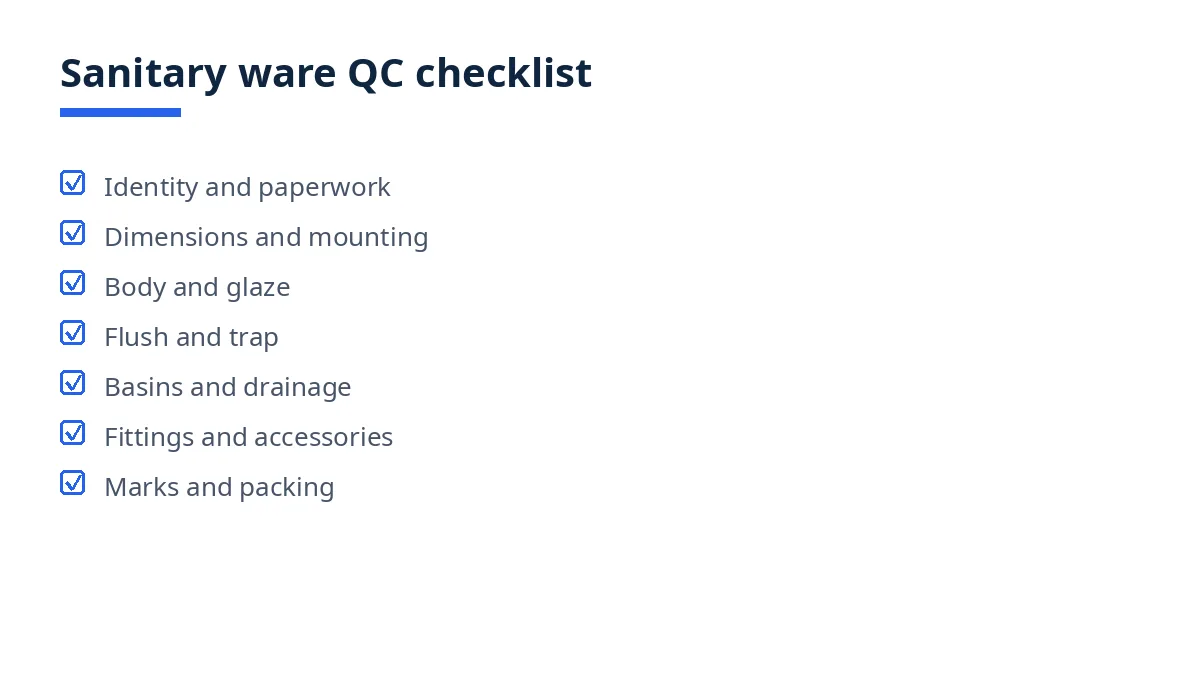
The full checklist (numbered, printable)
Identity, model and paperwork
Confirm model, color, size and quantity on sampled cartons match the purchase order, packing list and approved sample.
Confirm the destination-market standard in the order, and that every report names the model and batch.
Confirm the approved drawing is on the table, with mounting-hole and outlet positions, overall dimensions and trap type.
Confirm the included-parts list: seat and cover where supplied, cistern fittings, waste, trap, overflow ring and bolts.
Dimensions, fit and mounting
Measure height, width and depth against the drawing, record actual values, and compare with the agreed tolerance.
Check mounting-hole positions with a template from the drawing: holes must line up without forcing brackets.
Check trap outlet size and position against the rough-in dimension, and confirm the spigot is round and undamaged, with no glaze runs inside.
Check basin flatness and wall contact with a flat surface and straight edge, and record any rocking, gap or twist.
Trial-fit seat, cover and, for close-coupled suites, cistern to pan: seats must sit flat and stable, and joints must seat evenly without leaking on a fill-and-flush check.
Body and glaze
Check face, back, underside and rim under normal and side light, and record pinholes, crawling, specks, ripples, blistering, cracks and dull spots.6
Run a hand over rims, edges and basin interiors: glaze must feel even, with no rough patches, sharp drips or unglazed areas.
Check shade within a piece, between pieces in a set, and across cartons under the same light; segregate any different firing lot.
Check warpage on a flat surface: a rocking pan, basin or pedestal base is a failure.
Check for crazing with oblique lighting and an ink or dye check, and compare with the lab evidence for that body and glaze.5
Check rims, edges, feet and pedestal-to-basin fit for chips, cracks and gaps; the set must stand level.
WC flush, trap and water use
Witness a flush test on production samples, watching refill speed, siphon consistency, rim wash, splash control and repeat performance.6
Check bowl wash, water seal and oversplash after flushing: the bowl must wash evenly, the trap must retain water at the required depth, and no water may splash beyond the rim.
Measure flush volume against the declared volumes and the destination-market limit, such as the 1.28 gallons per flush maximum for WaterSense labeled toilets in the United States.3
Check outlet and inlet valves after filling: no steady drip into the bowl, and shut-off must be clean without continuous running.
Check the trapway by eye and hand where accessible for glaze runs, debris and obstructions, and confirm the flush evidence for the model: EN 997 covers toilet-paper flushing, small-ball flushing, oversplashing and after-flush volume, with an average water absorption limit of 0.5 percent by mass for glazed ceramic WC pans.2
Basins, urinals and drainage
Fill each sampled basin, release the waste, and confirm all water drains away with no pooling.4
Check overflow protection and tap-hole size and position, and trial-fit the waste and trap connection.
Check wall-hung fixings and load evidence: under EN 14688, a 1.50 kN load for one hour must cause no crack, break or permanent distortion.4
Check urinals as WC pans for glaze, dimensions and trap fit, and spot-check stain resistance only as the maker directs.4
Fittings, seats and accessories
Check seat material, color, hinge type and buffers against the order, with hinge bolts complete and matching the pan shape.
Check cistern fittings for correct type, complete seals and smooth operation through several flush cycles.
Check metal parts, wastes, traps and brackets for even finish, correct size and freedom from corrosion, burrs and sharp edges, with every accessory packed with its own piece, labeled by model.
Marks, labels and packing
Check permanent marking where required: model, maker mark and market marking, legible and consistent across the lot.
Check carton marks against the order: model, color, quantity, carton number and destination marks, with mixed cartons marked as mixed.
Check individual protection: pieces wrapped and separated so glazed surfaces cannot touch each other or the carton wall, with rim and corner protection as specified.
Check carton strength, pallet pattern and stacking marks for the route, count pieces against the packing list, and photograph sampled cartons.6
Common failures and how to fix them
The most common failure is a glaze fault across a batch: pinholes, crawling or crazing. Stop packing, re-inspect under side light with an ink check, and segregate affected pieces.
Next is a mounting or trap mismatch: holes that do not line up, or an outlet missing the rough-in. Stop, check the template against the drawing and several pieces from the same batch, and find whether the drawing, mold or fixing kit is wrong before more pieces are packed. Repeatability across several pieces matters more than one perfect unit.6
Flush failure is third: a pan that clears once in a demonstration and not on repeated flushes, or a valve that leaks after filling. Re-test on production samples through several cycles, check water level and valve seating, and restart packing only when repeated flushes clear and seal.
Shade drift is fourth: pieces from different firings packed as one set. Re-sort complete sets by firing lot, and mark any mixed lot on the carton. Breakage in transit is fifth: rim chips and pedestal cracks after arrival. Re-check carton protection, dividers and stacking for the actual route.
Above the agreed acceptance level, options are re-inspection after sorting or rework, documented partial acceptance, or rejection. Record the decision and carton numbers, and keep the photos with the report.
Downloadable template / summary table
Add the drawing, tolerances and acceptance numbers, and record a result per piece.
Section | Checks | Evidence |
|---|---|---|
Identity | Model, standard, parts | Order, reports, sample |
Dimensions | Size, holes, outlet, seat fit | Measurements, template |
Body and glaze | Defects, shade, crazing | Side light, ink check |
Flush and trap | Clearing, seal, volume | Witness test, volume |
Basins | Drainage, overflow, load | Fill test, load report |
Fittings | Seat, cistern, metal parts | Cycle test, parts count |
Packing | Marking, protection, count | Carton check, photos |
How Exportain helps
Exportain is a B2B marketplace connecting buyers with Bangladeshi suppliers of sanitary ware, so the specifications behind this checklist can be agreed at the enquiry stage, before production starts. Exportain is not a party to the goods contract and does not inspect goods. Use inspection services when you plan the check, and agree the drawing, tolerances and test evidence in writing first.
FAQs
When should this checklist be used?
Use it at final inspection, when goods are finished and packed, and flush and fit checks can still run on production pieces. For larger and first orders, also use it in production, while glaze, mold and fitting faults can still be corrected.
Who should complete it?
The buyer, a local agent or an independent inspector can complete it, using the approved sample, drawing and a randomly drawn sample.
What are the most common failures?
Glaze pinholes, crawling and crazing, mounting-hole and trap misalignment, weak flushing, valve leaks, shade drift across firings, and rim chips from weak carton protection are the failures found most often.
Can a third party do it?
Yes, if you share the approved references, drawing, tolerances and acceptance levels first, and agree sample size and timing before production finishes.
Next steps on Exportain
Before production starts, agree your drawing, template, tolerances, flush volumes and label wording, then read the AQL acceptance quality limit explainer and pre-shipment inspection guide, and plan the check with inspection services.
Sources
- ISO 2859-1:1999 - Sampling procedures for inspection by attributes — Part 1: Sampling schemes indexed by acceptance quality limit (AQL) for lot-by-lot inspection. International Organization for Standardization (accessed )
- EN 997:2018 - WC pans and WC suites with integral trap. European Committee for Standardization (CEN) (accessed )
- Residential Toilets | US EPA. U.S. Environmental Protection Agency (accessed )
- EN 14688:2015+A1:2018 - Sanitary appliances - Wash basins - Functional requirements and test methods. European Committee for Standardization (CEN) (accessed )
- Standard Test Method for Crazing Resistance of Fired Glazed Ceramic Whitewares by a Thermal Shock Method. ASTM International (accessed )
- Ceramic Sanitary Ware Quality Check for Bulk Purchase. QDJS Industry, (accessed )
About the author
Sourcing from Bangladesh?
Post a request for quotation and suppliers on Exportain can send you their quotes directly.
Post an RFQ


