Private Label Tank Tops Manufacturing in Bangladesh: A Brand Owner's Guide
Tank tops leave a brand owner few places to hide: the neckline, armhole and strap carry the fit, and the print and label pack carry the brand. This guide covers cut and fit ownership, artwork ownership, label packs, and how to compare quotes for private label tank tops from Bangladesh.
Short answer
Private label tank tops from Bangladesh put the brand in the cut, the artwork and the label pack. Own the neckline and armhole pattern, the print files and dye recipes, and the label wording in writing, then compare every quote on the same specification and delivery term.
On this page
Key takeaways
A tank top has almost no trim, so the brand lives in the neckline, armhole and strap cut, the print placement and the label pack, and each of these must be specified and owned in writing.
Fix athletic versus casual positioning before sampling, because it pulls fabric, rib, stretch and label wording in different directions.
Artwork ownership covers three separate items: the graded pattern, the print files and screens, and the dye recipe for each colour, plus the label and hangtag artwork.
There is no typical MOQ, price or lead time: minimums run per style and per colour through dye lots, print set-ups and label runs, so compare quotes only on the same cut, fabric and delivery term.
A tank top has no sleeves, no collar stand and almost no trim, and that is why a private-label order for tanks goes wrong in places other garments do not. The brand lives in a few decisions: the neckline shape, the armhole depth, the strap width, the print placement, and the wording on a label that must fit a narrow neck seam. Get those decisions into writing before sampling, and the repeat order can match the first.
A private-label tank top carries your name, your labels and your packing, made to your specification, not a factory range with a hang tag added. When the arrangement is not written down, a pattern the factory graded, a print file it prepared or a label plate it paid for can reasonably be treated as its own working material, and moving the order elsewhere means rebuilding them.
The Bangladesh Knitwear Manufacturers and Exporters Association (BKMEA), established in 1996, is the apex trade body for the knitwear sector and represents approximately 2,540 knitwear member factories.1 Knitwear exports reached $5,963.76 million in July to September 2026, up 6.88 percent year on year, according to data released by the Export Promotion Bureau (EPB).2 Several factories can therefore quote on a tank order, but only your tech pack sets a shared specification. In the Harmonized System, heading 6109 covers T-shirts, singlets and other vests, knitted or crocheted.3 See the HS code for tank tops guide.
Why this matters for buyers and sellers
For the buyer, a tank top is a fit product before it is a fashion product. A neckline one centimetre lower than approved, an armhole that gapes on a medium but not on a small, or a strap that twists after washing changes how the garment reads on the body, with no sleeve or collar to distract from it.
For the seller, the risk runs the other way. A tank pattern graded across sizes, a print screen cut for your artwork and a label run printed with your brand name cannot be sold to another buyer. A short run still uses the pattern work, screen set-up and label run, so cost per piece rises as quantity per colour falls. That is why factories protect short tank orders with minimums, and why the negotiation that works changes the order structure rather than asking for an exception.
Fix athletic versus casual positioning before the first sample. An athletic tank is judged on stretch recovery and whether performance wording on the label can be supported. A casual tank is judged on hand feel, drape and colour retention. The two positions pull fabric, rib and label wording apart.
Step-by-step: how it works
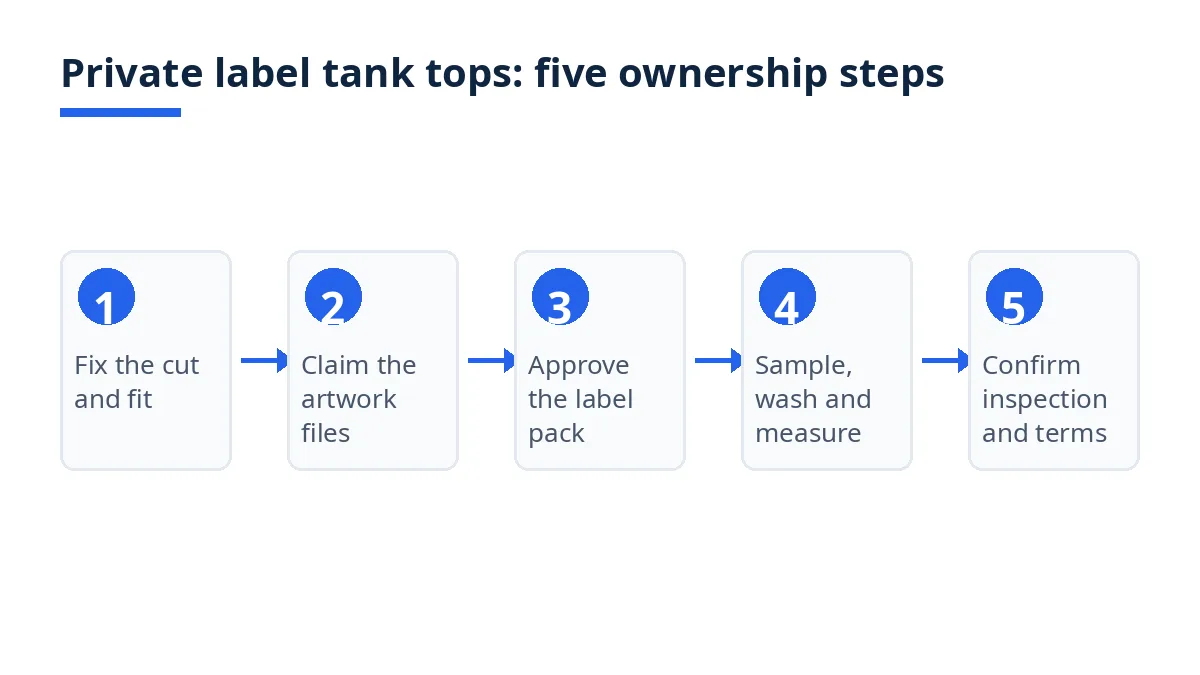
Fix the cut on paper before you discuss price. State the neckline shape, the armhole depth, the strap width, the body length and the grade rules across sizes. A crew, scoop, V, racerback and muscle cut are five different patterns.
Claim the artwork files in the quotation. List every file the order creates: graded pattern, print artwork and screens, dye recipe per colour, and label and hangtag artwork. State who owns each file and what is handed over at the end of the order.
Approve the label pack as a set. Approve the neck label, side-seam label if used, hangtag and carton marking together: a label error found at packing means relabelling the whole shipment.
Sample the fit, then wash it, then measure it again. Order a proto sample, then a pre-production sample in actual fabric, colour, construction, artwork and labels. Measure before and after washing, on more than one size, and approve or list corrections in writing.
Agree inspection and delivery term before you confirm. Write the inspection level and acceptance values into the purchase order, and state one delivery term and named place per quotation, so quotes compare on the same basis.
Cut and fit ownership for tanks
The pattern is the brand asset that matters most for a tank, because the garment has so few parts. Record neckline depth and width, armhole depth and curve, strap width, chest and hem widths, and body length from the highest shoulder point at each size. A racerback changes the back pattern and strap placement entirely, and a muscle cut changes the armhole curve and side seam, so a neckline or armhole change after sampling is a new pattern, not a tweak.
Grading deserves its own line in the tech pack. A tank graded by a fixed increment at every size can drift at the extremes, so ask for the grade rules in writing and sample the smallest, the middle and the largest sizes. Wash the samples, because uneven shrinkage changes the armhole depth and body length after laundering.
Print and dye artwork ownership
Artwork ownership divides into three items, each needing a separate line. First, the print artwork: file, colours, placement measured from the neckline and armhole, and print method. A chest print placed by eye drifts toward the armhole on some sizes, so placement must be measured from fixed points and checked on more than one size. Second, the screens or plates, and whether you paid for them separately. Third, the dye recipe per colour, because a recoloured repeat depends on it.
The print method also constrains the fabric. Screen printing suits cotton and cotton blends and carries a set-up per colour. All-over printing and sublimation suit different fibre mixes and behave differently after washing, so method, fibre content and wash expectation must be agreed together. A dyed-to-order colour carries its own dye-lot minimum.
Label and hangtag packs for tanks
A tank label pack is small but crowded. The neck seam carries the brand label, the size and the fibre and care information, and on a narrow strap or a racerback there may be no comfortable place for a second label at all. Decide early whether the size and care information sits on the neck label or moves to a side-seam label, and approve the wording before the label run is ordered.
If you sell into the European Union, Regulation (EU) No 1007/2011 states that a textile product shall be labelled or marked with the name and percentage by weight of all constituent fibres in descending order.4 Label percentages must therefore match the fabric actually used, and a blend change during production is a label change as well. For athletic positioning, a hangtag claim should rest on a test or fabric specification you hold. Give each size and colour its own barcode, and put the size/colour breakdown on the carton marking.
Costs, timelines and documents
What are the typical costs and timelines?
There are no typical costs or timelines a guide can state as fact. Each factory prices your cut, fabric, print method, label run, packing and delivery term for your specification, and the delivery term changes which costs sit in the price. The Incoterms 2020 rules set out 11 rules, seven for any mode of transport and four for sea and inland waterway transport, allocating cost and risk between seller and buyer.5 Compare quotations only when they state the same rule and named place.
For timelines, sampling depends on fabric availability, pattern work and correction rounds, and bulk production on dyeing, print set-up, label delivery and line capacity. Ask for sampling, fabric-ready, production and inspection dates as separate lines.
Cost driver | What sets it | State in your enquiry |
|---|---|---|
Cut | Pattern and grading across sizes | Neckline, armhole, strap, grade rules |
Fabric | Fibre mix, weight, stocked or dyed to order | Composition, weight, colour status |
Print or dye | Set-up per colour, dye lot per colour | Method, colours, placement, dye status |
Labels and hangtags | Separate print runs per item | Label set, wording, barcode per size and colour |
Delivery term | Which costs and risks sit where | One rule and named place for every quote |
Example figures: a buyer orders 1,000 tanks in one style across four colours at 250 per colour, with a two-colour chest print. The print needs two screens and each colour needs its own dye lot. If the per-colour dye minimum is 300 pieces, the order clears the garment total but fails on each colour. The same 1,000 pieces in two colours at 500 per colour clears the dye line. The example shows structure only, not a typical MOQ, price or lead time.
Which documents are needed?
The order documents are the tech pack, the itemized quotation and the purchase order, with the cut specification, the artwork ownership lines, the label pack approval and the MOQ per style and per colour on both. The inspection plan belongs in the purchase order as well. ISO 2859-1 defines a system of acceptance sampling plans for inspection by attributes, indexed by acceptance quality limit (AQL) for lot-by-lot inspection, and AQL is the maximum average percentage of defective items considered acceptable during random sampling.6
For export clearance in Bangladesh, goods may not be loaded unless an export declaration, the Bill of Export or Shipping Bill, is submitted to Customs and approved.7 Enclosed documents include the export contract or purchase order where there is no export letter of credit, the commercial invoice, the packing list, the EXP form certified by an authorized dealer, and a certificate of origin issued by the EPB or a Chamber of Commerce and Industry.7
Bangladesh-specific rules and tips
Check membership claims with the association. BKMEA membership, if claimed, is verifiable with BKMEA itself.1 A confirmed membership tells you the firm is an active knitwear business; it tells you nothing about the cut on offer or capacity for your order.
Ask which inputs are bought in for your order. Neck and armhole rib, elastane for an athletic stretch, and some yarns may be bought in for your specification, and a bought-in rib can set both the minimum and the earliest production date. Record whether each fabric colour is stocked or dyed to order.
Treat the fibre label as part of the fabric decision. A blend change made to solve a dye or stretch problem changes the fibre percentages on the label, and under the EU rule those percentages must appear in descending order.4 Raise any blend change as a label change at the same time.
Mistakes and red flags
What are the most common mistakes?
Approving fit on one size only. A tank approved on a medium can fail at the extremes, where the armhole and strap behave differently. Sample the smallest, the middle and the largest sizes, and wash them before approval.
Letting print placement float. A chest print measured from no fixed point drifts toward the neckline or the armhole across sizes. Measure placement from the neckline and the armhole, and check it on more than one size.
Leaving artwork ownership unwritten. A pattern, print file, dye recipe or label plate that the factory paid for and holds can stay with the factory when the order moves. Write ownership, file handover and repeat-order access into the quotation.
Copying label wording from another product. Fibre percentages, care wording and performance claims belong to one specific fabric and one specific garment. Copying them onto a tank with a different blend produces a label that does not match the goods.
Comparing quotes across different cuts. A lower price on a crew neck with a single chest print is a different offer from a racerback with an all-over print, even at the same quantity. Compare only replies to the same tech pack on the same delivery term.5
Treating a profile or a badge as a guarantee. A profile is a starting point for enquiries. It does not test whether a factory can cut your armhole or hold your print placement, and a badge is not a guarantee of capacity, quality or delivery. See the tank tops quality control checklist for neckline, armhole and print points.
Checklist
Before you confirm, every line should be answered in writing.
Cut fixed: neckline shape, armhole depth and curve, strap width, body length, grade rules.
Fit sampled at smallest, middle and largest sizes, washed and measured.
Artwork ownership written: pattern, print files, dye recipes, label artwork, handover terms.
Print method, colours and placement agreed, measured from the neckline and the armhole.
Label pack approved as a set: neck label, side-seam label if used, hangtag, carton marking, barcodes.
Fibre percentages checked against the actual fabric, in descending order for EU sales.4
MOQ confirmed per style and per colour; binding line named; set-up costs itemized apart from the unit price.
Inspection level and AQL values in the purchase order.6
Quotations compared on the same specification and delivery term.5
Export set agreed: invoice, packing list, EXP form, certificate of origin, Bill of Export.7
How Exportain helps
On Exportain, browse suppliers and post a request for quotation (RFQ) on the RFQ board with your tech pack summary, neckline and armhole specification, print method and delivery term, so suppliers quote against the same cut. Ask each reply for its per-style and per-colour minimums and for its artwork ownership terms in writing.
Read the badges for what they record. Verification is a document and photo review by staff, not a factory inspection, and membership plans never grant a trust badge.8 A badge cannot confirm an armhole curve or a print placement, so sample approval and inspection stay with you. See how supplier verification works on Exportain and the MOQ definition guide.
FAQs
What should I know first about private label?
Private label means the tank carries your name, labels and packing, made to your specification. Before finding a factory, fix the neckline, armhole and strap specification, print method and placement, and label pack, and write down who owns the pattern, print files, dye recipes and label artwork.
What are the typical costs and timelines?
There are no typical figures a buyer can rely on: each factory sets price, MOQ and lead time for your cut, fabric, print method, label run and delivery term. Ask for each stage as a separate dated line.
Which documents are needed?
The order documents are the tech pack, itemized quotation and purchase order, with cut specification, artwork ownership, label approval and MOQ per style and colour on both. The export set is the Bill of Export, invoice, packing list, EXP form and certificate of origin.7
What are the most common mistakes?
Approving fit on one size only, letting print placement float, leaving artwork ownership unwritten, copying label wording, and comparing quotes across different cuts or delivery terms.5
Next steps on Exportain
Browse suppliers, then post your neckline and armhole specification, print method and delivery term on the RFQ board so suppliers state MOQ per style and colour and artwork terms. Before you confirm, read how to import tank tops from Bangladesh.
Sources
- BKMEA at a Glance. BKMEA (accessed )
- RMG exports rise 6.1pc to $10.58b in Q1FY27. Daily New Nation, (accessed )
- Classification Detail — HS Code 6109. United Nations Statistics Division (accessed )
- Regulation (EU) No 1007/2011 on textile fibre names and related labelling and marking of the fibre composition of textile products. European Union, (accessed )
- Incoterms 2020 Explained: Complete Guide (2026 Update). Inecta (accessed )
- ISO 2859-1:2026 - Sampling procedures for inspection by attributes — Part 1: Sampling schemes indexed by acceptance quality limit (AQL) for lot-by-lot inspection. ISO (accessed )
- Customs Clearance Procedures for Export. Bangladesh Customs, National Board of Revenue (accessed )
- Supplier verification: Earn trust badges buyers can see. Exportain (accessed )
About the author
Sourcing from Bangladesh?
Post a request for quotation and suppliers on Exportain can send you their quotes directly.
Post an RFQ