Private Label Jackets in Bangladesh: A Leather Brand Owner's Guide
A brand-owner guide to private label leather jackets from Bangladesh: five control decisions, six journey steps, and the label, test and export records that keep the second order identical to the first.
Short answer
Private label leather jackets from Bangladesh are built to the brand owner's identity, so the brand owner must control the mark, the artwork and plates, the leather lot and shade standard, the label proofs per market, and the test evidence before bulk production. Settle mark ownership, plate ownership and surplus-label control in writing, approve a sealed sample worn under the agreed light, and require lab reports naming the leather, color and lot.
On this page
Key takeaways
Private label changes who answers for the jacket: the brand owner controls the mark, artwork, plates, label proofs, test evidence and repeat standard, while the maker controls cutting, stitching and packing.
In the European Union a distributor selling under his own name or trademark is treated as the manufacturer for labelling purposes, and leather parts in a textile product must be declared with the animal-origin phrase.
An intent-to-use trademark application in the United States does not register the mark until it is converted to a use-in-commerce basis, and mark ownership and artwork confidentiality must be settled in writing before artwork is sent.
Leather evidence must name the jacket it belongs to: check LWG certificate dates and scope, require lab reports naming the method, leather, color and lot, and hold bulk until the report for your lot is filed.
A leather jacket with a leather outer surface is indicatively classified at 4203.10, and the invoice, packing list and labels must describe the same garment, with the full national code confirmed in the destination tariff.
A private label order reverses the usual buying question. You are not choosing a jacket from a catalog and adding a logo at the end. You are putting your name on a jacket someone else makes, and that name is yours to defend. This guide is about private label leather jackets from Bangladesh, for a brand owner in the United States, the United Kingdom, the European Union or the United Arab Emirates who will sell under their own name.
The maker controls cutting, stitching and packing; you control the identity: the mark, the artwork, the label proofs, the test evidence and the repeat-order standard.
Your name on someone else's jacket: what private label changes
A wholesale buyer accepts a maker's jacket, shade and label and judges a finished product. A private label buyer builds a jacket to their own identity, so every identity decision must be made before bulk production, not discovered in it. That changes who answers for labeling. Under the European Union textile labeling rules, a distributor is treated as the manufacturer for labeling purposes where he places a product on the market under his name or trademark, attaches the label himself, or modifies the content of the label.1 The same rules require textile products containing non-textile parts of animal origin to carry the phrase "Contains non-textile parts of animal origin", and require labels to be durable, easily legible, visible and accessible, and securely attached.1 The United States position differs in form: the Federal Trade Commission leather guides list the products they cover, including bags, footwear and belts when not sold as part of a garment, and do not list garments such as jackets, so do not treat those guides as the jacket labeling rule.2 Confirm the jacket position for each selling market with your adviser before the label run.
A sample proves something different too. A wholesale sample proves a jacket sells. A private label sample proves the jacket is yours: the mark sits where the artwork says, the shade matches the standard repeats will be held to, and the leather evidence names the lot bulk will use.
Five decisions that stay with the brand owner
Five decisions cannot be delegated by silence.
Decision | What you decide | What happens if you leave it open |
|---|---|---|
The mark | The exact mark, its owner, and the markets where it is filed | Another party files first, or the maker uses a near-identical mark for a second customer |
Artwork and plates | Who owns the plates, dies and artwork files, and what happens to them when the order ends | Plates stay with the maker and your mark keeps working after you leave |
Leather and shade | The leather type, the tannery evidence, and the shade standard repeats are judged against | The second order uses a new lot and the shade drifts panel by panel |
Labels and tests | The label text per market, and the test methods and limits bulk must meet | Labels are printed from an old proof and test evidence names a different lot |
Repeat and exit terms | How repeats are priced, how set-up charges are treated, and how branded stock is handled at the end | A repeat is repriced as a new order and unsold branded jackets stay in circulation |
The brand-owner journey, step by step
The journey has six control points, each ending with a written record.
Decide the mark. Fix the exact word mark, logo and device, the owner of each, and the markets where protection will be sought.
Confirm the rights. Check availability and filing position with your adviser, and settle ownership of the mark in writing before artwork is sent.
Lock artwork and plates. Approve final artwork and agree who owns the plates, dies and files.
Approve the sealed sample. Judge the sample worn, against the artwork, the shade standard and the label proofs. Seal one approved jacket as the bulk standard.
Confirm labels and tests. Approve label proofs per market and confirm the test methods and limits.
Control the repeat. Price repeats against the same standard, re-approve shade when the leather lot changes, and close out branded materials at the end of each order.
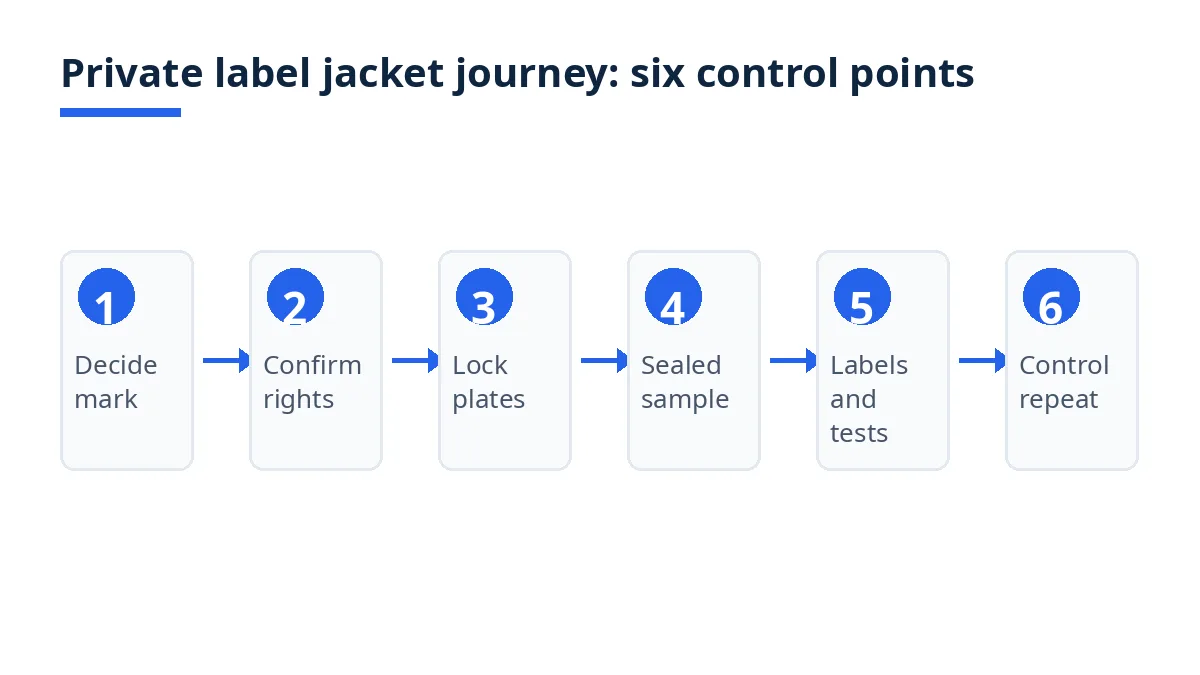
Put a date in the order for each record, and treat a missed record date as a hold on bulk.
Protect the mark before the first sample
A trademark filing is a legal step, not a branding step, and it belongs before artwork leaves your hands. In the United States, an application must state a filing basis. The United States Patent and Trademark Office lists four: use in commerce, intent to use, foreign registration, and foreign application claiming priority within six months.3 An intent-to-use application rests on a verified statement of a bona fide intention to use the mark in commerce as of the filing date, but that basis alone does not register the mark: registration waits until the application is converted to a use-in-commerce basis by an allegation of use.3 A mark is in use in commerce with goods when it is placed on the goods, their packaging, or associated displays, and the goods are actually sold or transported in commerce.3
Three rules follow. File or confirm rights in each selling market separately; a filing in one market does not protect the mark in another, and the brand owner, not the maker, owns that task. Never send final artwork before mark ownership and artwork confidentiality are settled in writing. Keep the mark exactly as filed on every label, hang tag and carton. Your adviser should check the mark and filing basis together. Exclusivity needs the same written treatment: if you want the maker not to sell your design, colorway or marked jacket to another buyer, say so in writing, name the design and markets covered, and set a duration.
Plates, dies, labels and artwork: who owns what when production ends
Plates, dies, embossing blocks, print screens and artwork files are small items with long consequences. Settle four lines in writing before the first sample: who pays for each item, who owns it, where it is stored, and what happens to it when the relationship ends. State who owns each item if you pay for it, and what use the maker may make of it afterwards.
Labels and packaging need tighter control than the jacket itself, because a label without a jacket is still your brand in another party's hands. Agree label quantities against the jacket quantity, including the printer's minimum run. A run of 1,000 labels against an order of 600 jackets leaves 400 labels that must be counted, stored, used only on your jackets, or destroyed under your instruction. Count branded boxes, hang tags and polybags the same way, and instruct the maker in writing that surplus branded material is never sold or used on another order.
Keep the jacket the same on the second order
Leather makes repeat consistency harder than fabric, because hides vary and shade moves between lots. A leather jacket is judged worn, not flat on a table: a front that looks straight when laid out can pull at the shoulder once zipped, one sleeve can hang longer than the other, and a lining that sits well in the hand can twist when an arm goes through it.4 Judge the sealed sample worn, zipped and under the agreed light, and judge bulk against that sample, not against a photograph.
Leather evidence must name the jacket it belongs to. The Leather Working Group audit, first launched in 2005, covers 17 sections including water and energy use, environmental and chemical management, waste and effluent treatment, and health and safety, and awards Gold at 85 percent, Silver at 75 percent, Bronze at 65 percent and Audited at 50 percent, with the final medal set by the lowest-scoring section.5 Certification is valid for 24 months for leather manufacturing facilities and 12 months for part-processed material traders, and certification does not guarantee that there will be no restricted substance failures in a final product.5 Check the certificate's dates and scope. The audit covers the tannery, not the jacket workshop, so tannery evidence never replaces jacket inspection.
Shade control follows the same discipline. Grain and shade must stay consistent across the front panels, back panel and both sleeves, and between jackets in the same color, under the agreed light, and natural marks such as scars, insect holes and growth wrinkles are graded by position and size rather than treated as zero defects.4 Test evidence closes the loop. Leather is classified as chrome-free where it contains less than 1,000 mg/kg of total chromium on a dry weight basis under BS EN 15987, and for Gold and Silver certification chromium VI levels must be below 3 mg/kg, with any higher level an automatic failure.5 In the European Union, leather articles coming into contact with the skin must not be placed on the market where they contain chromium VI at or above 3 mg/kg of the total dry weight of the leather, measured by EN ISO 17075, under the restriction added to Annex XVII entry 47, which applies from 1 May 2015.6
Labels that carry your name carry your responsibility
Approve the brand, composition and market labels separately. The composition and care label carries the material facts. For textile components, the European Union rules require fiber content to be stated with fiber names and percentages, and require the presence of non-textile parts of animal origin, such as leather parts in a textile product, to be indicated by the phrase "Contains non-textile parts of animal origin".1 Labels must be durable, easily legible, visible and accessible, and securely attached, and where the manufacturer is not established in the Union, the importer must ensure the label and the accuracy of the information on it.1 For the United States, remember the scope limit: the leather guides do not list garments, so confirm the jacket labeling position, including fiber content, origin and care wording, with your adviser rather than copying a rule written for bags or footwear.2
Composition wording also decides how the word "leather" may be used for products within the scope of the United States leather guides: the unqualified term "leather" should be used only where the product is composed in all substantial parts of leather, imitation or simulated leather must be disclosed as such, and bonded or reconstituted leather must carry the percentage of leather fibers and non-leather substances where the bonded-leather term is used.2 A jacket whose panels are bonded or reconstituted material must not be sold under your name as plain leather, in any market, on any wording your adviser has not cleared.
The Harmonized System comprises more than 5,000 commodity groups, each identified by a six-digit code, and is used by more than 200 countries and economies as a basis for customs tariffs.7 A leather jacket with a leather outer surface is indicatively classified at subheading 4203.10, articles of apparel, under heading 4203, with national extensions of 4203.10.40 in the United States schedule, 4203 10 00 in the European Union, and 4203 10 00 00 in the United Kingdom.8 Length does not split jackets from coats inside 4203.10, a textile outer surface leaves heading 4203 entirely, and a furskin lining or fur outside beyond mere trimming removes the garment from Chapter 42.8
Price the brand work separately from the jacket
The jacket price pays for leather, lining, hardware, cutting, stitching, packing and freight on the agreed delivery term. The brand price pays for the work that makes the jacket yours: artwork and plates, samples, label runs, testing and re-approval. Example figures only, for one style in two colors and four sizes, 600 jackets in total. They are not a quotation or a market price.
Brand-work line | Example figure (USD) |
|---|---|
Plates, dies and artwork set-up, one-time | 420 |
Sample rounds, 3 rounds at 85 | 255 |
Lab tests, 2 methods at 120 | 240 |
Brand set-up total | 915 |
Jacket unit price, 600 jackets at 46.00 | 27,600 |
Order total before freight, duty and taxes | 28,515 |
Arithmetic: 420 + 255 + 240 = 915; 600 x 46.00 = 27,600; 27,600 + 915 = 28,515. The label run sits outside this table because it is counted per label, not per jacket: 1,000 labels printed against 600 jackets leaves 400 surplus labels to control under the rule in the plates section. Minimum quantities multiply the same way for a brand owner as for any buyer, and the counting basis decides the real order size. A minimum order quantity is the smallest quantity a supplier will accept on its normal terms, counted per order, per style or per color, and sometimes combined with a minimum order value, and there is no standard minimum for Bangladesh or for garments that can safely be assumed.9 Material, trims and variety drive the minimum: custom leather brings the tannery lot into the calculation, custom labels and packaging bring their suppliers' minimums with them, and every extra color or size adds changeovers.9 No typical timeline can be stated for a private label jacket, because sample rounds, shade approval, label printing and lab testing each depend on the previous record. Delivery terms belong in the same written record: Incoterms 2020 provides 11 rules with a clear allocation of cost, risk and obligations, and collects the costs for each rule in article A9/B9.10 Only CIF and CIP oblige the seller to buy insurance for the buyer, at different levels of cover, and under DAP the seller does not unload while under DPU the seller does, which is the sole difference between those two rules.10 State the rule and the named place in full.
Bangladesh export file: what travels with a branded jacket
Goods must not be loaded or stuffed in containers or a ship for export unless an export declaration, known as a Bill of Export or Shipping Bill, has been submitted to Customs in the prescribed format and approved by the Customs authority.11 The enclosures for all export consignments include the export letter of credit or, where there is none, the export contract or purchase order approved by the negotiating bank, the signed commercial invoice, the packing list, the EXP form certified by Authorised Dealer banks, the certificate of origin, the VAT certificate and the taxpayer identification number.11 Product-specific papers sit on top of that set where they apply, including an Export Registration Certificate for jute, jute goods and tea, which does not apply to leather jackets, and a phytosanitary certificate for agricultural goods where the destination requires one.11
The invoice and packing list must describe the same garment as the classification and label files, with the brand name exactly as it appears on the label. A supplier can hold up to five trust badges, each naming the checks behind it: identity, phone and email, business registration, export registration through the Export Registration Certificate, and facility photos.12 Verification is a review of documents and photos by Exportain staff: it is not a factory visit and not a check against a government database, and a badge is not a guarantee of production capacity, product quality or delivery.12 Ask for the documents yourself. Exportain is not a party to your trade, does not inspect goods, book freight or clear customs, and holds money for a goods order only when both parties agree to a funds hold.12
Mistakes that put another maker's jacket under your name
Sending artwork before ownership is settled. The files leave before the ownership lines are written.
Treating a trademark application as a registration. An intent-to-use filing does not register the mark until it is converted to a use basis, and selling under an unregistered mark while claiming registration misstates your position.3
Approving a sample from a photograph. A jacket judged flat hides the shoulder pull, the sleeve difference and the lining twist that only the worn jacket shows.4
Letting the maker keep surplus labels. A label run larger than the jacket order leaves branded labels uncounted. Count them, control them, or instruct their destruction in writing.
Using one label proof for every market. The European Union distributor rule, the animal-origin phrase and the United States scope position differ by market, and one proof cannot answer all three.1 2
Calling bonded or reconstituted material plain leather. The bonded-leather wording requires the percentage disclosure.2
Releasing bulk before the test report names your lot. A report for another lot, color or season proves nothing about the jackets in the cartons. Hold bulk until your lot's report is filed.
Reordering on the first order's price and standard without a fresh shade approval. A new leather lot needs a new panel approval under the agreed light. The repeat is a new order for shade purposes even when the style is unchanged.
Brand-owner sign-off checklist
Work through this list with the order file open, and do not release bulk until every line is answered in writing.
Mark, owner and filing markets recorded; artwork sent only after ownership and confidentiality are agreed.
Plates, dies, files and artwork versions listed, with owner and end-of-order treatment for each.
Label quantities counted against jacket quantities, with surplus branded material controlled or destroyed by written instruction.
Label proofs approved per market, with the brand label, composition and care wording, and market declarations checked separately.
Sealed sample approved worn and zipped, photographed under the agreed light, and filed with the artwork version and leather lot.
Leather type, tannery evidence and certificate validity checked, with the certificate confirmed with the issuer where it matters.
Lab reports filed naming the method, the leather, the color and the lot, including chromium VI evidence for the European Union market.6
Classification confirmed in the destination tariff for the exact jacket, with the invoice, packing list and labels describing the same garment.8
Minimum counted in writing per order, per style and per color, with set-up charges and repeat-order treatment stated.
Delivery term and named place stated in full, with freight, insurance, inspection and payment terms in the same written record.10
Export file complete: Bill of Export approval, invoice, packing list, EXP form, certificate of origin, VAT certificate and taxpayer identification number.11
What should I know first about leather jackets?
Know that a private label jacket is three products in one: a jacket, a brand record and a shipment file. The jacket must fit and wear as the sealed sample does, judged worn rather than flat.4 The brand record must show who owns the mark, the plates and the artwork, and which label proof belongs to which market.1 The shipment file must describe the same garment in the classification, the invoice and the labels, indicatively at 4203.10 for a leather outer surface.8
What are the typical costs and timelines?
There are no typical costs or timelines for a private label leather jacket: no rule fixes either. Costs split into the jacket price and the brand price, and the brand price carries set-up, samples, label runs and testing on separate lines. Timelines follow the six control points in order, and each point waits for its written record: artwork, rights, plates, sealed sample, labels and tests, and repeat control. Agree a date for each record, and treat a missing record as a hold on bulk.
Which documents are needed?
The brand file holds the mark ownership record, numbered artwork versions, label proofs per market, the sealed-sample photograph, leather and tannery evidence, and lab reports naming your lot and method. The export file holds the approved Bill of Export with the export letter of credit or approved contract, signed commercial invoice, packing list, EXP form certified by Authorised Dealer banks, certificate of origin, VAT certificate and taxpayer identification number.11 The order file holds the quotation with unit price, minimum quantity counted per style and color, lead time, delivery term, payment terms and validity.9
What are the most common mistakes?
Sending artwork before ownership is settled, treating a trademark application as a registration, approving a sample from a photograph, letting surplus branded labels stay uncounted, printing one label proof for every market, calling bonded material plain leather, releasing bulk before the test report names your lot, and reordering without a fresh shade approval when the leather lot changes.
Next steps on Exportain
Browse Bangladeshi suppliers and read each profile's trust and verification checklist before you shortlist, checking what each badge actually covers.12 When the mark, artwork and label decisions are written down, post a free RFQ stating the jacket, the leather type, the label markets and the delivery term in full, and compare quotations on identical brand-work and jacket lines. Read the MOQ guide before you fix quantities, the verification guide before you rely on a badge, and how to buy for the eight-step buying process. Exportain is a B2B marketplace where buyers find Bangladeshi suppliers and post requests for quotation. It is not a party to the contract for the goods, and it does not inspect goods, book freight or clear customs.
Sources
- Regulation (EU) No 1007/2011 on textile fibre names and related labelling and marking of the fibre composition of textile products. EUR-Lex (accessed )
- PART 24—GUIDES FOR SELECT LEATHER AND IMITATION LEATHER PRODUCTS. Federal Trade Commission (accessed )
- Basis. United States Patent and Trademark Office (accessed )
- Quality Control Checklist for Leather Jackets. Exportain, (accessed )
- Certification - Leather Working Group. Leather Working Group (accessed )
- Commission Regulation (EU) No 301/2014 amending Annex XVII to Regulation (EC) No 1907/2006 (REACH) as regards chromium VI compounds. European Union, (accessed )
- What is the Harmonized System (HS)?. World Customs Organization (accessed )
- HS Code for Leather Jackets: Classification Guide for Importers. Exportain, (accessed )
- MOQ Meaning (Minimum Order Quantity). Exportain (accessed )
- Incoterms® 2020. International Chamber of Commerce (ICC) (accessed )
- Customs Clearance Procedures for Export. Bangladesh Customs, National Board of Revenue (accessed )
- How Supplier Verification Works on Exportain. Exportain, (accessed )
- MOQ
- supplier verification
- quality control
- HS Codes
- buyer guide
- Bangladesh sourcing
- Private label
- Leather jackets
About the author
Sourcing from Bangladesh?
Post a request for quotation and suppliers on Exportain can send you their quotes directly.
Post an RFQ