

Private Label Leather Belts Manufacturing in Bangladesh: A Brand Owner's Guide
A brand-owner guide to private label leather belts from Bangladesh: write one brief, own the design, brief the buckle and marks, set the labels per market, and clear four approval gates before bulk production.
Short answer
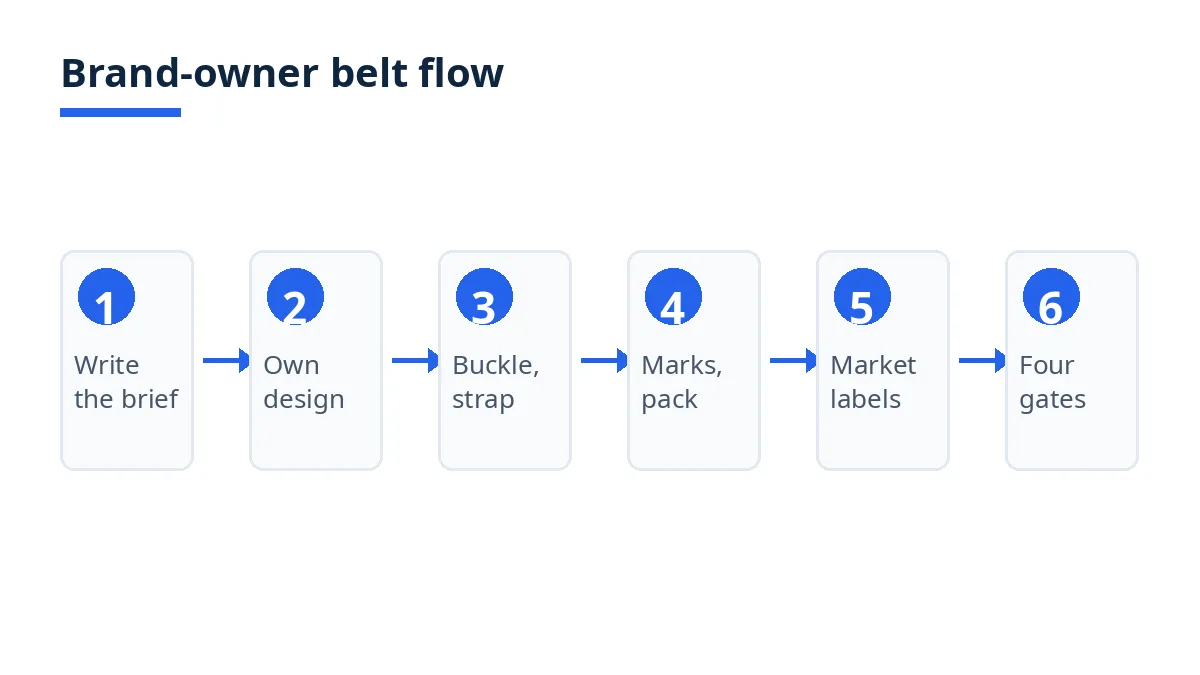
Private label leather belts from Bangladesh start with one written brand brief, not a catalogue choice. Fix the wearing belt, the buckle, the marks, the pack, and the labels for each selling market in that brief, settle who owns the pattern, tooling, and artwork, and approve the belt at four gates against a sealed sample before bulk production begins.
On this page
Key takeaways
Write one version-numbered brief covering the wearing belt, buckle, marks, pack, and market labels, and send the identical document to every maker.
Settle pattern, tooling, artwork, exclusivity, and confidentiality ownership in writing before the first sample, with legal advice on the wording.
Brief the buckle as the brand signature and the strap, edge, and keeper as one surface, judged against one approved sample under one agreed light.
Approve the belt at four gates, brief, mark, wear, and sealed, and judge bulk inspection against the sealed belt, not a photograph.
Price the brand work on separate lines from the belt, and count every minimum per size, per color, and per buckle finish, on example figures only.
A belt carries a brand at the buckle, and the buckle is the first thing a customer touches. The strap, the holes, the keeper, and the tip all sit under that first touch. Private label leather belts manufacturing in Bangladesh starts there: decide what the belt says about your brand before you ask any maker for a price, and put every decision in one written brief that every maker receives.
No companies are named or ranked here. Every number that looks like a price, minimum, or timeline is an example figure.
Start with the belt the customer wears, not the label
A customer judges a belt while wearing it. The buckle must fasten and release at every hole, the keeper must hold the tip, and the tip must lie flat. The quality control checklist for leather belts works along the strap in the order a wearer notices each fault, starting with length, hole spacing, and hole count, then buckle fit, keeper travel, and tip shape.1 A drifting hole run or a prong that will not seat reads as your brand failing.
Fix the wearing facts first: strap width and thickness, hole count and spacing, hole shape, tip shape, and the size run. Measure every belt flat, uncoiled, and relaxed, and agree the shade standard and light source.1
Write one brand brief that fixes the belt before the marks
One document should carry the whole order. Version-number it, date it, and send the identical document to every maker. A quotation that answers a different brief cannot be compared with another.
The brief has five parts: the assortment (each style, the size run, and the quantity per style, per color, and per size); the strap (leather, construction, edge finish, stitching, and lining where fitted1); the hardware (buckle frame, prong, attachment, keeper, and tip, each with a finish and a named sample); the marks (every brand mark, its position, its method, and its artwork file); and the pack and the markets (box, sleeve, insert, carton, and the label rules for each country where the belt will be sold). State what is fixed and what is open: a fixed line is a requirement, and an open line is answered with a named option and a price effect.
Decide who owns the belt design before the first sample
Private label covers three arrangements. In an original equipment arrangement, the maker produces to your tech pack and artwork. In an original design arrangement, the maker offers its own patterns and styles for you to label. In a mixed arrangement, you supply the design and the maker supplies a standard construction. Name the arrangement in the brief.
Settle four points in writing before the first sample, with legal advice: pattern ownership, tooling ownership, artwork control, and exclusivity and confidentiality. Advice, not a legal claim: an exclusivity promise that is not written down, dated, and signed is a conversation, not a term.
Brief the buckle as the brand signature
On a belt, the buckle is the logo. Customers see it first and handle it at every fastening. Brief it with the same care as a printed logo: frame shape and size, prong shape and seating, attachment method, finish, and the approved buckle for comparison.1 A buckle that looks right and seats badly fails the belt at the first wearing.
Name the finish in words a finisher can repeat: base material, coating or plating, color standard, and the sample that defines it. Test the sample as worn, at the first, middle, and last holes, and check the finish for rust, scratches, and burrs.1 A buckle shipped on its own is classified on its own terms, so keep loose and fitted buckles on separate order lines.2
Brief the strap, the edge, and the keeper as one surface
Brief leather type and grain, shade, stitching, edge finish, and keeper together, against one approved sample, under one agreed light. The checklist checks grain and shade along the full strap length, stitching along both edges for the full length, and edge finishing along both edges.1
Natural marks such as scars, insect holes, blood veins, and growth wrinkles are inherent in genuine leather, and the inspection goal is grading rather than zero defects, with grading turning on position and size.1 Agree the grading rule before production: which marks are accepted, where on the strap, and at what size they are rejected. Ask for evidence naming your leather and lot, and confirm any certificate that matters with the body that issued it. The keeper must sit where specified, slide as designed, and hold the tip without creeping.1
Brief the marks on the strap: emboss, deboss, foil, print, and the inside label
Every mark needs four decisions: what it says, where it sits, how it is made, and who approves the proof. Embossing presses the mark in, foil adds a metallic layer, print sits on the surface, and an inside label is stitched or attached. Brief each mark separately, with its artwork file, size, position, and proof.
Hold one version-numbered master artwork file per mark. Approve every label proof word for word, checking content, spelling, and position.1 Require a physical proof on your leather, in your color, at the production size, before the label run.
Composition wording is part of the mark. In the United States, the Federal Trade Commission guides cover belts when they are not sold as part of a garment, and the unqualified term leather should be used only where the product is composed in all substantial parts of leather.3 Non-leather material that appears to be leather, leather processed to simulate a different kind, and a backing that is not apparent on casual inspection should each be disclosed as the guides describe.3 Disclosures should stay on the product until the consumer purchaser receives it.3 Brief the wording with your adviser.
Brief the pack and the carton as the shelf
Brief both the pack and the carton. The box, sleeve, and insert carry the brand, the size, and the care and composition information the selling market requires. The carton carries the count, the size run, and the marks the warehouse needs to pick without opening it. A belt packed in a tight coil takes a crease, so brief the coil diameter, sleeve or tissue, polybag, and carton as specified, packed so the strap does not crease, kink, or take a buckle mark.1 State the wearing size on the belt, box, and carton in the same terms. State in writing how unused labels and boxes carrying your mark are stored, counted, and destroyed or returned.
Brief the labels and the rules for each selling market
Brief the labels per market, in a table with one row per market. Never approve one label for all markets on the assumption that the strictest label covers the rest.
For the European Union, where a textile product contains non-textile parts of animal origin, their presence must be indicated with the phrase "Contains non-textile parts of animal origin" on the labelling or marking whenever the product is made available on the market, in a way that is not misleading and that the consumer can easily understand.4 A textile product with two or more textile components of different fibre content must bear a label stating the fibre content of each component, and labels must be durable, easily legible, visible, and accessible.4 Confirm applicability for each belt style with your adviser. A distributor placing a product on the market under its own name or trademark, or attaching or modifying the label, is treated as the manufacturer.4
For chemical safety in the European Union, leather articles and leather parts coming into contact with the skin must not be placed on the market at or above 3 mg/kg of chromium VI in the total dry weight of the leather.5 EN ISO 17075 is the recognised analytical method, with a determination limit of 3 mg/kg.5 Require test evidence naming your leather, lot, and method before bulk production. The Leather Working Group audit uses the same 3 mg/kg line for Gold and Silver, with any higher level an automatic failure, and states that certification does not guarantee no restricted substance failures.6
Classification belongs in the same market table. The indicative heading is 4203, and belts and bandoliers sit at subheading 420330.7 Watch straps fall under heading 9113, machinery belting under heading 4205, and textile or plastics straps under their own material headings.2 The United States line is 4203.30.00; the United Kingdom lists hand-made and other under 4203.30.2 Confirm the full national code in the destination tariff for each belt style.2
Price the brand work separately from the belt
Price them on separate lines: buckle tooling and mold charges, embossing plates and dies, sample charges per round, leather lot and shade-standard charges, label and pack tooling, and the unit price of the belt itself. State whether each one-off charge is charged once, per repeat, or waived on repeat.
Example figures: 300 pieces per size across four sizes in one color and finish means a smallest order of 1,200 pieces; a second color and finish makes it 4,800. A minimum order quantity is the smallest quantity a supplier will accept on its normal terms.8 Ask for the counting basis in writing; the drivers are custom material, trim minimums, and changeovers.8
Standardize the buckle and the mark before negotiating quantity, and ask about stock leather, fewer colors, standard trims, a surcharge, a trial order, small-run capacity, or shared runs, each with a trade-off in unit price.8 Compare quotations only on one identical specification.8 The Incoterms 2020 rules allocate cost, risk, and obligations across 11 rules; name the term and place in every quotation. CIF, reserved for maritime trade, defaults to Institute Cargo Clauses (C) cover, while CIP requires Clauses (A) cover.9
Approve the belt at four gates, then hold the sealed belt
Approval works as four gates: brief, mark, wear, and sealed. At the brief gate, the maker confirms in writing that the brief is understood, complete, and quotable. At the mark gate, physical proofs of every mark are approved word for word. At the wear gate, a finished belt is fastened and released at the first, middle, and last holes.1 At the sealed gate, one belt is signed and sealed as the standard for bulk production, and bulk inspection is judged against that sealed belt, not against a photograph.
Agree the sampling basis, AQL values, defect classes, and the action on a fail in writing before bulk production. The belt checklist states that AQL figures are buyer-specified values only, so do not accept a sampling plan that presents a standard table as a belt mandate.1 Where lab testing is specified, the report must name the method and record the result, including colorfastness to rubbing under ISO 17075 where specified.1
Mistakes that put another name on your belt
Approving a belt from a photograph. Approve physical samples, on your leather, at every gate.
Approving the artwork and forgetting the label. A mark approved as artwork can still be misspelled on a label or printed in the wrong disclosure wording.
Assuming the plate, the mold, or the pattern is yours. Settle ownership in writing before the first sample.
Approving shade on a swatch, not on a strap. Approve shade on a full strap, under the agreed light, from buckle end to tip.
Approving one buckle finish for the whole lot. Name the sample, the light, and the comparison method, and check the finish at the sealed gate and at inspection.
Assuming exclusivity that was never written down. Agree exclusivity in writing, with legal advice.
Copying a classification, a label, or a disclosure from another product. Confirm each one for each belt style.
Brand-owner checklist before bulk production
Run this checklist at the sealed gate. Read each supplier badge for the checks it records: verification on Exportain is a review of documents and photos by staff, not a factory visit and not a check against a government database, and a badge is not a guarantee of capacity, quality, or delivery.10
Brief version and quantities fixed and identical for every maker.
Arrangement named, with pattern, tooling, artwork, exclusivity, and confidentiality answers in writing.
Buckle, keeper, and tip specified, with a named finish standard.
Every mark briefed, with physical proofs approved word for word.
Strap, edge, stitching, and keeper briefed against one approved sample, with a defect-grading rule.
Leather and lot evidence named, with test method and result recorded.
Pack, carton, coil, and size marking briefed, with unused brand material counted and controlled.
Labels briefed per market and approved on the physical proof.
Classification confirmed per belt style in the destination tariff.
Minimum counted in writing, with one-off charges and repeat treatment stated.
Four gates cleared, sealed belt signed, and sampling plan agreed in writing.
What should I know first about private label leather belts?
Start from the wearing belt, not the catalogue. Fix strap width and thickness, hole count and spacing, tip shape, and the size run in a version-numbered brief, name the arrangement and the ownership answers, and brief the buckle as the brand signature. Send the identical brief to every maker.
What are the typical costs and timelines?
There is no typical cost or timeline stated here, because every figure in this article is an example figure and no market price or lead time is claimed as a fact. Price the brand work on separate lines, with repeat-order treatment stated in writing. Timelines follow the gates: brief, mark, wear, and sealed, each with a named approval and a date, and bulk production starts only after the sealed gate is signed.
Which documents are needed?
The documents are the brief and its ownership answers, the artwork master files, the physical mark proofs, the test evidence naming your leather, lot, and method, the classification confirmation for each belt style in the destination tariff, and the order record stating quantity, unit price, Incoterm, payment terms, and validity. Keep invoice and packing list descriptions in classification terms, and confirm any certificate with the body that issued it.2
What are the most common mistakes?
The most common mistakes are approving a belt from a photograph, approving artwork and forgetting the label proof, assuming plate, mold, or pattern ownership without a written agreement, approving shade on a swatch instead of a full strap, approving one buckle finish for a whole lot, assuming exclusivity that was never written down, and copying a classification, label, or disclosure from another product.
Next steps on Exportain
Browse Bangladeshi suppliers and filter by badge, sample availability, and OEM or ODM capability, then read how supplier verification works on Exportain and the MOQ guide before you order. Check the belt quality checklist and the HS code guide for leather belts against your brief, then post a free RFQ with your version-numbered brief, quantities per style, color, and size, destination, and delivery term.
Sources
- Quality Control Checklist for Leather Belts. Exportain, (accessed )
- HS Code for Leather Belts: Classification Guide for Importers. Exportain, (accessed )
- 16 CFR Part 24 — Guides for Select Leather and Imitation Leather Products. Federal Trade Commission (accessed )
- Regulation (EU) No 1007/2011 on textile fibre names and related labelling and marking of the fibre composition of textile products. European Union, (accessed )
- Commission Regulation (EU) No 301/2014 amending Annex XVII to REACH as regards chromium VI compounds. European Commission, EUR-Lex, (accessed )
- Certification - Leather Working Group. Leather Working Group (accessed )
- Classification Detail: HS, 2017, Code 4203. United Nations Statistics Division (accessed )
- MOQ Meaning (Minimum Order Quantity). Exportain (accessed )
- Incoterms® 2020. International Chamber of Commerce (ICC) (accessed )
- How Supplier Verification Works on Exportain. Exportain, (accessed )
- MOQ
- supplier verification
- quality control
- HS Codes
- buyer guide
- Bangladesh sourcing
- Private label
- Leather belts
About the author
Sourcing from Bangladesh?
Post a request for quotation and suppliers on Exportain can send you their quotes directly.
Post an RFQ


