Private Label Hoodies and Sweatshirts Manufacturing in Bangladesh: A Brand Owner's Guide
A brand owner's guide to private label hoodies and sweatshirts from Bangladesh: factory clusters, capacity checks, MOQ and price drivers, your label duties and supplier verification.
Short answer
Private label hoodies and sweatshirts from Bangladesh means a Bangladeshi knitwear factory sews hoodies and sweatshirts to your tech pack and applies your brand labels, tags and packing instead of its own. You own the specification, artwork and label content, and you stay responsible for labelling accuracy in your market. Source by sending one tech pack to several factories and comparing MOQ per style and colour, samples and one delivery term.
On this page
Key takeaways
Private label means a Bangladeshi factory sews to your tech pack and applies your labels, tags and packing, while you own the specification, artwork and label content.
BKMEA represents approximately 2,540 knitwear member factories, and knitwear exports reached $5.963 billion in July to September 2026, per EPB data.
MOQ and price are set per style and per colour by fabric and dye lots, fleece finishing, artwork set-up and separate label, tag and carton runs.
Your label is your legal statement: in the EU it must carry the fibre name and percentage by weight of all constituent fibres in descending order.
Exportain verification is a document and photo review, not a factory inspection, and a badge is not a guarantee.
Private label hoodies and sweatshirts from Bangladesh means a Bangladeshi knitwear factory sews the garments to your tech pack and applies your brand labels, tags and packing instead of its own. You own the specification, the artwork and the label content. The factory owns the production run. This guide covers where factories sit, how minimums are set, what drives the price, which label duties stay with you, and how to check a supplier.
The supply base is large. The Bangladesh Knitwear Manufacturers and Exporters Association (BKMEA), established in 1996, is the apex trade body for the knitwear sector and represents approximately 2,540 knitwear member factories.1 Knitwear exports reached $5.963 billion in July to September 2026, up 6.88 percent year on year, within ready-made garment exports of $10.578 billion, according to data released by the Export Promotion Bureau (EPB).2 That scale gives a brand owner several factories to quote on one style.
Private label hoodies and sweatshirts from Bangladesh: what you are buying
What should I know first about hoodies and sweatshirts?
Private label is a specification contract, not a catalogue purchase. You are not buying a finished hoodie with a logo added. You are buying fabric sourcing, dyeing, cutting, sewing, finishing, labelling and packing, all run to your documents.
What the factory supplies. The factory supplies the production capacity: fabric purchase or knitting, dyeing and fleece finishing, cutting, sewing lines, print or embroidery units, finishing and packing. Ask which steps happen in its own building and which go to a subcontractor, because that decides where your labels travel during production.
What you supply. You supply the tech pack, size chart, artwork files, label and tag artwork, barcode data and packing instructions. The woven main label, size label, care and content label, hang tag and printed carton are produced from your files, in print runs you approve. An error in your file is reproduced on every piece, so proof approval is a production step.
Where the factories sit. Factory data reported by the Financial Express in 2020 covered the industrial zones of Ashulia, Gazipur, Narayanganj and Chattogram.3 Ask for the factory address, not only the head office address, and ask where dyeing and printing happen: each transfer between sites adds handling to your fabric and labels.
How the product is classified. In the Harmonized System, heading 6110 covers jerseys, pullovers, cardigans, waistcoats and similar articles, knitted or crocheted.4 See the HS code for hoodies and sweatshirts guide before you write a code into your purchase order.
Part of the order | Brand owner owns | Factory owns |
|---|---|---|
Design | Tech pack, size chart, artwork | Pattern making to your chart |
Fabric | Composition and weight spec | Sourcing, dyeing, finishing |
Branding | Label, tag and carton artwork | Printing and applying branding |
Quality | Sample and proof approval | In-line and final self-checks |
Labels in law | Accuracy of fibre and care content | Sewing the approved label |
Your label is your legal statement. If you sell into the European Union, Regulation (EU) No 1007/2011 states that a textile product shall be labelled or marked with the name and percentage by weight of all constituent fibres in descending order.5 The factory sews the label you approve, so its fibre names and percentages must match the fabric you specified and the sample you tested. Private label does not transfer that duty to the factory.
Why this matters for buyers and sellers
For the buyer, private label turns a generic fleece garment into stock that carries your brand, your size chart and your retail packing. The risk runs the other way as well: fabric dyed to your colour and labels woven with your name cannot be sold to another buyer, so the factory carries your branding risk inside its minimum and its price.
For the seller, a private label order is steadier than a spot order when the brand repeats the style, because the pattern, artwork set-up and label runs are already paid for and approved. BKMEA states that it addresses environmental and labour standard issues in its member factories,1 and a factory working to buyer audit calendars schedules line time in planned blocks.
Two controls protect both sides. The first is an inspection plan agreed before production. ISO 2859-1 defines a system of acceptance sampling plans for inspection by attributes, indexed by acceptance quality limit (AQL) for lot-by-lot inspection.6 AQL is the maximum average percentage of defective items considered acceptable during random sampling, and it determines sample sizes and acceptance or rejection thresholds.6 The second is one delivery term for every quotation: the Incoterms 2020 rules set out 11 rules with a clear allocation of cost, risk and obligations.7
Step-by-step: how it works
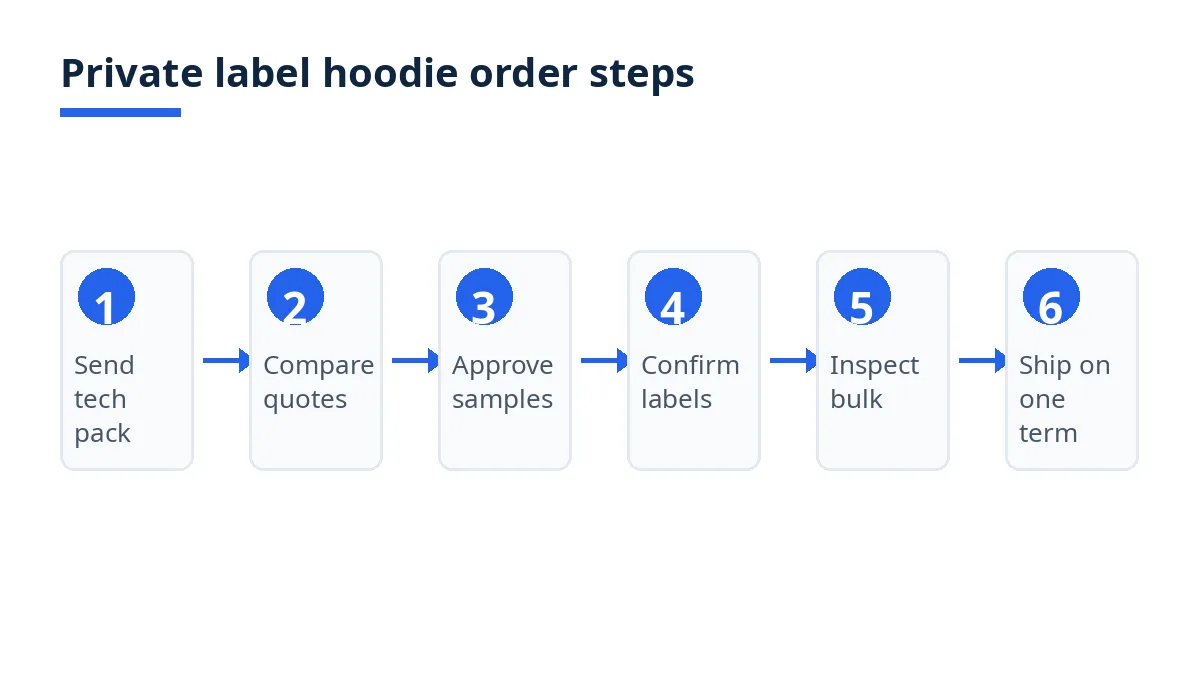
Write one tech pack and one label pack. State fabric composition, construction and weight, hood or crew neck, pocket and zip details, size chart, artwork and trims. Add the label pack: main label, size label, care and content label, hang tag, barcode and carton marks, each as a separate file.
Send the same pack to several factories. Give the quantity per style, per colour and per size, the target market and one delivery term. Ask each factory for its MOQ per style and per colour, which steps are in-house, and where the factory and its dyeing partner sit.
Compare quotations line by line. Compare fabric, construction, artwork, trims, label and tag runs, finishing and packing on the same specification and the same Incoterm.7 Ask for set-up costs itemized apart from the unit price. See the hoodies and sweatshirts MOQ in Bangladesh guide for what sets each minimum.
Approve samples and label proofs together. Order a proto sample, then a pre-production sample in your fabric and colour with your labels sewn in. Measure it, wash it and check the label content against the fabric spec.5 Approve or list corrections in writing.
Confirm the order with the controls written in. Put the split per colour, the inspection level and AQL values following ISO 2859-1,6 the packing spec and the delivery term into the purchase order. Record which set-ups and label runs you have paid for.
Inspect, then ship on the agreed term. Inspect the finished lot against the approved sample and the purchase order, including label placement, barcode scans and carton marks. Release shipment only on the term and named place in the order.7
Costs, timelines and documents
What are the typical costs and timelines?
There are no typical costs or timelines a guide can state as fact. Each factory prices your fabric, hood and pocket construction, artwork, trims, label and carton runs, finishing and packing, and the delivery term you choose.7 Private label adds its own lines on top of the garment: woven labels, printed tags, barcode stickers and printed cartons are ordered separately from the sewing run, each with its own minimum.
The price drivers are fabric composition and weight, dyeing and fleece finishing, cutting and sewing, print or embroidery set-up and application, trims such as drawcords, eyelets and zips, your label and tag package, retail packing, inspection and the delivery term. Each adds cost for a different reason, so ask for the quotation split by line rather than accepting one unit price.
Example figures: a brand owner splits 1,200 pieces across four colours at 300 per colour, with a woven label run sized for the full 1,200. The label run clears its minimum on the total, while each colour sits below its per-colour dye minimum. The same 1,200 pieces in two colours at 600 per colour can clear both lines. The example shows structure only, not a typical MOQ, price or lead time. For timelines, ask for each stage as a separate line: label and tag production, sampling and corrections, fabric and dyeing, bulk production, inspection and shipment. Label runs and fabric dyeing usually start the clock, because sewing cannot finish until labels arrive and cutting cannot start until fabric is ready.
Which documents are needed?
Your order documents are the tech pack, the label pack with approved proofs, the itemized quotation and the purchase order. For export clearance in Bangladesh, goods may not be loaded unless an export declaration, the Bill of Export or Shipping Bill, is submitted to Customs and approved.8 Enclosed documents include the export contract or purchase order where there is no export letter of credit, the commercial invoice, the packing list, the EXP form certified by an authorized dealer, and a certificate of origin issued by the EPB or a Chamber of Commerce and Industry.8
Bangladesh-specific rules and tips
Check the factory behind the address. Ask whether the address on the quotation is the sewing factory or a head office, and where knitting, dyeing, printing and embroidery happen. The industrial zones reported for factory data include Ashulia, Gazipur, Narayanganj and Chattogram.3
Confirm association claims at the source. If a supplier claims BKMEA membership, confirm it with the association itself. BKMEA represents the knitwear sector and its member factories,1 so membership signals an active knitwear business. It does not confirm capacity for your style or your delivery date.
Keep one legal name across every paper. The export declaration names the exporter and the foreign buyer,8 so the name on the trade licence, quotation, proforma invoice and payment account should match. A mismatch slows clearance and payment matching.
Ask which inputs are imported for your order. Zips, eyelets, specialty yarns and some label materials may be bought in for your specification. An imported trim can set both the earliest production date and a separate minimum, so ask for its lead time before you fix your launch date.
Agree the size ratio per colour before production. Private label stock is sold under your name, so a broken size ratio in one colour is your markdown, not the factory's. State the ratio per colour in the purchase order and check it at inspection.
Mistakes and red flags
What are the most common mistakes?
Sending artwork without a label pack. A logo file is not a label specification. Without sizes, materials, fold types, placement and barcode data for each label and tag, the factory guesses, and the guess is sewn into every piece.
Approving the garment sample but not the labels. Buyers measure the hoodie and skip the sewn-in labels, then find a wrong fibre percentage at inspection. The label content is your legal statement in your market,5 so proof it like the tech pack.
Comparing quotations on different specifications. A lower price on a lighter fleece, stock labels instead of your woven labels, or a different delivery term is a different offer. Compare only replies to the same tech pack, label pack and Incoterm.7
Treating capacity claims as checked facts. A stated monthly capacity is a claim until you test it against your style: ask how many lines run fleece hoodies and what share is already booked for your window.
Reading a badge as a guarantee. A profile badge records a document or photo review. It is not a guarantee of capacity, quality or delivery,9 and it does not replace sample approval or inspection.
Changing artwork after labels are woven. A late colour or spelling change restarts the label run and can move the whole order. Freeze artwork at purchase order stage and record the freeze in writing.
Checklist
Before you confirm, every line should be answered in writing.
Tech pack sent: fabric, hood or neck, pocket, artwork, trims, sizes, packing.
Label pack sent and proofs approved: main label, size label, care label, hang tag, barcode, carton marks.
Fibre names and percentages on the content label checked against the fabric spec.5
Split stated per style, colour and size, with one size ratio per colour.
MOQ confirmed per style and per colour; label and tag minimums confirmed apart.
In-house and subcontracted steps named: dyeing, printing, embroidery, finishing.
Set-up and label costs itemized apart from the unit price; paid set-ups recorded.
Pre-production sample with your labels sewn in, measured, washed and approved in writing.
Inspection level and AQL values in the purchase order.6
Quotations compared on the same specification and Incoterm.7
Export set agreed: invoice, packing list, EXP form, certificate of origin, Bill of Export.8
How Exportain helps
On Exportain, browse suppliers and post a request for quotation (RFQ) on the RFQ board with your tech pack summary, label pack summary, split per colour and delivery term, so factories quote against the same specification. State your target market in the RFQ, because your labelling duties follow the market you sell into.5 When you accept a quotation, Exportain creates one order and issues one proforma invoice from the accepted terms.9
Exportain Verified means Exportain has checked identity, phone, email and business registration, and Export Verified means it has checked the Export Registration Certificate (ERC).9 Factory Verified means it has reviewed photos of the manufacturer factory, while Trading Company Verified means it has reviewed photos of the trading company office or warehouse.9 Verification is a document review by staff, free, and never granted by membership plans.10 It is not a factory inspection,9 10 so sample approval, label proofing and inspection stay with you. See how supplier verification works on Exportain and the MOQ definition guide.
FAQs
What should I know first about hoodies and sweatshirts?
Private label means the factory produces to your tech pack and your label pack, and the minimum is set per style and per colour by fabric and dye lots, artwork set-up and label and tag runs. Knitted hoodies and sweatshirts sit under HS heading 6110, which covers jerseys, pullovers, cardigans, waistcoats and similar articles, knitted or crocheted.4
What are the typical costs and timelines?
There are no typical figures a buyer can rely on, because each factory prices your fabric, construction, artwork, label package, split and delivery term.7 Ask for both split by line and by stage.
Which documents are needed?
The order documents are the tech pack, the label pack with approved proofs, the itemized quotation and the purchase order. The export set is the Bill of Export, commercial invoice, packing list, EXP form certified by an authorized dealer, and a certificate of origin.8
What are the most common mistakes?
The most common mistakes are sending artwork without a full label pack, approving the garment sample without proofing the sewn-in labels, comparing quotations on different specifications or terms,7 and reading a badge as a guarantee. A badge is not a guarantee of capacity, quality or delivery.9
Next steps on Exportain
Browse suppliers, then post your tech pack summary, label pack summary and split per colour on the RFQ board so factories state their MOQ per style and per colour. Before you confirm, read how to import hoodies and sweatshirts from Bangladesh and the hoodies and sweatshirts quality control checklist.
Sources
- BKMEA at a Glance. BKMEA (accessed )
- Exports up over 6% to $13.1bn in Q1 of current fiscal. United News of Bangladesh (accessed )
- 400 textile makers fold operations in 3 years. The Financial Express, (accessed )
- Classification Detail — HS Code 6110. United Nations Statistics Division (accessed )
- Regulation (EU) No 1007/2011 on textile fibre names and related labelling and marking of the fibre composition of textile products. European Union, (accessed )
- ISO 2859-1:2026 - Sampling procedures for inspection by attributes — Part 1: Sampling schemes indexed by acceptance quality limit (AQL) for lot-by-lot inspection. ISO (accessed )
- Incoterms® 2020. International Chamber of Commerce (ICC) (accessed )
- Customs Clearance Procedures for Export. Bangladesh Customs, National Board of Revenue (accessed )
- Trust & Safety Center. Exportain (accessed )
- Supplier verification: Earn trust badges buyers can see. Exportain (accessed )
- supplier verification
- knitwear
- buyer guide
- Bangladesh sourcing
- bangladesh garments
- Hoodies and sweatshirts
- Private label
About the author
Sourcing from Bangladesh?
Post a request for quotation and suppliers on Exportain can send you their quotes directly.
Post an RFQ