Private Label Finished Leather Manufacturing in Bangladesh: A Brand Owner's Guide
Private label finished leather puts your brand name on a tannery's leather. Settle the brand file, the sample approvals, the labeling, and the trademark questions in writing before bulk.
Short answer
Private label finished leather from Bangladesh means a tannery makes finished leather to your specification and applies your brand identity: artwork, label or stamp, and packaging. You own the specification, shade and finish standards, and approval decisions; the tannery owns the material and the process. Settle the brand file, trademark permission, and approval loop in writing, count the minimum per color and finish combination, approve a branded sample, and inspect branded lots against the standard.

On this page
Key takeaways
Settle the brand file first: one version holding the material specification, the brand identity, the approval record, and the commercial frame.
Approval runs in order: specification, shade and finish samples, sample hides, branded sample, written approval, then bulk. A change restarts the loop from the changed stage.
Trademark permission is a written question for a professional adviser: ownership, registration markets, permission scope, unused labels, and dispute handling.
A minimum counts per color and finish combination. Example figures: 75 hides per combination across 3 colors and 2 finishes is 450 hides, with 550 labels left from a 1,000-label run.
A tannery audit assesses the tannery, never the product. Require lab evidence for the lot itself, by named method, separately from audit evidence.
Private label finished leather in Bangladesh puts your brand name on leather that a Bangladeshi tannery makes to your specification. You own the brand identity and the approval decisions. The tannery owns the material, the process, and the production record. This guide follows that split from the first specification sheet to the repeat order, so each decision is settled in writing before it costs you a lot.
Private label is neither wholesale buying nor a custom product design program. In wholesale buying, you accept leather made to the tannery's range and judge it grade first and lot first. In a custom program, you design the finished product through a technical pack. In private label finished leather, the leather itself is the product, and your work is identity: the specification, the shade and finish standard, the label and packaging, and the approval record that ties every lot back to your brand.
Private label finished leather in Bangladesh: what you own and what the tannery owns
Write the split down, because every later argument comes from a line that was never written. You own the brand name, the artwork, the specification, and the right to approve or reject each stage. The tannery owns the hides, the tannage, the finishing line, and the duty to make the leather match the approved standard. If the tannery chooses a finish shade because no standard was set, that is your missing standard. If you change the shade after approval, that is a new approval, not a correction.
Three questions settle the split before any sample is made. Who supplies the brand artwork, in what file form, and who holds the master copy. Who applies the brand to the leather, the labels, and the cartons, and what happens to unused labels and marked stock if the order ends. What counts as approval at each stage, who gives it, and in what form. Put the answers in the order record. A private label order with no written split is a wholesale order with your name attached, and your name is the part with the most to lose.
Settle the brand file before you ask for a price
A brand file is one document that holds everything the tannery needs to make your leather and nothing it needs to guess. Build it before you request a quotation: a quotation given against an incomplete file will be revised against the complete one, and each revision moves the price, the minimum, or the date.
The file has four parts. The material specification: animal, tannage, finish type, thickness range with measuring points, shade standard, and grade rules. Finished leather is graded, not passed as a perfect sheet, and grading turns on position and size: damage in a corner area may mean only a grade drop, while damage in the main area may scrap the hide.1 Shade, thickness, grain, and softness move from hide to hide and across one hide, so the file must name the standard each hide is judged against, not only the target shade.1 Identity: brand name and artwork as they must appear, label or stamp design, size and placement, carton and packing marks, and the exact material wording. The approval record: approver, stage covered, and versioning of changes. The commercial frame: quantities per color and finish combination, destination, delivery term, and payment terms. Keep one version at a time. When a page changes, issue a new version number and date, and retire the old one in writing.
Brand file part | What to fix in writing | Approval evidence |
|---|---|---|
Material specification | Animal, tannage, finish, thickness range, shade standard, grade rules | Sealed sample per finish and color |
Brand identity | Artwork, label or stamp, size, placement, carton marks | Signed artwork proof |
Approval record | Approver, stage covered, version number and date | Dated written approval per stage |
Commercial frame | Quantities per combination, destination, delivery term, payment terms | Accepted quotation matching the file |
Sealed samples anchor the file. Keep one sealed sample per finish and color, showing grain, shade, softness, and finish, stored flat, away from light, and apart from other colors.1 If the standard lives only in an email thread or a photograph, shade drift becomes a matter of opinion, and opinion favors whoever holds the goods.
The sample and approval loop, in order
Private label approval runs as a loop with a fixed order, and skipping a stage does not save time. It moves the argument to a later stage, where it costs more. Work the loop in this order: specification, shade and finish samples, sample hides, branded sample, written approval, then bulk.
First, the tannery confirms the specification in writing, including anything it cannot make to the stated tolerance. Second, shade and finish samples show the color and surface against the standard, under the agreed light. Third, sample hides show the material at full size: grade, thickness, hand-feel, and finish evenness against the sealed sample. Fourth, the branded sample shows the finished identity: the label or stamp applied as it will appear in bulk, the packing, and the carton marks. Fifth, you approve in writing, naming the version, the date, and the lots covered. Only then does bulk start.
Photographs help between stages. They do not replace any stage: a photograph cannot show hand-feel or be judged under the agreed light. Approve the branded sample in hand, or state in writing that you accept the risk of approving from photographs. Where your specification requires a test, require the result by named method against your specification, for the lot offered, before bulk ships. Do not treat a tannery audit as lab evidence for your lot.
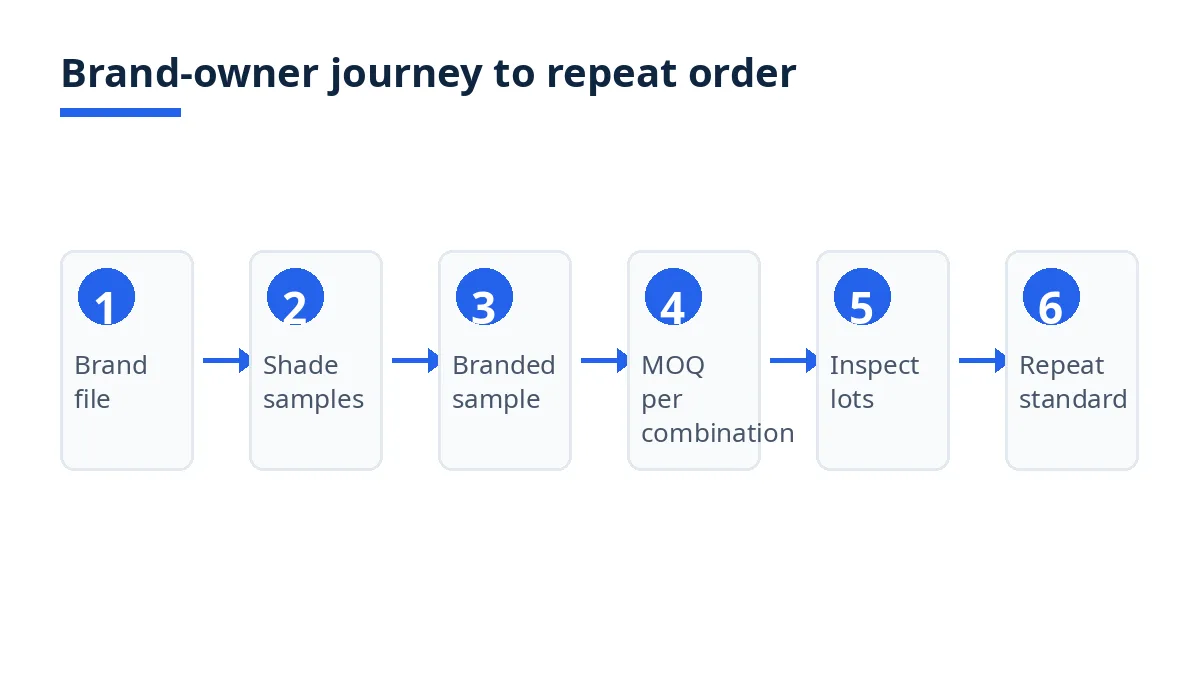
A change at any stage restarts the loop from the changed stage, with a new version number. A shade change after the branded sample means a new shade sample, a new branded sample, and a new approval. That feels slow. It is faster than receiving a bulk lot in a shade your customers will not accept under your name.
Labeling and packaging identity: what carries your name
Your brand reaches the buyer on the leather, on the label or tag, on the packing, and on the documents. Each carrier must say the same thing. The most common private label failure is four carriers that disagree: a stamp that claims one material, a tag that claims another, a packing list that counts a third quantity, and an invoice that describes a fourth.
For finished leather sold as material, the wording that matters most is the material description. In the United States, the Federal Trade Commission guides for select leather and imitation leather products state that it is unfair or deceptive to use the unqualified term "leather" for a product unless the product is composed in all substantial parts of leather.2 The guides apply to listed industry products such as handbags, luggage, wallets, belts when not sold as part of a garment, footwear, and similar articles, and they address manufacture, sale, distribution, marketing, and advertising of those products.2 Finished leather hides as material sit upstream of those products, so settle the description with the buyer of your leather and with professional advice for each market, rather than assuming one market's wording fits every market.
Three disclosure rules from those guides shape what you put on a product that carries your name:
If all or part of a product is made of non-leather material that appears to be leather, disclose that the material is not leather, or its general nature, using terms such as "Not leather," "Imitation leather," "Simulated leather," "Vinyl," "Vinyl coated fabric," or "Plastic."2
When leather has been embossed, dyed, or otherwise processed to simulate a different kind or type of leather, disclose the kind and type of leather in the product.2
Ground, pulverized, shredded, reconstituted, or bonded leather that is not wholly the hide of an animal should not be represented as leather. If a term such as "bonded leather" is used, disclose the percentage of leather fibers and the percentage of non-leather substances, as in the guides' example of 60 percent leather fibers and 40 percent non-leather substances.2
Disclosures should appear as a stamping on the product or on a tag, label, or card attached to the product, fixed so as to remain attached until the consumer purchaser receives it, and in advertising that would otherwise create a false impression.2 A trade name, trademark, stamp, tag, or label should not misrepresent that a product is made from animal skin or hide when it is not, including a stamp or device shaped like a tanned hide or an animal silhouette.2 For your order, every word on the stamp, the tag, the carton, and the invoice describes the same material, in the same terms, and any misleading word is removed before approval, not after shipment.
Packaging identity needs the same discipline. Carton marks carry the brand, the color and finish, the count, and the lot identity. Roll packing protects the finish: hides rolled, never folded, paper between rolls, no weight on the finish, rolling neck to butt.1 A crease set by folding is a brand defect, because the customer meets your name at the same moment they meet the crease.
Brand protection: trademark questions to settle in writing
A trademark is a sign capable of distinguishing the goods or services of one enterprise from those of other enterprises, protected by intellectual property rights.3 Protection can be obtained through registration with the national or regional trademark office, or internationally by filing in each country or through the Madrid System.3 In principle, registration confers an exclusive right to use the mark, which the owner can use exclusively or license for payment; the term is usually ten years, renewable indefinitely, and trademark rights are private rights enforced through court orders.3
This guide gives no legal advice. Trademark law differs by market, and the questions below are questions to settle with a qualified professional adviser before the tannery applies your mark to anything. Do not treat this section as advice about your mark, and do not let a supplier's assurance stand in for an adviser's answer.
Settle these five questions in writing: who owns the mark, and is it registered in each market where the leather or the goods made from it will be sold; what written permission authorizes the tannery to apply the mark, to which goods, in which quantities, and for how long; what happens to artwork files, printing plates, stamps, unused labels, and marked stock if the order or the relationship ends; whether the tannery may use your mark, artwork, or specification for any other buyer, in any form, including as a sample; and how a dispute over the mark is handled, and which law and forum apply. Registration in one market does not by itself answer the position in another, so ask the adviser market by market. Keep the master artwork file yourself, send artwork only in the form the permission names, and require the return or certified destruction of unused labels and artwork at the end of the order if your adviser recommends it. A mark that leaks into another buyer's goods damages the brand in a way no inspection can undo.
MOQ per color and finish combination
A minimum order quantity is the smallest quantity a supplier will accept for a product on its normal terms, counted per order, per style, or per color as the supplier states, and a supplier can combine a quantity minimum with a minimum order value.4 For private label finished leather, the count that matters is per color and finish combination. A tannery lot is dyed and finished as one combination. Three colors in two finishes are six lots, not one order with six shades.
There is no standard MOQ for Bangladesh that you can safely assume, so read each supplier's stated minimum and its counting basis.4 Labels, hang tags, and packaging come from suppliers with minimums of their own, and a custom label made only in large runs can drive your MOQ even when the leather quantity is acceptable.4 A branded order therefore carries two minimums: the leather minimum per combination and the identity minimum for labels, stamps, and cartons.
Work the count on paper before you approve anything. Example figures: a tannery lot minimum of 75 hides per color and finish combination, across 3 colors in 2 finishes, is 3 × 2 × 75 = 450 hides in total. If labels are supplied in runs of 1,000, the same order needs 450 labels for the hides plus spares, and 550 labels from the run remain unused unless the next order uses the same label. That surplus is a real cost of the brand identity, and it belongs in the order record before production.
Negotiation follows the usual levers: fewer colors or finishes, a stock color or finish in place of a custom dye, standard labels or cartons in place of custom ones, a small-order surcharge, or an honest trial order with a realistic forecast.4 Each lever trades something away. Fewer combinations narrow the range. Standard identity items weaken the brand presentation. A surcharge raises the unit cost. Choose the trade in writing, per combination. Never agree a headline minimum without its counting basis: "450 hides" means nothing until you know whether it is 450 per order, per color, or per color and finish combination.
What a branded order adds to cost, time, and paperwork
A branded order costs more than the same leather unbranded, and the extra cost sits in identity, approval, and control, not in the hide: artwork preparation, label and stamp tooling, sample rounds, approval handling, label and carton minimums, branded-lot inspection, and rework when a branded sample fails. No typical figure is stated here, because no opened source in this guide supports one. Compare quotations only on one identical brand file, and require each quotation to state unit price, MOQ, lead time, Incoterm, payment terms, and validity.4
Time follows the approval loop, not the production line alone. Each sample round takes the time the round takes, and each change restarts the loop from the changed stage. Build the calendar backward from the ship date, allow a full round for each approval, and hold the bulk start until the written approval exists.
Documents for a branded order must match the brand file, line by line. Classification deserves a separate check: heading 4107 covers leather further prepared after tanning or crusting, of bovine (including buffalo) or equine animals, without hair on, with subheadings that split whole hides and skins from sides and full grain, unsplit leather from grain splits and other leather.5 Treat every heading as indicative and verify it against the destination tariff with your broker before shipment, because the animal, preparation, form, grain, and finish decide the heading.
Document | What it must match |
|---|---|
Brand file and version record | Specification, artwork, approval stages, quantities per combination |
Artwork proof and approval | Label or stamp design, size, placement, material wording |
Sample and lab record | Sealed sample identity, lot identity, test methods and results |
Packing list | Count, area, color and finish marks, roll labels, lot identity |
Commercial invoice | One line per leather type, quantity, unit, price, delivery term |
Classification note | Heading checked against the destination tariff, recorded as indicative until verified |
Bangladesh notes: the tannery behind your brand name
Your brand name travels with the tannery's record. A buyer who questions the tannery's environmental performance questions your brand, because the name on the carton is yours. Ask for evidence about the producing site itself, separately from evidence about your lot, and read both before you approve bulk.
The Leather Working Group audit is an assessment of how a tannery measures, controls, and reports the impact of its manufacturing operations, covering 17 sections that include water and energy usage, environmental management, chemical management, waste management and effluent treatment, and health and safety.6 Companies are rated in each section against thresholds of 85 percent for Gold, 75 percent for Silver, 65 percent for Bronze, and 50 percent for Audited, and a manufacturer must achieve its medal rating across all categories or be certified at the level of the lowest category.6 Certification is valid for 24 months for leather manufacturing facilities, commissioning manufacturers, and subcontractors, and 12 months for part-processed material traders.6 The audit is a tannery audit, never a product certificate: LWG certification does not guarantee that there will be no restricted substance failures in a final product, and traceability is rated separately as a percentage.6
Effluent evidence belongs beside the audit. Tanners in Bangladesh were relocated from Hazaribagh in Dhaka to the Savar Tannery Industrial Estate, and the central effluent treatment plant there was reported in May 2026 as capable of treating between 14,000 and 18,000 cubic meters of waste a day, against about 45,000 cubic meters needed during the peak period following Eid-ul-Azha.7 The same report records a government plan for capable tanneries to establish their own effluent treatment plants, with support where necessary.7 The audit itself notes that the efficiency of a common effluent treatment plant could affect the scores achieved, and that third-party evidence of its performance is required.6 The practical question is which site made your lot, what audit evidence covers that site and its dates, and what effluent evidence covers the same site. A certificate for a different site, or an expired audit, answers none of those questions.
Quality checks that protect a brand name
Quality control for branded leather checks two things at once: the material and the identity. A lot can pass as material and fail as a brand lot, because the shade is right and the label is wrong, or the finish is right and the carton count is short. Inspect branded lots against the brand file, not against a general idea of good leather.
Start with the sealed standard. Compare shade under the agreed light, finish against the approved sample, thickness at the agreed points, and hand-feel against the sample, hide by hide where the sampling plan requires it. Grade each hide under your rules, with defects recorded by position and size.1 Then check identity on the same hides: label or stamp legible, correctly placed, and matching the approved proof; material wording identical on the stamp, the tag, and the invoice; carton marks matching the packing list. Then reconcile counts: hide count, area total, color and finish marks, and roll labels against the packing list and the order.1 A label shortfall is a shipment shortfall, because unmarked hides cannot ship under your name without a new approval.
Lab evidence follows the same rule as the approval loop: each test by the method your specification names, with the result judged against your specification, for the lot offered. No universal pass mark is stated here, because none applies across buyers. A pre-shipment inspection samples finished, mostly packed goods; it is not a check of every piece, and it is not a guarantee.1 Agree the sampling plan, the defect classes, and the acceptance basis in writing before production, and require a report that records the lot, the sample size, defects with photographs and position marks, thickness readings, shade findings, lab methods and results, and packing findings.
Repeat orders test the brand file, not the tannery's memory. Before each repeat, confirm that the sealed standard, the artwork version, and the label stock are unchanged, or issue a new version and run the approval loop for the changed part. Shade drifts lot to lot.
Mistakes and red flags for brand owners
The mistakes below are brand mistakes first and material mistakes second. Each one is preventable in the brand file.
Approving from photographs alone, without the branded sample in hand.
Accepting a verbal approval, or an approval that names no version and no date.
Setting one shade standard for every finish, when aniline, semi-aniline, and pigmented finishes show shade and pore structure differently.1
Counting the MOQ across combinations, when the minimum applies per color and finish combination.
Letting the tannery hold artwork, plates, and unused labels without written terms.
Copying labeling wording from another market without professional advice for the market you sell into.
Treating a tannery audit as evidence that your lot meets your specification, when the audit assesses the tannery and your lot needs its own lab evidence.6
Inspecting unbranded hides and assuming the branded lot matches, when identity checks were never run.
Accepting a quotation that states no MOQ counting basis, no label minimum, and no approval stages.
Red flags in a supplier's answers follow the same pattern: a supplier who will not name the producing site, or who offers audit evidence for a different site; who quotes a branded order without asking for artwork, label quantities, or approval stages; who promises one minimum for every combination without asking how the count is split; or who cannot show a sealed sample per combination. Any of these is a reason to pause the order and fix the file, not a reason to negotiate harder on price.
Brand-owner checklist before the first bulk order
Every line must be true, in writing, and tied to a version or a date, before bulk starts. A line that is true verbally is not true for this checklist.
Brand file issued as one version, with material specification, identity, approval record, and commercial frame.
Sealed sample per finish and color held, with grade rules and shade standard recorded.
Artwork proof approved, with label or stamp size, placement, and material wording fixed.
Trademark questions settled with a professional adviser, and written permission for the tannery to apply the mark recorded.
MOQ counted per color and finish combination, with label and carton minimums counted separately.
Quotation accepted against the same brand file, stating unit price, MOQ, lead time, Incoterm, payment terms, and validity.
Approval loop completed in order, with dated written approval naming the version and the lots covered.
Tannery audit evidence and effluent evidence read for the producing site, with dates checked.
Inspection plan agreed, with sampling basis, defect classes, lab methods, and report contents fixed.
Packing, roll, and carton rules agreed, with count and label reconciliation against the packing list.
What should a brand owner settle first in a private label finished leather order?
Settle the brand file, the trademark questions, and the approval record before you settle the price. The file fixes the specification, the identity, and the quantities per combination. The trademark questions fix ownership, registration markets, and written permission, answered with professional advice. The approval record fixes who approves each stage and how changes are versioned. A price agreed before these are settled will be revised against them, after the sample rounds, when your options are narrowest.
What do branded orders cost, and how long does approval take?
Branded orders add identity, approval, and control lines to the cost of the same leather unbranded: artwork, tooling, sample rounds, label and carton minimums, inspection, and rework. No typical cost figure is stated, because none is supported by an opened source. Time follows the approval loop: each change restarts the loop from the changed stage. Build the calendar backward from the ship date, allow a full round per approval, and do not start bulk on a pending approval.
Which documents does a private label finished leather order need?
The order needs the brand file and version record, the artwork proof and written approval, the sample and lab record tied to the lot, the packing list reconciled to counts and labels, the commercial invoice with one line per leather type, and a classification note recorded as indicative until verified against the destination tariff. Heading 4107 covers bovine and equine leather further prepared after tanning or crusting, with subheadings splitting whole hides from sides and full grain from grain splits.5 Have your broker confirm the heading for your animal, preparation, form, grain, and finish before shipment.
What are the most common mistakes in private label finished leather?
The most common mistakes are approving from photographs alone, accepting verbal approvals with no version or date, setting one shade standard for every finish, counting the MOQ across combinations, leaving artwork and unused labels without written terms, copying labeling wording across markets without professional advice, and treating a tannery audit as lot evidence. Each moves a brand decision into a bulk lot, where fixing it costs a shipment. Fix each one in the brand file, before bulk.
Next steps on Exportain
Write your brand file first, with the specification, the artwork proof, and the quantities per color and finish combination, then browse Bangladeshi suppliers and read each profile's trust and verification checklist before you shortlist. Badges on Exportain record a document and photo review by staff, not a factory inspection or a guarantee, and membership never grants a badge.8 When the file is ready, post an RFQ carrying the full brand file, and ask each supplier to answer on the same specification, the same combinations, and the same approval stages. For the badge meanings and the checks behind them, read how supplier verification works on Exportain before you commit money.
Sources
- Quality Control Checklist for Finished Leather. Exportain, (accessed )
- PART 24—GUIDES FOR SELECT LEATHER AND IMITATION LEATHER PRODUCTS. Federal Trade Commission (accessed )
- Trademarks. World Intellectual Property Organization (accessed )
- MOQ Meaning (Minimum Order Quantity). Exportain (accessed )
- Classification Detail: HS, 2017, Code 4107. United Nations Statistics Division (accessed )
- Certification - Leather Working Group. Leather Working Group (accessed )
- Govt to fix Savar CETP's deficiencies, back tanneries' own ETPs: Commerce minister. The Daily Star, (accessed )
- How Supplier Verification Works on Exportain. Exportain, (accessed )
- MOQ
- supplier verification
- quality control
- HS Codes
- buyer guide
- Bangladesh sourcing
- Finished leather
- Leather
About the author
Sourcing from Bangladesh?
Post a request for quotation and suppliers on Exportain can send you their quotes directly.
Post an RFQ