

Quality Control Checklist for Printed Labels and Tags From Bangladesh
A numbered QC checklist for printed labels and tags from Bangladesh: artwork and text, dimensions, print legibility, care symbols, barcode scanning, attachment strength, wash durability and packing, with fixes for common failures.
Short answer
Use this printed labels and tags quality control checklist to check artwork and text, label dimensions and tolerances, print legibility and colour, care-label symbols in the ISO 3758 order, barcode scanning and quiet zones, sewn and adhesive attachment, wash durability and carton packing on labels and tags from Bangladesh before shipment. Agree artwork, tolerances, barcode numbers and acceptance levels in the purchase order first.
On this page
Key takeaways
Compare every label type against its own approved artwork, and check each language version separately rather than assuming one passing version covers the rest.
Check care symbols in the ISO 3758 order, washing, bleaching, drying, ironing and professional textile care, with no symbol cut off by a fold or seam.
Scan barcodes rather than judging them by eye, keep the quiet zones clear of artwork, and record the verifier grade against the agreed level.
Wash sampled labels with the garment and re-check print, colour and symbol clarity, since a label that looks sound before washing can fail after it.
A printed label carries the information a shopper, a customs officer and a laundry rely on: brand, size, fibre content, care instructions and the barcode that gets the garment sold. When a label is wrong, the garment behind it can be held, returned or marked down even though the garment itself is sound. This checklist covers the label itself, for buyers sourcing printed labels and tags with garments from Bangladesh.
Why this checklist matters
Labels fail in ways that are easy to miss on a folded garment: a care symbol in the wrong order, a size label sewn into the wrong batch, a barcode with its quiet zone crowded by artwork, or an adhesive tag that lifts off a coated fabric. All of these surface after shipment, when fixing them means opening cartons. Checking labels before shipment keeps those failures in the factory.
A second reason is that a label is checked by more than one reader: the buyer reads the brand and size, the retailer scans the barcode, and the end customer follows the care symbols. One checklist that follows the label from artwork approval to carton packing covers all three readers in a single pass.
Before you start
Do not begin until the references are complete: approved artwork for every label type, the purchase order and packing list, the size and colour breakdown, the approved care instructions, and the barcode numbers for every SKU. Agree tolerances, the sampling plan and acceptance levels in the purchase order first, and draw the sample randomly across sizes, colours and cartons.
Check the label plan before bulk printing. Confirm which label types the order needs, because a woven brand label, a printed care label, a size label and a hang tag are made differently and fail differently. Confirm the destination markets too, since wording, language and symbol conventions differ between the USA, the UK, the EU and the UAE.
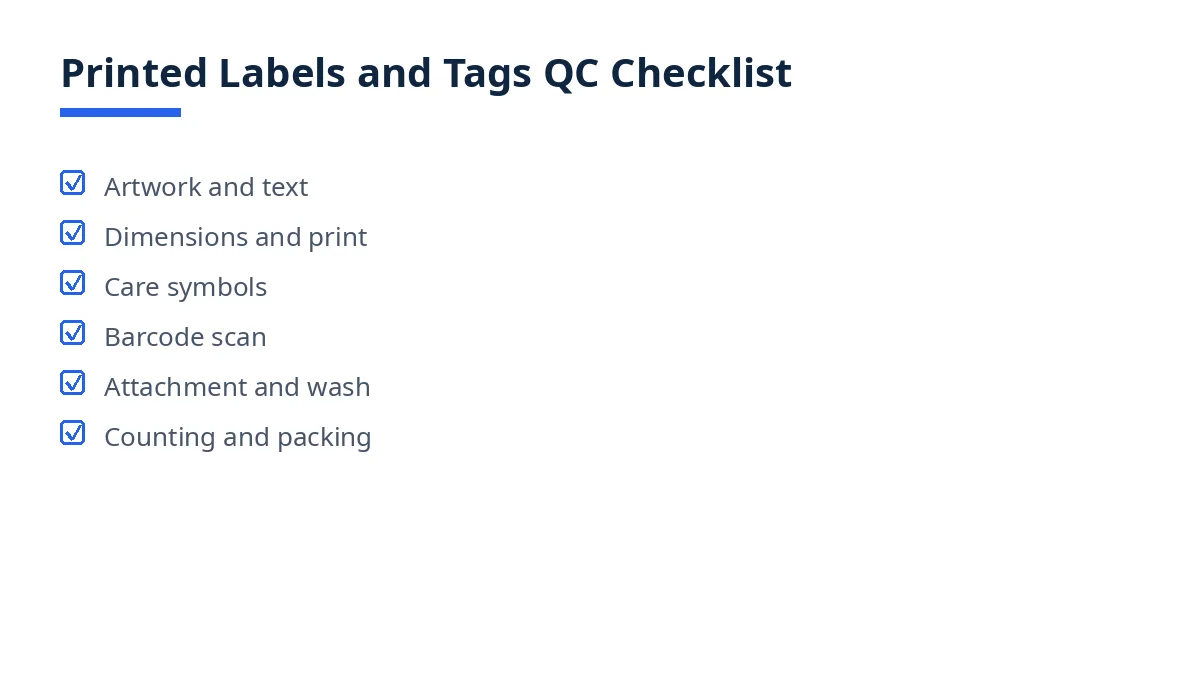
The full checklist (numbered, printable)
Artwork, text and language
Compare every label type against the approved artwork, line by line, including brand name spelling, logo placement, size, style code and country of origin line.
Check bulk text against the approved wording.
Check fibre composition wording and percentages against the approved composition sheet, not an earlier version.
Check each language version against its own approved text, not assumed correct because another version passed.
Check that any claim on the label matches evidence agreed with the buyer, and record unsupported claims as failures.
Check hang tag text against the purchase order: price, style, colour and size must match the garment it will carry.
Dimensions and tolerances
Measure sampled labels flat, without stretching, and compare each measurement with the agreed tolerance.
Check the folded width of folded labels, since a label correct when flat can still sit wrong once folded into a seam.
Check the attachment zone is free of print that the seam or adhesive would cover.
Check hang tag dimensions and hole position, so the tag hangs straight and the fastener does not tear through the card.
Record actual measurements.
Print legibility and colour
Read the print at a normal reading distance under normal light, and confirm every line is legible without guessing.
Check print colour against the approved swatch under the same light, and confirm it matches across sampled labels rather than drifting between print runs.
Check for blurred, doubled or missing print, ink smears, pinholes and uneven coverage across the full print area, not only at the centre.
Check the reverse side for show-through, where heavy ink on the face makes the back unreadable.
Check small print in particular: size numbers, care wording and barcode numbers are most often printed too small or too faint.
Care-label symbols
Check the care symbols against the approved care instructions, symbol by symbol, and confirm none has been added, dropped or replaced.
Check the symbol order: washing, bleaching, drying, ironing and professional textile care, in that sequence. ISO 3758:2023 gives care instructions in the order of five main treatments: washing, bleaching, drying, ironing and professional textile care.1
Check that the symbols describe the most severe treatment that does not cause irreversible damage to the article, which is the basis of the ISO 3758 system.1
Check that no symbol is cut off by a fold, seam or trimmed edge, and that a bar or cross on a symbol is fully visible.
Check symbol size and clarity: each symbol must be large and sharp enough to read on the finished label, not only on the proof.
Barcodes and variable data
Scan every barcode type in the sample with a handheld scanner, and confirm each code reads on the first pass.
Check the quiet zone on both sides of each barcode: the empty space beside the start and stop symbols must be clear of artwork and text, since GS1 guidance states that the light margin is needed so adjacent artwork does not interfere with reading.2
Check the encoded number against the purchase order and SKU list, and confirm the printed human-readable number matches it.
Where a verifier is used, record the grade against the agreed level. GS1 standards require barcodes to have a quality of ANSI Grade C, corresponding to ISO/IEC 15416 Grade 2, when the item reaches the end of its normal supply-chain use.2
Check variable data on hang tags and stickers, such as size and price, against the carton contents: a correct barcode on the wrong size is still a wrong label.
Attachment and adhesive
Pull each sewn label gently by hand: stitches must pass through the label, with no skipped stitches, loose ends or stitching that misses the edge.
Check label position against the approved placement, including side, distance from the seam and orientation, on sampled garments.
Check adhesive labels after handling: press, rub and flex the label as a garment would be handled in packing, and confirm the edges stay down.
Check hang tag fasteners: the pin or string must hold the tag without tearing garment or tag, and must be removable without damaging either.
Wash and wear durability
Wash sampled labels with the garment following the approved care instructions, then check print legibility, colour and symbol clarity.
Check for colour bleed onto the garment fabric after washing, and for fraying or curling at the label edges.
Check heat sensitivity where relevant: a label that warps, melts or loses print under ironing at the labelled temperature is a failure even if it looked sound before.
Counting, sorting and packing
Count labels per garment and per carton against the purchase order, and confirm mixed sizes and colours are sorted into the correct cartons.
Check that spare labels are handled as the buyer directed, and are not left loose in cartons where they could be mixed into the wrong shipment.
Check carton labels against the contents: style, size breakdown and quantity on the carton must match the packing list.
Common failures and how to fix them
The most frequent failure is a care symbol error: a symbol in the wrong order, a missing bar under a wash symbol, or a symbol partly cut off by a fold. Stop, compare the bulk label against the approved care instructions symbol by symbol, and re-check the fold position before more labels are sewn in. Next is a barcode that scans in the factory but fails at retail, usually because the quiet zone is crowded or the print contrast is low: re-check the artwork spacing and print contrast on a fresh sample, and verify with a scanner rather than by eye.
Mixed size labels are another regular failure, where one size run is sewn into another size batch. Re-sort the affected batch by checking the label against the garment size before packing. Blurred or faint print usually traces to a worn plate or low ink: re-print a test label and compare it with the approved proof before the bulk run continues. Adhesive labels that lift off coated or treated fabrics need a different adhesive or a sewn alternative, agreed with the buyer, not simply pressed harder.
Above the agreed acceptance level, options are re-inspection after sorting or rework, documented partial acceptance, or rejection.
Downloadable template / summary table
Copy the checklist into your inspection sheet, add the artwork references, tolerances and acceptance numbers, and record a result per label type.
Section | Checks | Evidence |
|---|---|---|
Artwork and text | Brand, size, origin, language, claims | Artwork comparison |
Dimensions | Length, width, fold, attachment zone | Measurements |
Print and colour | Legibility, colour, smears, small print | Visual check, swatch |
Care symbols | Symbol set, order, visibility | Symbol-by-symbol check |
Barcodes | Scan, quiet zone, encoded number, grade | Scanner, verifier report |
Attachment | Stitching, position, adhesive, fastener | Pull and handling checks |
Wash durability | Legibility, bleed, fraying, heat | Washed samples |
Packing | Counts, sorting, carton labels | Packing list |
How Exportain helps
Exportain is a B2B marketplace connecting buyers with Bangladeshi suppliers, so the label specifications behind this checklist can be agreed at the enquiry stage, before printing starts. Browse suppliers, post an RFQ describing the label types and markets in the order, and use inspection services when you plan the check. Supplier profiles show which document and photo checks have been recorded, not factory inspections. Exportain is not a party to the goods contract and does not inspect goods.
FAQs
When should this checklist be used?
Use it at final inspection, when labels are attached and goods are largely packed. For first orders and new artwork, also use it before bulk printing, while a plate or artwork error can still be corrected.
Who should complete it?
The buyer, a local agent or an independent inspector can complete it, using the approved artwork, size breakdown and a randomly drawn sample.
What are the most common failures?
Care symbol errors, crowded barcode quiet zones, mixed size labels, blurred print and lifting adhesive labels are the failures buyers find most often.
Can a third party do it?
Yes, if you share the approved artwork, tolerances, barcode numbers and acceptance levels first.
Next steps on Exportain
Before bulk printing starts, agree your artwork, tolerances, care symbols and barcode numbers, then read the AQL acceptance quality limit explainer and the pre-shipment inspection guide, and plan the check with inspection services. You can also post a free RFQ via RFQs.
Sources
- ISO 3758:2023 — Textiles — Care labelling code using symbols. International Organization for Standardization (accessed )
- Barcode quality. GS1 Sweden (accessed )
- pre-shipment inspection
- quality control
- aql inspection
- bangladesh garments
- Printed labels and tags
- Care labels
About the author
Sourcing from Bangladesh?
Post a request for quotation and suppliers on Exportain can send you their quotes directly.
Post an RFQ


