Typical MOQ for Potatoes in Bangladesh (and How to Negotiate It Down)
A potato MOQ from Bangladesh is usually one full reefer container, about 27 to 29 tonnes. This guide explains how the number is set by harvest lot, grade, pack and container load, and which levers bring it down.
Short answer
For potatoes from Bangladesh, expect a minimum order of one full reefer container, about 27 to 29 tonnes, for fresh table or processing potatoes, and one certified lot for seed potatoes. The MOQ is set by the harvest lot, the grade, the pack and the container load. You can bring it down by taking the standard 25 kg bag and size band, joining a planned grading run, offering a higher unit price or a firm written reorder, and splitting the order across sailings with separate documents for each part.
On this page
Key takeaways
Fresh table and processing potatoes are usually quoted by the full reefer container, about 27 to 29 tonnes, while seed potatoes are quoted per certified lot.
Ask what the MOQ applies to first: per variety, per size band, per pack or per shipment changes the whole negotiation.
Standard 25 kg mesh bags, a standard size band, a flexible ship date and a firm written reorder are the levers that move a potato MOQ.
Split shipments need their own invoice, packing list, transport document and phytosanitary certificate per part, and the letter of credit must allow them.
A buyer who needs 12 tonnes of table potatoes a month asks three Bangladeshi sellers and gets the same answer three times: one full container, take it or leave it. That number is set by the harvest lot, the grade, the pack and the container, and each of those can be traded against something the seller values.
What does a potato MOQ actually cover?
A minimum order quantity is the smallest number of units, cartons or invoice value a supplier will accept on a single purchase order.1 For potatoes, that one number hides three minimums: per variety, per size band and pack, and per shipment.
Ask which unit the quoted figure uses before you negotiate anything. One container per order is a different deal from one container per variety, and a minimum per size band can turn a two-variety order into two full containers. The pack has its own minimum too: printed 5 kg retail bags carry a higher floor than plain 25 kg mesh bags.
The quoted MOQ is a commercial position, not a law of nature. Three cost drivers sit underneath most quotes: fixed setup costs, raw material bought in fixed lots, and line time and labour.1 For potatoes, those are the harvest lot and the grading run, a perishable crop bought in bulk, and the sorting and packing shift. A request that answers one of those drivers reads as a trade.
What is the typical MOQ for potatoes from Bangladesh?
There is no single published MOQ for Bangladeshi potatoes. What the trade does publish is the container-sized starting point, and the order type decides how far below it you can go.
Order type | Typical starting point | What sets the floor |
|---|---|---|
Fresh table potatoes | One full reefer container, about 27 to 29 tonnes | Container load, grading run and pack size |
Seed potatoes | One certified lot, quoted per variety and class | Seed certification and inspection per lot |
Processing potatoes | One full reefer container, about 27 to 29 tonnes | Storage history and fry test per lot |
Trial or sample order | A small air-freight quantity or a shared load | Freight per tonne and inspection cost |
The container figure comes from published fresh-potato export practice: one exporter lists a minimum order of one 40-foot high-cube reefer container, with an indicative load of about 27 to 29 tonnes depending on configuration.2 The usual export pack is a 25 kg jute or leno mesh bag, and 10 kg ventilated cartons are the other common choice; the common size bands are 35 to 55 mm, 40 to 60 mm, 50 mm and above, and 60 mm and above.2 Treat the container as the default opening quote.
Seed potatoes work differently. Seed falls under HS 0701.10, while other fresh or chilled potatoes fall under HS 0701.90, and seed is a certified planting material with its own marketing rules.3 A seed order is quoted per certified lot, so splitting one across buyers is harder than splitting a table-potato lot. Processing potatoes ship in container loads too, but they are also judged on storage, since tubers kept too cold accumulate reducing sugars and fry dark.3
A trial order is the exception to the container rule. Small quantities can move by air freight or as part of a consolidated load. The freight per tonne on a small shipment is high, so work out the landed cost per tonne before you celebrate a small quantity.4
How is a potato MOQ set?
Three steps in the chain set the number you are quoted. First, the harvest lot. The January to March harvest of 2025 supplied the record crop that year.5 A lot already graded to your size band and variety can be sold in smaller pieces than a lot that still needs a grading run. Ask whether your size band is already graded and held in stock.4
Second, grading. Buyers judge a table potato on its variety and tuber shape, on skin and flesh colour, on even sizing, and on the absence of greening, sprouts, soil and damage.3 The Codex standard for ware potatoes requires tubers to be intact, sound, firm and clean, practically free from pests, with sprouts no longer than 3 mm and green colouration under one eighth of the surface, and it classifies ware potatoes into Extra Class, Class I and Class II.6
Third, the container load. After harvest, tubers rest for ten to fourteen days in air held at 12 to 16 degrees Celsius with humidity of 85 to 95 percent, which heals wounds and toughens the skin, then travel near 7.5 degrees for table use and near 10 degrees for processing.3 A reefer container is loaded to a set weight and airflow pattern, so a part load wastes refrigeration and freight already booked. That is why the container, not the tonne, is the unit most sellers quote.
What pushes the MOQ up, and what pulls it down?
The same seller can quote a different MOQ in December and in July, because the crop behind the quote changes. The Bangladesh Bureau of Statistics puts the 2024-25 harvest at 11.57 million tonnes, up 9.17 percent on the 10.60 million tonnes grown the year before.5 A record harvest means more graded stock is available, when a smaller first order is easiest to place.
A narrow size band, a printed pack, a seed lot, a short lead time or a new destination pushes it up, because the phytosanitary certificate is issued for one consignment, not for a series of small ones.7 Stock on hand, a flexible ship date and harvest timing pull it back down.4
Which negotiation levers work for potatoes?
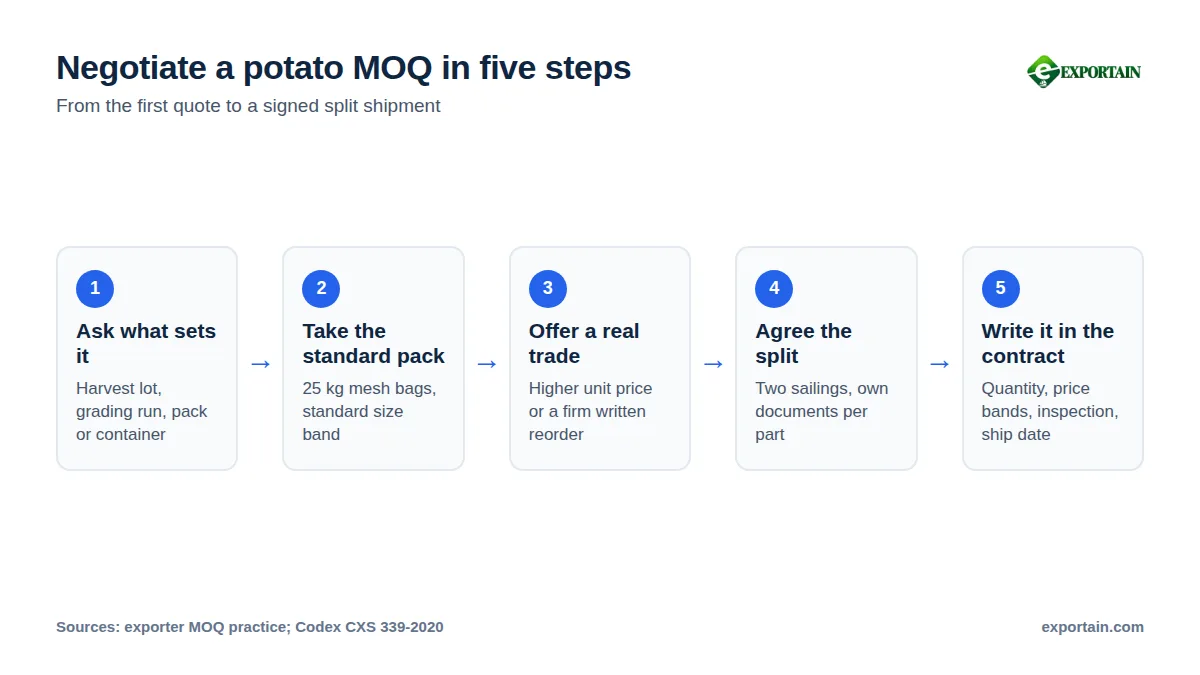
Ask the seller directly what sets the minimum: the harvest lot, the grading run, the pack or the container.4
Pay a higher unit price on the small run, when the barrier is the fixed cost of a short grading run. Compare landed cost per tonne, not unit price alone.4
Take the standard pack and size. A standard 25 kg mesh bag in a size band the seller already grades removes the print run and the extra grading pass.4
Combine varieties or size bands into one total quantity, so two varieties share one container load.1
Join a run already planned, and give up control of the ship date.4
Offer a firm reorder in writing: trial quantity, reorder condition, size and date.4
Be flexible on the ship date. Offer a slow week, or let the seller choose the slot within a window you set.4
Pay faster. It helps a seller buying a harvest lot for your order, but it shifts risk onto you, so offer it only to a seller you have checked.4
Pay a grading or setup fee, and ask for it to be credited against your first reorder.4
Do not promise volume you cannot back up: a broken reorder commitment costs you the next request.1
How do trial orders and split shipments work for a perishable load?
A trial order for potatoes is a paid pilot, not a free sample, so get the reorder terms in writing before you pay.1 A trial by air freight lets you check the variety, size band and packing, but the freight per tonne is high.
A split shipment divides one order across two or more sailings. Decide the split before the first truck arrives, because a split is also a payment trap when the contract assumed one shipment and one invoice.8 The contract should say that partial shipments are allowed, and if a letter of credit is in the deal, the credit itself must allow them.8
Each partial shipment needs its own commercial invoice, packing list and transport document, for the quantity on that vessel.8 The payment term should say whether you pay as each part ships, or only when the full order is complete. Two shipments also mean two freights and two document sets, so agree in writing who carries the extra freight.8
The phytosanitary certificate follows the consignment, not the contract. It is issued by the exporting country's national plant protection organisation, under the IPPC standard ISPM 12, and it attests that the consignment was inspected or tested and meets the importing country's requirements.7 A split order therefore needs a certificate for each consignment, with the quantity and marks matching its own invoice and packing list. A certificate with unauthorised alterations or conflicting information is invalid.7
What should the contract say about quantity?
Put the quantity in tonnes and in bags, not in tonnes alone: 28 tonnes in 25 kg mesh bags is 1,120 bags, and the bag count is what the loader counts. Write the tolerance into the order as well.
Add five clauses that protect a negotiated MOQ: the minimum quantity per order and per reorder, with the price at each quantity band; the partial shipment rule, including whether the letter of credit allows it;8 the inspection point at loading, with the right to reject a lot outside the agreed band; the document set for each shipment;3 and the latest ship date, because a late potato shipment is a sprouting shipment, not merely a late one.
A worked example: negotiating a 28-tonne quote down to a first order that fits
Example figures: a Malaysian wholesaler sells about 12 tonnes of table potatoes a month and wants to test Granola from Bangladesh. The seller quotes one 40-foot reefer container, about 28 tonnes in 25 kg mesh bags, which is more than two months of the buyer's sales. Asked what sets the minimum, the seller names the grading run and the reefer booking. The buyer offers four trades: the standard 25 kg mesh bag and the seller's usual 40 to 60 mm band instead of a printed 10 kg retail bag; a flexible ship date inside a three-week window; a higher per-tonne price on the first container, in exchange for a written reorder minimum at the standard price for the next two orders; and payment in two parts, with the balance due only after the loading inspection confirms the size band and the defect limits.
The seller accepts the full 28-tonne container on those terms, split across two sailings of about 14 tonnes each, each with its own invoice, packing list, bill of lading and phytosanitary certificate, and each paid for as it ships.8 The buyer still takes 28 tonnes, but the stock arrives in two lots and the cash goes out in two parts. The negotiation did not move the total quantity. It moved the risk, the timing and the price of the first order.
Which mistakes cost potato buyers the most?
Negotiating the unit price and forgetting the freight. A lower quantity can be the most expensive order once freight is spread over fewer tonnes.4
Assuming the minimum is per order. It may be per variety, per size band, per pack or per invoice value.1
Overpromising reorders. A commitment you cannot meet damages the relationship and may trigger penalties in the contract.1
Leaving the deal verbal. Quantity, reorder minimum, price bands, lead times and payment terms must appear in the purchase order or the sales contract.1
Ignoring the phytosanitary certificate. Small orders still need one, and a certificate that does not match the invoice quantity or the consignee can hold the load at the border.7 Get the MOQ in writing as tonnes, bags, variety, size band and pack, with the price at each quantity band and the reorder terms beside it.
Next steps on Exportain
Start with our guide to importing potatoes from Bangladesh, then compare it with the wholesale potatoes overview and the potatoes quality control checklist before you write your specification. When you are ready for quotes, post a request for quotation that names the variety, size band, pack, quantity per shipment and destination.
Sources
- Minimum Order Quantity: How to Negotiate MOQ With Suppliers. Import Business Guide, (accessed )
- Egyptian Potato Export Season 2026/27: Exciting Launch. GEO Exporting, (accessed )
- Fresh Potatoes: Ware and Processing Supplier - HS 0701.90. Commbril (accessed )
- How to Negotiate a Lower MOQ and Know When It Is Worth Doing. Wholesalers Catalog (accessed )
- Potato yield at all-time high, price at decade low in FY25. The Financial Express (accessed )
- Standard for ware potatoes (CXS 339-2020). Codex Alimentarius Commission (accessed )
- Phytosanitary Certificate for Export: What It Is, When You Need One, ePhyto and Common Mistakes. Triplicate, (accessed )
- Partial Shipments and Matching the Payment. Export Meadow, (accessed )
- minimum order quantity
- potatoes Bangladesh
- potato MOQ
- MOQ negotiation
- fresh potatoes
- seed potatoes
- processing potatoes
About the author
Sourcing from Bangladesh?
Post a request for quotation and suppliers on Exportain can send you their quotes directly.
Post an RFQ