

Quality Control Checklist for Plastic Household Products From Bangladesh
A numbered QC checklist for plastic household products from Bangladesh: dimensions, lid fit, warping, flash, colour, hinges, handles, food-contact evidence, labels and packing, with fixes for common failures.
Short answer
Use this plastic household products quality control checklist to check dimensions, wall thickness, lid fit, surface defects, colour, hinges, handles, load and leak performance, food-contact declarations where they apply, and labels and packing on plastic household products from Bangladesh before shipment. Agree tolerances, test methods and acceptance numbers in the purchase order.

On this page
Key takeaways
Agree the sample, tolerances, test methods and acceptance numbers before inspection, and draw the sample randomly across items, colours and cartons.
Test lids on their own bodies and check wall thickness and dimensions against the agreed tolerances, because a lid or rim fault repeats across the run.
Treat food-contact evidence separately: check the declaration of compliance and migration evidence item by item, and never extend a food-contact claim to another item or resin.
Hold lots with strong odour, hinge or handle cracking, or a large melt-flow shift for review, and record the release decision against the approved sample.
This plastic household products quality control checklist is for buyers checking buckets, basins, storage boxes, baskets, jugs, dustbins and food containers from Bangladesh before shipment. A plastic household item is judged in the hand and in use: a lid that will not seal, a warping bucket, a cracking handle or a colour that shifts across a set all show at once. Agree the sampling plan, tolerances, test methods and acceptance numbers in the purchase order, and draw the sample randomly across items, colours and cartons.
Why this checklist matters
Plastic household products concentrate risk in moulding. Dimensions decide whether lids fit, boxes stack and handles carry a load, while wall thickness decides whether a bucket flexes, cracks or splits at the handle mounts. A small fault on one piece repeats across a whole run, because every piece comes from the same mould.
A written checklist removes interpretation: each point is checked against the approved sample, specification sheet and packing list, and recorded as pass, fail or not applicable. Because plastic parts vary more than metal parts with shrinkage and cooling, agree tolerances for plastic specifically.
Before you start
Do not begin until the references are complete: an approved sample per item and colour, the purchase order, a specification sheet naming resin type, wall thickness, dimensions with tolerances, colour reference and intended use, and the packing specification. Flag food-contact items separately, because the two groups are checked differently.
Agree the sampling plan in advance. ISO 2859-1 specifies an acceptance sampling system for inspection by attributes, indexed in terms of the acceptance quality limit (AQL), for lot-by-lot inspection.1 For tolerances, ISO 20457 specifies geometrical and dimensional tolerances for plastic moulded parts, together with acceptance conditions, noting that plastic parts vary more than metal parts with shrinkage, processing, geometry and warpage.2 See the AQL acceptance quality limit explainer.
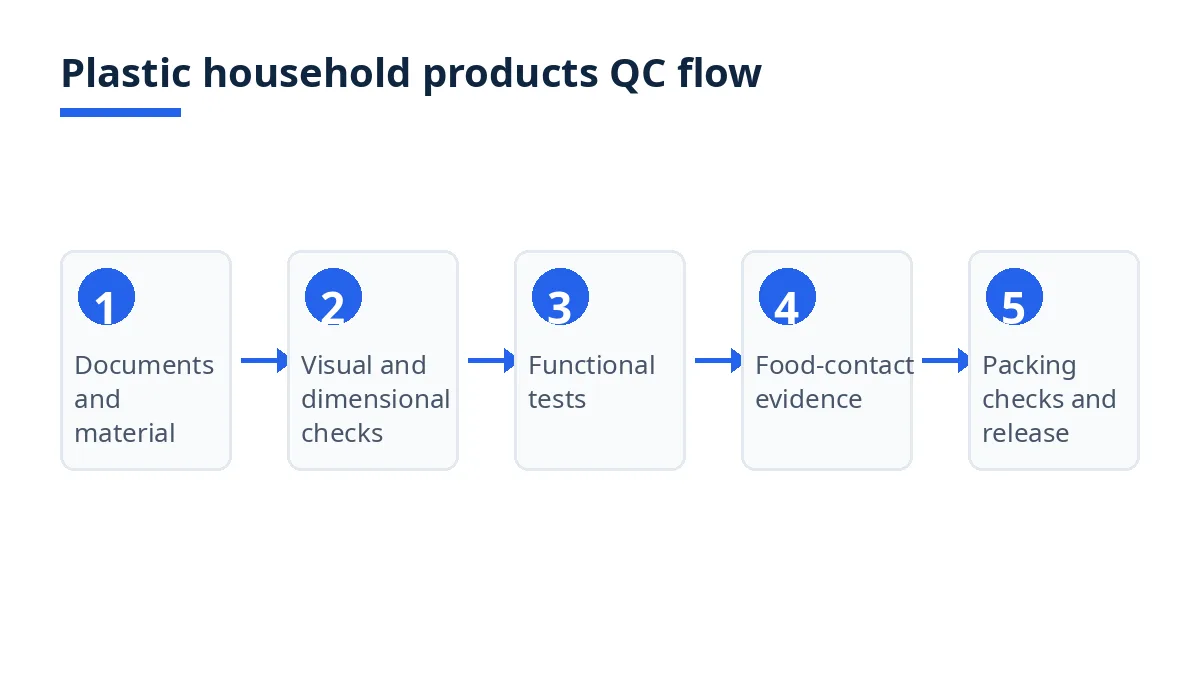
The full plastic household products quality control checklist (numbered, printable)
Documents, material and traceability
Confirm the purchase order, specification sheet and packing list match the goods: item, size, colour, resin type and quantity.
Check the approved sample for each item and colour is present, and record any bulk difference as a failure.
Confirm the resin type in the specification, such as polypropylene or high-density polyethylene, matches the supplier declaration and material test report.
Where a material report is required, check it names the resin grade, lot and test method, and compare it with the agreed specification.
Confirm colour is defined by an agreed reference, such as a signed colour chip, not by a word.
Confirm food-contact status item by item, so food-contact items carry their own declaration and evidence.
Dimensions, fit and assembly
Measure length, width, height and rim diameter per item, against the agreed tolerance.
Measure wall thickness at the base, side wall and rim, and record actual values, not pass marks alone.
Check base and rim dimensions together: a box correct at the base but not at the rim will not stack or take its lid.
Test lids on their own bodies: each lid must seat fully, close without forcing and stay closed when lifted by its body.
Test snap fits, screw threads and press fits: threads must engage smoothly and not cross-thread or strip under normal hand force.
Check nested and stacked items nest or stack evenly without rocking, jamming or leaning, to the height allowed.
Check handles, grips and mounts for secure fixing, full movement where a handle pivots, and no sharp edge or loose pin.
Surface, colour and appearance
Check every surface for flash along parting lines and rims, and record sharp or raised flash as a failure.
Check for short shots, where the mould did not fill completely, and sink marks, dents above ribs or bosses.
Check for warping by placing flat-based items on a flat surface, checking for rocking, and lids for gaps.
Check for flow lines, weld lines, burn marks, silver streaks and mould release residue, against the approved sample and the agreed cosmetic standard.
Check colour within each piece, between pieces and across the range, under the same light, against the approved reference.
Check prints, logos and in-mould labels for alignment, legibility and adhesion, with no blurred, doubled or peeling elements.
Check for contamination: black specks, foreign material, dust under the surface and odour differing from the sample.
Functional tests: lids, hinges, handles and load
Open and close each hinged lid repeatedly: the hinge must move freely, stay attached and not crack or whiten.
Fill buckets, basins and jugs to stated capacity and check for leaks at seams, handle mounts and bases, and flexing.
Load baskets and buckets with an allowed weight, lift by the handle, checking for handle slip, mount cracking or deformation.
Check microwave-safe, freezer-safe or dishwasher-safe claims only against agreed evidence, and record an unsupported claim as a failure.
Check no item has a sharp edge, burr or cracked rim that could cut a hand.
Food-contact items only: declarations and migration evidence
For food-contact items only, check the declaration of compliance names the material, article and intended food-contact use, and is dated for this production.
Confirm the declaration covers the food types and temperatures the item will meet, such as hot food, acidic food or repeated use.
Under Regulation (EC) No 1935/2004, food-contact materials must be made under good manufacturing practice so that, under normal or foreseeable use, they do not transfer constituents to food in quantities that could endanger health or change food composition, taste or odour.3
Under Commission Regulation (EU) No 10/2011, only Union-listed authorised substances may be intentionally used in plastic food-contact materials and articles, which must comply with specific and overall migration limits.4 Check the migration evidence names the item tested, and never extend a food-contact claim to a different item or resin.
Check food-contact items for odour and taste transfer, and record any strong plastic odour: it points to resin or process problems needing investigation before release.
Material evidence: melt flow and resin checks
Where a melt flow report is required, confirm it names the resin lot, temperature and load. ISO 1133-1 specifies procedures for determining the melt mass-flow rate and melt volume-flow rate of thermoplastics under specified temperature and load.5
Compare the reported melt flow value with the agreed resin grade specification, and treat a large shift from the previous lot as a reason to hold the lot.
Labels, markings and packing
Check labels and markings are present, legible and correctly placed, including item name, size, colour, quantity, origin and care or use markings.
Check barcodes and carton stickers scan and match the purchase order, item, colour and quantity, and set contents match.
Check food-contact items carry the required food-contact marking, and general household items carry none they have not earned.
Check packing: each item is protected as specified, lids are packed with their bodies or in the specified ratio, and cartons are not overfilled so as to warp rims or crush baskets.
Check carton count, markings and gross weight against the packing list, and weigh and measure cartons.
Check no hard insert, strap or tape can dent, scratch or warp the pieces it touches, and cartons are sealed and stacked as specified.
Common failures and how to fix them
The most frequent failure is a lid that will not seal, usually because the rim warped during cooling or the lid and body came from a different mould cavity. Stop, fit lids to several bodies, measure rim dimensions, and only then restart packing. Warping in buckets and basins comes from uneven cooling or thin walls: check thickness and cooling before more pieces are moulded.
Flash along rims points to mould wear or clamping pressure: trim a test piece only to prove the cause, then fix the mould or setting, because returning flash is not a fix. Colour mismatch points to more than one masterbatch lot or an unpurged colour change: re-sort complete sets before packing and re-check under the same light.
Odour in a food-contact item is a hold, not a cosmetic note: quarantine the lot, check the resin source and declaration, and do not release it on a visual pass. Handle or hinge cracking points to a weak section or wrong resin grade: load-test a sample first.
Above the agreed acceptance level, options are re-inspection after sorting or rework, documented partial acceptance, or rejection.
Downloadable template / summary table
Copy the checklist into your inspection sheet, add tolerances and acceptance numbers, and record a result per item.
Section | Checks | Evidence |
|---|---|---|
Documents and material | Order, sample, resin, colour | Spec sheet, declarations |
Dimensions and fit | Size, thickness, lid fit | Measurements, fit checks |
Surface and colour | Flash, warping, shade | Visual checks, photos |
Functional tests | Hinges, handles, leaks, load | Test results |
Food-contact items | Declaration, migration evidence | DoC, lab reports |
Material evidence | Melt flow, resin lot | Lab reports |
Labels and packing | Markings, barcodes, cartons | Packing list, cartons |
How Exportain helps
Exportain is a B2B marketplace connecting buyers with Bangladeshi suppliers of plastic household products, so the specification sheet, tolerances and packing terms can be agreed at enquiry. Use inspection services when you plan the check, and read the pre-shipment inspection guide first. Exportain is not a party to the goods contract and does not inspect goods.
FAQs
When should this checklist be used?
Use it at final inspection, when goods are finished and packed. For first orders and larger lots, use it during production, while mould settings and colour can be corrected.
Who should complete it?
The buyer, a local agent or an independent inspector can complete it, using the approved sample, specification sheet and a random sample.
What are the most common failures?
Lids that will not seal, warping, flash, colour mismatch, hinge or handle cracking and odour in food-contact items are the failures buyers find most often.
Can a third party do it?
Yes, if you share the approved sample, specification sheet, tolerances and acceptance levels first, and results are reported item by item against the sample.
Next steps on Exportain
Before production starts, agree your specification sheet, resin type, tolerances, test methods and label wording, then read the AQL acceptance quality limit explainer and pre-shipment inspection guide, and plan the check with inspection services. You can also post a free RFQ via RFQs and compare quotes from Bangladeshi suppliers.
Sources
- ISO 2859-1:1999 - Sampling procedures for inspection by attributes — Part 1: Sampling schemes indexed by acceptance quality limit (AQL) for lot-by-lot inspection. International Organization for Standardization (accessed )
- ISO 20457:2026 - Plastics moulded parts — Tolerances and acceptance conditions. International Organization for Standardization (accessed )
- Regulation (EC) No 1935/2004 of the European Parliament and of the Council of 27 October 2004 on materials and articles intended to come into contact with food and repealing Directives 80/590/EEC and 89/109/EEC. European Union (accessed )
- Plastic materials and articles in contact with food: Regulation (EU) No 10/2011 summary. European Commission, EUR-Lex (accessed )
- ISO 1133-1:2022 - Plastics — Determination of the melt mass-flow rate (MFR) and melt volume-flow rate (MVR) of thermoplastics — Part 1: Standard method. International Organization for Standardization (accessed )
About the author
Sourcing from Bangladesh?
Post a request for quotation and suppliers on Exportain can send you their quotes directly.
Post an RFQ


