How Much Does Piece-By-Piece Inspection Cost in Bangladesh?
Piece-by-piece inspection cost in Bangladesh has no single price. This guide explains what drives a 100% inspection quote, how defect sorting, rework and re-checks are handled, and how to compare itemised quotes for the same scope.
Short answer
Piece-by-piece inspection cost in Bangladesh has no single price. Every unit is checked, sorted, and either accepted, repaired and re-checked, or rejected, so the total follows piece count, the defect types checked, sorting and rework handling, location, and report detail. Compare itemised written quotes for the same scope, and confirm every figure and turnaround in the firm's written quote.

On this page
Key takeaways
Piece-by-piece inspection checks every unit in the agreed scope and sorts each unit into accepted, repaired, or rejected, so there is no sample size and no lot verdict from a sample.
The quote follows piece count, defect types checked, sorting and rework handling, location, and report detail, not the value of the order.
Compare itemised written quotes for the same scope, and confirm the pricing model, travel, report detail, and re-check terms before accepting any quote.
A usable report gives counted totals by defect type, photographs, and the re-check result for repaired pieces; a percentage alone does not report a piece-by-piece visit.
Piece-by-piece inspection asks a different question from a sampling inspection. It does not ask whether a lot is probably good enough to ship. It asks, for each unit, whether that unit is acceptable, repairable, or rejected. Every unit in the agreed scope is checked against the same list and put into one of those piles before shipment.
This guide is for a buyer sourcing from Bangladesh who needs to budget for that check. It does not price any named inspection firm, and it states no market rate. Every money figure here is labelled as an example, and every figure you rely on should come from the firm's written quote.
Piece-by-piece inspection is also called 100% inspection or full inspection. A full inspection checks every unit included in the agreed inspection scope, and defective units found during the inspection can be separated so that the factory can repair, replace, or remove them before shipment.1 A sampling inspection judges a lot from a sample instead. ISO 2859-1 is the sampling standard: acceptance sampling plans for inspection by attributes, assessing quality from samples instead of checking every item.2 Piece-by-piece inspection has no sample size, because each piece gets its own verdict.
Why this matters for buyers and sellers
For the buyer, piece-by-piece inspection controls the units that actually ship, not a statistical picture of them. That matters most when one defective unit reaching a customer is expensive: a safety item or a high-value item. Full inspection is particularly useful when the acceptable defect level is very low, unit value is high, or past inspections found recurring problems.1
For the seller, a sorting visit can save an order that a sampling inspection would have failed outright. A piece-by-piece visit names the faulty units one by one, so rework is aimed at the pieces that need it.
Piece-by-piece inspection is not always the right spend. It is slower than sampling, and the cost rises with every unit, so for a large lot with stable quality and a cheap defect, sampling usually gives a better return. It also is not a promise of zero defects: inspection effectiveness still depends on the inspection criteria, product complexity, accessibility, testing methods, and human factors.1 Team size and shift length therefore belong in the quote, not just the piece count.
Keep neighbouring work apart: sample inspection judges approval samples, and lab testing measures sample properties in a laboratory. See the pre-shipment inspection guide for the sampling method a full sort replaces.
Step-by-step: how it works
Work through these steps in order, keeping every answer in writing.
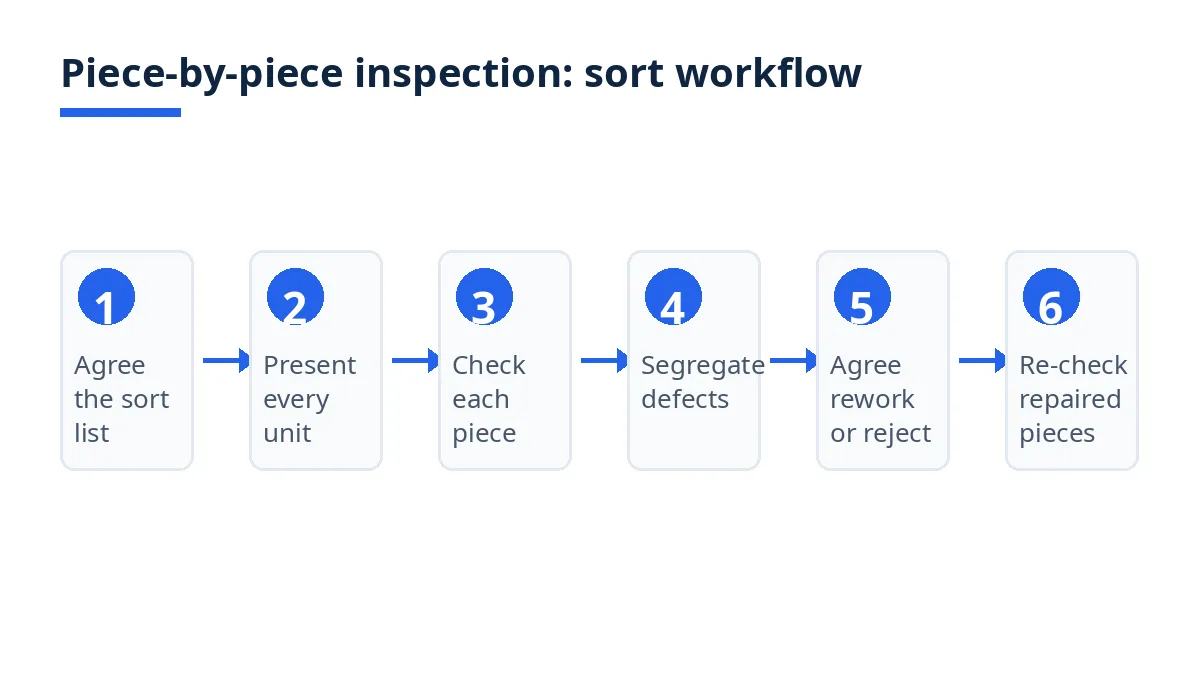
Agree the sort list. Write the defect types, the defect classes, and the disposition for each: accept, repair and re-check, or reject. State whether the visit checks every criterion or only one defect type, because a single-defect sort must never be reported as a full check. A sorting job needs a fixed, written standard to follow, a conformity sample, or both.3
Confirm the goods are complete and presented for handling. State the total piece count, the styles, sizes, and colourways, and whether the goods are packed or unpacked. Ask how many products should be checked and whether they are already all together, since scattered goods slow the visit and invite pieces being missed.3
Check each piece in a fixed order. The inspector works through the lot piece by piece against the approved sample, the specification, and the sort list, checking appearance, workmanship, measurements, function, labels, and packing where each is in scope. Each piece is segregated at once.
Segregate defects as they are found. Accepted, repairable, and rejected pieces go to separate labelled areas, each labelled with the defect type. Counting by defect type matters: one repeated defect points at a single production step, while mixed defects point at a wider process problem.
Agree the disposition for each pile in writing. Accepted pieces are cleared for packing or shipment. Repairable pieces go back with a repair instruction and a re-check booking. Rejected pieces stay segregated until you decide whether they are scrapped, returned for remake, or sold elsewhere under a separate agreement.
Re-check every repaired piece. A repair is not accepted on the factory's word. The re-check covers the repaired defect and, where a repair could affect another criterion, the neighbouring criteria too. State whether the re-check is included in the original quote or charged as a separate visit.3
Read the report as a counted record, not a verdict. A usable report states the total pieces checked, accepted, repaired, and rejected, the defect count by type, photographs, and the re-check result. A report giving only a percentage has not reported a piece-by-piece visit.
Costs, timelines and documents
What drives the cost
No single piece-by-piece inspection fee applies across Bangladesh. A quote is built from the items below, and changing any one of them changes the total.
Cost driver | Why it moves the quote |
|---|---|
Piece count | Every additional unit adds handling and checking time |
Defect types checked | One defect type is a fast sort; full criteria take far longer per piece |
Pieces per inspector per day | More checks per piece means fewer pieces per inspector per day |
Sorting and rework handling | Unpacking, segregating, labelling, repacking, and re-checking add labour |
Location and travel | Distance, travel time, and any overnight stay sit inside or beside the fee |
Report detail | A counted photo report takes longer to compile than a one-page summary |
Re-check visits | A second visit for repaired pieces is separate workload |
Pricing models: per piece, per man-day, or a mix
Firms price piece-by-piece work in three main ways. Per-piece pricing charges a rate for each unit checked. Per man-day pricing charges a rate for one inspector working one full day. A mixed quote charges a man-day rate plus a per-piece rate above an agreed daily throughput.
Per-piece pricing is the model most closely tied to 100% inspection. One firm's pricing guide describes per-piece pricing as used for 100% inspection where every single unit is checked rather than a statistical sample.4 The same guide describes per man-day pricing as the most common pricing model in the industry.4 Neither description sets a Bangladesh rate for your order. Ask what is included per piece, and how many pieces one inspector completes per day for your product and defect list.
Example figures: how a quote adds up
Example figures only. These numbers are invented to show the arithmetic, not quoted from any firm and not a market rate. Confirm every figure in the firm's written quote.
Example case | Example arithmetic | Example total |
|---|---|---|
Example A: small lot, single defect sort | 800 pieces at an example rate of 0.20 per piece | 160 |
Example B: medium lot, full-criteria check | 2,000 pieces at an example rate of 0.35 per piece | 700 |
Example C: man-day quote, sorting team | 3 inspectors for 2 days at an example rate of 200 per man-day | 1,200 |
Example D: re-check visit added | Example A plus a one-day re-check at an example rate of 200 | 360 |
Example A and Example B differ in the defect list and the rate that list justifies, yet the totals differ by more than four times, because the piece counts differ too. Example C shows why team size matters: three inspectors finish in two days what one inspector would take six days to finish. Example D shows the cost buyers forget: the re-check. Add travel, report detail, and any lab test as separate lines.
Timelines
There is no typical piece-by-piece turnaround that applies to every order, because the timeline follows the same drivers as the cost: piece count, checks per piece, team size, factory readiness, and the rework loop. A small lot with a single defect check can finish in a day. A large lot with full criteria needs a larger team, more days, or both. A repair pile adds a second timeline: repair time, then a re-check visit, then packing. Ask the firm to state three dates in writing: the checking days, the repair window, and the re-check day.
Book early: a visit booked for the day before loading leaves no repair window, and the buyer then faces shipping rejected pieces, shipping short, or delaying the shipment.
Documents to prepare
Send the full quote pack before a firm prices the visit, and the same pack to the inspector on the day.
Purchase order or order reference, with the total piece count by style, size, and colourway
Current specification revision, with the revision number and date on every page you send
Approved sample record, including how the sample was approved and any conditions attached
Defect list with photographs, defect classes, and the disposition for each class
Measurement chart with tolerances, where measurements are in scope
Packing instruction, including whether packing itself is checked and who repacks
Sort disposition instruction: what happens to accepted, repaired, and rejected pieces
Bangladesh-specific rules and tips
Bangladesh factory locations shape the quote more than buyers expect. A factory in Dhaka, Gazipur, or Narayanganj may sit near an inspector base, while a factory farther afield adds travel time and possibly an overnight stay. Give the exact factory address in the quote request, and ask whether travel is included in the rate or charged as a separate line.
Factory readiness is the most common cause of a wasted sorting day in Bangladesh. Confirm before the visit that all pieces are finished, gathered in one place, and available for handling, with sorting tables and helpers arranged. Agree in advance what happens if inspectors find a higher quantity than announced: whether they go on and invoice the corresponding fees, or stop at the booked count.3
Protect the chain of custody for rejected pieces: they should stay segregated, labelled, and counted until you release them in writing. If they are mixed back into the good pile during repacking, the sorting visit has been undone. Do not accept a factory pre-sort as a substitute: pieces the factory removed before the inspector arrived were never checked against your list.
If your buyer manual sets a stricter sorting rule, that manual governs, and the defect list in the booking should follow it.
Exportain's inspection services category shows why you should confirm availability before relying on a listing: the category page currently shows the message "No services published in this category yet". Arrange the inspection directly with the firm on its own quote and terms. Exportain itself does not inspect goods, test goods, or act as a party to the contract for goods.
Mistakes and red flags
Checking against photographs instead of the approved sample. Photographs cannot settle shade, hand feel, weight, or construction details reliably.
Buying a single-defect sort and reporting it as a full check. The report should name the defect types checked.
Accepting a "100% checked" claim with no counted totals. A real report gives pieces checked, accepted, repaired, and rejected.
Lowering the standard mid-sort to save pieces. If you give revised, lower standards, many products might be saved that way, but that double standard creates a second, undocumented specification.3 If a standard must change, change it in writing, for the whole lot, before the sort continues.
Red flag: a quote with no defect list attached. If the defect list is not in the quote, the inspector has no written standard to sort against.
Red flag: a report with no rejected-piece count. If rejected pieces are not counted and segregated, they cannot be traced.
Red flag: a price far below every other quote for the same scope. Check what has been left out: fewer defect types, no photographs, no re-check, or no travel included.
Checklist
[ ] Sort scope written down: total piece count by style, size, and colourway
[ ] Defect list with photographs, classes, and disposition for each class
[ ] Pricing model confirmed, with travel and report lines stated
[ ] Pieces per inspector per day, team size, and checking dates confirmed
[ ] Factory readiness confirmed: goods complete, gathered, sorting space and helpers arranged
[ ] Rejected-piece segregation and release rule agreed in writing
[ ] Report format confirmed: counted totals, defect counts by type, photographs, re-check results
[ ] Quote confirmed in writing before the visit starts
How Exportain helps
Exportain connects international buyers with Bangladeshi suppliers and trade service providers. Exportain itself does not inspect goods or act as a party to the contract for goods, so piece-by-piece inspection is arranged directly between the buyer and the firm, on the firm's own quote and terms.
Post a free RFQ with the product, the piece count by style, size, and colourway, the defect types to be checked, the disposition for each class, and the report detail you need. A request that names the sorting scope draws itemised quotes, while a request that only asks for inspection draws vague ones. You can also browse the inspection services category, noting that it currently shows "No services published in this category yet".
FAQs
What should I know first about piece-by-piece inspection in Bangladesh?
Know that piece-by-piece inspection checks every unit in the agreed scope, sorts each unit into accepted, repaired, or rejected. Fix the piece count, the defect list, the disposition for each class, and the report detail in writing, and confirm whether the re-check and travel are included.
What are the typical costs and timelines?
There is no typical cost or timeline that applies to every order, because the quote depends on piece count, defect types checked, sorting and rework handling, location, report detail, and re-check visits. Compare itemised written quotes for the same scope, and treat every figure and turnaround as a quote item to confirm.
Which documents are needed?
You need the purchase order, the current specification revision, the approved sample record, the defect list with photographs, the measurement chart with tolerances, the packing instruction, the sort disposition instruction, and the report format requirement.
What are the most common mistakes?
The most common mistakes are booking before the goods are complete, checking against photographs, reporting a single-defect sort as a full check, skipping the re-check of repaired pieces, and comparing quotes with different scopes.
Next steps on Exportain
Start with the sorting scope, not with a price request: write the piece count, the defect list, and the disposition for each class, then ask for itemised quotes for the same scope. Read the pre-shipment inspection guide and the AQL guide for the sampling methods a full sort replaces. When the scope is ready, post a free RFQ.
Sources
- Full Inspection vs Sampling Inspection: Which to Choose?. NBN QC (accessed )
- ISO 2859-1:2026 — Sampling procedures for inspection by attributes — Part 1: Sampling schemes indexed by acceptance quality limit (AQL) for lot-by-lot inspection. ISO (accessed )
- Defect sorting job (100% check). QualityInspection.org (accessed )
- How Much Does Product Inspection Cost? 2026 Pricing. Tetra Inspection (accessed )
About the author
Sourcing from Bangladesh?
Post a request for quotation and suppliers on Exportain can send you their quotes directly.
Post an RFQ