

Quality Control Checklist for Paper Bags From Bangladesh
A numbered QC checklist for paper bags from Bangladesh: dimensions, gusset and bottom construction, GSM, print, handles, strength and moisture tests, food-contact papers, labels and packing, with fixes for common failures.
Short answer
Use this paper bags quality control checklist to check dimensions, gusset and bottom construction, paper grammage, print quality and colour fastness, handle strength and attachment, tensile, burst and drop evidence, moisture and grease resistance, food-contact papers, labels and packing on paper bags from Bangladesh before shipment. Agree tolerances, test methods and acceptance numbers in the purchase order.

On this page
Key takeaways
Agree the sample, tolerances, test methods and acceptance numbers before inspection, and draw the sample randomly across sizes, designs and cartons.
Measure width, gusset and height against the size chart, open each bag fully, and lift filled bags by their handles to test the bottom seam and handle patches.
Check paper grammage and print against the approved sample and proof, rub printed areas for ink transfer, and compare colour under the same light.
Review tensile, burst, Cobb and drop evidence per paper lot, and check food-contact papers for the destination market before shipment.
A paper bag is judged in the customer's hand: a handle that pulls free, a bottom seam that opens under load, or print that rubs off onto clothing shows at once. This checklist gives buyers of paper bags from Bangladesh a way to check a shipment before it leaves the factory. Use an agreed sampling plan rather than pieces the factory selects. ISO 2859-1 specifies an acceptance sampling system for inspection by attributes, indexed by the acceptance quality limit (AQL), for lot-by-lot inspection.1
Why this checklist matters
A paper bag concentrates risk in a few points: the paper weight, the handle attachment, the gusset and bottom fold, and the print. A bag can measure correctly flat and still fail when opened, filled and carried, because a short handle patch, a weak glue line or a shallow gusset only shows under load. Checking the bag as it will be used, filled and lifted by its handles, catches those failures while rework is still possible.
A written checklist also removes interpretation. Each point is checked against the approved sample, the specification and the packing list, and recorded as pass, fail or not applicable. Set acceptance numbers per defect class in the purchase order.1
Before you start
Do not begin until the references are complete: an approved sample per bag style, size and print design, the purchase order and specification, a size chart giving width, gusset, height and handle length with tolerances, and the packing specification. Agree the sampling plan in advance,1 and draw the sample randomly across sizes, designs and cartons, so one run cannot stand in for the whole lot.
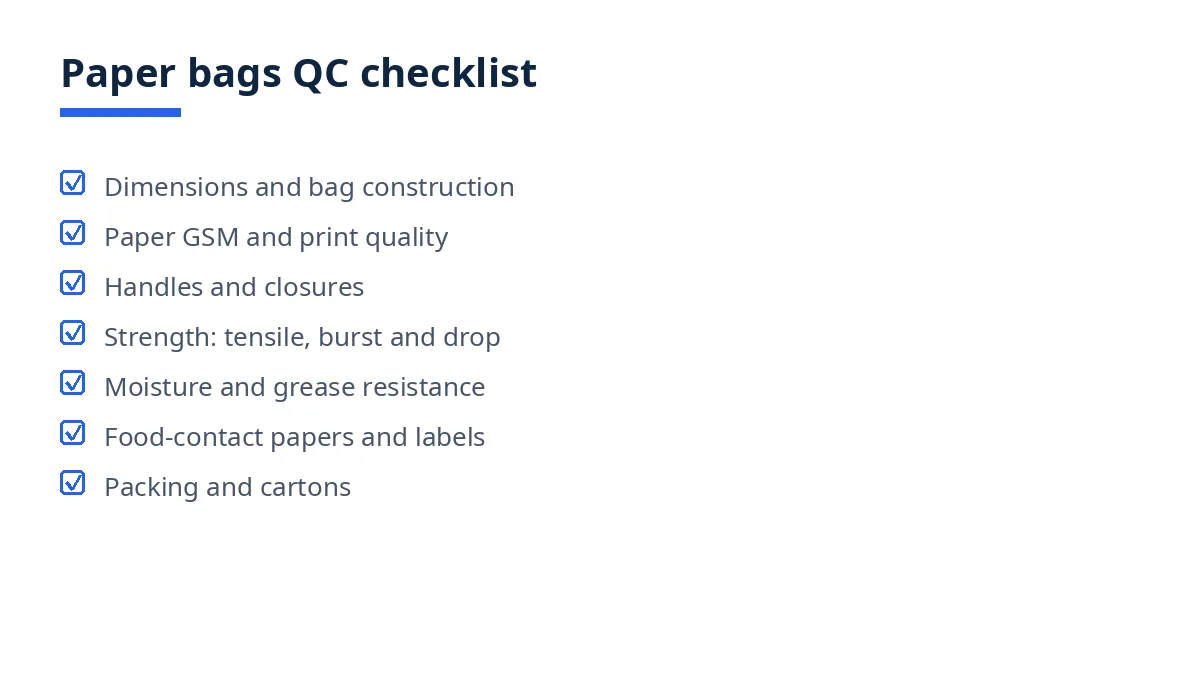
The full checklist (numbered, printable)
Dimensions and bag construction
Measure width, gusset depth and height on sampled bags, laid flat and smoothed without stretching, and compare every measurement with the size-chart tolerance, recording actual values rather than pass marks alone.
Open each sampled bag fully and check that the gusset expands evenly on both sides, with no side pinched or glued shut.
Check the bottom construction: the fold sits square, the glue line runs the full width, and no edge lifts when the empty bag is opened and closed.
Fill a sampled bag with its intended contents, or an agreed equivalent weight, and check that it stands upright, holds its shape and shows no bulging seam.
Check that every size, style and design in the order is represented in the sample, with no design substituted.
Paper, GSM and print quality
Check the paper against the approved sample for colour, finish and feel, including kraft, white kraft, coated or recycled stock, recording any bulk substitution as a failure.
Review grammage evidence for the bulk paper. ISO 536 specifies a method for determining the grammage of paper and board,2 compared with the grammage named.
Check print on every sampled bag against the approved proof: artwork position, spelling, barcode placement and colour, with no blurred or missing elements.
Rub printed areas firmly by hand and against a plain white cloth, checking for ink transfer or flaking, especially on dark panels and handles.
Check colour consistency within one run and across designs under the same light, against the approved standard, sorting any bag outside the agreed range.
Check lamination or coating where specified: full, even coverage, with no bubbles or peeling edges.
Handles, closures and attachments
Check every handle type in the order, twisted paper, flat paper, cotton, ribbon or die-cut, for correct material and length.
Pull each sampled handle firmly by hand: patches sit straight, glue or stitching covers the full patch, and no handle twists or lifts at a corner.
Lift sampled bags by their handles with the agreed test load, checking for detachment, patch or wall tearing, and stretching that leaves the bag lopsided.
Check die-cut handles where used: a clean, fully punched cut, the reinforced patch where specified, and no sharp edge.
Check closures where specified, such as a fold-over top, adhesive strip or tin tie: they close fully, stay closed under load, and reopen without tearing.
Strength tests: tensile, burst and drop
Review tensile evidence for the bulk paper where required. ISO 1924-2 specifies a method for measuring tensile strength, strain at break and tensile energy absorption at 20 mm per minute.3
Review bursting-strength evidence where required. ISO 2758 specifies a method for measuring bursting strength under increasing hydraulic pressure, applicable to papers in the range 70 kPa to 1,400 kPa.4
Where a filled-bag drop test is agreed, confirm the method, drop height and number of drops in advance. ISO 7965-1 specifies a method of vertical impact testing on a filled paper sack by dropping.5
Record every test report against the paper lot and bag style it covers; a report naming a different paper, lot or order is no evidence at all.
Moisture, grease and conditioning
Confirm that laboratory samples were conditioned before testing, and note the atmosphere on the report. ISO 187 sets the standard atmosphere at 23 °C and 50 % relative humidity, with 27 °C and 65 % permitted in tropical countries.6
Review water-absorptiveness evidence where moisture resistance is specified. ISO 535 specifies the Cobb method for paper and board,7 and the test time, such as Cobb60, must be named.
Check grease resistance where the bag will carry food or oily items: inspect the inside for staining after a filled-bag trial, and confirm any greaseproof lining covers the full inside surface.
Check for damp, musty or chemical odour on sampled bags, inside and out, and for water stains or mould spots.
Check that finished bags are stored off the floor and away from damp, and cartons show no water damage.
Food-contact compliance, labelling and claims
For bags that will touch food in the EU, check the compliance documentation against the bag as supplied, including paper, inks and adhesives. Regulation (EC) No 1935/2004 covers materials intended to come into contact with food, and its requirements apply to the finished bag.8
For bags that will touch aqueous or fatty foods in the United States, check the supplier's statement against the components used. Under 21 CFR 176.170, the food-contact surface, when extracted with solvents characterising the food type, must yield net chloroform-soluble extractives of not more than 0.5 milligram per square inch.9
Check that any environmental claim on the bag, such as recycled content, matches the agreed evidence, recording unsupported claims as failures.
Check printed labelling: brand, size, contents and any handling or recycling mark named in the specification.
Check that inks and adhesives on food-contact bags are the grades named in the compliance papers.
Packing and cartons
Count bags per bundle and bundles per carton against the packing list, checking that bundles are tied or banded as specified without crushing them.
Check that mixed sizes, styles or designs are never packed in one bundle unless allowed, and that each bundle label names its size, style and quantity.
Check carton labels against the purchase order: item, size, quantity, carton number and destination, with scannable barcodes.
Weigh and measure sample cartons, checking markings and carton count against the packing list.
Check that cartons protect the bags in transit: no torn carton, crushed corner or damp patch, and no loose strapping.
Open one carton per sampled lot from the middle of the pallet, not only the top carton, and re-check handles, print and bottom there.
Common failures and how to fix them
The most frequent failure is a handle that pulls free under load, usually because the patch was glued short, the glue had not cured, or the patch sits off-centre. Stop, lift sampled bags with the agreed load, compare patch size and glue coverage against the sample, and only then restart packing. Next is a bottom seam that opens when filled, which traces to a short glue line or an unpressed fold.
Print that rubs off points to ink, coating or curing: re-check a rubbed sample against the proof and confirm the ink grade before further printing. A bag that measures correctly flat but will not stand upright usually has a shallow or one-sided gusset: open sampled bags fully and compare gusset depth on both sides. Damp or musty bags point to storage: move the stock and re-inspect the affected cartons as their own group.
Above the agreed acceptance level, options are re-inspection after sorting or rework, documented partial acceptance, or rejection.
Downloadable template / summary table
Copy the checklist into your inspection sheet, add the size chart, grammage, handle test load and acceptance numbers, and record results.
Section | Checks | Evidence |
|---|---|---|
Dimensions and construction | Width, gusset, height, bottom fold, filled shape | Measurements, filled check |
Paper, GSM and print | Paper stock, grammage, print, colour, rub resistance | Sample comparison, reports |
Handles and closures | Handle type, patch, pull test, die-cut, closure | Lift test |
Strength tests | Tensile, burst, drop | Reports per lot |
Moisture and grease | Conditioning, Cobb, grease trial, odour, storage | Reports, trial |
Food contact and labels | EU and US papers, claims, labelling | Compliance papers |
Packing | Bundles, labels, cartons, counts | Packing list |
How Exportain helps
Exportain is a B2B marketplace connecting buyers with Bangladeshi suppliers of paper bags and packaging, so the specifications behind this checklist can be agreed at the enquiry stage. Use inspection services to plan the check. Supplier profiles show which document and photo checks have been recorded, not factory inspections. Exportain is not a party to the goods contract and does not inspect goods.
FAQs
When should this checklist be used?
Use it at final inspection, when bags are finished and packed. For larger and first orders, also use it in production, while handles, glue and print can still be corrected.
Who should complete it?
The buyer, a local agent or an independent inspector can complete it, using the approved sample and size chart and a random sample.
What are the most common failures?
Handles pulling free, bottom seams opening under load, print rubbing off, shallow gussets, and damp stock are the failures buyers find most often.
Can a third party do it?
Yes, if you share the approved references, tolerances, test methods and acceptance levels.
Next steps on Exportain
Before production, agree your size chart, grammage, handle test load, print standard and food-contact papers, then read the AQL acceptance quality limit explainer and the pre-shipment inspection guide, and plan with inspection services.
Sources
- ISO 2859-1:1999 - Sampling procedures for inspection by attributes — Part 1: Sampling schemes indexed by acceptance quality limit (AQL) for lot-by-lot inspection. International Organization for Standardization (accessed )
- ISO 536:2019 - Paper and board — Determination of grammage. International Organization for Standardization (accessed )
- ISO 1924-2:2008 - Paper and board — Determination of tensile properties — Part 2: Constant rate of elongation method (20 mm/min). International Organization for Standardization (accessed )
- ISO 2758:2014 - Paper — Determination of bursting strength. International Organization for Standardization (accessed )
- ISO 7965-1:2024 - Packaging — Drop test — Part 1: Paper sacks. International Organization for Standardization (accessed )
- ISO 187:2022 - Paper, board and pulps — Standard atmosphere for conditioning and testing and procedure for monitoring the atmosphere and conditioning of samples. International Organization for Standardization (accessed )
- ISO 535:2023 - Paper and board — Determination of water absorptiveness — Cobb method (ISO/TC 6/SC 2 catalogue listing). International Organization for Standardization (accessed )
- Regulation (EC) No 1935/2004 on materials and articles intended to come into contact with food. European Union (accessed )
- 21 CFR 176.170 - Components of paper and paperboard in contact with aqueous and fatty foods. U.S. Food and Drug Administration (accessed )
About the author
Sourcing from Bangladesh?
Post a request for quotation and suppliers on Exportain can send you their quotes directly.
Post an RFQ


