Pajamas and Sleepwear Exporters in Bangladesh: Verified Supplier Checklist
A numbered supplier checklist for pajamas and sleepwear from Bangladesh: papers and export registration, relaxed-fit grading and set matching, fabric hand and wash durability, fibre and care labels, set packing, safety evidence and agreed sampling and acceptance terms.
Short answer
Use this checklist to check a pajamas and sleepwear exporter in Bangladesh before ordering: legal papers and export registration, relaxed-fit grading across all sizes, fabric hand and wash durability, fibre and care labels, set versus separates packing, safety evidence for children's ranges, and agreed sampling and acceptance terms.
On this page
Key takeaways
Check legal papers and export registration first, and treat any name mismatch across documents as a stop item until it is explained in writing.
Measure the full graded size set, not only the sample size, and check top and bottom together for shade, hand and waistband recovery.
Judge fabric hand against the approved sample and ask for wash evidence tied to the bulk fabric and colour before approving bulk.
Settle the children's sleepwear safety route and the label wording before bulk fabric is ordered, and agree random sampling and acceptance numbers in the purchase order.
A sleepwear order is judged on the body overnight, not on a hanger. A top that rides up, a waistband that loses recovery, or a top and bottom that no longer read as one set will reach the buyer as a complaint, even when stitching looks clean. This checklist checks the exporter behind the set before a purchase order is signed.
Start from the size of the pool, not from a quotation. Sleepwear production sits inside Bangladesh's knitwear sector, and the Bangladesh Knitwear Manufacturers and Exporters Association states that it represents approximately 2,540 knitwear member factories.1 That breadth is why this checklist runs on evidence rather than on claims.
Why this checklist matters
Sleepwear fails differently from daywear. Fit is relaxed, so a small grading error spreads across chest, hip and inseam at once. Fabric hand matters more because the garment stays against the skin for hours, and wash durability matters more because a set is laundered far more often than a jacket.
Score every item one of three ways. A pass means you have seen evidence that matches the order. A conditional pass means the gap is written down, dated and owned, and must close before shipment. A stop means the order waits — for a name that differs across documents, an expired registration, a fit block never graded beyond the sample size, an undisclosed subcontractor, or a safety document that does not cover the age range ordered. Only new evidence clears a stop, never reassurance.
Before you start
Before contacting suppliers, settle the range (adult, child, or both; set or separates), the tech pack with a size chart and points of measure, the target markets and their label and safety requirements, and the payment and inspection plan. Name the stop decision-maker before quotations arrive.
Ask every shortlisted exporter for the same document set at the same time: trade licence, Taxpayer Identification Number, VAT registration, Export Registration Certificate, bank details in the same legal name, and a current factory address with a named contact. Exporters require an Export Registration Certificate from the Office of the Chief Controller of Imports and Exports before initiating cross-border export.2 Treat a name that differs between the quotation, the certificate and the bank account as a stop item until it is explained in writing.
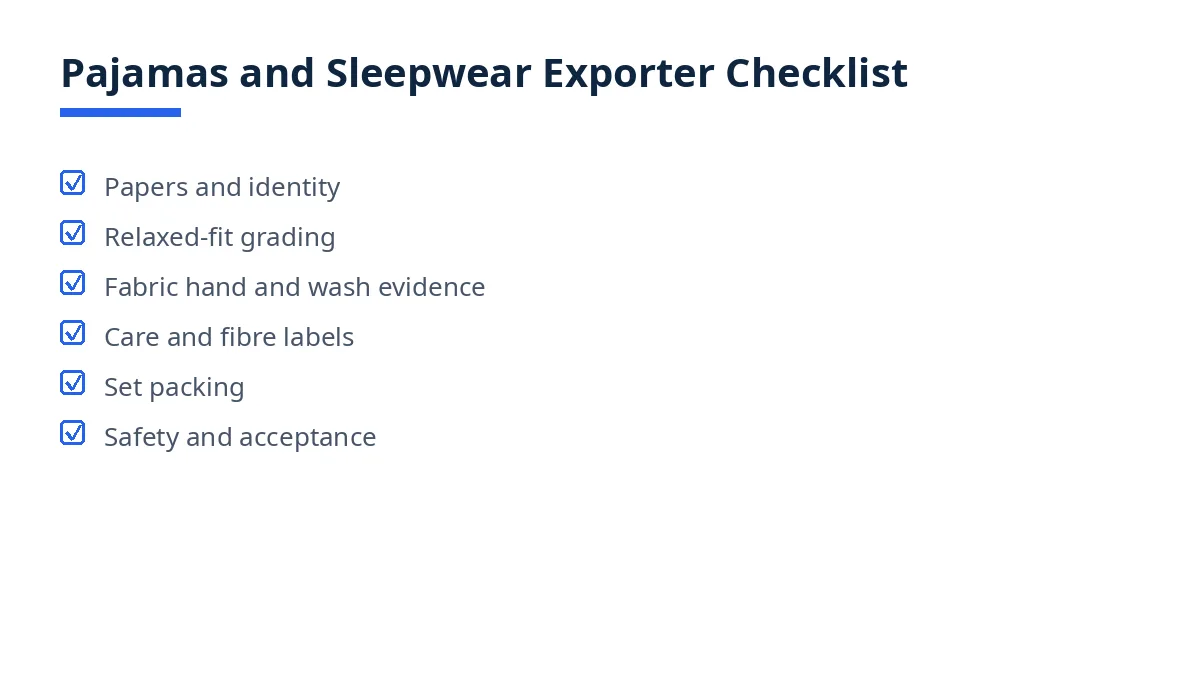
The full checklist (numbered, printable)
A. Papers and legal identity
Confirm the exporter's legal name matches on the trade licence, Export Registration Certificate, bank account and quotation, and record each expiry date.2
Confirm the exporter, not only an intermediary, holds the registration, and ask in writing who will cut, sew, dye, print and pack the order if any stage sits elsewhere.
Confirm the factory address given is where the sleepwear will be made, and ask for a dated machine list that fits the styles ordered.
Ask for two trade references from buyers of sleepwear, and ask each the same three questions: delivery against the agreed date, repeat-order consistency, and how defects were handled.
B. Relaxed-fit grading and set matching
Ask for the graded size chart for every size ordered, with points of measure for top (chest, length, shoulder, sleeve) and bottom (waist relaxed and stretched, hip, inseam, leg opening), and confirm the grade steps between sizes.
Measure a full size set, not only the sample size, against that chart: a fit correct in medium can still be tight at the hip or short in the inseam at the largest size.
Check top and bottom together as a set: shade, hand and print placement must read as one garment, and waistband recovery must hold the bottom in place without digging in.
For children's sleepwear bound for the United States, settle the safety route before bulk fabric is ordered. Children's sleepwear that does not meet the definition of an infant garment or a tight-fitting garment is subject to the flammability requirements of 16 CFR part 1615 for sizes 0 through 6X or part 1616 for sizes 7 through 14.3 Ask which route applies to each style and what test evidence will cover it.
Check closures and trims as a system, on bulk trims rather than a single sample: buttons that stay fastened, drawcords that cannot slip out of the casing, and elastic that recovers after stretching.
C. Fabric hand, wash durability and appearance
Judge fabric hand against the approved sample, colour by colour: compare softness, weight and drape, and record any bulk lot that feels thinner, harsher or stiffer than the sample.
Ask for wash-durability evidence tied to the bulk fabric and colour, covering length and width change, waistband recovery, seam appearance and print cracking after washing. ISO 5077 specifies a method for determining the dimensional change of fabrics, garments or other textile articles in specified washing and drying procedures.4
Check shade within each set and across the size range under the same light, against the approved lab dip, and re-sort complete sets before packing when more than one dye lot is present.
Check prints and embroidery for placement and adhesion after washing where the pack requires it, and confirm the print area sits clear of seams that flex overnight.
D. Labels, care wording and set packing
Check fibre labelling against the destination market before bulk labels are printed. Regulation (EU) No 1007/2011 covers textile fibre names and labelling of fibre composition.5
Check care symbols against the wash evidence, not habit: the symbols must reflect the harshest treatment the set survives. ISO 3758 establishes a system of graphic symbols for care labelling, giving information on the most severe treatments that do not cause irreversible damage during textile care.6
Check that every piece in a set carries the correct size, fibre and care label, and that the wording matches the bulk fabric where it differs from the sample fabric.
Confirm the packing plan states whether the style ships as a set or as separates, how tops and bottoms are paired in each polybag and carton, and how size ratios are marked, then check a sample carton against that plan.
E. Compliance, certificates and references
Where a harmful-substances claim will appear on the product, check the certificate scope, product class and expiry date, and confirm it covers the bulk fabric, colours and trims ordered. Under OEKO-TEX STANDARD 100, the certificate and label are only awarded if all components of an item meet the required criteria without exception, including fabric, threads, dyes, finishes, prints and accessories.7
Check that any other claim in the pack, such as fibre content or origin, matches evidence held for the bulk lot, and record an unsupported claim as a failure.
Ask whether any stage is subcontracted; if so, ask for the subcontractor's name, address and stage, then apply the same checks to that stage.
F. Commercial terms, sampling and acceptance
Agree the sampling plan in advance, drawn randomly across sizes, colours and cartons, rather than from pieces the factory selects. ISO 2859-1 defines the acceptance quality limit as the quality level that is the worst tolerable process average when a continuing series of lots is submitted for acceptance sampling.8
Agree tolerances, test methods and acceptance numbers per defect class in the purchase order, and name who decides on re-inspection, sorting, partial acceptance or rejection.
Agree the inspection point in writing: a mid-production check while fit and wash issues can still be corrected, and a final check when goods are finished and largely packed.
Confirm the payment, lead-time and remake terms cover a failed final check, including who pays for re-inspection after sorting or rework.
Common failures and how to fix them
The most frequent failure is a set that fits the sample size and fails at the extremes: the largest size pulls across the hip, or the smallest size swims at the shoulder. Stop, measure the full graded set, and correct the grade before more fabric is cut. Next is a waistband that passes flat and fails after washing: wash a sample set to the care label, measure relaxed and stretched waist again, and only then approve the bulk elastic.
Shade drift between top and bottom usually traces to different dye lots. Re-pair complete sets from a single lot before packing. Care-label errors are quieter: symbols copied from another style that promise a hotter wash than the fabric survives. Re-check every symbol against the wash evidence, and reprint before packing.
Above the agreed acceptance level, the options are re-inspection after sorting or rework, documented partial acceptance, or rejection, following the purchase order rather than the shipment date.
Downloadable template / summary table
Copy the checklist into your supplier file with the graded size chart, wash evidence and acceptance numbers, and record a result per item.
Section | Checks | Evidence |
|---|---|---|
Papers | Legal name, registration, expiry | Documents seen |
Fit and sets | Grading, set matching, children's route | Measured size set |
Fabric and wash | Hand, wash change, shade, prints | Sample comparison, wash reports |
Labels and packing | Fibre, care, set pairing, cartons | Label proofs, sample carton |
Compliance | Certificate scope, claims, subcontracting | Certificates, references |
Terms | Sampling, acceptance, inspection point | Purchase order |
How Exportain helps
Exportain is a B2B marketplace connecting buyers with Bangladeshi suppliers of pajamas and sleepwear, so this checklist can be agreed at the enquiry stage. Browse suppliers, compare the pajamas and sleepwear manufacturers guide, and post the graded size chart and wash requirements with an enquiry.
FAQs
When should this checklist be used?
Use it before a purchase order is signed, and again when you renew terms, move to a new style, or add a children's range, because each change resets the fit, label and safety evidence.
Who should complete it?
It can be run by you, by a local agent or by an independent inspector — whoever runs it works from the tech pack, the graded size chart, the wash evidence and a randomly drawn sample.
What are the most common failures?
A grade that fails at the largest or smallest size, a waistband that loses recovery after washing, shade drift between top and bottom, and care labels copied from another style are the failures buyers find most often.
Can a third party do it?
Yes, as long as the third party starts from your approved references, tolerances, acceptance levels and children's safety route, and reports evidence item by item instead of giving a single pass mark.
Next steps on Exportain
Before you commit to a supplier, agree the graded size chart, wash evidence and label wording, then read the supplier verification guide and the MOQ guide, and plan the final check with the pre-shipment inspection guide. You can also post a free RFQ via RFQs and compare quotes from Bangladeshi suppliers.
Sources
- BKMEA at a Glance. BKMEA (accessed )
- An investor's guide to export from Bangladesh. The Daily Star (accessed )
- Clothing Business Guidance. U.S. Consumer Product Safety Commission (accessed )
- ISO 5077:2007 - Textiles — Determination of dimensional change in washing and drying. International Organization for Standardization (accessed )
- Regulation (EU) No 1007/2011 on textile fibre names and related labelling and marking of the fibre composition of textile products. European Union, (accessed )
- ISO 3758:2023 - Textiles — Care labelling code using symbols. International Organization for Standardization (accessed )
- OEKO-TEX STANDARD 100 for textiles tested for harmful substances. Hohenstein (accessed )
- ISO 2859-1:1999 - Sampling procedures for inspection by attributes — Part 1: Sampling schemes indexed by acceptance quality limit (AQL) for lot-by-lot inspection. International Organization for Standardization (accessed )
About the author
Sourcing from Bangladesh?
Post a request for quotation and suppliers on Exportain can send you their quotes directly.
Post an RFQ